Showing posts with label Afghanistan. Show all posts

Saturday, 13 October 2012

Time to come home...

****

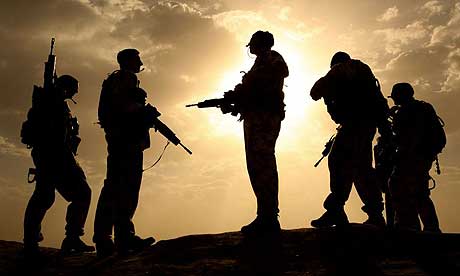
Maybe we were right to be in Afghanistan. Maybe not. But right now there's little point, value or purpose in us remaining there. And young men who signed up to defend Britain are dying in a dusty desert wondering what they are defending. So this - for all the cynical spin and politics around it may signal an end and a few lives saved:

At the security council meeting, Mr Osborne is said to have asked how the British deployment can be justified to the the public for the next two years, amid continuing casualties and doubts about the Afghan government. 

I do hope so. And that those brave men and women can come home for Christmas.

...

Friday, 3 August 2012

Olympic quote of the day

****

From the now great Bradley Wiggins:


'The guys in Afghanistan are heroes... I just ride a bike'

'Nuff said.

....

Friday, 14 May 2010

Friday Fungus: Pleospora papaveracea and the war on drugs

My mycological fascination button was activated by this little posting from Al Jahom about research into using Pleospora papaveracea (and other mold-like fungi) as a biological agent to control opium poppy production back in 2000. And recent reports on a serious fungal infection of Afghan poppies! Some of the research abstracts are here and one concludes that:

In the field, P. papaveracea was more consistent in its effects on opium poppy from a local seed source designated Indian Grocery. P. papaveracea caused higher disease ratings, more stem lesions, and equal or greater yield losses than did D. penicillatum on Indian Grocery. The late-maturing opium poppy variety White Cloud was severely damaged by disease, regardless of formulation or fungal treatment. P. papaveracea was the predominant fungus isolated from poppy seed capsules and the only fungus reisolated from the field the following year. These studies provide a better understanding of the infection process and the differences between these two pathogenic fungi and will be beneficial for the development of the fungi as biological control agents.

There is no doubt that P. papaveracea is effective against opium poppies – especially when the plants are young and the Afghan growers’ description of the disease affecting their crops is consistent with a mildew-like fungal infection. P. papaveracea is a natural parasitic fungus of poppies native to central Asia – not the product of genetic engineering or manipulation.

However, there will always be concerns about the deliberate introduction of biological agents – even naturally occurring ones – to a given environment in terms of secondary effects as well as impacts on human health. There is no confirmation that the Afghan reports are the result of deliberate human action and it could be a natural outbreak of an existing fungus. Indeed, the outbreak could be effectively controlled (I suspect) through the use of the aerial spraying techniques used to control fungal and pest threats to less controversial crops.

Similar fungal agents are being developed to control coca and marijuana production and recently Peru has passed a law banning the use of biological agents in coca eradication. Also – as has been the case with apples and roses – breeding programmes are likely to result in disease resistant varieties.

....

Sunday, 21 March 2010

Gordon: you've had your photo op - now make sure these men can vote

The revelation that British troops serving in Afghanistan are unlikely to be able to vote in the forthcoming General Election represents an appalling failure on behalf of this Labour Government. When they changed the law in 2001 requiring annual registration (and also opening up postal voting to scandal and abuse) over 100,000 serving soldiers, airmen and sailors dropped off the register.

This needs sorting. But this suggests it won't:

A recent strawpoll on the British Army Rumour Service, an unofficial military website, found that 57% of those canvassed planned to vote Tory, compared with 7% who said they would back Labour.


After all Mr Brown won't be wanting 50,000 or so Tory votes from service men and women now, would he?

....

Thursday, 11 March 2010

Today's Gordon Brown Lie...the master at work!

***

Since the Afghans more or less invented low intensity warfare how on earth does Gordon Brown get away with saying this - without challenge?


"In response to allegations that the Government was slow to replace the soft-skinned Snatch Land Rover patrol vehicles, which are vulnerable to roadside bombs, Mr Brown said that it was not known for some time in either Iraq or Afghanistan that enemy forces would use guerilla tactics, including home-made bombs, rather than facing allied troops in open battle."

Gordon, this is a lie. And you are a liar.

H/T Man in a Shed for the article

...and just to make my point, Parlez me nTory directs me to this little book: Afghan Guerilla Warfare: Mujahideen Tactics in the Soviet Afghan War (Paperback)

...

Sunday, 8 November 2009

Afghanistan: so what's changed?

I have been re-reading Meyer & Brysac’s wonderful “Tournament of Shadows” – a breathtaking gallop through the “Great Game” and the contest for central Asia between Britain and Russia. I doing so I’ve come across three quotations that say so much about our present entanglement in Afghanistan that I thought I’d share them with you:

The first is attributed to Dost Mohammed the Afghan ruler ousted by the British in the (ultimately disastrous) 1st Afghan War:

“We have men and we have rocks in plenty but we have nothing else”

So why were we there? For sure it was not to serve in any way the interests of the Afghan people. And has anything changed?

The second quote is from Sir Henry Rawlinson, warrior scholar, Tory MP and leading advocate of the “Forward School”:

“In the interests then of peace; in the interests of moral and material improvement, it may be asserted that interference in Afghanistan has now become a duty and that any moderate outlay or responsibility we may incur in restoring order in Caboul will prove in the sequel to be true economy.”

Rawlinson’s concern (and how familiar this sounds) was that Afghanistan contained “…a machinery of agitation…” ideal to act on the “…seething, fermenting festering mass of Muslim hostility in India.” Put simply we should take action in Afghanistan to protect ourselves from violence and terrorism – now where have I heard that said?

Which brings us to the third quotation which comes from Sir John Lawrence – Viceroy of India in 1863 and the advocate of what his detractors called “masterly inactivity” over the perceived threat from central Asian and Afghanistan in particular.

“I am firmly of the opinion that our proper course is not to advance our troops beyond our present border, not to send English officers into the different states of Central Asia; but to put our own house in order by giving the people of India the best government in our power, by conciliating as far a practicable, all classes and by consolidating our resources.”

So there we have it – Afghanistan contains nothing of strategic interest yet some promote the fear of the Muslim mob while others argue that good government at home will manage that problem and that involvement only begets violence and division. Nothing has changed?