Showing posts with label Detroit. Show all posts

Tuesday, 27 August 2013

Subsidising millionaires - another reason regeneration fails to make change

****

...and yes it's Detroit again. Learning the lessons that ruined the city, ignoring them and returning to the same old model and the same old mess:

Just a week after the city declared bankruptcy, a state board approved a $450 million bond issue for a new Red Wings hockey arena near downtown. To help finance it, Detroit would pay $284.5 million in subsidies and an additional $12.8 million annually on bond interest. In return, Red Wings owner Mike Ilitch, who also owns the Detroit Tigers, MotorCity Casino Hotel, and Little Caeser’s pizza, would chip in $365.5 million for the arena and several mixed-use projects. The new complex would represent an upgrade from the dated Joe Louis Arena, where the Red Wings play now, and—boosters say—would potentially revitalize the Midtown area, which is already gentrifying somewhat. The Detroit Development Authority would fund and operate the arena with downtown property taxes. In other words, revenue traditionally used for schools and basic services would instead subsidize a billionaire.

As ever with these projects - and regeneration is riddled with them - the initial impact seems good. A new grand shiny stadium, theatre or concert arena springs up amidst the dereliction promising a new world of prosperity, wealth and success.

But then nothing happens, nothing changes. Except we've subsidised the grand project of a millionaire, provided contract opportunities for than millionaire's friends and raised false hopes in the hearts of suffering local people. And - even if the millionaires haven't stuffed their pockets - we've thrown a load of tax money at another grand and failing project.

In Detroit's case we know the story (as Scott Beyer describes):

The publicly operated Cobo Convention Center opened in 1960 and began losing money immediately, running annual deficits reaching tens of millions. In 1977, the Ford Motor Company financed the gargantuan, $350 million Renaissance Center; two decades later, Ford sold the complex for just $76 million to rival GM. The city connected the two facilities in 1987 with a much-ridiculed, $200 million People Mover. The monorail never came close to covering its upfront costs and still operates with annual losses around $10 million, while doing basically nothing to address transportation needs. Detroit continued to wield its eminent domain power, with attempted or successful takings to accommodate the city’s two remaining auto plants, a private bridge, a business park, a major housing complex, a waterfront casino district, and two relatively new stadiums—Comerica Park and Ford Field.

And did it work? Does shiny regeneration ever work? I don't think so. But we persist (and not just in Detroit) with vast schemes and programmes, subsidising large organisations and wealthy men to do things they wouldn't otherwise do.

....
Now the government is seriously underway with the £1bn HCA Build to Rent Fund: we in UKR are proud to be at the final stages of Round One of this programme, together with 44 other organisations, all pioneers in their own way: some house builders, some RPs (registered providers or, in English, Housing Associations) and some new entrants to the market (UKR included). - See more at: http://www.estatesgazette.com/blogs/jackie-sadek/2013/08/the-prs-debate-finally-gathers-momentum/#sthash.qz8tpW5j.dpuf

Now the government is seriously underway with the £1bn HCA Build to Rent Fund: we in UKR are proud to be at the final stages of Round One of this programme, together with 44 other organisations, all pioneers in their own way: some house builders, some RPs (registered providers or, in English, Housing Associations) and some new entrants to the market (UKR included). - See more at: http://www.estatesgazette.com/blogs/jackie-sadek/2013/08/the-prs-debate-finally-gathers-momentum/#sthash.qz8tpW5j.dpuf
Tuesday, 6 August 2013

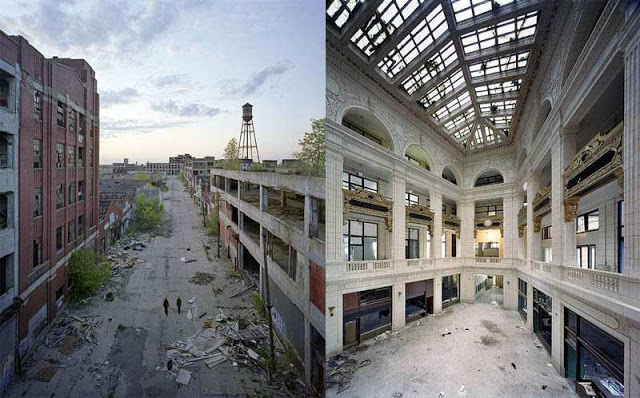
Detroit and Liverpool: thoughts on urban renewal

****

We've all seen parts of the crisis in Detroit - the bankruptcy of the City government, the abandoned houses you can buy for a few dollars (although nobody does) or the endless chatter about racial strife and political corruption. Not to mention crime, violence and urban decay.

And this is nothing new. People have been commenting on the problems of Detroit since the 1950s with each generation of observers seeing the crisis through the prism of that age's prejudices. And during this time Detroit continued to decline. Fingers are pointed at 'white flight' (let's call it 'jobs sprawl'):

One consequence of this dysfunction has been a severe case of “job sprawl” within the metropolitan area, with jobs fleeing the urban core even when employment in greater Detroit was still rising, and even as other cities were seeing something of a city-center revival. Fewer than a quarter of the jobs on offer in the Detroit metropolitan area lie within 10 miles of the traditional central business district.

The result of this is that Detroit's population has dropped from 1.8 million to just over 700,000 with, inevitably, the better educated, the more entrepreneurial and the more ambitious departing the city.

Everyone points to different urban pathologies as the cause, partly guided by ideological prejudice and partly by whatever is academic flavour of the month in urban studies. Yet we never point the finger at 'regeneration' as the heart of Detroit's problems preferring instead to speak of industrial decline or even Detroit as a sort of municipal buggy whip manufacturer.

So let's look at the 'regeneration' efforts:

For decades it has done the opposite, championing a growth policy that mirrored the city’s overly-centralized private sector. It has gambled—with tax breaks, subsidies, and extensive eminent domain—on stadiums, casinos, office towers, factories, and a downtown monorail, only to find that these didn’t produce nearly the anticipated benefits.

We see here the classic inward investment approach - focus on big 'transformative' projects and provide incentives to developers and favoured businesses. And these inward investment strategies were matched by brutal clearance and community redesign:

Throughout the 1950s and 1960s white mayors steamrolled roadways through functioning black neighborhoods like Black Bottom, and housed the displaced in dangerous, high-rise government projects. Funding for this and other “urban renewal” came from federal programs like President Johnson’s Model Cities, and using Detroit as a flagship, was meant to modernize aging urban communities. 

There's no doubt that racism played a part in Detroit's failure but far more important to that failure was the misplaced belief that the solution - always and every time - lay in securing external finance, public or private, to be directed by the City government or its agents. Every time there is a crisis, out comes the begging bowl and up goes the cries for "more resources" or for "more investment".

Here in England we have been shielded from part of Detroit's problem - rightly or wrongly, local government here doesn't have the unrestricted borrowing power of a US city. But the pattern of urban decline is little different. Take Liverpool, once a great city of empire, now a shadow of its past. This isn't to detract from the efforts - some more successful than others - to reinvent the city and to create a vibrant and dynamic cultural and social heart to Merseyside. But Liverpool still lives with that historic decline:

There are persistently high levels of deprivation in the city and Liverpool remains ranked as the most deprived local authority area in England on the ID 2010, with its position unchanged from the 2004 and 2007 Indices. 

All that 'regeneration' hasn't prevented Liverpool from remaining poor - just as was the case with Detroit. Millions in regeneration funding, economic development cash and a myriad of 'interventions' have left Liverpool just as it was in 1980 - the poorest city in England. And still the clearance continues:

...Liverpool City Council’s planning committee gave the go-ahead to a two-phase hybrid application from housing association Plus Dane Group for the clearance and redevelopment of 5.97 hectares of the Victorian-built terraced houses in the Welsh Streets area, which is part of the Princes Park regeneration zone.

Not only does this approach divide communities and undermine the sense of history in a place but it repeats past errors - and mirrors Detroit's errors - by seeing social investment as a parallel to economic development. People may have a slightly newer house (or some people at least) but they still don't have good prospects of personal economic advancement. Liverpool - despite the investment - remains poor.

And people leave. Since its peak in 1931, Liverpool's population has declined by nearly 50% as people have moved to places with better prospects - some not so far away but others far, far away from the Liver Birds. This is pretty similar to Detroit. Yet we still hear the plaintive cries of the urban leader:

Deputy Mayor, Councillor Paul Brant, said: “You cannot cut your way to growth. In Liverpool we are innovating and investing in schemes that will deliver jobs and economic benefit, whether it’s using our borrowing power to kickstart developments, or to generate new income streams as we have done by purchasing Everton FC’s training ground.

Look at Detroit and ask whether this approach - an approach that has attracted plenty of government cash to Liverpool over the years - will do anything to transform the city? Or, when the next Index of Multiple Deprivation is published, will Liverpool still be England's poorest city?

The sad truth is that the 'regeneration' policies we follow - and continue to follow nationally and locally - are part of the problem not part of the solution. Waiting for the Whitehall fairy to wave the magic funding wand is a fine strategy for council officers and the trooping backwards and forwards to London for meetings gives an illusion of activity but it doesn't help the city, whether that city is Detroit, Liverpool or my city of Bradford.

Here we're rabbiting on about being a 'producer city' which suggests a commitment to business creation and innovation. But, in reality, this is simply repackaging the same old approach - big grand projects that will 'transform' and much about how public investment will lead or draw out private investment. Bradford's not as poor as Liverpool but we have adopted the same strategy as that city - a strategy that echoes the failed approach of Detroit.

....

Sunday, 28 July 2013

Density and intensity...about the modern city.

****
This is Shanghai from Rob Whitworth on Vimeo.

OK it's a great video intended to show the City at its best, it doesn't include the dark side, the bad buildings, the deprivation, the people without papers living on the fringes of developments. But it shows a city that's alive - buzzing with activity and opportunity (often despite the preferences of the stifling People's Republic bureaucracy).

Contrast this with the images we see of Detroit - emptyness, dereliction, inactivity and a poverty of spirit that seems to scream out; "there is no hope."


Whatever we do to make our cities work, it's clear that density and intensity are essential. And that this doesn't come from the managerialism of government, from licenses, controls and taxes. As one observer points out about Detroit:


[The] per capita tax burden on City residents is the highest in Michigan. This tax burden is particularly severe because it is imposed on a population that has relatively low levels of per capita income.

The City’s income tax… is the highest in Michigan.

Detroit residents pay the highest total property tax rates (inclusive of property taxes paid to all overlapping jurisdictions; e.g., the City, the State, Wayne County) of those paid by residents of Michigan cities having a population over 50,000.

Detroit is the only city in Michigan that levies an excise tax on utility users (at a rate of 5%). 


The answer - or perhaps something that just gives cities a chance to succeed - is to allow them to chop taxes, to tear up regulations and to prefer that crowded wonder of the market to deliver growth. The secret lies in allowing people to do things rather than finding reasons to stop them. To let people have the fruits of their own success to spend, to invest, to play with. And to eschew the planning and second-guessing that municipal authorities so love.

In Shanghai there's a fantastic model of the city showing how it will be in the future. However, almost from the moment of its completion this half-acre model was out of dat - no maglev, no new city and a seemingly endless parade of identical tower blocks. Shanghai show that, even with planning, a city can fight back and deliver growth, change, innovation and excitement.

The most frightening thing here is that we see pride, excitement, dynamism and change in China - a communist state - and dereliction, destruction, depression and decay in the land of the free. And that should be a wake up call to us all.

However much we wish to pretend otherwise, too much of our 'regeneration' does not work.

....