Showing posts with label Shanghai. Show all posts

Sunday, 28 July 2013

Density and intensity...about the modern city.

****
This is Shanghai from Rob Whitworth on Vimeo.

OK it's a great video intended to show the City at its best, it doesn't include the dark side, the bad buildings, the deprivation, the people without papers living on the fringes of developments. But it shows a city that's alive - buzzing with activity and opportunity (often despite the preferences of the stifling People's Republic bureaucracy).

Contrast this with the images we see of Detroit - emptyness, dereliction, inactivity and a poverty of spirit that seems to scream out; "there is no hope."
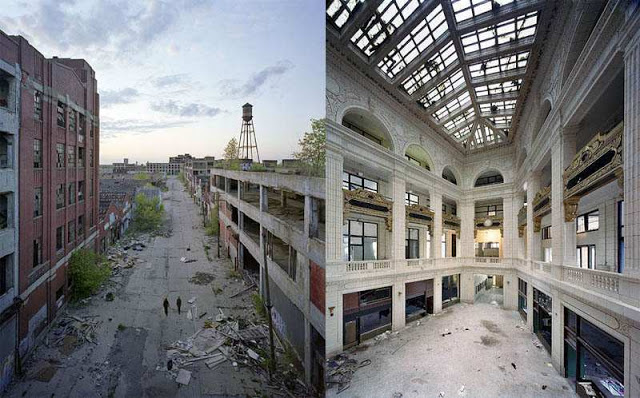


Whatever we do to make our cities work, it's clear that density and intensity are essential. And that this doesn't come from the managerialism of government, from licenses, controls and taxes. As one observer points out about Detroit:


[The] per capita tax burden on City residents is the highest in Michigan. This tax burden is particularly severe because it is imposed on a population that has relatively low levels of per capita income.

The City’s income tax… is the highest in Michigan.

Detroit residents pay the highest total property tax rates (inclusive of property taxes paid to all overlapping jurisdictions; e.g., the City, the State, Wayne County) of those paid by residents of Michigan cities having a population over 50,000.

Detroit is the only city in Michigan that levies an excise tax on utility users (at a rate of 5%). 


The answer - or perhaps something that just gives cities a chance to succeed - is to allow them to chop taxes, to tear up regulations and to prefer that crowded wonder of the market to deliver growth. The secret lies in allowing people to do things rather than finding reasons to stop them. To let people have the fruits of their own success to spend, to invest, to play with. And to eschew the planning and second-guessing that municipal authorities so love.

In Shanghai there's a fantastic model of the city showing how it will be in the future. However, almost from the moment of its completion this half-acre model was out of dat - no maglev, no new city and a seemingly endless parade of identical tower blocks. Shanghai show that, even with planning, a city can fight back and deliver growth, change, innovation and excitement.

The most frightening thing here is that we see pride, excitement, dynamism and change in China - a communist state - and dereliction, destruction, depression and decay in the land of the free. And that should be a wake up call to us all.

However much we wish to pretend otherwise, too much of our 'regeneration' does not work.

....

Saturday, 13 March 2010

Urban planning - the quickest route to a dead community

It is one of the oldest debates around - do we have a grand plan or do we let stuff happen. The planners tend to win this argument - sometimes to the extent of the picture above which of a model showing the "finished" version of Shanghai. This will be a planned city - the untidy, cramped neighbourhoods with winding alleys and street vendors will be replaced with great accommodation towers. The crazy shopping streets will be sanitised and tidied up - turned into tourist attractions or into a copy of the west's stale shopping experience.

Be warned this is what planners do to a place.

What planners say is that we can't allow - Jane Jacobs-like - for cities to evolve and adapt to the needs and demands of their residents. This is far too untidy. Cities need to be planned - in the past for an assortment of reasons (traffic management, zoning industry, public transport) but today the planning is need to create "sustainable cities". Here's one view from the Royal Town Planning Institute (RTPI)- what I call the "Shanghai View":

"Spatial planning operates at all the different possible scales of activity, from large-scale national or regional strategies to the more localised design and organisation of towns, villages and neighbourhoods. It affects everyone, making policies setting out visions for places and decisions about matters ranging from the location of major new transport or energy facilities and employment development, through to the development of new shops, schools, dwellings or parks needed by local communities. It considers the things that we value and supports our ongoing use of the environment to maintain or enhance these; from the integrity of the atmosphere to limit climate change, to the provision of habitat for individual species; from the identification of global cultural heritage to locally valued townscapes. It maintains the best of the past, whilst encouraging innovation in the design and development of future buildings and neighbourhoods to meet our future needs."


...or possibly urban planners as little gods? Without the guiding hand of the planner our urban environment would be chaotic, jumbled, unmanaged and unsustainable say the RTPI. But would it? If we did away with grand spatial planning, with national planning guidance, with splendidly pompous urban designers..with all the vast and expensive infrastructure of the planning industry, would things actually be so bad?

Should we not revisit the thinking of Jane Jacobs about the organic nature of cities and remember that:

"There is a quality even meaner than outright ugliness or disorder, and this meaner quality is the dishonest mask of pretended order, achieved by ignoring or suppressing the real order that is struggling to exist and to be served."


Planners seek to imposed a false, politically mediated order on communities. Is it any surprise therefore that the public view planning and planners with distrust. Or that the development industry so often see the planning system as an obstruction to economic development, to the provision of homes and to the ability of business to respond adequately to consumer demand.

Planning should be driven by the needs, demands and expectations of neighbourhoods and the people living in those neighbourhoods. Designs about development should be decided democratically at this level - not mediated through and impenetrable, lawyer-dominated, centralised planning system designed merely to obstruct.

Above all we must resist the geographers temptation - the drawing of marks on a map, tidying up of edges. Married to the architect's hubris this had led to cities without soul, places without character. To great squares with no animation, to the replacing of untidy flea markets with shiny malls and to dysfunctional places filled with unhappy people. Planning has done this to us. It's time to reject its ideas, to rediscover the untidy, disordered cities we love.

If we don't learn this all we will do is create our own failing planned cities - and a world of Shanghais would be a bad place.

....