Showing posts with label garden cities. Show all posts

Thursday, 25 September 2014

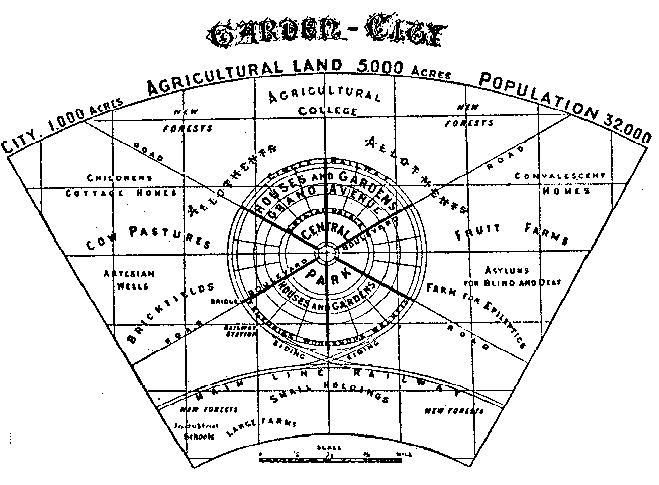
The garden city - a stultifying, depressing but comfortable, car-free suburban zombie-land


I've known David Rudlin and Nicolas Falk from Urbed off and on for about a dozen years mostly because they've both been involved in some of the thinking - good and bad - about the future of Bradford as a place. And like many in the urbanist and urban design world, David and Nick are, I fear, a little trapped in a planning model rather than a people model. The solutions Urbed produce are - at the macro level - about deciding things for people collectively or, worse, about trying to second guess the aggregate impact of millions of consumption decisions.

Urbed were the winners of the Wolfson Economics Prize 2014, which focused on "how best to deliver a new garden city which is visionary, economically viable and popular." And, in Urbed's slightly disruptive tradition, the winning entry rejected the old 'new town' model of the garden city in favour of large urban extensions. It's well worth reading how Urbed responded to this brief because it reveals a very high quality of thinking about the challenges of a brief to deliver places rather than a new generation of uninspiring, predictable housing estates.

Given the brief Urbed's response was exciting, challenging and stimulates us to think about the model for future development in England. However - and this is what I will examine in the rest of this article - the approach is profoundly illiberal, assumes that more fixing of the housing market is needed because our planning systems have skewed that market and fails to consider how travel, communications and work will change over coming decades.

Writing in New Start, Nick Falk sets out some of the essentials that lie behind the Urbed entry.

Tomorrow’s cities not only have to be affordable in a world where few earn enough to make a deposit on a house, but also to cut carbon emissions, and create a sense of community. Letchworth was built at a time when the man was the breadwinner, working locally, and when energy was delivered by the coalman. Various religions brought people together; alcohol was banned, and people made their own entertainment. The motor car was hardly practical for most people’s needs.

The problem, as Nick recognises, is that the system we have of designating land for development (while protecting most other land) results in unaffordable housing. In Surrey there is famously more land given over to golf than to housing. It's true that our system of housing finance has also contributed but the primary cause remains the deliberate limiting of land available for the development of housing. Indeed, Falk notes this - although he may not have meant it this way - when he says:

...we have to find ways of doubling housing output and locating them where there is easy access to jobs and services, and this means taking much of the risk out of development.

Put more simply (and from the perspective of the housing consumer rather than the urbanist or planner) we need to build most of the housing in places where people actually want to live. This is something of a challenge and isn't met by the Urbed approach of urban extensions but rather by something that Nick Falk rejects - small scale developments in local communities that act to sustain those communities as places. The problem is - as Falk comments - the 'experts' reject this approach:

Through focus groups, we found that not only was there a general feeling among professionals that concentrating growth in a few planned settlements would produce better results than spreading it around, but we also identified ways in which a ‘social contract’ might be negotiated. 

This preference is determined not by the economic realities of housing demand but by a concern with 'climate change' and 'low carbon'. Thus we reject the idea of extending a village with, say, 400 homes to be one with 600 homes (thereby securing the future of the village pub, the post office and the shop) because such development is predicated on the motor car as the primary means of transport.

The result of this is that development simply doesn't meet either need or demand without public subsidy. Indeed, Nick recognises this with his proposal to freeze land values. Ostensibly this freeze is to prevent 'speculation' but, in reality, it represents an enormous public subsidy to those developing the garden city. Indeed, it is clear that - if the Howardian model is to work - such intervention is inevitable. In effect the state identifies a given area for development and takes the additional value rather than allowing this value to accrue to the land owner. The idea that this can happen without compensation is nonsensical.

Nick Falk also cites places like Freiberg in Germany as examples of how this 'social' development approach has worked. Now, it may be that this is the case for some but if the only option for the young worker in the South East of England is such a place, I fear that they'll still look in envy at those in million pound homes in gorgeous Surrey villages asking why. Indeed, this is the vision Nick Falk would impose on those young workers:

In Vauban, if Rieselfeld residents are to be believed, green living is compulsory. 'It jumps in your face a little,' Claudia Duppe warned me, 'and there is a lot of social control. If you walk into the quarter with an Aldi carrier bag, it's, "Sorry, I'm not talking to you; you shop at a discount supermarket and you don't buy organic." It feels claustrophobic, because everyone expects you to behave in the same way - and of course you are not allowed to have a car.'

This would be the triumph of the urban planner, a place where a supposed 'social contract' determines every last thing about the way people live forcing on them a constricting, unnecessarily dense urbanism where there words of Jane Jacobs critique of the garden city become stark and depressing:

...the creation of self sufficient small towns, really very nice towns if you were docile and had no plans of your own and did not mind spending your life with others with no plans of their own. As in all Utopias, the right to have plans of any significance belonged only to the planner in charge.

This, rather than the shining city on the hill, is the reality of the garden city. Nick Falk would have us create pretty 21st versions of Stepford, Connecticut (or at least its fictional version). Places where conformity with the 'social' rules are enforced by what began as a charming 'common weal' and quickly becomes the suppressing of difference - a modern prohibition.

I do not want to live in this socially contracted world of Falk's 'pocket utopia' for that supposed perfect place is anything but perfect. Instead it is the creation of planners who see people as things to be placed in carefully designed 'communities' and 'neighbourhoods' rather than as free agents able to, through their interacting with others, create real communities and real neighbourhoods - places that work. Some people want to live hugger-mugger in dense city places, some want space to breathe and a view and others want a variety of choices in between. For a few, Falk's 'green wonderland' would be just the ticket but if this is presented as the future of the urban place it will be one free from creativity and edge, bereft of individual initiative, a stultifying, depressing but comfortable car-free suburban zombie-land.

....


Thursday, 11 September 2014

How can you have community-led design when there is no community...more on the problem with garden cities


Philip Ross is a former mayor of Letchworth Garden City and founder of the New Garden City Movement, he is keen on garden cities. And, for New Start magazine, he has blogged about these new garden cities:

Community-led garden cities need to start with a community-led definition of what a garden city is. This definition should belong not to one organisation or thought up in Whitehall but should reflect community values. It needs to be born of a partnership and an alliance between the social values and the design and architectural values. The ambition must be to deliver a sustainable community, a community proving inter-generational equity that is socially, economically and ecologically sustainable. If successful it will create a sense of place, purpose and a stake in community, in one word ‘citizenship’.

The funny thing here is that Letchworth, where Ross was mayor, wasn't created by any community but by the ambition of one man - Ebenezer Howard. Indeed, there is a good reason for this - before Howard built Letchworth it was fields of corn, potatoes and sugar beet in rural Hertfordshire.It may well be the case that today Letchworth has a fantastic community doing wonderful things filled with sustainability, inter-generational equity and stakeholder engagement. I don't know, I've never been to Letchworth (although I'd be very surprised is more than one-in-ten of the residents are involved in Ross's little sustainable enterprise).

I've raised concerns about the idea of new garden cities and especially the vision of them as sort of neat, tidy, middle-aged versions of Freetown Christiana all filled with commonweal, cooperation and collectivism. Frankly this is a recipe for a controlled environment littered with signs telling us not to do things, where the management of gardens and the content of garages is fussed over by the garden city's appointed guardians.

It merits saying again and again - garden cities aren't the solution to the UK's housing problems, cannot be delivered on the model Howard used back in the days before we had a planning system and seem to me more akin to Stepford or Midwich than any place I'd like to live. As ever, Jane Jacobs summed it up in her comments on Ebenezer Howard:

“His aim was the creation of self sufficient small towns,really very nice towns if you were docile and had no plans of your own and did not mind spending your life with others with no plans of their own. As in all Utopias, the right to have plans of any significance belonged only to the planner in charge."

....


Friday, 8 August 2014

You can't build Howardian Garden Cities under our planning system

****

They're all the rage - Ben Reeve Lewis lovingly describes:

Towns designed for living in where the mortgage and rental profits are ploughed back into the community. A socialist idyll without a donkey jacket or Tom Paxton fisherman’s cap to be seen anywhere.

The problem is that this 'ploughing pack' of profits from development was only possible because Ebenezer Howard could toddle out from London and buy agricultural land in Hertfordshire on which to build his city. There were no spatial plans, no 'National Planning Policy Guidance', no five-year housing supply requirements and no green belt. Above all there was no allocation of land for housing, a process that captures all the added value for the landowner rather than the developer.

And because Howard bought cheap land the organisation running Letchworth was well endowed with the profits from development allowing it to build libraries, parks and so forth without the need for taxation. Today - as we talk about a new generation of garden cities - we would do well to remember that Howard's model simply isn't possible under our planning system.

...

Monday, 21 July 2014

On how planning nearly killed Birmingham and why garden cities aren't the answer

****

And before Brummies leap in and accuse me of doing down their city, the same goes for Bradford, for Leeds and for just about every other big city. Here's the quote from The Economist blog:

In the post-war era, there was a strong sense among British politicians that cities were slightly unpleasant things like mushrooms that ought not be allowed to grow too fast. Inspired by utopian city planners such as Ebenezer Howard and Le Corbusier, they decided that urban metropolises had to be cut back. Without much consultation, enormous numbers of people were "decanted" from inner-city slums to grey suburban council estates, where loneliness and crime thrived. Meanwhile, the city centres themselves were strangled with great elevated roads intended to get people in and out of the "commercial" zones. Birmingham probably suffered the worst of anywhere. Even Joseph Chamberlain's grand Council House was surrounded by roads.

Right now planners across the country are 'learning the lessons' of the past and drawing up new - and newly grand - schemes for cities and towns. Yet the echo of the think described above remains - cities are nasty, unclear, dangerous places and people want to live in ordered, structured and safe communities. We even have a "new" garden city movement:

Garden cities are back on the political and social agenda. Barely a day goes past without Boris Johnson, Nick Clegg, David Cameron or Ed Miliband talking about them. Lord Wolfson has got in on the act by launching a competition to build a new garden city in England. The prize of £250,000 is enough to properly kickstart a new social garden city movement.

And this 'movement' has a rhetoric filled with today's trendy rhetoric of 'cooperatives', 'community ownership' and 'social enterprise' - all guaranteed to get us shaking with excitement at this ordered world outside the city, a Utopian wonderland of community leadership, social capital and parks.

Forgive me if I don't share your excitement at building boring places filled with dullness, where every activity is purposeful, where committees of local worthies decide what you have in your front garden, the colour of your front door and whether you can put a six foot pink gnome by your gate. If you want these garden cities go build them but don't pretend they replace the excitement of the city or the mixed community of the market town or the tranquillity of the village. I'm with Jane Jacobs on Ebenzer Howard and garden cities:

“His aim was the creation of self sufficient small towns,really very nice towns if you were docile and had no plans of your own and did not mind spending your life with others with no plans of their own. As in all Utopias, the right to have plans of any significance belonged only to the planner in charge."
And we've seen what planners did to Birmingham. Useful though those planner might be, we can't put them in charge.
....

Thursday, 26 June 2014

Regeneration, garden cities and why Jane Jacobs didn't like Ebenezer Howard

****

Anne Power, Professor of Social Policy at the LSE isn't a fan of our renewed enthusiasm for 'Garden Cities' - indeed she was quite scathing in an interview with 'Inside Housing':

Garden cities are environmentally damaging, expensive and slow to build, said Professor Anne Power...talking about the government’s plans for a new generation of the developments.

So where does this take us? I'm not convinced by Professor Power's argument on either speed, cost or environmental risk but her view is important since it comes from someone who has spent a lot of time worrying about the problems of cities.

But there's another view - for me a better, more liberal and more exciting view - that of Jane Jacobs. I've always loved the way in which planners and regeneration boffins claim Ms Jacobs for one of them - when the very opposite is true. This means that planners go on about people-led and evolving city systems while completely ignoring anything that looks remotely untidy or outside municipal control.

Anyway, here's what Jane Jacobs though of Ebenezer Howard, the guru of 'garden cities' and godfather of town planning:

“His aim was the creation of self sufficient small towns,really very nice towns if you were docile and had no plans of your own and did not mind spending your life with others with no plans of their own. As in all Utopias, the right to have plans of any significance belonged only to the planner in charge."

And we see this reflected in the self-righteousness of 'transition' towns, in the obsession with the local multiplier (have NEF actually conducted any real tests on their model or is mine still the only one) and in a focus on anything other than tilling the soil of enterprise.

So much that is written about community regeneration either mistakes the activities of the relatively wealthy residents of poorer places for regeneration or else implants a set of values that were best left behind when the Woodstock generation left that muddy field and headed into the real world.

I was at an interesting session on the next round of LEADER funding (EU funding directed to the rural economy, farm diversification and rural business productivity). It was striking - and depressing - to see the argument presented that we'd have to focus on economic growth (you know, jobs and businesses) because that was what DEFRA wanted. The implication - and this is clear in so much community regeneration - was that a better economy with more jobs, more income and more wealth was somehow not what regeneration is about. So much better to open up a new cycle path, run awareness-raising on climate action or plant herbs in street verges.

The problem we have is that our "plan-led" system has competing objectives - it wants reduce carbon emissions, it urges us to be healthier, it wishes to plan out crime and it wants to promote biodiversity. And, wonderful though these things may be, they all require a compromise - we cannot meet the idea for all of them. Something has to give.

And the first thing to give is economic growth, jobs and business. The very act of planning - or requiring someone to seek permission to do something with their property is a drag on the economy. But when we want that decision - to build a home, to open a business, to extend a factory - to also contribute to combating climate change, preventing obesity and providing homes for bats, we have problem.

...

Thursday, 5 June 2014

Garden Cities, new towns and the concreting of Kent


The shortlist for the Wolfson Economics Prize to build a new 'garden city' has been announced. There are five finalists some of whom have specified the location or possible location for the proposed new city. The most specific and, perhaps for this reason, the most prominent is that from housing charity, Shelter:

This entry proposes a new garden city on the Hoo Peninsula, Medway, Kent, starting with a settlement of up to 48,000 people - about the size of Welwyn Garden City at Stoke Harbour. This would be part of a larger cluster of settlements eventually totaling 150,000 people. The entry proposes a model designed to attract massive private investment into the provision of high quality homes, jobs, services and infrastructure. The delivery model prioritises speed and volume over profit margins, aims to acquire land at low cost and transfer valuable assets to a Community Trust for the long term. Local people would be offered shares in the city.

Now if you know the Hoo peninsula, you'll know that it has been the favoured location for every second mad-cap scheme - airports come especially to mind. Presumably - and this is the cynic in me speaking - this is because Hoo is far enough away from where all those bohemian fans of garden cities live but close enough to London to make building the 'garden city' viable. Indeed, the Shelter proposal includes a link to the High Speed railway (to a station that doesn't exist) so all those 150,000 people can be sped into the city for their day jobs.

And Shelter justifies this by being rude about Hoo:

 "A muddy, tidal estuary with poor transport links, a huge ugly power station dominating views, and few local facilities or job opportunities."

What Shelter doesn't mention is that the Hoo peninsula contains large tracts of protected salt marsh - some pretty special habitats in an important marine fringe corridor. Nor that the history of Hoo goes back to the 9th century and that the villages of the peninsula, far from being ugly or unpopular, are attractive and well-liked.

And all this would be on top of another enormous development at Ebbsfleet (between Dartford and Gravesend for those not so clear about North Kent geography). Along with other proposed developments in existing local plans, the south bank of the Thames estuary - from Dartford to Gillingham - would add perhaps 300,000 new residents all hugger-mugger to the HS1 route and living the sort of dormitory existence that is the antithesis of the 'garden city'. We get the suburbanisation of Kent rather than some rebirth of Ebenezer Howard's idea of Christaller-esque communal self-sufficiency.

It may well be that the idea of new towns - call them 'garden cities' if that yanks your chain - is the right way to respond to the continuing housing pressure in London (I still need to be convinced here - the experience of large cities is that people want to live near the centre is they can). But simply to point at one spot - declared 'ugly' and 'isolated' by the planners - is quite the wrong response albeit typical of Shelter.

Finally, we should remember that we cannot replicate Howard's vision because of the 1947 Town & Country Planning Act. When Howard was creating Letchworth, he could buy agricultural land at agricultural land prices and build on that land unconstrained by 'local development frameworks', 'spatial plans' or an enthusiastic local council planning department. And because he could buy the land cheaply, Howard's model could capture land value increase for communal benefit. However much you think this a wonderful idea (and I'm all for it myself), so long as the value is value as housing land, which it will be under our planning system, then capturing the added value for communal purposes is at best marginal and more likely of no significance at all.

The Shelter proposals are predicated on land purchase at low cost - I cannot see how, given the manner in which the planning system works, they can achieve this. Unless they're expecting to pay Hoo landowners less than the immediate, post-purchase value of the land. What we are seeing with these proposals - both the specifically-located one from Shelter and also other finalists - are schemes that require a significant relaxation of planning system constraints so as to make them workable. It's not going to happen is it?

....

Monday, 30 December 2013

Another report on housing that ignores the planning system....

There is a growing number of people who think that the lack of housing - affordable or otherwise - in the UK is some sort of failing of capitalism and that, if we had a different system things would be all fine and dandy.

Here's a fine example of the genre from Michael Bauwens on the P2P Foundation blog:

The high cost of housing is draining money out of the productive economy, mainly through land and house price inflation, with damaging effects for national and individual household budgets. Many new homes are unaffordable to ordinary working people, some offer poor value for money in terms of quality or construction, design and energy performance, and cost pressures frequently drive out good design in the spaces between buildings and in the concept of supporting new neighbourhoods. Many new developments are socially, environmentally and economically obsolete from the moment they are conceived, let alone designed or built.

This is great but the author fails to adequately answer the question as to why housing is so expensive. Instead we have a straw man built for the author to attack:

...in Britain, only 0.6% of the population – 36,000 people – own about half of the land. This is a significant structural reason for soaring housing prices and continuing wealth inequality.

Now this is true but there's a big problem with the argument. This ownership structure has absolutely nothing at all to do with the price of housing. Take a peek at the map of the UK. Most of the land these 36,000 people own isn't about to be used to build housing. Indeed, much of it is of pretty limited value - agricultural land values remain at below £10,000 per acre (in Scotland the value is below £5,000 per acre).

 Residential land values are another matter altogether - in 2010 the English average for residential land was about £950,000 per acre. In simple terms land for building on is nearly 100 times the value of the land for growing stuff. And more to the point, those 36,000 people our author thinks are the problem don't own most of this building land.

The problem isn't a question of market failure but a consequence of intervention in the market. We told in the article how wonderful the garden cities movement was:

The most notable example is the new town of Letchworth, 34 miles north of London, which was created in 1903 when developer Ebenezer Howard acquired 4,000 acres of farmland. He worked with ethical investors, Quakers, philanthropists and others to build a town whose land values would be community owned. 

The essential point here isn't that Howard had a wizard wheeze but that he was able to buy farmland and build houses on that land. And in building houses on the land (and shops, pubs, hospitals, etc.) Howard made it possible to capture (in our author's slightly partisan words):

...both the “unearned increment” of land value increases as well as “economic rent” of land (the excess returns commanded by a finite resource), so that everyone, not just investors, could benefit.

Howard was able to go into the market, buy agricultural land at agricultural land values and then get more value from the land by 'farming' houses rather than wheat or sugar beet. In England today this is not possible for the simple reason that residential land is worth ten times what agricultural land is worth. It doesn't matter whether you're running a co-operative, setting up a 21st century new town corporation or a wicked capitalist developer, you will pay nearly £1,000,000 per acre to the land owner (and a great deal more than that if you're anywhere near London).

The reason for the huge gulf between agricultural land values and residential land values isn't to do with capitalism, it isn't to do with who owns the land and it isn't to do with the uneven distribution of wealth. It's because of this:

In recent years the idea that physical planning should be conceived as a national, rather than a local, responsibility, has gained ground. The establishment of a Ministry of Town and Country Planning in 1943 was followed in the same year and in 1944 by statutes which brought this goal nearer to fulfilment. But the main weaknesses persisted. The 1947 Act seeks to cure them by solving the financial problems of local authorities and at the same time erecting a new structure of planning machinery to ensure that planning will be centrally co-ordinated and also effectively executed. 

There were few planning constraints on Howard's development at Letchworth or the later Welwyn Garden City meaning that the 'collectivist' model he preferred was fundable without government support or involvement. Since the 1947 Town & Country Planning Act and the creation of 'green belts' the model proposed here - an updated garden city movement - is simply not possible.

The reality is that any discussion of housing that doesn't mention the planning system misses the main barrier to lower values and more construction - planning. And we've seen the outcry when pretty minor changes to the planning system are introduced as the National Trust, the CPRE and national media plonk their heavy guns on the government's lawns.

Mutual systems of housing ownership and housing finance are a fine idea (although we should be careful what we wish for) but the real debate should be about how to balance the desire to protect open country and community identity - the reasons for the 'green belts' - with the equally pressing need for new housing, especially in the South East. And any report offering solutions to our housing challenges that ignores the planning system - as our author does here - is simply a waste of paper.

....