Showing posts with label cows. Show all posts

Monday, 26 August 2019

Environmental campaigners, more than any other group, are the ones living off fake news.


 There's nothing new with what's now called fake news - in WW1 rumours of a Russian army spread:
"There is being circulated everywhere a story that an immense force of Russian soldiers – a little short of a million, it is said – have passed, or are still passing, through England on their way to France."
The news was given credibility by this being reported in The Times - even though that newspaper merely reported the rumours, it failed to explain they were false (which a quick call to the Foreign Office would have confirmed). So it is with fake news:
Singers and actors including Madonna and Jaden Smith shared photos on social media that were seen by tens of millions of people. “The lungs of the Earth are in flames,” said actor Leonardo DiCaprio. “The Amazon Rainforest produces more than 20% of the world’s oxygen,” tweeted soccer star Cristiano Ronaldo. “The Amazon rain forest — the lungs which produce 20% of our planet’s oxygen — is on fire,” tweeted French President Emanuel Macron.
Last week you couldn't move for media reports describing a catastrophe in the Amazon as the entire cast of great and good the world over piled into the story so as to demonstrate that, above all, they cared! Thing is, though, that a lot of what the great and good were sharing was every bit as fake as Russians with snow on their boots marching though England in 1914.
And yet the photos weren’t actually of the fires and many weren’t even of the Amazon. The photo Ronaldo shared was taken in southern Brazil, far from the Amazon, in 2013. The photo that DiCaprio and Macron shared is over 20 years old. The photo Madonna and Smith shared is over 30. Some celebrities shared photos from Montana, India, and Sweden.
Even if this is down to an excess of enthusiasm over fact-checking, the fakeness of the story is at an even bigger magnitude than just celebs splashing pictures of random fires across social media while shouting "climate change" or "far right Brazilian government". It seems - at least according to one of the authors for the most recent Intergovernmental Panel on Climate Change report that not only are the photographs fake but:

The Amazon rainforest is not the "lungs" of the planet - “There’s no science behind that. The Amazon produces a lot of oxygen but it uses the same amount of oxygen through respiration so it’s a wash.”

Nor are the fires burning at a record rate - "it’s just 7% higher than the average over the last 10 years ago, Nepstad said."

And anyhow those fires aren't actual rainforest - "(w)hat increased by 7% in 2019 are the fires of dry scrub and trees cut down for cattle ranching as a strategy to gain ownership of land."

It seems - as always that, if you poke a little into any scare story you quickly find it's full of holes, based on dubious information and doubtful science. The reports are filled with frightening words "agribusiness", "right wing", "multinationals" and assorted dots are joined to show how, even if it's not quite a world-wide conspiracy, there's a lot of 'links' between all the nasty people we're told not to like by the great and good.

The same - and this is linked to those fires - goes for cows. To listen to so-called experts, you'd surmise that, to save the planet, all we have to do is stop eating meat and drinking milk. If we do this, hey presto, climate change is fixed. But again the claims look dodgy (and they come from a report that "claimed livestock are responsible for 18% of GHG emissions, but the figure calculated emissions along the entire supply chain, from land use to processing and refrigeration in supermarkets").

So given that every sort of food get transported from farm to processing plant to supermarket, we're left mostly with the methane that cows burp (methane we're told being a much worse greenhouse gas than carbon dioxide). Here's what happens to that methane in the actual real world:
While methane is 28-times more heat-trapping than carbon dioxide, methane’s lifespan is just a decade, while CO2 — known as a long-life pollutant — remains in the atmosphere for 1000 years.

After ten years, methane is broken down in a process called hydroxyl oxidation into CO2, entering a carbon cycle which sees the gas absorbed by plants, converted into cellulose, and eaten by livestock.

To put that into context, each year 558m tons of methane is produced globally, with 188m tons coming from agriculture. Almost that entire quantity — 548m tons — is broken down through oxidation and absorbed by plants and soils as part of the sink effect.
And then (who knew?) the number of cows we farm has reduced - America's beef herd is a third smaller than in 1975 and dairy cattle numbers have dropped by even more. Those cows are bigger and produce more milk or more beef per cow - better livestock management, improved feed and genetic science is doing more to save the planet from cow farts than all the shouty vegans telling us to be 'plant-based', and all without us losing the joy of a t-bone steak to go with that great bottle of red.

These are just two examples of how the environmentalist movement, now locked in step with anti-capitalist thugs and animal rights fanatics, uses fake news to propagate its ideology. We could do the same with fracking, nuclear energy, the number and impact of extreme weather events, declining glaciers and dying polar bears. There really is a case for responding to climate change but almost none of the arguments dominating social media and the press stand up to close examination. All these arguments have done it create a ridiculous sense of panic and emergency among the credulous - and we're all credulous at times regardless of how wise we think ourselves.

What's missing in all this is journalism - from big broadcasters and agenda-setting broadsheet newspapers - that asks sceptical questions about the things that environmental campaigners tell them. It seems that, in accepting climate change (or even Climate Emergency or Climate Crisis) as an act of faith, too many journalists simply don't bother to question the latest scare and plonk it straight in front of the viewer, listener or reader. As a result anyone questioning of these stories - even those like me who accept much of the science around global warming - is badged a denier, someone who doesn't recognise that there's a climate emergency dontcha know, and we must act now. More than Trump, Brexit or those nasty right-wingers, environmental campaigners are the ones living off fake news.

....

Wednesday, 16 December 2015

How to respond when your precious theory is debunked. The case of farting cows.


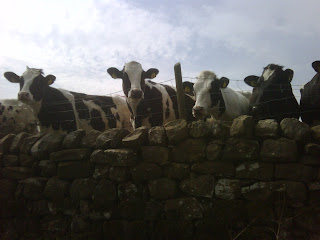
"Who're you blaming for climate change, matey?"
We should stop eating meat because of climate change. All the cow farts, pig trumps and sheep letting one rip are contributing to greenhouse gas emissions thereby leading to the end of civilisation as we know it closely followed by the earth ceasing to be a viable ecosystem for anything more sophisticated than cheese mould. It is of course nonsense - it's lettuce that should bother us:

Lettuce is “over three times worse in greenhouse gas emissions than eating bacon”, according to researchers from the Carnegie Mellon University who analysed the impact per calorie of different foods in terms of energy cost, water use and emissions.

Published in the Environment Systems and Decisions journal, the study goes against the grain of recent calls for humans to quit eating meat to curb climate change.

Collapse of the vegetarian's strongest argument (global warming is because we eat meat). Except for the noble soul who has the job of defending the cow fart argument because the funding of his institution depends on it:

The initial findings of the study were "surprising", according to senior research fellow Anthony Froggatt at Chatham House, an independent think-tank which is currently running a project looking at the link between meat consumption and greenhouse gas emissions.

Mr Froggatt told the Independent it is "true lettuce can be incredibly water intensive and energy intensive to produce", but such comparative exercises vary hugely depending on how the foods are raised or grown.

"We usually look at proteins rather than calories, and as a general rule it is still the case that reducing meat consumption in favour of plant-based proteins can reduce emissions," he said.

Watch that spin there Froggatt old chap! Especially since his argument that these naughty scientists haven't taken everything into account is quickly debunked too:

But surprisingly, even if people cut out meat and reduced their calories to USDA-recommended levels, their environmental impact would increase across energy use (38 per cent), water (10 per cent) and emissions (6 per cent).

Dang and double dang! Poor Froggatt is left with just the weakest of weak arguments - akin to sticking out his bottom lip, stamping his foot and insisting he is right:

"We do know there is global overconsumption of meat, particularly in countries such as the US," he said. "Looking forward that is set to increase significantly, which will have a significant impact on global warming."

We can expect more along these lines - a narrow focus on what the actual animal does (fart mostly) rather than a proper appraisal of the entire production process. It is, sadly, how science goes these days - look at vaping, at sugar taxes, at overweight girls or indeed almost any public health or climate change research and you'll find assumptions, ad hominem, lousy methods and the reliance on simply repeating a given mantra regardless of the actual evidence.  But then pointing at critics shouting heretic has always been an effective tactic in the short run.


....

Friday, 20 November 2015

Cows aren't destroying the planet. Ignorant folk like George Monbiot are.

****

George Monbiot is having a go at cows. Well, not just cows but sheep, pigs, chickens and goats as well. And probably alpaca, yaks and dromedaries too.

Raising these animals already uses three-quarters of the world’s agricultural land. A third of our cereal crops are used to feed livestock: this may rise to roughly half by 2050. More people will starve as a result, because the poor rely mainly on grain for their subsistence, and diverting it to livestock raises the price.

As usual with Monbiot, the article is replete with links to assorted stuff mostly from the more scaremongering end of the climate change community. And the premise seems superficially appealing - it does require a whole load of grass to fatten a cow and, if we're growing grass we can't be growing grain crops suitable for humans to eat. The problem with this argument is that the facts about agriculture's land use don't fit Monbiot's scare story:

Ausubel, Wernick, & Waggoner (2013) argue that ‘peak farm’ is already a reality, saying ‘while the ratio of arable land per unit of crop production shows improved efficiency of land use, the number of hectares of cropland has scarcely changed since 1990. Absent the 3.4 percent of arable land devoted to energy crops (Trostle 2008), absolute declines would have begun during the last decade.’

In simpler terms, improved agricultural efficiency is allowing us to feed the world's population while using less land. The main reason for this, of course, is that there is a lot less inefficient subsistence farming (the sort of farming that organisations like Oxfam spend a lot of time trying to preserve) and a lot more commercial and industrial agriculture. Moreover, in terms of resource use, this sort of intensive farming is far more environmentally friendly:

Agricultural economists at UC Davis, for instance, analyzed farm-level surveys from 1996-2000 and concluded that there are “significant” scale economies in modern agriculture and that small farms are “high cost” operations. Absent the efficiencies of large farms, the use of polluting inputs would rise, as would food production costs, which would lead to more expensive food.

Farming - not everywhere but in too many places - is treated as if it were some sort of cultural activity rather than the means by which we feed the world's population. Monbiot talks about waste management issues associated with farming but doesn't recognise that these exist because, unlike other industries, farming has not had to capture the cost of this waste. It is not an inevitable consequence of of the business. Moreover, as those chaps at UC Davis showed, less intensive production is more polluting.

Finally can we put this greenhouse gas malarkey to bed. The cow's only source of carbon is the grass she chews. And the grass only has one source of carbon - the atmosphere. A good chunk of that carbon ends up in those fine marbled steaks we eat. So saying that a lot of the 'greenhouse gas' emissions come from cows farting might be true, but only if we believe that somehow those cows are magically creating more carbon than they consume.

As usual Monbiot is telling half-truths and peddling misinformation.

....

Friday, 30 April 2010

Friday Fungus: Cows

Last night I missed the last of the “Great Election Debates” as going out celebrating 21 years of marriage seemed and altogether better idea! And what an excellent night out it was at the recently opened Gauchos on Park Row in Leeds – brilliant steak, some tasty mushrooms and good Argentinian red wine.

Since we’re talking about Argentina, I would be remiss of me not to mention a mushroom – Psilocybe cubensis – that is native to that place and indeed has been called the “Argentina Mushroom”. Firstly, you should note that possessing these mushrooms is illegal in the UK as they are “those” sort of mushrooms. And it would be tricky to plead ignorance as they don’t grow wild in the UK either!

Secondly, there’s a beef connection. Cubensis grows on cow dung or where cow dung has lain:

“Large, fleshy, cap and a persistent ring on stalk; bruising blue; on cow manure. Color varies depending of the age of the mushroom. When they are babies they can be a deep golden brown. As they mature the caps lighten turning a rich golden color right before their veils break loose.”

This mushroom has become one of the most commonly grown drug mushrooms spawning slang names and DIY kits. And – according to The Partnership for a Drug Free America – this is the effect of using Psliocybins.

For my part, I’m sticking to all those fantastic, edible mushrooms – life’s weird enough without the need for hallucinogens! With them you just get this!

....