Showing posts with label creativity. Show all posts

Saturday, 12 March 2016

It really is creative people - artists, innovators, entrepreneurs - that drive growth

****

We've become a little obsessed by a thing called STEM - science, technology, engineering and maths. And I think this is great is what you're planning is a technocracy - don't get me wrong scientists, engineers and tech folk are great, indeed if you want your child to get on in life never - under any circumstances - let them cop out from studying these subjects, never. But, just as you shouldn't let your child give up maths and science, you shouldn't let them drop arts subjects either.

And this is why arts matter - from some top French academic economists:

Historical accounts often assert that notable individuals matter for the growth of particular cities. This column uses a new database of 1.2 million people from 2,000 cities since 800CE to show that some types of ‘notable’ individuals have made a difference. Specifically, the presence of many entrepreneurs and artists is associated with faster long-term growth, but the association does not hold for notable military, political or religious figures

And - this is a moment of View from Cullingworth prediction - arts and creative subject will be more important to future jobs than they are at present. Robots will take over and routinise jobs we pay expensively trained technicians to do today and in doing so raise productivy giving us more time and money to spend on good stuff. And the good stuff is arts, culture and creativity - that's where the future jobs are. For sure, our technical world means those creative people will need a pretty sound understand of STEM but it's the people with this understanding as well as skills or knowledge in art, language, history, architecture and music who will be the future elite. Maybe.

....

Thursday, 13 June 2013

More proof of boozing's creative powers...

****

Following on from the earlier experiment that showed - following expert review that:

The team that drank alcohol came up with better ideas. And more of them.

The researchers asked the public:

Elsewhere, the public were also consulted for their opinions as to the best idea on the shortlist – both online and on the streets – asking 18-30 year-old drinkers in pubs. All consulted were asked to rate the ideas in order of effectiveness as to which would be most likely to persuade them to alter their drinking habits? 

And you've guessed it folks - the drunk team won again!

....

Friday, 26 April 2013

Proof of the creative value of boozing...


The Very Stuff of Creativity!


The Drum, fearless as ever in its search for the truth, set out to discover whether the great creative myth - that alcohol sets the design juices flowing - was true. And it seems that we were right back in 1990 - getting a little sloshed helps with the creative process:

The team that drank alcohol came up with better ideas. And more of them.

There were some interesting findings of a less intended nature (and not just that drunk people can't draw straight lines) such as:

Most of our guinea pigs attended as part of a creative team. We expected that they’d automatically pair off with their partner and get to work. But that wasn’t the case.

Instead, both groups immediately started working in large group brainstorms. I thought creatives hated brainstorms! But we left them to it, expecting them to peel off into their creative teams at some point.

They didn’t.

Fascinating stuff and yet again a reminder that the disinhibiting nature of alcohol is a boon and a blessing to mankind whatever the fussbuckets may say!

....

Saturday, 10 September 2011

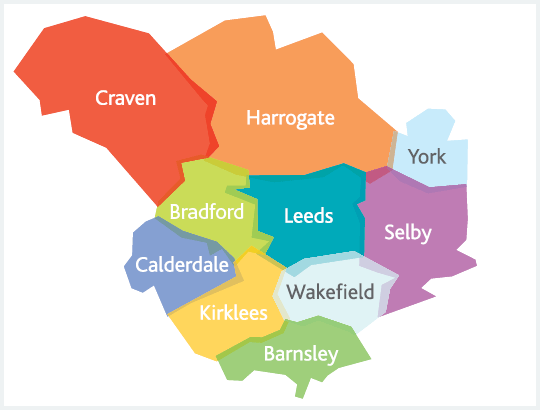
Leeds City Region needs enterprise, excitement and initiative - not sure that's what its getting

Yesterday – following their extravagant summit -  I wrote many a fine word about the problems with Leeds City Region LEP. The unrepresentative, public sector majority board, the Leeds-centric nature of the emerging strategy and the manner in which the ‘plan’ merely revisits the failed plans and strategies of the past thirty years. We appear to have learned little in that time and to have grown an exoskeleton of impenetrable regeneration babble to excuse that lack of learning.

But rather than a diatribe about this, I want to comment on how these bodies can be made to work – but only if we ignore the dominant ‘shiny regeneration’ approach to economic development.

If Local Enterprise Partnerships (LEPs) are to work, it won’t be through fine words and setting targets over which the Partnership has absolutely no control.  And it certainly won’t be by staging a few cosy fireside chats with self-selected business audiences or by buttering up some big property developers or retailers in the hope that they’ll wave their magic business wand and create that “dynamic, low carbon economy” everyone seems to want.

The clue – if we need one – lies in the name. In those two words – “local” and “enterprise”. This isn’t about the nonsensical and mythical “competitive advantage” game (that Porter has so much to answer for) or the Jane Jacobs for property developers that the Centre for Cities peddles. Success comes because people – local people succeed. Success comes from having an enterprising, creative and innovative population.

This isn’t about fast trains, enterprise zones or “City Region Strategies”, it’s about stomping around local communities talking to local folk, chatting with the corner shopkeeper, listening to the aspirations of these neighbourhoods. That’s where the growth will come from – not in revisiting the broken windows fallacy but in the enterprise and initiative of ordinary people.

If the LEPs simply become ways to divvy up grants and to farm the development taxes everyone seems so keen on (which are just another drag on economic growth), then they will fail. So a few bits of the ‘city region’ will benefit from this cash injection while the fundamental problem – our lack of enterprise compared to successful places – is simply not addressed.

Here are a few things I think that a LEP should do:

  1. Extend the successful community-based enterprise development work done in Bradford across the city-region
  2. Create a network of enterprise colleges under the ‘free schools’ model – concentrating this in the poorest communities
  3. Establish a business microfinance system – lots of businesses need a little as £500 to get going and the LEP could help support this sort of lending
  4. Sponsor and support business networking, local business hubs and enterprise support – working at the local level

The essence of this is that it is focused on people rather than on grand projects, big business or the ever elusive inward investment. If we have successful, exciting people, we will get successful and exciting businesses. And this will attract more excitement, more success and more business. And that growth in “gross value added” we all seek.

But most importantly, it will be fun.

....