Showing posts with label economic growth. Show all posts

Friday, 16 August 2019

"We don't like cities, oh no. We love 'em"


One of the concerns emerging from Onward's research into the 'politics of belonging' was a concern about cities:
71% of people think that “more people living in cities has made society worse”
We could, of course, explore what exactly we mean by city here but the sentiment is an important one given that, as Onward showed in earlier research, we don't want new homes built outside the city. At the heart of the sentiment is that people really do yearn for community and, rightly or wrongly, consider that the city does not provide for such neighbourliness.

Despite this finding people continue to move into cities and the larger the city the more attractive it is to the migrant.
The United Nations in 2009 and the International Organization for Migration in 2015 both estimated that around 3 million people are moving to cities every week. Approximately 54% of people worldwide now live in cities, up from 30% in 1950. Sources estimate this will grow to 2/3 of world population in the next 15-30 years. More than half of urban dwellers live in the 1,022 cities with greater than 500,000 inhabitants.
The reasons for this migration are primarily economic - the city is where the work is so you go to the work - but there are also a collection of amenity and social factors that perhaps get less attention. I had an unresolved conversation a while ago with former ASI research director, Sam Bowman about whether the wider amenity value of a place is factored into housing costs (there's more fun stuff in a city meaning that the value from the rent is greater). There are more social and business opportunities in a city making it more appealing as a place to live.

The problem is that this doesn't explain the disconnection between what people say they want (essentially suburbia) and what they actually buy (city living). There is probably a 'life stage' factor in all this with younger people and wealthy 'empty nesters' populating a largely child free city while those with families choose the suburbs but it also reflects how suburbia not only lacks the city's amenities but also lacks affordable places to live. In times past suburbs, even well-connected suburbs, were cheaper than the city (they were also cleaner and smog-free) but the virtual halt on expansion changed this pattern.

The policy challenge is, I suspect, less about housing than it is about the connectedness of housing to the city amenities and associated agglomeration effects. When we look at transport infrastructure we spend too much time calling for multi-billion investments connecting city to city rather than creating a more intensive network within a large urban area. When you have that connectedness (as London has) it is ridiculous to then have restrictions on development within easy access of that network (which London also has). Elsewhere the situation differs either because of dispersed populations or because of topography, fragmented political geography and underinvestment (Transpennine England is a good example here) - there is no network and without it less agglomeration effect and less successful cities.

The other part of the policy challenge relates back to people thinking living in cities makes society worse, to the lack of social capital in dense urban places, and to the transience of environments dominated by private rented property. Plus, of course, the persistent problem of affordability. The odd thing is that in a previous age we considered that as a principal means of providing housing, private renting was exploitative and we replaced it via municipal housing and the encouragement of home ownership. Today many urbanists seem to favour renting as an approach praising its flexibility and, of course, affordability.

Suburbia was our historical compromise between the city and the countryside - many of the amenities of the city and access to its agglomeration effect while maintaining a sense of space and an idea of community. We need to recognise that strategies to prevent the expansion of cities - for reasons of cohesion, environmental protection and snobbery - have contributed to a significant problem. Right now most of the land needed to accommodate expanding cities is non-urban and at the margins of the exiting built area. We are actively preventing development here - this needs to change. At the same time we need to look at strategies aimed at making the city itself more liveable - experimenting with flat pack housing and sky gardens or building more child-friendly environments within developments.

None of this precludes the need for more development land at the city margin or the requirement to spend money on the networks needed to integrate new development into the wider city but we need to get away from the rigidity of current plan-driven development models. We need to recognise that families need private outdoor space (and parks, while great, don't meet this need) and that cities do too little to make families welcome. This matters because families stay put for a substantial time - the demands of children (schools, childcare support and the activities of growing up) tend to keep people in one place for a long time, something that would allow for denser urban areas to develop the sense of community that transient singles really don't provide.

How our urban environments develop, whether or not we shape them in the manner of suburbia or as rabbit hutches for tomorrow's peons, is one of the big policy questions but sadly one mostly pushed aside by dominant obsessions with slaying perceived environmental demons. The decline in community is as big a problem as climate change yet we seem not to be thinking about how to restore trust, how to create stable neighbourhoods and how to get this without throwing out the social and economic advantages of the city.

....


Friday, 11 January 2019

An elite educated bureaucracy makes places poorer...


Or so some research seems to show....
I use a natural experiment to show that the regions of China with over a thousand years of sustained exposure to state-building are significantly poorer today. The mechanism of persistence, I argue, was the introduction of a civil service exam based on knowledge of Confucian classics, which strengthened the social prestige of the civil service and weakened the prestige of commerce. A thousand years later, the regions of China where the Confucian bureaucracy was first introduced have a more educated population and more Confucian temples, but lower levels of wealth.
The crucial point here is about prestige - in a world where the high prestige professions are non-commercial, the endeavour of the brightest to secure that prestige undermines economic development.

Much might be said about the situation in Europe where, increasingly, high prestige jobs are to be found in non-commercial environments, what Deirdre McCloskey calls the "clerisy" - academia, medicine, think tanks, central bureaucracies and a host of grand jobs in what might be called the international third sector. Even within the world of commerce, the prestige lies either with performers or with the administrators of large business systems - we are encouraged to see the creators as the parasites not as the means to provide the goodies society wants.

Thus the debate around the rich and successful isn't, "wow, how can we get more people like that creating value for society" but rather, "why aren't they paying more tax so more of us in prestige jobs can have more power and money". We're more bother by the relatively unimportant question of whether entrepreneurial businesses are paying enough money to the state rather than how we can support them (and others) to deliver more social value through that enterprise, innovation and creativity.

The lesson from history - the Dutch republic, Britain in the 18th century, the USA after the civil war, and places like Hong Kong or Singapore today - is that when doing business is valued by society and those leading is have the highest prestige then economic benefit to everyone is greatest. Sadly, we're in a time where entrepreneurship is disparaged, doing business is characterised as exploitative and non-productive, non-commercial roles are seen as the most important, most privileged.

....

Tuesday, 22 November 2016

Welcome to the 'Great City of the West' - mankind's dead end

In the opening chapter of 'Starman Jones', Robert Heinlein sets the scene with the young hero, dreaming of space, watching the Chicago, Springfield & Earthport Ring Road - essentially a high speed inter-city transit:

"The incredible sight and the impact on his ears always affected him the same way. He had heard that for the passengers the train was silent, with the sound trailing them, but he did not know; he had never ridden a train and it seemed unlikely, with Maw and the farm to take care of, that he ever would."

In this short chapter, Heinlein not only sets the scene for 'Starman Jones' but describes the chasm that divides rural and urban America. It's true that, in American Dream style, Max Jones, Heinlein's hero does escape from his rural isolation such that the book closes with Max on one of the trains. But we need to be interested in the rest of Max's world, in the people who stay on the farm. These people, rednecks, provincials, the "left behind" have suddenly become important folk. Not individually but collectively.

The election of Donald Trump, the UK's vote to leave the EU, the growing support for France's Front National and similar trends in Holland, Denmark, Sweden and Germany all focus on people who aren't living in the shiny world of what Ishaan Tharoor in the Washington Post calls "the West's major cities". And the world beyond the cities is filled with reactionary forces aimed at stopping the glorious people in those shiny cities from dominating the world - there's even an "if mayors ruled the world" group that says this:

“These reactionaries,” Barber said, “are the last wave in a series of political attempts to pretend that sovereign states still work.” The nation-state isn't about to disappear, he cautions. But Barber envisions a future where there'll be a “rebalancing of the relationship” between nations and cities that will enable greater local governance across the world for the benefit of all.

By greater local governance, Barber doesn't mean a local municipality at some sort of human scale but rather grand 'city regions' ruled by elected but autocratic mayors. And some places will be left outside these 'Great Cities of the West' struggling in rural decrepitude or small town decline. Other rural places will tag themselves onto the great cities, stretching their boundaries so as to get some small crumbs from the mayor's table. Soon these latter places will realise they've the worst of both worlds - higher taxes, more regulations and the envious sight of money pouring into super-rich inner suburbs and city centres. Places the residents of the city region's remoter outposts seldom visit and that's often merely to gawp at the beautiful people as they enjoy their playground while shrugging at the unaffordability of all this stuff.

Since the West's population is increasingly concentrated in cities, we've come to assume that the city is the demographic and, therefore, political form of the future. There's a hankering for the idea of the city state - essentially autonomous places within a weak state - and, in this, with the idea of strong, enlightened leaders elected by those cities' wise and enlightened electorates. The result - or rather the objective of the 'Mayors Should Rule the World' advocates - will be a fragmented, divided polity dominated by the needs and preferences of those ruling mayors (or rather those with access to these mayors).

Returning to 'Starman Jones' for a second, we see the manner in which the human world's design intentionally favours the city as a form. It's not just that the train swished through Max Jones' rural America but that the design of such systems today is creating such a world - England's HS2 is designed to connect London to Birmingham, Leeds, Sheffield and Manchester. What lies between the cities is irrelevant except as a place filled with ghastly NIMBYs who oppose the railway for spoiling the countryside. But why should someone in an old mining village like Havercroft or Fitzwilliam look kindly on HS2? Like Max Jones they'll be watching the fast trains whoosh by while wondering where their children and grandchildren will get a job that's better than in a warehouse or serving on at a cheap restaurant (assuming that the robots and minimum wage rises haven't killed those jobs).

There's no actual reason, other than our sociable nature, for us to live in those 'Great Cities of the West'. Indeed, they're filled with untypical humans. There are the brave few who upped sticks and travelled thousands of miles to live poor quality lives on the fringes of the gleaming, sparkly city hoping for a lucky chance. We've the fortunate beneficiaries of inheritance or beauty who can skim across the surface of the city enjoying its lights and pleasures while affording the means to avoid its darkness. And there's a vast mass of clever, skilled, hard-working people who turn the wheels of the city's economy but can't get a stake in the city, can't find the means to settle and have a family, and who justify this on the basis that they can get to see the beauties in their plays, galleries and stadiums.

If this - 'The Great City of the West' is the future of mankind then it isn't a future, it's a dead end. Because the great mass of the city dwellers can't afford a family, the only way to provide the services is to import more people from elsewhere. But what happens when those elsewheres don't provide people any more? The city grinds to a halt when economic growth in other places reduces the imperative to migration. So perhaps this explains the enthusiasm of the great and good of such places for elsewheres to remain poor - not starving but just poor enough for the stream of migrants not to dry up. But this is a false perspective - even the gradual rising of economies results in reduced birth rates so the city cannot win if it does not breed.

And cities are, in everything they do, anti-child:

...localities with higher densities and higher prices — the two are often coincident — have considerably lower birth rates than areas with lower prices. This becomes even more evident when one considers the segment of the population between 5 and 14 years old, when children enter school. In 2012, urban areas with the highest percentage of children are predominately lower density and lower cost, including Houston, Dallas-Fort Worth, Riverside-San Bernardino, Atlanta, and Phoenix. Urban areas with the lowest percentage of people in these age groups were also the New Urbanist exemplars, such as Boston, San Francisco, New York, and Seattle.

And who would - without necessity or accident - have children in a high-rise environment featuring fug-filled air that causes asthma, streets filled with rushing vehicles, public spaces designed for adults, and places dominated by strangers. In San Francisco and Berkeley over 70% of households are childless. And we're supposed to see dense urban living as a better model than the sprawl or the suburbs, the comfort of the small town or the community of the village?

The problem isn't just that the rural and small town West has rebelled against the city but that the city is a failing model - at least the idea of the concentrated, centralised, mayor-led city. These things are parasites, sucking away all the good from small towns with the promise of riches, opportunities and better bars while giving little back when it comes to the long-term quality of our lives. Urbanists talk about 'liveability' and 'walkability', about public spaces, even about play - yet the reality of the city is selfish, focused on the here and now rather than on creating places to which people can relate, where they might want to spend their whole lives.

Planners rejected suburbia as somehow too naff, 'not our sort of place' and then justified their rejection with tales of sustainability, sprawl and the curse of the motor car. Yet suburbs - at least the one I was brought up in - were liveable, open and child-friendly. They might have been a bit boring for childless, young adults but they weren't boring for children and, mostly, weren't so for grown ups with sheds to do hobbies in, gardens to keep and associations to join.

So no, the city is not the West's defence "against right-wing nationalism" but rather one cause of that right-wing nationalism existing in the first place. If your billions of infrastructure spending excludes most of the country they won't thank you for it. If every policy you espouse is designed for the child-free world of the city, the provincials will hate you for it. And if your attitude to people who don't live in the 'Great City of the West' is sneering, dismissive and patronising don't be so surprised when they kick out at you.

This idea of a the city as a place piled on top of itself, crowded, expensive, frantic, is a dead end. It is a model that will fail and in doing so may threaten what we choose to call western civilisation. The lesson in all this is to understand that, as one commentor obeserved, cities come with a huge barrier called "cost of living", a barrier that far from making the city a solution sets it up as a parasite.

Right now the only route to success in the city for the likes of Max Jones is still to borrow your uncle's space suit and save humanity. And given that few provincial folk have uncles with space suits (or other opportunities to save mankind come to think of it) they'll stay in declining rural and small town communities sneered at by people in cities who think the future of humanity is having shiny things but no children. It won't end well.

....


Monday, 12 September 2016

Diversity and the metropolitan diaspora


OK we have to accept a more-or-less economic definition of successful here (which I'm guessing will be fine for most folk) but the evidence tells us that more diverse places - that is places with lots of people who weren't born there - are more successful:

One of the most important ways for cities to get connected is through migration. Jim Russell and his collaborator Richey Piiparinen at Cleveland State University’s Center for Population Dynamics have been documenting how Cleveland has been getting more connected to the global world through this process. This includes foreign immigration but isn’t limited to that. A key part of it is the influx into places like Cleveland of people who have lived in major global cities like New York, then cycled out.

Now diversity isn't an absolute guarantor of success but within this work lies the germ of an economic development strategy that might rebalance England (bearing in mind that my country is, compared to most places, a pretty small place). This isn't about attracting skilled migrants from the other side of the world - or even from Paris - but rather to look at how you provide the opportunities for people to 'cycle out' from an increasingly expensive and intolerable London.

We've seen some of this 'cycling out' with the success of Brighton, Reading and now Bristol - all places close enough to London to allow for folk to scuttle back and forth. Other places may well begin to fit this pattern - Whitstable, Canterbury and even Margate. As London overheats the result is that innovators and creators relocate, taking the risk of a smaller pool against the certainty of greater affordability. In the USA this is now noticed - here's an article about chefs in New York:
Bret Thorn, senior editor at the trade publication Nation’s Restaurant News, agrees. “We are experiencing a serious brain drain from New York City,” he says. “Chefs leaving to move home to Cleveland (Dante Boccuzzi) and Minneapolis (Gavin Kaysen). You don’t have to put up with the exorbitant rents or deal with the general cost of doing business or the difficult community boards. You can go to Oklahoma City and have customers who are interested and will marvel at what New Yorkers might be bored with.”
We've yet to hit this point yet in England but it gets closer with each rent hike and each new regulation. Intemperate actions like the shutting down of Fabric don't help and neither does the understandable preference of local authorities for order and the interests of residents. London's fantastic - yes seriously Londoners, fantastic - public transport has helped the city keep these innovators as it's possible to move further from the expensive centre without losing connectivity.

The question for us to ask is what drives the success of these out-of-London places - why Margate and not Hastings, how come Bristol but not Leicester. Some of this is about access - good road and rail links - but this isn't the only factor. And looking at the evidence from the USA it's tracking the pioneers who go back home - the creator who decides to sell the overpriced two-bed flat in Greenwich and head back with the proceeds to Birmingham (or wherever) or the new entrepreneur who thinks success is more likely in their lower rent home town than in London.

Places like Bradford need to invest some time on their diaspora, in the connections that already exist. We moan and mither about the brain drain but simply ignore those brains once they've left. Perhaps part of the strategy is to talk to these exiles - most will have a soft spot for home (if only because of friends and family) and can be relied on to put in a good word. But maybe the big benefit comes when those people decide to take their well-gotten gains and head somewhere cheaper - if they've been loved by the home town even though they left, surely the chances of them returning are greater.

Of course, for me, the home town is London. And I can't afford it.

....

Wednesday, 25 May 2016

Local protectionism is no way to raise economic growth in poor places - a critique of inclusive growth


****

The RSA, that trendiest of slightly left wing think tanks, has launched a thing called the 'Inclusive Growth Commission':

Chaired by former BBC economics editor Stephanie Flanders and building on the success of the RSA’s City Growth Commission, the Commission will seek to devise new models for place-based growth, which enable the widest range of people to participate fully in, and benefit from, the growth of their local area.

The core of the Commission's argument is:

Public services and welfare remain fragmented; economic and social policies often seem to pull in opposite directions. Although growth is happening and unemployment falling, large sections of the population are not benefiting. Big wealth gaps and large numbers of economically inactive people have negative impacts on local economies, life chances and social cohesion. Costs to the state remain high, growth is low and prosperity the privilege of a few.

It seems an entirely noble idea to look more closely at how, to borrow a phrase, the proceeds of growth can be shared. The focus - entirely right for a geographer like me - is place-based, stressing the uniqueness of a particular town or city and seeking development solutions that resonate with that locality. The problem is that the RSA, like many other such organisations, has taken as its text the idea that inequality is the cause of poverty in places like Manchester, Liverpool and Bradford.

The worry I have with this place-based model, especially when coming from a centrist, 'government is good' ideology, is that we fall easily into the ideas about resilience, the local multiplier and social models of business. Here's Neil McInroy from the Centre for Local Economic Studies (CLES):

Overall, the plans to build a more inclusive growth model faces a choice. On the one hand the commission can add a stronger social face to an economy which works for the few, not the many. In this, they will reveal some of the problems of growth and this will prompt some policy changes. However, will the commission’s recommendations alter the longstanding frame to local economic activity – where productivity and growth has a pre-eminent position and is viewed as having much higher importance than that of inequality and poverty?

McInroy sets out a 'critique' based on his organisation's position - alongside the New Economics Foundation, Transition Towns and the New Weather Institute - as advocates of what I call local protectionism. For McInroy there is a dominant regional growth model - agglomeration - that needs to be challenged if we are to get an inclusive economy. Essentially in the critique the place-based model means that growth has to be spread across a region rather than being focused on city centres and 'growth hubs'. McInroy will point to the success of Manchester city centre and then to the fact that, despite this success, the metropolitan area of Manchester still contains many of England's poorest places.

It also has losers – city region peripheries, smaller towns and the low skilled. We must look at areas beyond city centres to outer boroughs. We must focus much more on local supply chains and ensure investment to local small businesses is on an equal footing to global corporates and global investors.

In here we have the problem - that reference to 'local supply chains' will be familiar to anyone reading the output of CLES, NEF and NWI. It refers to the view that local supply chains keep more money within the community than supply chains based on the national economy. The idea of the local or regional multiplier is central to this assertion - NEF make a good living from plugging their LM3 model to all and sundry (despite it having no real theoretical basis or any robust empirical support). The problem is that the local multiplier is something of a myth - the impact of excluding national supply chains is, in effect, the same as any act of protectionism. So any gain from having the money circulate within the community for longer is lost in that community having to pay higher prices.

The second element here is the persistence of the view that welfare payments somehow contribute to a local economy. It's true that the very poor places in Manchester and Liverpool receive large amounts of the money we redistribute (giving the lie to those who say there is no dispersal, no 'trickle down') but it is also true that, however valid that welfare payment might be, it still carries an opportunity cost. If the money wasn't raised in taxes it would have been used in another way - perhaps on consumption, maybe invested.

No-one disputes the objective - we'd like more of those people dependent on benefits not to be dependent on benefits. I'm guessing that's what the RSA mean by inclusive growth. The issue is how we go about this - do we run the risk of a slower rate of growth by insisting that large sums are redistributed in some way. If we reject the idea of agglomeration as a driver of growth, then we have to put something in its place. The problem is that the alternatives on offer from the likes of McInroy will act only to futher damage local economies by raising prices and decoupling them from the more successful national economy.

In the end local economies thrive because government does not direct them - the vanity of the RSA position and the stupidity of the CLES outlook is that there is some magical role for local or regional government in delivering both economic growth and a less unequal society. For me the reduction of actual poverty is more important than endlessly fretting over measures of inequality (or 'relative poverty' as folk like to call it) and this is brought about by government not obstructing the drivers of growth. It implies lower taxes when often poorer places have high taxes. It demands less regulation and intervention when the preference of big city governments is to intervene more. And it requires that we connect poor places to the rich places making it possible for people to travel - economically and physically - from the former to the latter.

....

Tuesday, 5 April 2016

'Growth for The North' - taking local ownership of the Northern Powerhouse


At a recent LGA meeting we heard from Lord Adonis, chairman of the National Infrastructure Commission and former transport minister. It was interesting, not just from the insight he gave into the work published on Crossrail Two, Northern transport connectivity and energy connections but for the context he have for decision-making. It is that context that is relevent to any discussion about the 'Northern Powerhouse'.

Much of the debate around the Northern Powerhouse is characterised by either negativity (witty statements like 'Northern Poorhouse' or 'Northern Powersham', for example) or else by an emphasis on devolution to 'metro-mayors' in the 'core cities'. It seems to me that this misses the point and worse reinforces two unwanted images of The North - as supplicants arriving cap in hand at national government's doors asking for more, and as a bunch of rivalrous, squabbling places unable to get their act together on priorities for economic growth. I would add that the capture of the agenda in some of those cities - Manchester especially - by the idea of 'inclusive growth' drags The North still further away from the place it needs to be to deliver on a Northern Powerhouse.

Lord Adonis made the observation that Crossrail Two got the green light for two reasons - the planning, costing and economic impact work was undertaken and sound, and Transport for London (TfL) as well as the London Mayor were committed to provide 50% of the scheme's funding. The result is that a £16 billion scheme will actually cost central government less than half that amount releasing the economic benefits (that show up in GDP figures and growth) to the whole nation. This is the sort of deal any national government wants to see - regardless of politics.

Right now there is not only no agreement or consensus in The North about infrastructure investment priorities but there is no mechanism for business in The North to do what's happening in London and fund 50% of that investment. There are any number of schemes and projects - ranging from the lunatic (a trans-Pennine tunnel under the High Peak) through to the sensible (reducing rail travel times east to west). And although Transport for the North has made a start with sifting these options and alternatives, it has made only a little progress and it isn't clear how its governance or administration functions. Crucially there is no means for The North to capture business contribution (for example via a business rates supplement) as national government is reserving this supplement for those places who take George Osborne's shilling off the drum and accept a 'metro-mayor'.

If, to use an eminently sensible idea, Transport for the North were to propose a new motorway linking the M56 to the A1(M) North of Bradford and Leeds, the expectation is that central government - through its agencies - would stump up all the cash. And the same would go for HS3, widening the A64, a rail link to Leed-Bradford International Airport and an upgraded Pennine crossing from Newcastle to the M6. We have to find a mechanism for local contribution and pooling that potential business rate supplement should be the best approach - assuming national government can set aside its obsession with Heseltine's rewarmed core city focus and the idea of 'metro-mayors'.

The essential requirement if we are to deliver the infrastructure elements of a Northern Powerhouse is cooperation between Merseyside, Manchester, Leeds-Bradford, Teeside and Tyneside (and the rest of The North) rather than the creation of competing entities based on travel-to-work geography in regional cities. This isn't to reject city devolution or even the idea of mayors but rather is to say that a Northern Powerhouse is best served by a bigger vision encompassing the whole of The North rather than a set of visions focused on the challenges of city government.

We're talking here about infrastructure - indeed specifically transport infrastructure - but there are other areas where The North needs to collaborate rather than compete - our education system underperforms compared to London and the South East, our urban mass transit (where it exists at all) is limited and not focused on economic growth, our cultural sectors lack bite, arts funding is London-centred, and we still experience a steady trickle of the bright and best to elsewhere in the world.

The problem, however, is compounded by the approach of city leaders and Northern Labour politicians to the problem - the Northern Powerhouse may not be a reality as yet but it's only going to become one if you get behind the idea and make it work. Simply shouting a lot about The North's problems and blaming all of this on central government isn't especially conducive to getting any commitment - let alone momentum - behind the idea of working together with that government to improve The North's economic performance. If the only approach is to stick a begging bowl under the treasury's nose and say 'fill it up please' then we will never have the growing, self-reliant and powerful North of England that surely everyone up here wants.

It is possible for leaders in The North to make this work but we won't get there if all our time is spent waiting for someone else to jump, fussing about how too much of it is about Manchester (or Leeds, or Newcastle), or making sad noises about how badly done to we all are. The work of Transport for the North, albeit quite tentative, suggests that wider collaboration on a similar basis around the whole economy not just transport is far more important than the geography of a 'combined authority' in Yorkshire or the list of 'asks' in a city devolution scheme. We need to take the idea of Transport for the North - cooperation, collaboration - and create something like 'Growth for the North' that's prepared to fund the feasibility and prepare the ground for more central government investment in The North alongside similar investment in growth from The North's businesses and residents.

....

Friday, 4 December 2015

Things that aren't really true.

****

Like this...

The most important factor is women’s education. Already today, an Ethiopian woman with secondary education has on average only 1.6 children, compared to a woman with no education who has 6 children.

We're told this again and again but raised levels of female education are a consequence of another more important change - raised levels of income and the end of subsistence farming. If people are poor (and scratching a living from a tiny, unfertile plot of land on less than a dollar a day is what we're talking about here) then having lots of children makes economic sense.

This isn't an argument against sending girls to school more an observation that parents don't send girls to school if they need human resources to scrat a living from the land. The work them and marry them off as soon as they can produce babies. So when Oxfam and others idealise marginal farming systems despite the ecological damage they do, they also prevent the growth that means fertility rates will fall.

Educated women, like lower fertility rates, are a consequence of economic growth - the former isn't the cause of the latter.

....

Sunday, 25 October 2015

Inconvenient truths - public funding of science doesn't promote economic growth

****

I'm in favour of science. Mostly for the "cor, wow" factor and because what scientists do at the far boundaries of our knowledge is fantastic. I'm even in favour of some of our taxes being spent on that science. But not because it helps in any way towards the growth in our economy.

In 2003, the Organization for Economic Cooperation and Development published a paper on the “sources of economic growth in OECD countries” between 1971 and 1998 and found, to its surprise, that whereas privately funded research and development stimulated economic growth, publicly funded research had no economic impact whatsoever. None. This earthshaking result has never been challenged or debunked. It is so inconvenient to the argument that science needs public funding that it is ignored.

When I did my masters degree, I looked at this stuff and the evidence is pretty clear - investment in research and development by firms is very effective in drive economic growth whereas there's no link between said growth and investment in research and development by governments or government agencies. Rather than the preferred university-led approach to research we need to look at firm-led approaches. Here's what I found:

There is evidence to suggest that university-led innovation strategies focusing on collaboration and the spinning off of businesses from HEIs leads to a misplaced focus on scientific research rather than business growth (Jones 1995, Frenz & Oughton 2005). Perhaps the most effective way to generate effective innovation at the level of the firm (where it has a direct impact on economic performance) is to reduce the barriers to innovation. The biggest of these barriers is cost and econometric models suggest that reducing innovation costs is more effective that investing in R&D or building innovation networks and systems (Martin 1999).

It won't happen, of course, because the system is controlled by universities and the friends of universities.

....

Saturday, 29 November 2014

Multiplication and economic growth....

****

Tim Worstall reminds us that there's something of a problem with the Keynesian multiplier:

And if we look closer at this, and we find that the relationship is actually only one to one, then we’ve a disproof of the central Keynesian contention. Which is that a rise in government spending (when in recession, when there’s unused assets lying around) increases GDP by more than the increase in government spending. We were certainly in recession, government spending certainly changed, but if GDP only changed by the amount of spending change then that’s a disproof, not a proof, of the central Keynesian claim. 

But the myth is widespread - if you look at the work of many in the field of local and regional economics, the idea of the multiplier is absolutely central to the presumed effectiveness of the policies they propose. Now I appreciate that Worstall is making a different point (essentially the arithmetic is just arithmetic never scientific proof - the biggest problem with much of macroeconomics) but we still need to remind ourselves that the multiplier is something of a myth. It's a myth when it's observed that government spending increases GDP by the amount of government spending (i.e. there is no multiplier) and just as much a myth when it's used to justify some sort of localist quasi-protectionism or that government procurement contributes to economic growth.

My concern is that this approach to public spending results in more expensive local services (the only reason for the quasi-protectionism is that non-local supplier may be cheaper) without any real evidence - other than arithmetic - that there is any economic benefit to deliberately making prices higher. Indeed, most of the time in economics we'd rather prefer prices to be stable and not determined by the arbitrary (or protectionist) choices of government.

The same applies for the local high street. Because supermarkets are more efficient, their prices are (mostly) lower than the prices in the precious independents on the high street. If we regulate and tax so as to penalise supermarkets for being more efficient all we do is to make prices higher for the consumer. And because such price rises fall most painfully on the poorest, such regulation and taxation is highly regressive (rather like duty on booze and fags - but that's another story). All those trendy folk talking about 'resilience' and 'sustainable high streets' are, when you boil it down, calling for the prices of basic everyday goods to be higher so the greengrocer on the high street isn't undercut by the supermarket.

Thus, to return to the multiplier, any benefits that might come from money circulating more in the local community are more than absorbed by the higher prices. And this is before we consider the opportunity costs of government spending. We simply can't presume that simply spending the money has more economic impact than either lower borrowing or lower taxes (or both). As has been observed:

"From where to people find the means to purchase consumption goods, other than production?"

Even if we accept that there is some local impact, it is limited by several factors (ones that NEF ignore in their LM3 model). Since the biggest cost for most businesses is wages, we have to start by noting that around 40% of that cost go straight back to the government in tax. And, after this, other significant costs - utilities, fuel, transport - aren't retained within the local community either. If our assessment is on consumers then we should note that their biggest costs (tax, rent or mortgage, utilities and transport) aren't retained locally. What the advocates of local multipliers are arguing is that the economy will be transformed by the redirection of part of the cost of groceries - in reality this is an utterly insignificant effect even assuming inefficiencies haven't wiped out any gain.

At the heart of all this work is a keen urge for the public sector to feel it is contributing - by its very existence - to economic growth and not just on a pound for pound basis (which isn't really growth) but as a stimulus to the economy. The problem is that, between protectionism and opportunity cost, any benefits that might arise from the multiplier are lost - and this assumes there are such benefits in the first place.

....


Monday, 20 May 2013

There is no moral basis for taxation...

****

This isn't an argument against tax but a simple statement of fact. We pay taxes because we have to and, possibly, because we get some sort of benefit from the payment of those taxes. And in paying those taxes it is entirely proper for us to arrange our affairs so as to pay only the tax that is due and nothing more. I would add that it is for the tax authorities - and no-one else least of all parliament - to assess what we pay and determine whether we have complied with the rules parliament has prescribed.

If parliament believes that I do not pay enough taxes (and assuming that I am not guilty of evading taxes which is a crime) then parliament has it within its power to change the rules that determine how much tax I pay. None of this is about any sort of moral duty or responsibility. Taxation is merely expedient - the means whereby government secures the revenues that government needs to carry out its purpose.

It rather worries me that - for reasons of political opportunity rather than good government - politicians (aided by their friends and relations in the broadcast media) have decided to whip up some sort of mob, to conduct a sort of moral crusade targeted primarily at large corporations.

Why does it worry me? Quite simply because corporations - businesses of one sort or another - are what will lift us out from the ire of recession. It won't be government however much they wish to scatter the magic fairy dust from the basement of the Bank of England across the land. It won't be shiny new value-destroying railways, ridiculous floating airports or delving ever more tunnels under London (there is something wonderfully Swiftian about today's infrastructure schemes) that will provide that elusive growth.

Yet every politician is now dragged into condemnation of tax 'avoidance' - from committees of MPs asking impertinent questions of people who actually contribute to the economy (unlike those MPs) to cabinet ministers writing pleading letters to jurisdictions with tax regimes that have met with disapproval. All to pretend that somehow this attack will help make the economy better and, worse still, accompanied by words like 'evil', 'corrupt' and 'immoral'.

There is no moral basis for taxation - government imposes a levy on our incomes, wealth and expenditure because it can do just that. But this is not a moral act and seeking to reduce how much tax we pay is therefore not immoral. What we see in a ghastly ignorant mob egged on by politicians and other hacks who point at businesses and successful men crying: "look there, wealth and money! We should have more of that for us to spend. These people are moral pygmies for not paying more tax than they owe!"

And the business people are dragged before the media - the court of mob rule - and accused of what? Essentially of complying with the rules set down by parliament, the European Union and contained in solemn treaties between sovereign nations.

Put yourself in the place of those businesses - international in scope and purview. Do you decide to develop your UK business? Or do you go somewhere else? Perhaps China, Brazil or Indonesia - places where the government welcomes your acumen, investment, jobs and wealth.

There is so moral basis for taxation - saying so is stupid and damages our economy.

....

Tuesday, 19 February 2013

Why Sir Paul Nurse must be run out of town on a rail

****

Of course it's political. Absolutely it's political. Everything is political when it comes to protecting and preserving liberties. As someone who is prepared to accept the idea that man's activity affects the climate (although I refuse to believe - and evidence supports me here - that we're the only cause of changing climate), I know it is political.

Which is why people like Sir Paul Nurse (why do they always mention his Nobel Prize - it wasn't in climate science and he's no more qualified to opine on the subject than I am, perhaps less so) need to be challenged:

A feature of [the global warming] controversy is that those that deny there is a problem often seem to have political or ideological views that lead them to be unhappy with the actions that would be necessary should global warming be due to human activity. I think that’s a crucial point. Because these actions that are likely to include measures which include concerted world action, curtailing the freedom of individuals or companies or nations, and curbing some kinds of industrial activity.’


Sir Paul's conclusion is that we have to stop people doing things - curtail freedom in response to climate change. I absolutely and completely reject this conclusion - we need to be prepared, we need to respond to the technical and scientific challenges of a changing climate. But we don't need to wreck the world's economy and condemn billions - and still more billions yet unborn - to a short, painful and grinding life of poverty.

You're all right Sir Paul, you've lovely comfortable jet-setting life. I'm pleased for you and your family.

And  I'm prepared to go for growth so the part of the world's population that isn't all right can enjoy at least a bit of your lifestyle. And I think that decency AND the interests of mankind are on my side.

You and your sort should be run out of town on a rail.

....

Friday, 7 December 2012

The dark truth about regeneration...it doesn't work

****

"Intervention" cried Heseltine and this was parroted by every economic development department, regional development agency and local authority. The echo of this word still bounces around the public sector - something must be done, invest in economic development...intervene, intervene, intervene.

It doesn't work:

...there is virtually no association between economic development incentives and any measure of economic performance. We found no statistically significant association between economic development incentives per capita and average wages or incomes; none between incentives and college grads or knowledge workers; and none between incentives and the state unemployment rate.

Is that clear enough for you? Oh for sure there are specific examples of lovely shiny things that have come from those incentives - an office block here (probably filled with public sector employees), an apartment complex there - but the strategy as a whole hasn't worked. Indeed, it could be even worse:

The only statistically significant association we find is between incentives and the poverty rate.

I'm not suggesting that regeneration actually makes places worse (although I could line up a convincing argument or three to support that contention) but that these incentives don't deal with the underlying reason for the place being poor and declining.

A couple of days ago the chancellor bunged a load more into the Regional Growth Fund - essentially an economic development fund - and a similar amount into market-facing basic research. I can tell you now that this will not do anything to address the problems of declining places. Nor will giving more powers and cash to so-called "local economic partnerships" (these are not local, not focused on economics and not partnerships but otherwise admirable bodies).

But folks, "something must be done" and this means the regeneration boondoggle will continue - Slough (home of Amazon in the UK) are appointing a new boss in this area at a salary of £126,000, for example. And the great regenerator who lands the job won't solve Slough's problems but will doubtless leave behind a masterplan or two, a collection of shiny schemes and a room filled with regeneration and economic development strategies.

Regeneration doesn't work.

....

Wednesday, 31 October 2012

Heseltine was wrong in 1982, wrong in 1992. He's still wrong in 2012.

****


I don’t know where to start with Lord Heseltine’s review. Perhaps with the bits I agree with – elected mayors, for example. Or maybe with a witch’s warning about reviews that everyone seems to ‘applaud’. But I’m choosing instead to begin with the big fib that Heseltine starts with -  his claim that the proposals are innovative, radical & different.


If there is an upside to the worst economic crisis of modern times it is the emergence of an audience for deep seated and radical proposals. They distrust talk of isolated initiatives or quick wins. An ever more competitive world will only become more competitive not less. The structures and attitudes of yesterday did not work that well then and certainly will not cope with the new world order.

All this may be true but Heseltine doesn't offer "deep seated and radical proposals" but exactly the things he disdains - "the structures and attitudes of yesterday..." 

Anyone who has listened to Lord Heseltine over the years will know that the themes of his thesis remain constant. The specific context of these particular proposals may be different from that led to the urban development corporations in the early 1980s or to “City Challenge” in the 1990s but the prescription remains the same.

Competitive bidding:


All my experience confirms that competitive funding is key to unleashing the entrepreneurial spirit in local areas. It injects a surge of excitement and incentivises communities to seek a wider and much more ambitious vision to anything they had thought of before. A healthy rivalry between areas comes into play. It drives collaboration, creativity, commitment and ambition. I therefore believe that the single pot of central government funds for economic development should be made available to local areas on a competitive basis.


Plan-led investment:


The Government will need to set out the requirements that LEPs must meet in their bids to secure funding. It should consult LEPs, local authorities and the business community in doing so. It is important that this framework is focused on high level outcomes and does not become detailed and prescriptive. This would rein in the creativity of local areas and undermine the benefits of local empowerment. However, there will be some essential criteria which have to be met for government to devolve such significant funding.


Sidelining local authority planning departments:


LEPs should therefore be given additional funding, specifically to develop their new strategic plans. This must be used to hire professional private sector planners as part of a deliberate attempt to spread best practice, engage private sector expertise and avoid LEPs being entirely dependent on the already stretched planning departments of their local authorities.


Cross-department regional offices:


This leads to the conclusion that we should bring together civil servants from different departments whose work impacts on the economy into Local Growth Teams so they can work seamlessly together, closer to the people and agencies affected by their work. They should facilitate both economic development matters that straddle LEP boundaries and partnerships around and between functional economic market areas


These tired old policies are accompanied by a familiar litany of how business-style public sector management is need, how economic development is driven by “innovation strategies” and some ridiculous obsession with “British ownership” as if that is somehow significant in our economy. What Lord Heseltine presents is simply his inevitable dirigiste, managerialist vision of how government should be organised. And it’s presented with panache and conviction.

The problem is that this agenda failed to regenerate the North when Britain was booming. Why on earth does anyone think that this agenda will regenerate the North when Britain isn’t booming? There is nothing at all in Heseltine’s prescription that will take us one inch neared a more dynamic, entrepreneurial economy. Instead we’ll have an economy designed and run by a closed sect of business managers working hand-in-glove with a closed sect of public sector managers.

In the end these are tired old proposals from a delightful and eloquent old millionaire. They are policies that haven’t delivered regeneration when they were tried before – except for some shiny city centres. But ask yourself this. Those city centres – Manchester, Liverpool, Newcastle, Leeds – have they delivered regeneration for the wider community? Travel a few hundred yards to Newton Heath, to Harehills, to Kensington and look around you. That depressing place of high unemployment, poor education, rampant crime and unshiftable poverty wasn’t changed when Heseltine’s policies were tried before. What makes you think it will work this time?

....

Thursday, 27 September 2012

A brief thought about innovation strategies and growth...

****

The innovation strategy - or innovation-led growth -  isn't usually about "innovation" but is about government investment in science and in manufacturing industry. Stuff like:

A £200m fund for early-stage ventures; freedom to raise money for the Green Investment Bank, and a new business bank to lend to growth sectors including advanced manufacture and life sciences.

..and

Invest the proceeds of the forthcoming 4G spectrum auction - estimated at £4bn - in science, technology and innovation.

Plus...

Higher education funds for radical inventions around knowledge creation - putting design thinking at the heart of the new Catapult centres.

All good stuff and "targeted" at the things that made regions "competitive" - at innovation. Or so we're told. The truth is that innovation - or a great deal of it - isn't about science but about boring things like systems and distribution. Amazon's success is as much built on getting super swift logistics as it is about whizzo techie wonderments. But it's the latter that suck up the innovation funding from governments.

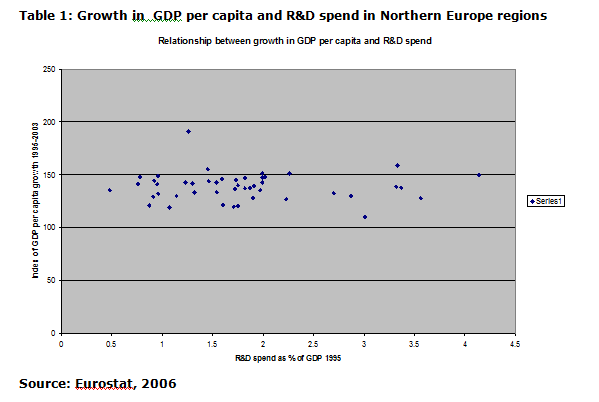
The problem is that, while innovation is awfully important at the firm level, at the macro level there's not much evidence that R&D spending impacts on growth:

And here lies our problem. We know that innovation generates growth (by reducing costs, by creating new products and so forth) but we can't capture that growth by looking at the sort of investments that typify government innovation strategies. Indeed, if a firm only innovates because of grant-funding (or 'soft loans' which amount to the same hill of beans) then we have to question whether the innovation is real or merely staged to secure the funding.

It seems to me - and there is some evidence to support this - that the real benefits lie in:

  • Concentrations of private sector knowledge workers (think Thames Valley)
  • Low (or no) taxes on capital gains
  • A focus on service/process innovation (services are 80% of our economy after all)
  • Active incentives (such as reduced taxes) for business innovation
  • Similar incentives for individual investors in innovation (tax reliefs or lower personal taxes)

What is clear however is that schemes predicated on the activities of universities - clutching another batch of government funding to their chests - do not deliver innovation and do not benefit growth.

....

Tuesday, 4 September 2012

We should celebrate working less hard to get what we need...

****

Apparently fresh Tory thinking is all about rediscovering the work ethic - egged on by Niall Ferguson, MPs seeking a glorious future on the 'right' of the party are coming over all Weberian:

Since 1950, average UK working hours have fallen by a third. Globally, the statistics are disheartening. In the first decade of the new century, the average German worked 14 per cent fewer hours than the average Briton, and 20 per cent fewer hours than the average American – who in turn worked much less than his counterparts in Singapore, Hong Kong and South Korea. 

So proclaims 'rising star' Domimic Raab as he calls for us to knuckle down, ram our noses up against the grindstone and raise a proper sweat. But Dominic, in his urge to be more-right-wing-than-thou, completely misses the point. We are very significantly richer today than we were in 1950. Even the poorest in our society have central heating, washing machines, televisions and even cars.

Dominic - urging us like some Stakhanovite commissar to work harder - claims this is the very reason why the Chinese, Singaporeans and Indians are catching us up. These foreign folk are working harder - or so Dominic shows us with a couple of anecdotes. I get the argument about red tape, about barriers to business that Dominic puts across but this has absolutely nothing at all to do with rediscovering the work ethic.

In truth - and I'm speaking personally here - I rather like the idea that economic growth, technological advance and cultural change means most of us get a pretty comfortable life without having to spend most of it slaving away at work that we really don't enjoy. Back in the 1950s much of that hard work Dominic Raab celebrates was done in dangerous, unhealthy mines, factories and mills. That today's generation needn't do those jobs to get on is an improvement not a step backwards.

It may suit our new puritan age for people like Dominic Raab to preach about the virtues of hard work but it will not bring economic success, growth. Just grumpy folk desperate for a party!

....


Saturday, 21 July 2012

Time for tax cuts...

****

...and not just because the stimulus they'll bring will help economic growth but because they are popular. Yes folks the age of people meekly telling pollsters they'll happily pay more tax "for the NHS" or some such weakness are over:

One in three British adults think taxes should be cut and the amount of funding for social housing reduced, according to a survey by a left-leaning think tank.

A survey of 2,000 people carried out by Yougov for the Labour-affiliated Fabian Society think tank shows 32 per cent of people agree that ‘tax rates should fall to pay for less provision’ of public housing.

A total of 35 per cent said the current balance is about right with just 16 per cent saying tax rates should rise to pay for more social housing services.

The survey showed that 72 per cent of people think social housing should be means-tested or partly paid for by the taxpayer. Nine per cent said there should be no state funding for social housing at all.

The findings also showed that two in three people think funding for programmes to help people out of work is too high or about right.

A total of 27 per cent think taxes should be cut to pay for less help for the unemployed, with 40 per cent saying the balance is about right.

Just 16 per cent said there should be higher taxes to fund more services to help people out of work.
The whining mithering left-wing commentariat are wrong - both about the economics and also the politics. And it's the welfare budget that ordinary folk have their eyes set on - the idea that we can give people just enough money that, despite a pretty depressing life, they have an active disincentive to risk that position.

So, rather than pouring endless cash into the bottomless pit of bank balance sheets, or squandering billions of 'grand projects', let's cut taxes for ordinary people. Raise the tax threshold to the minimum wage, cut the basic rate of tax to 15% and lower the top rate to 40%. We might have to lose a few civil servants (perhaps ministers would like to start with their own offices - all those 'special advisors' are an utter waste of cash) and close down some much loved programmes. But the population will have cash in its pockets, cash to spend on food, on home improvements, on clothes - on the things like holidays they can't afford at the moment.

And wouldn't that help just a little? And wouldn't it put a little deep blue water between the Conservatives and that subsidiary of public sector trade unionism, the Labour Party?

Go on George, you know you want to!

....

Thursday, 5 July 2012

Oddly enough this is good news...

****

...although I'm sure some won't portray it that way:

If the cancer-specific and sex-specific trends estimated in this study continue, we predict an increase in the incidence of all-cancer cases from 12·7 million new cases in 2008 to 22·2 million by 2030.

It may seem odd to portray the near doubling of new cancer cases as good news but, as the authors point out:

Our findings suggest that rapid societal and economic transition in many countries means that any reductions in infection-related cancers are offset by an increasing number of new cases that are more associated with reproductive, dietary, and hormonal factors

Rather than dying from infection and communicable disease, people will be dying from conditions - and cancers are primarily one of these - that are associated with longer lives. This makes cancer more of a problem and puts some imperative on development in treatment but it is a clear indication that trends show that people in developing countries will be living longer, healthier and happier lives. Mostly because of economic growth.

....

Friday, 18 May 2012

More evidence that planning stifles economic growth...

****

Now this isn't to say that we shouldn't have planning but is to observe that, if we do have planning, then we must appreciate the costs that society faces from having that planning. And the main cost is in economic growth - fewer jobs, fewer businesses and more expensive goods in the shops:

Using the quasi-natural experiment of the variation in planning policies between England and other UK countries and a difference-in-difference approach, we isolate the impact of Town Centre First (TCF) policies. We find that space contributes directly to the productivity of stores and planning policies in England directly reduce output both by reducing store sizes and forcing stores onto less productive sites. Our results suggest that since the late 1980s planning policies have imposed a loss of total output of at least 18.3 to 24.9%. This is equivalent to more than a ‘lost decade’ of output growth in a major sector generated directly by government policy.

Maybe we were right to have TCF policies but, in having them, we must also accept that loss of output growth and that lower productivity. Plus of course the negative impact on the UK economy of that lost output and lower productivity. We may be socially richer from having a "vibrant" high street but we are economically poorer.

So next time some planning expert tries to tell you it supports the economy - laugh in his face.

....