Showing posts with label migration. Show all posts

Tuesday, 1 August 2017

How migration caused the North-South divide


Yorkshire Day perhaps isn't the best day to share these findings but they tell a different story from the one we're usually told. I also appreciate, since I live here, that whatever they say all the best and brightest live in Yorkshire.

The thing is, however, that some clever folk at the London School of Economics (Gregory Clark, UC Davis and Neil Cummins) have looked at whether the North's relative economic underperformance is about "bad geography" or "bad people". And I hate to be the bringer of bad news but these folks at LSA have analysed surnames, probate records, MPs, doctors and other measures of social status like going to Oxford and discovered that the North's relative problem is down to the best and brightest in every generation heading South. Not just recently but more-or-less since records began (for the purposes of this research that is about 1840).


Our researchers conclude:
The poorer economic and social outcomes in the north of England have two possible sources. The first source is negative economic shocks in the early twentieth century that blighted the traditional industries of the north, and disadvantaged thereafter those born in the north in terms of employment opportunities, education and health. The second source is the selective outmigration of those with greater social status from the north to the south. In this paper we present good evidence in favor of the second interpretation, both using surname evidence and data on individual families.

Holders of surnames concentrated in the north in the 1840s were not disadvantaged in recent years in terms of education, occupation, political power, or wealth compared to the holders of surnames concentrated in the south in the 1840s. Since they are even now disproportionately located in the north any geographic disadvantage of that area would have reduced their social status. Further holders of northern surnames dying in the south were wealthier than holders of southern surnames dying in the south. And in sign that migration to the north was of less advantaged southerners, holders of southern surnames dying in the north were no richer that northern surname holders dying in the north. These northern surnames dying in the north were an adversely selected group, so the southern migrants must also be adversely selected.
To put it more simply: since about 1870 there has been a net out-migration from the North of England to the South of England and most of the migrants are, for want of a better term, the 'best and brightest'. The often noted regional inequality isn't down to the actions of government but rather to the choices of people.

....

Thursday, 16 February 2017

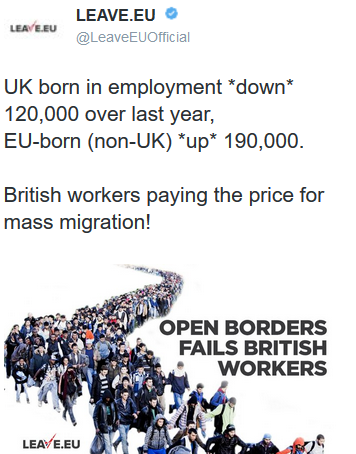
Cause and effect - how falsehoods are created

While the precise nature of truth isn't straightforward, we should be much clearer about falsity and the unethical use of data to present something that may not be true:


Firstly, of course, Leave.EU don't provide a source for the claim. The source is the latest ONS population digest:


Looking at the estimates by country of birth, between October to December 2015 and October to December 2016:
  • UK born people working in the UK decreased by 120,000 to 26.37 million
  • non-UK born people working in the UK increased by 431,000 to 5.54 million
The inference that Leave.EU make is that the reasons for this decline in the number of UK born people working is migration - 'British workers paying the price for mass migration'. And this could, indeed, be the reason for the decline. The problem is that neither the ONS data not Leave.EU provide the information needed to establish whether or not migration does put UK born people out of work.

And there are other equally plausible reasons for the decline such as 'baby boomers' retiring, the decline in public sector employment leading to early retirements, increased numbers of people staying in full-time education, more women opting to remain as housewives. Unless all these possible reasons - and maybe others I've not thought of - are shown not to be the reason, we cannot make the claim that Leave.EU make. It is, regardless of the source's quality, a falsehood.

....

Sunday, 18 September 2016

How Jaywick and West Texas tell us the Intergenerational Foundation's research doesn't say what they think it says


The Intergenerational Foundation has done some research - it's pretty good and you can read the full report (pdf) here. The IF look at 'intergenerational segregation' - the extent to which people of different ages tend to concentrate in the same areas. And both the IF and also the media has focused on how the increasing geographical segregation of young and old in England is a consequence of housing problems such as lack of choice and affordability.

Here's the BBC's 'OMG this is terrible' report on the research:

Young families are being "ghettoised" in inner city areas by the housing crisis while older homeowners become isolated in the suburbs, a report says.

The Intergenerational Foundation study says the number of areas dominated by over-50s has risen sevenfold since 1991 as young people move into the cities.

Even within urban areas, older people, children and young adults are living increasingly separate lives, it adds.

I'm sure this pattern will be repeated across other media and will be reflected in reports on similar research in the USA and continental Europe. And the argument that it's all about housing costs will be repeated again and again without question or criticism. Put simply we are more age segregated as a result of older people being unable to move to more 'age appropriate' accommodation because there isn't enough of that housing so young people aren't able to cycle out from the cities into the suburbs. And young people are renting in the city because they can't afford to buy the limited number of houses that come available in those desirable suburbs.

The problem here is that this really doesn't match what the IF's research is saying. Here's a chunk of those findings:

...places with the highest median ages are predominantly in rural parts of the country, particularly around coastal areas, while urban MSOAs stand out for being more youthful.There is also evidence of a north-south divide, as the broader south east surrounding London contains a number of lighter MSOAs – which represent comparatively youthful smaller towns and cities in the region such as Watford, Milton Keynes and Cambridge – whereas the MSOAs which are outside the large northern cities appear to be shaded darker. This pattern supports the finding from previous studies that there is a substantial net inflow of internal migrants who are in their 20s from northern towns and cities to London, while the out-flow of former London residents in their 20s and 30s tends to be to other towns in the south east.

I'm not arguing that there isn't a problem with housing supply (in general or specific to particular needs or demands) but rather that the IF research doesn't really provide an argument supporting the typical description of that housing crisis - young people unable to afford to buy property and, therefore, trapped in rented accommodation. Nor does the work really tell us that these affordability and supply issues are the reasons for England's 'age segregation'.

To understand this, we should note that the highest median ages are 'around coastal areas'. Other than for parts of the South Coast like Brighton and Bournemouth, England's coastal towns are pretty affordable and characterised by high levels of multiple deprivation:

An Essex seaside village is the most deprived neighbourhood in England, according to official statistics.

The community east of Jaywick near Clacton-on-Sea has again topped a list that measured deprivation in 32,844 areas across the country, the government report found.

But all of the local authorities with the highest proportion of deprived neighbourhoods are in the north - Middlesbrough, Knowsley, Hull, Liverpool and Manchester.

And of the top 10 neighbourhoods, Blackpool, the ‘Vegas of the North’, has five in the list, and eight in the top 20.

We see this pattern repeated in other seaside towns - Great Yarmouth, Skegness, Bridlington, Minehead - where an ageing population doesn't have the sort of characteristics popularised by those who want to blame all our problems on 'Baby Boomers'.

John Byford, 48, councillor for Skegness South, said: “Opportunities around here are few and far between. There’s no industry. People like it that we don’t have the fast motorways, but that’s also a problem because it means we don’t get the industry.”

The recently released movie 'Hell and High Water' features two brothers robbing banks so they can pay off the debts on their late mother's ranch. Based in West Texas the film is a contemporary Western nodding to the themes and storylines we're so familiar with from the traditional genre. One thing that strikes you watching is the utter, abject poverty of West Texas with shacks and shuttered shops frequented by tired, old people. These are dying communities without young people and kept going only by the fortune of oil and gas, at least until that runs out too.

So where have those young Texans gone? To the cities:

Texas’s spectacular growth is largely a story of its cities—especially of Austin, Dallas–Fort Worth, Houston, and San Antonio. These Big Four metropolitan areas, arranged in a layout known as the “Texas Triangle,” contain two-thirds of the state’s population and an even higher share of its jobs. Nationally, the four metros, which combined make up less than 6 percent of the American population, posted job growth equivalent to 30 percent of the United States’ total since the financial crash in 2007. Within Texas, they’ve accounted for almost 80 percent of the state’s population growth since 2000 and over 75 percent of its job growth. Meantime, a third of Texas counties, mostly rural, have actually been losing population.

Why would you stay in a dusty, isolated West Texas town like Post or Brownfield when there's no work and no prospect of work? Same goes - perhaps a little less starkly - for England. Young people are leaving what might be called secondary communities in the North - places like Oldham and Burnley as well as those coastal towns we've already mentioned. And if you've made up your mind to head elsewhere for work you're going to go where those prospects are best which in England means you head to London. It's this pattern of migration that the IF are picking up in their research not merely the consequences of England's failing planning and housing policies.

And the problem is that, while we can do something to make London less age segregated by housing policies, we'll struggle to respond to the desire of older people to live somewhere slower, quieter and more communal than a great big city. Or for that matter the wish of single, fun-loving young folk to live in big cities with great nightlife and loads of other young people. The problems IF identify are as much a consequence of wealth and choice as they are of sclerotic housing policies.

...

Monday, 12 September 2016

Diversity and the metropolitan diaspora


OK we have to accept a more-or-less economic definition of successful here (which I'm guessing will be fine for most folk) but the evidence tells us that more diverse places - that is places with lots of people who weren't born there - are more successful:

One of the most important ways for cities to get connected is through migration. Jim Russell and his collaborator Richey Piiparinen at Cleveland State University’s Center for Population Dynamics have been documenting how Cleveland has been getting more connected to the global world through this process. This includes foreign immigration but isn’t limited to that. A key part of it is the influx into places like Cleveland of people who have lived in major global cities like New York, then cycled out.

Now diversity isn't an absolute guarantor of success but within this work lies the germ of an economic development strategy that might rebalance England (bearing in mind that my country is, compared to most places, a pretty small place). This isn't about attracting skilled migrants from the other side of the world - or even from Paris - but rather to look at how you provide the opportunities for people to 'cycle out' from an increasingly expensive and intolerable London.

We've seen some of this 'cycling out' with the success of Brighton, Reading and now Bristol - all places close enough to London to allow for folk to scuttle back and forth. Other places may well begin to fit this pattern - Whitstable, Canterbury and even Margate. As London overheats the result is that innovators and creators relocate, taking the risk of a smaller pool against the certainty of greater affordability. In the USA this is now noticed - here's an article about chefs in New York:
Bret Thorn, senior editor at the trade publication Nation’s Restaurant News, agrees. “We are experiencing a serious brain drain from New York City,” he says. “Chefs leaving to move home to Cleveland (Dante Boccuzzi) and Minneapolis (Gavin Kaysen). You don’t have to put up with the exorbitant rents or deal with the general cost of doing business or the difficult community boards. You can go to Oklahoma City and have customers who are interested and will marvel at what New Yorkers might be bored with.”
We've yet to hit this point yet in England but it gets closer with each rent hike and each new regulation. Intemperate actions like the shutting down of Fabric don't help and neither does the understandable preference of local authorities for order and the interests of residents. London's fantastic - yes seriously Londoners, fantastic - public transport has helped the city keep these innovators as it's possible to move further from the expensive centre without losing connectivity.

The question for us to ask is what drives the success of these out-of-London places - why Margate and not Hastings, how come Bristol but not Leicester. Some of this is about access - good road and rail links - but this isn't the only factor. And looking at the evidence from the USA it's tracking the pioneers who go back home - the creator who decides to sell the overpriced two-bed flat in Greenwich and head back with the proceeds to Birmingham (or wherever) or the new entrepreneur who thinks success is more likely in their lower rent home town than in London.

Places like Bradford need to invest some time on their diaspora, in the connections that already exist. We moan and mither about the brain drain but simply ignore those brains once they've left. Perhaps part of the strategy is to talk to these exiles - most will have a soft spot for home (if only because of friends and family) and can be relied on to put in a good word. But maybe the big benefit comes when those people decide to take their well-gotten gains and head somewhere cheaper - if they've been loved by the home town even though they left, surely the chances of them returning are greater.

Of course, for me, the home town is London. And I can't afford it.

....

Friday, 15 July 2016

Why stopping immigration is good politics but lousy policy


****

We need immigration. This shouldn't be a matter of argument or dispute, it should be a matter of fact. Without immigration our society - the civilisation too many claim is threatened by migration - withers and dies.

Though demographers have long anticipated the transformation Japan is now facing, the country only now seems to be sobering up to the epic metamorphosis at hand.

Police and firefighters are grappling with the safety hazards of a growing number of vacant buildings. Transportation authorities are discussing which roads and bus lines are worth maintaining and cutting those they can no longer justify. Aging small-business owners and farmers are having trouble finding successors to take over their enterprises. Each year, the nation is shuttering 500 schools.

One of the world's oldest and greatest civilisations, Japan is slipping slowly away. Whole abandoned villages, towns populated almost exclusively by the old, shuttered businesses closed from lack of a workforce. Without new blood Japan will die - not a sudden violent shock but a gradual decline to the point where the assets and value of the nation are devoured by the old. Yet Japan still keeps one of the world's strictest immigration systems:

Abe, however, ruled out any significant change to Japan’s closed-door approach to immigration at the UN general assembly in New York in September.

“It is an issue of demography,” he said. “I would say that before accepting immigrants or refugees, we need to have more activities by women, elderly people and we must raise our birth rate. There are many things that we should do before accepting immigrants.”

This is the demographic equivalent of tilting at windmills or commanding the tide not to come in - yet it is actively promoted as a policy by politicians eager to exploit people's distrust of migrants, a distrust built on race, religion, culture and language:

“Look at nurses, they believe their income will be cut if we let in Filipinos and Indonesians,” said Katsuyuki Yakushiji, a sociologist at Toyo University in Tokyo. “They also say that these people can’t speak Japanese well and that could be risky. Yet, at the same time, they complain about severe overwork and say we need to add nurses.”

Familiar rhetoric to Europeans and now, tragically for an immigrant culture, in the the USA - short-term fears and self-interest are placed above the fact that there aren't enough people to do the jobs we want done. And that it's not just high skills we need but also old-fashioned labour from people willing to kill chickens, clean lavatories and help old people get in and out of bed.

It's great politics - easy pickings - to wind people up about immigration, to claim that it's damaging our culture or society. But it's lousy policy - we need those immigrants for, as Japan shows us, without them the basis of society, the social compact that forms our civilisation, slowly washes away.

....

Friday, 8 July 2016

Some geography stuff - mostly not about Brexit - to read...


Free to a loving owner - the declining villages of Southern Europe

US Gun Ownership 
 
"According to the survey, which was conducted among 1,001 Americans in the aftermath of the Orlando nightclub shooting, 36 percent of U.S. adults either own a firearm personally, or live with someone who does. That's the lowest rate of gun ownership in the CBS poll going back to 1978. It's down 17 points from the highest recorded rate in 1994, and nearly 10 percentage points from 2012."

Not quite what we take from the news about guns in the USA.


Sluggish European economies - a long view
 
"First, in 1900, European countries were not only the world’s economic and military powers. They were also among the most populous countries in the world. By contrast today, Russia is the only country in the top 10 most populous. Then Germany is 16th and France is 20th. More importantly, some of the new demographic powers, India, Nigeria, Egypt, Mexico, the Philippines and Indonesia, are growing at a healthy clip, as can be seen from their Total Fertility Ratios (TFR, see table) whereas European countries are growing very slowly at TFRs that will ensure stagnation or shrinkage in the sizes of their population."
Always good to see geographers taking a long view (unlike most economists) of the reasons for Europe's sluggish economy. Also reminds us why we need immigration.


Brits still think they're working class
 
"Despite a long-term decline in the size of the working class to just 25%, the proportion of the public who identify themselves as working class has remained stable over time, says the survey. Significantly, it finds that with middle class occupations who still regard themselves as working class are more likely to be socially conservative on issues such as immigration."
Some more demography - and yet again a reminder that geography is just as (perhaps more) important as economics.


How left and right miss the point about unaffordable housing
 
"But I soon discovered, after looking past the cultural distinctions, that both conferences had the same message. Speakers and attendees at each recognized, whether they were predisposed or not towards free-market ideology, that the lack of a true market in cities was causing the affordable housing crisis. That is, existing residents buy homes in destination cities, and then utilize land-use regulations and anti-growth public officials to prevent new construction. This creates artificial shortages, driving up prices and pushing out poorer demographics."
And again we're reminded that too much debate about housing simply ignores the spatial realities - that pesky geography.


Brexit doesn't mean we'll need to build fewer houses
 
"In summary, the current basis for UK estimates of housing need are already predicated on a 45% drop to total net-in-migration by 2021, so for Brexit to have any downward pressure on planned housing targets in Local Plans, it would need to be assumed that Brexit resulted in European net-migration to the UK falling to virtually zero over the medium to long term. This seems unlikely."

A reminder that not only are OAN housing numbers mostly rubbish but Brexit won't change this fact!


The slow death of Southern Europe's villages
 
"In the southern Italian medieval village of Sellia, local mayor and paediatrician Davide Zicchinella published a decree forbidding locals from falling ill and dying. While Zicchinella has admitted that he cannot fight the laws of nature, he’s hoping that his action will prompt elderly residents to take up healthier lifestyles."

The sad tale of how Southern Europe's ancient villages are, quite literally, dying as demography, migration and crap planning leave them as places filled with the old and poor.

.....

Sunday, 24 April 2016

Millionaire migration...

****

When we think of people moving, we tend to focus on the traditional sort of economic migration or the terrible consequences of war, oppression and terror. There's another collection of mobile people who don't get talked about - millionaires.

In a fascinating article for New Geography, Joel Kotkin looks at where there millionaires are moving to and from. And he starts by reminding us how important the spending power of the rich people is to many urban economies:

Former New York Mayor Michael Bloomberg has suggested that today a successful city must be primarily “a luxury product,” a place that focuses on the very wealthy whose surplus can underwrite the rest of the population. “If we can find a bunch of billionaires around the world to move here, that would be a godsend,” Bloomberg, himself a multi-billionaire, said toward the end of his final term. “Because that’s where the revenue comes to take care of everybody else.”

You don't have to be comfortable with this dependency on the very rich to understand the realpolitik of Bloomberg's observation. And Mayor Mike knew it is an issue because the very rich aren't moving to places like New York, nor are they moving to London:

The biggest winners are not the elite global cities, like New York or London, but ones that are comfortable, and boast pretty settings and world-class amenities. The leading millionaire magnets in 2015 were Sydney and Melbourne, gaining 4,000 and 3,000 millionaires, respectively, many from China. In third place is Tel Aviv, a burgeoning high-tech center which is attracting Jews fleeing Europe, notably from France.

Dubai ranks fourth, luring many Middle Easterners seeking a safer, cleaner business locale. Then comes a series of some of the most attractive cities on the planet, including Seattle (seventh) and Perth (eighth). In many cases these cities are gaining from “flight capital” from Asia and the Middle East.

Kotkin observes that the migration of millionaires seems driven by two factors - the safety of money and the safety of the millionaire. As a result millionaires leave Russia and China where property rights are weak and leave France because they don't feel safe (the big French exodus is of Jews and it's striking that they feel safer in Tel Aviv than they do in Paris).

Countries and cities need to worry about the exodus of millionaires - here's the impact of just one individual switching US states:

The movement for example of one billionaire — hedge fund manager David Tepper — from New Jersey to Florida could leave the Garden State with a $140 million hole just from his change of address. Overall New Jersey depends for 40 percent of its revenue of income taxes, one-third of which is paid by the top 1 percent of the population.

And the two top destinations for millionaires? The USA and Australia.

.....

Friday, 12 February 2016

Some interesting stuff to read including snowflake bullies, non-racist football, child mental health and why public health lie all the time

****

Bullies with a cause - exploring the 'snowflake fascists':

To make matters worse, among “the most consistent findings in educational studies of creativity,” according to psychologists Erik L. Westby and V.L. Dawson, is that “teachers dislike personality traits associated with creativity.” Although teachers report they value creativity, these nonconformist children who act and think differently and don’t quite fit in—the children most in need of teachers’ support and protection—are, research reveals, teachers’ least favorite students.


Rod Liddle on form as he discusses why football isn't racist whereas middle-class professions are (and has a go at Beyonce):

It’s not just Millwall, mind — football has done extraordinarily well in accustoming the white folks to divest themselves of racial prejudice. It is still the focus of anti-racist odium from the middle-class liberal left, of course, which despises what it sees as a lowbrow white working-class leisure pursuit. And yet there were more black players on Millwall’s books in 1975 than there were black journalists on the Guardian’s staff. A greater proportion of black footballers then and now than black academics, black lawyers, black MPs, black educationalists, black social workers — name your middle-class profession and the answer will be the same. And black Britons thrived in the same trades as those working-class supporters on the terraces — as electricians, plumbers, labourers.


Frank Furedi in challenging mode as he discusses mental health and children:

Confused and insecure children are likely to be diagnosed as depressed or traumatised. Virtually any energetic or disruptive youngster can acquire the label of attention deficit hyperactivity disorder (ADHD). Youngsters who give their teachers a hard time or argue with adults are likely to get stuck with the label of oppositional defiant disorder.

The proliferation of new medicalised categories with which to label school pupils says far more about the inventive powers of the therapeutic imagination than the conditions of childhood. Pupils who suffer from shyness are offered the diagnosis of social phobia. The diagnosis of school phobia can now be applied to label those children who really dislike going to school.


And Chris Snowden explaining slowly and carefully why public health lies all the time about drinking:

The graph represents the relationship between alcohol consumption and mortality. It is, I think, well known that the relationship is J-shaped. This particular J-curve is based on 34 prospective epidemiological studies which collect data on how much people drink and then follow them over a period of years with a view to seeing if they die and what they die of. As this graph shows, the risk of death declines substantially at low levels of alcohol consumption and then rises, but it does not reach the level of a teetotaller until the person is consuming somewhere between 40 and 60 grams of alcohol a day, which is to say between 35 and 50 units a week.


Here's a canter through the weird and wonderful world of consumer apps (this Uber for everything!):

Valet Anywhere will find you and park your car for you. Dufl will pack and ship your bags for you. Zingy, Barkpost, Wag! and FetchPetCare all offer on-demand dog-walking. Over the holidays, I received a breathless pitch for Thirstie, an app billed as a “discovery-to-delivery platform that allows you to stock up on last-minute wine, beer and spirits under an hour.” (Lest you think Thirstie has cornered its market, it’s locked in a Coke-Pepsi-style battle with its arch rival, Saucey.)


Meanwhile the Adam Smith Institute are running against the tide on migration - a welcome challenge to the media-led shouting:

The best international development policy would be to let in more workers from the third world in to work in Britain, according to a new paper from the Adam Smith Institute. Politicians should stop trying to save entire countries with foreign aid programmes and instead help their inhabitants by letting them move to developed countries, it says.


Finally, this is a really great idea:

Using this LoT (Locator of Things) technology, Pixie has basically created a network of items that can correspond and even talk which each other. This does not only create a ‘smart household’, but it also adds potential smart technology to the city. Add a pixie to your bicycle and find it back easily. Let your car give you a sign when you forgot to bring your driver license. Or add a Pixie to your shopping cart and let it find a your pre-set shopping list.


....

Thursday, 26 November 2015

In which a Guardian writer bemoans the lack of slums...


Or so it seems:

In this mix of complexity and incompleteness lies the possibility for those without power to assert “we are here” and “this is also our city”. Or, as the legendary statement by the fighting poor in Latin American cities puts it, “Estamos presentes”: we are present, we are not asking for money, we are just letting you know that this is also our city.

It is in cities to a large extent where the powerless have left their imprint – cultural, economic, social: mostly in their own neighbourhoods, but eventually these can spread to a vaster urban zone as “ethnic” food, music, therapies and more.

All of this cannot happen in a business park, regardless of its density – they are privately controlled spaces where low-wage workers can work, but not “make”. Nor can this happen in the world’s increasingly militarised plantations and mines. It is only in cities where that possibility of gaining complexity in one’s powerlessness can happen – because nothing can fully control such a diversity of people and engagements.

OK, our writer - one Saskia Sassen - doesn't actually use the word 'slum' here because that would load a whole lot of negatives onto her narrative. This narrative is filled with the popular "everything is being bought up by huge corporations" line - as if the buildings in London, New York and Berlin were all owned by collectives, co-ops and interesting old couples who've lived there since the place was built. There's also a slightly worrying 'and lots of the money is Chinese' as if this is necessarily a problem (a decade or so ago the bad foreigners with funny names were Japanese).

Now the point about slums is that they allow people to do those capitalist things away form the gaze of the authorities occupying expensive real estate in the city proper. And our writer is perhaps right to be concerned about the squeezing out of these places:

"Arrival cities are known around the world by many names," Saunders writes: "slums, favelas, bustees, bidonvilles, ashwaiyyat, shantytowns, kampongs, urban villages, gecekondular and barrios of the developing world, but also as the immigrant neighbourhoods, ethnic districts, banlieues difficiles, Plattenbau developments, Chinatowns, Little Indias, Hispanic quarters, urban slums and migrant suburbs of wealthy countries, which are themselves each year absorbing two million people, mainly villagers, from the developing world."

But Sassen is also wrong because the arrival of those grand developers, the imposition of those gigantic regeneration schemes, and the suborning of public space to private use doesn't stop those migrants coming. They still fill up the cracks, occupy what space can be found that's too marginal, contested or contaminated to attract those rich foreigners with funny names and their millions. And Sassen seems overly bothered by the location of public buildings filled with regulators and controllers - as if these people are either the friend of the slum-dweller or their places of work truly public spaces.

In The Arrival City, Doug Saunders talks about Istanbul - not the old city of tourists and old architecture but the far suburbia where the rural migrants settled illegally and built the fastest growing, most dynamic communities of Turkey. And this is the pattern in all our cities - the success of those at the margin makes the success of the city, a success achieved in the teeth of government opposition, eviction, regulation and distrust.

But they stay in the city. I remember selling a magnificent hand-stitched quilt to a middle-aged Jewish lady in Mill Hill. She and her husband were rich, living in a multi-million pound house in a desirable North London suburb. Asking the woman why she wanted the quilt she told me that she 'wanted an heirloom, our families came here with nothing and we want our families to have something'. Those families didn't come to Mill Hill, they came to London's East End and lived in a couple of cramped rooms from where they made their way in the world.

We look at slums and see squalor, dirt and disorganisation. The leaders of these places speak of poverty, exclusion and prejudice. But those new arrivals aren't staying in those slums - the best summation of what drives them is this quotation from Marco Rubio, one of the men seeking the Republican nomination in next year's US Presidential election:

Many nights growing up I would hear my father’s keys at the door as he came home after another 16-hour day. Many mornings, I woke up just as my mother got home from the overnight shift at Kmart. When you’re young and in a hurry, the meaning of moments like this escape you. Now, as my children get older, I understand it better. My dad used to tell us — (SPEAKING IN SPANISH) — ‘in this country, you’ll be able to accomplish all the things we never could’. A few years ago, I noticed a bartender behind the portable bar in the back of the ballroom. I remembered my father, who worked as many years as a banquet bartender. He was grateful for the work he had, but that’s not like he wanted for us. You see, he stood behind the ball all those years so that one day I could stand behind a podium, in the front of a room.

This isn't a defence of slums, just an observation that, for many of those who live in urban poverty, their life is better than the one they left behind. And they also know their children's lives will be better too. I guess only a conservative would really understand this though.

....

Friday, 31 July 2015

The lesson we should take from Calais - prohibition doesn't work

****

We have banned them from entering the country. We have built walls and fences. We have deployed cameras. And armed police abound. Yet still they come:

Around 4,000 people have stormed fences and desperately tried to clamber on trains bound for Kent in the past three days - a deadly gamble that has allowed at least 150 to get to Britain but also claimed the lives of nine people.

Migrants have said that watching their friends die will not stop them trying to get to the UK with one saying: 'It's England or death'.

We can make all sorts of assumptions about the situation, about why these (mostly) men are swarming around the entrance to the Channel Tunnel, clambering onto and into trucks, and taking the most extreme risks to get to England. What is abundantly clear is that building fences, throwing up walls and arming the cops is not enough to keep them out. Let's also get straight that sending in troops won't keep them out either.

It won't win me any friends saying this but so long as our strategy for preventing refugees and migrants from entering the UK is a barrier - our contribution to managing the wider problem of the world's population displacement - we will see repeated examples of what's going on in and around Calais. Just as we know from booze and drugs, prohibition is ineffective and difficult to enforce.

Let's assume for a minute that all the migrants wanting to come to the UK are going to ask for asylum when they arrive. Do we not have a process for determining whether a claim for asylum is genuine? Complete with an appeal system, special courts and hostels? Wouldn't it be better to use that, now pretty well tested, approach to managing the process? After all we know it's working:

The man is the first individual confirmed to have been repatriated through a new removals programme that seeks to take advantage of recent legal judgments and changes to UK immigration policy, which mean that Somalis seeking asylum must successfully prove that they face a specific threat, rather than simply being at risk from indiscriminate violence.

There's a huge international problem that we are choosing to squeeze into one localised symptom of displacement created by a wrong-headed refusal to adopt a sensible approach when faced with ignorant, borderline racist nonsense in the tabloid newspapers. If we were looking to process migrants, establish those with a case and deport the rest - putting resource into a practical response rather than fences or guns - we might have a chance of getting a grip. So long as our response is prohibition the cost of containment will keep rising as migrants seek - and find - new ways round the barrier.

It isn't for reasons of humanitarianism that we need to change our policy around entry, it's for the simple and practical reason that the current approach - de facto prohibition - isn't working. We urgently need a system that allows the existing process dealing with migration and asylum to operate properly rather than spending ever larger sums grandstanding over camps around Calais.

....

Monday, 20 April 2015

A reminder why we have an international aid budget

****

I get the anger at there being cuts at home while the budget for international aid has been protected. And, for the record, I don't support the mandated 0.7%, the de facto hypothecation of the budget or the preference for bilateral deals. But having an international aid budget isn't simply a case of us rich folk being nice to poor people in Africa. Investing in those places - helping them develop - is absolutely in our interests.

As we've been reminded:

Whether it was the Mediterranean's deadliest refugee drowning in decades remains to be seen. But it was certainly terrible, and its political effects could spread far. One of the survivors of a refugee boat that capsized late on the night of April 18th in the waters between Libya and the Italian island of Lampedusa said that at least 700 people had been on board. Just 28 have been rescued so far. That would make it by far the worst maritime disaster in the Mediterranean since the second world war.

A great deal has been made of the decision by the EU (and individual states including Britain) to end "planned search and rescue operations in the Mediterranean" because it was believed that fishing refugees from out of the sea only encouraged more of them to attempt the risky crossing. I do not support this policy - it is quite simply inhumane. I remember the suggestion - I think from P J O'Rourke - that instead of turning these folk away, we should be on the beach with a towel and a passport. We keep saying how we want risk-takers and people with get up and go - isn't that the very definition of these refugees?

The solution, if that's the right word, is for there to be less reason to leave Africa in the first place. And while war and the depredations of lousy government are part of the story, economic opportunity is central - just like us, these Africans are seeking to better their lives and are taking enormous risks in doing so.

And this is why we have an aid budget. It's also why that aid is better directed through multilateral agencies like the World Bank and International Monetary Fund than through cosy bilateral deals or, worst of all, through the agency of well-meaning but wrong-headed NGOs. Right now our aid programmes are a mixture of anti-globalist nonsense, the subsidising of rural poverty and a few strong infrastructure programmes (mostly around health and education). It's not the size of the budget but its direction that is the problem - we need investment that comes with strings, with a bit of that Washington Consensus that the left are so touchy about but which has been the single biggest reason for reductions in world poverty.

So long as the gap between opportunities here and opportunities there exists people will try to arbitrage the gap - some will be ordinary economic migrants, students and the like. But there's big money to be made smuggling people across borders and, as the Americans have found, it's almost impossible to stop people crossing those borders. So investing in those countries so they have the infrastructure needed for development makes every kind of sense if we want to prevent out richer places being a huge magnet for the billion or so folk out there who'd like a better life.

....

Sunday, 29 March 2015

Taking us for mugs - Labour, immigration and a panic about kippers


Seeing this delightful mug I thought back through all my years of active involvement in politics - from smuggling Monday Club Tory, Sir Patrick Wall into a meeting of Hull students (in his own constituency) through any number of local and national elections all of which have featured at some point the implication, nay insinuation, that saying we need to 'control' immigration is tantamount to racism. Indeed that we didn't really mean 'control immigration' but rather that this was code for something worse, something nasty and sinister, something racist. Saying we needed less immigration was always portrayed by Labour as but a short step from 'send the blacks home' or some other similarly unpleasant and bigoted policy.

That was until UKIP arrived on the scene. Up to this point Labour had stuck to its guns on immigration - pointing out that, mostly and most of the time, it's good for the nation and good for the economy. Whatever we may have thought about the issue, Labour's approach and its policy while in government was very clear - even when confronted with popular concerns about too much immigration:


It is the duty of government to deal with the issues of both asylum and immigration. But they should not be exploited by a politics that, in desperation, seeks refuge in them.

There is a position around which this country can unify; that we continue to root out abuse of the asylum system, but give a place to genuine refugees; that we ensure immigration controls are effective so that the many who come, rightly and necessarily, for our economy, to work, study or visit here can do so; but that those who stay illegally are removed; but that we never use these issues as a political weapon, an instrument of division and discord.

This view - that people come here 'rightly and necessarily' - was widely supported across the country and especially welcomed by a business community struggling for skilled recruits. In simple terms Labour was pro-immigration but against the abuse of the system. Today this has changed - the Party's position (albeit a little vague) has shifted noticeably away from 'follow the rules, play by the system, and you're welcome' towards the point where control - for which we will always read reduce the numbers - outweighs and rational discussion of migration. Labour is in a panic about kippers.

Labour got things wrong on immigration in the past. But Ed Miliband has set out a new approach: controlling immigration and controlling its impacts on local communities. Britain needs immigration rules that are tough and fair.

The Tories have let people down on immigration. David Cameron promised to get immigration down to the tens of thousands, “no ifs, no buts”, but net migration is rising, not falling. It’s now at 260,000, higher than it was when David Cameron walked into Number Ten, and the Tories’ target is in tatters.

The position here is rather different - it is the Conservatives that have failed because of those (rather dumb) net migration targets and Labour will, by implication, stop the tide. But the real drive in the Labour Party for this dramatic shift in immigration policy hasn't been some sort of Damascene conversion - or maybe just a cynical one - but rather the threat perceived in some Labour heartlands from UKIP.

Ukip are not about to overturn dozens of Labour’s northern heartlands. But the result in Heywood is further evidence of the threat that Ukip poses Labour. It is one rooted in much more than the charisma of Mr Farage, but the disconnect between Labour (and all main parties) and the working-class. In 1979, there were 98 manual workers and 21 people who worked primarily in politics in Parliament. In 2010, 25 manual workers were elected to Westminster - and 90 people who had worked primarily in politics before becoming an MP. Average turnout was just 58 per cent in Labour’s 100 safest seats in 2010.

I say the threat is perceived because I see little prospect of UKIP winning any seats - they've an outside chance in Grimsby but it's a long shot - from Labour in May. But Labour activists feel the challenge - the local councillors in Bradford who saw their majorities in safe seats dwindle to a handful, the activists who get berated by ex-Labour UKIP supporters at the working man's club or the trade unionists reporting how many of their manual labour members are making UKIP sort of noises at work.

Last year in Rotherham UKIP won 10 seats in that classic Labour rotten borough of Rotherham. We know the reasons but we overlook the wider reality - across those rotten boroughs like Barnsley, Wakefield and Doncaster UKIP moved into second place and became the main challenger to Labour. And the traditional response to the "far right" (as Labour folk insist on calling nationalists) didn't work. People didn't think UKIP were racist - or at least no more racist than the Tories - and did think they had a point about immigrants, about political correctness and about local community.

The Labour people in these places had never been challenged. Or rather the challenge came from that nice bloke who owns a garage and always stands for the Conservatives. Now Labour felt threatened - branch meetings were dominated by people talking about what UKIP were doing. The poor quality (if shiny) leaflets from that party were give to councillors by folk with slightly shaking hands - "look, look - what are we going to do" exclaims the leaflet-finder. The MP is involved and, while reassuring local activists, heads off to London where he meets others with the same tales.

"We have to respond" these MPs say. "We can't be caught out on immigration. UKIP can win where the Tories never could". Party strategists (knowing full well that there's little or no chance of UKIP winning and that it's the Tories and SNP that Labour should worry about) sooth fretful MPs and dutifully inform higher-ups about their concerns. With the result that proper working-class policies are developed about 'controlling immigration' - local campaigners can point to the policy and persuade those disgruntled folk in Rawmarsh or Royton that they're best sticking with Labour.

Plus a mug. A mug that means people like me can point to Labour and say "you bunch of no good, low down hypocrites - after all those years of attacking Conservatives for wanting to control immigration, you come up with a policy important enough for you to emblazon it on a mug."

Or as someone called it - the racist mug.

The odd thing is that Labour know the numbers. They know they're not threatened by UKIP - indeed that in some places that Party's support holding up increases the chances of Labour winning. But because lots of ill-informed and panicky local councillors and activists are on about it, the Party has placed immigration controls at the heart of its election campaign. And of course on that mug.

....

Saturday, 18 October 2014

Social capital and the problem with immigration - some thoughts


****

Immigration is a problem. OK, you can call it a challenge, a significant policy issue or some other 'slightly-dodging-the-issue' form of words but the truth is that people – voters – are bothered about immigration. We know this because they tell us so in polling and because, if any of us have any ears, we hear it every day. Whether it’s a casual racist remark in a queue to go through security at Leeds Bradford Airport or the comments that trail behind crime reports, stories about ‘multiculturalism’ and descriptions of events at mosques.

The problem is that, whatever people say, immigration really isn’t an economic problem. There really isn’t much – or indeed any – substantial research evidence showing that immigration has a negative impact on levels of employment, economic growth or other measures of economic performance. So when Jonathan Portes reports this he is right:


“The research found evidence of a positive and significant association between increases in employment of migrant workers and labour productivity. It found that recruiting from outside the UK had allowed employers to fill skilled and specialist roles and enabled some organisations to expand. Employers reported that migrants' skills are often complementary to, rather than substituting for, those of UK born employees.”


However, this really isn’t the problem (or challenge or significant policy issue) at all nor is this simply a case of people being fed misleading information by politicians and the media. A positive economic impact simply isn’t sufficient for people to accept the social changes that immigration implies. Yet much of what we might call ‘immigration-positive’ research and comment is dominated by economic considerations, arguments over statistics and accusations that opposition to immigration is essentially racist.

If we are to understand immigration and, more importantly, develop policies that respond to the genuine concerns of very many people, then we need to get a much better grip on the sociology of immigration. We need to get a better idea of how immigration affects existing communities, how those communities react to immigration and how we manage migration so as to give a greater chance of that community reaction being positive rather than negative. By focusing on the economics of migration we have missed completely the real driver behind those community concerns that some politicians exploit.

Indeed it is the need to reduce negative social impact that should drive immigration policies and controls rather than the prevailing preference for points-based systems based on a more-or-less arbitrary decision as to whether the ‘skills’ of the immigrant are ‘needed’. The evidence, both from polling and from qualitative studies, shows consistently that worries about immigration relate inversely to people’s exposure to immigrants. I would add that my personal view is that Britain’s current anti-immigrant feeling is substantially driven by the migration from EU accession countries being to parts of the UK that have had limited prior experience of immigration.

None of this gets us any closer to a basis for setting policy - assuming we’re going to plonk for somewhere on the continuum from totally closed borders to totally open borders. Regardless of the economic case for immigration, the potential social negatives (the cost of which may not be wholly contained in an economic model of migration) require some degree of control. And that will mean that some people will not be allowed to migrate into the UK.

And there is a good argument for striking a balance in terms of cultural and ethnic heterogeneity. I know we like to talk about how many different languages are spoken in our communities (this isn’t new – I remember the Principle of Bedford FE College saying just this in 1983) but the breakdown in social capital implicit in that heterogeneity damages both the immigrant andreceiving communities:


“People in ethnically fragmented communities have lower levels of interpersonal trust; lower levels of civic, social, and charitable engagement; less efficient provision of public goods; more sluggish economic growth; and lower levels of happiness and general satisfaction. It seems that the more diversity we experience, the lower our quality of life is.”


The risk we run with open borders is that they meet a short-term economic need but in doing so provide the seeds for more sluggish development in the communities where those ‘needed’ immigrants settle. Indeed, we should recognise that some degree of homogeneity is essential if a community is to develop the institutions, connections and structures essential to building social capital. Put more bluntly, the people within a neighbourhood have to share more than the fact of living in that neighbourhood if it is to become community rather than merely a place.

The unanswered question here is how we determine the point at which we set our migration policy. This has to be where the economic benefits of immigration exceed any negative impact on educational attainment, health or crime. Not just because those negatives carry a cost that isn’t necessarily picked up by the employers of immigrant labour (the prime beneficiaries of the economic benefit) but because poorer schools, health and community safety are reflections of a dysfunctional neighbourhood, of the breakdown in the social capital needed for the long-term.

Finally, there has to be some connection between the expectations of the current demos and the actions of government. In a democracy this should be a statement of the obvious but I fear it is not so – too often the response from public officialdom to concerns about immigration is to say ‘there, there - don’t worry’ or else to suggest that the person expressing concerns is simply a bigot. A further type of response is to flood the individual with (essentially meaningless) statistics accompanied with the implication that they are some kind of idiot.

We need to have immigration controls for the very simple reason that the public – the demos – demands that we control the arrival of culturally-distinct people into the neighbourhoods where they live. This can’t be dismissed as racism, bigotry or prejudice (although all those things may be present on occasion) but rather should be seen as articulating the collapse of social capital in many neighbours that large scale immigration brings about. People are not idiots but are reflecting concerns about the loss of community in their words and choices. And government too often fails to pick up those concerns in defining policies (locally and nationally).

I believe that immigration enhances our nations bringing new ideas, attitudes, food, drink, music and dance to pour into the English cultural melting-pot. We are a vastly better society for having welcomed generations of migrants to our shores. And I don’t want to live in a place where we push people away, where we don’t offer sanctuary and where there’s a preference for a sort of sclerotic monocultural numbness. But if we want migration to work for everyone, we’ve got to manage it, to try and mitigate how it can damage social capital and to direct our attentions to integrating all the wonderful, hard-working people who have come to make their lives in our great country.

...

Monday, 5 May 2014

Bratislava, or why people would rather do low paid jobs in the UK

Bratislava Castle and Cathedral Church from the Danube
Chances are that you've not been to Bratislava. I mean why would you unless you had a hankering for the old capital of Royal Hungary, to pop into the places built by those Hungarian nobles as they whiled away the centuries somewhere other than Hungary (the Turks were running Budapest back then I gather).

Hold on. Isn't there an oddity here? Hungary? But isn't Bratislava capital of that ultra-new state of Slovakia? How did that happen then if it was so much a centre for the old Austro-Hungarian lot rather than the northern Slavs? What happened was part of the bizarre combination of lottery, plebiscite and bad decision-making that created boundaries after the first world war (when the Austro-Hungarian Empire ceased to exist) and then jiggled them about after the second world war. Meaning that today Pressburg, in whose church Emperors were crowned, is now called Bratislava and is the capital of Slovakia.

We paid a short visit to Bratislava so this is as much an impression as a considered analysis of politics of economics in the Slovakian capital city. And we were tourists, doing tourist things like visiting the cathedral and sitting in pavement cafes watching the world go by.

A few things will strike a visitor to Bratislava: every second building seems to be either an embassy or else to have the word 'narodny' prominently in its title - 'narodny' means 'national' in Slovak. Where there is a public square it will have a splendid piece of recent statuary celebrating a nation hero: here's the one for Ludovit Stur, leader of the 19th century Slovak National Revival:


All this sounds pretty splendid but Bratislava has a problem. Despite the capital status, all those embassies and national institutions, the city feels like a place with little purpose. In truth a poor place with little purpose. The streets are quiet - we were there at 9am on a work day and it was less busy than Harrogate on a Sunday - and for every grand building there is a tatty row covered with graffiti, a broken door or a little shop selling not much more than a few boxes of sad looking fruit and veg.

This is the capital city of a country with five-and-a-half million people. It ought to be buzzing, filled with people making, creating, entertaining and building a nation. It's not. And I can understand why a young, educated Slovak (the sort who are guiding tourists round the city, telling them just how awful communism was and how it left them so badly off) would decide that nursing a clapped out car to Dortmund, Rotterdam or Birmingham has more appeal that trying to make a good life in their homeland.

Which is why there are multilingual graduates working in English bars and cleaning Welsh hotels. And why the killing of chickens in Cullingworth is exclusively done by emigres from places like Bratislava. And why should I blame them for doing that? Or prevent them from having that opportunity to do a crap, low-paid job in Britain?

....

Monday, 21 April 2014

Note on the causes of health inequality...

****

This is from the ONS statistical bulletin entitled "Life Expectancy at Birth and at Age 65 by Local Areas in the United Kingdom, 2006-08 to 2010-12". It talks about possible reasons for health inequality - including this one:

One factor that has received less attention is the selective migration of healthy individuals from poorer health areas into better health areas or vice-versa. This type of migration has been shown to play a significant role in increasing or decreasing location-specific illness and mortality rates, which then consequently impact on life expectancy figures. Norman, Boyle and Rees (2005) demonstrated that the largest absolute flow within England and Wales between 1971 and 1991 was of relatively healthy people moving from more deprived into less deprived areas. The impact of this migration was to raise ill-health and mortality rates where these people originated from and lower them in the destination areas. The authors also noted that the benefit to less deprived areas was reinforced by a significant group of people in poor health who moved from less to more deprived locations.

Migration explains a lot of the variation it seems. So area-based approaches to reducing 'health inequality' may be addressing entirely the wrong target problem.

H/T Tim W

Tuesday, 17 December 2013

Can we stop getting so hysterical about migration. Mostly it's a good thing.

****

It is the end of days. As the hangovers fade in the New Year it will be to witness the spectacle of vast hordes trooping off planes, trains and boats clasping evidence of EU citizenship as proof they can work in our fine nation.

Under “transitional” rules introduced when Romania and Bulgaria joined the EU in 2007, migrants from these two countries can only work in the UK in seasonal jobs such as fruit picking, or if they are self-employed.

These restrictions end on January 1, 2014, and all Romanians and Bulgarians will then have the same rights to work in the UK as British citizens.

The model predicts that over the next five years from January 1 at least 385,000 migrants will move from Bulgaria and Romania – more than the population of Coventry. 

Swamped! Swamped I tell you - the pressures on our creaking public services will be too great, the schools won't have the places, the hospitals will be filled with the grannies of Roma and Bulgar migrants and we'll spend our lives speaking some sort of pidgin English.

Even if I was to accept that there'll be 385,000 arrivals from Bulgaria and Romania, I really don't believe that a country with 70 million people - 200 times that number - can't welcome some new arrivals. For sure, I want to know who is coming in and that they're doing something constructive. I'm all for putting them on a plane back home if they misbehave. But can we have a little less hysteria please?

If we want to challenge in that big bad ugly world - to compete in that ghastly "global race" some folk want to believe in - then we need migration. We need Brits to go an work in France, in Dubai and in Hong Kong. And to retire to Spain, Ireland or Florida. These international connections, the British diaspora is a vital component in our economy, in creating the links with the rest of the world we'll need for future trade and prosperity.

This works both ways. Those Romanians, Bulgarians, Pakistanis, Chinese, Russians, Somalis - all those immigrants we're so rude about - their links home generate new economic activity and benefit our nation. Not because of cheap labour or a willingness to accept the bending of employment rules but because diversity is essential to economic growth:

It is important to note how this ‘[population] churn’ helps cities. Knowledge-based economies run on the quality of ideas. Ideas are not only a function of intelligence or education, but also the depth of information a person, or a city, receives.

London is successful because it is diverse. And it has always been diverse.

So I'm with Sam Bowman from the Adam Smith Institute on this - more free movement is a benefit not a curse:

There are lots and lots of bad things governments do that ruin people’s lives. But few cause as much harm to the poorest people as the state controls of where people can work and live that we call ‘migration policy’. Even a marginal step towards a more liberal immigration policy would allow people to create an enormous amount of wealth, and probably do more good than almost any other possible policy. 

...

Tuesday, 10 December 2013

Poverty and place

****

It's a fact that most of the world's absolute poverty is rural.

The largest segment of the world's poor are the 800 million poor women, children and men who live in rural environments. These are the subsistence farmers and herders, the fishers and migrant workers, the artisans and indigenous peoples whose daily struggles seldom capture world attention.

And we also know that migration from those poor rural areas to urban communities not only raises the income of the migrant but also contributes to economic growth. We are shown the dreadful squalour of shanty towns, favelas and slums and we assume that this is a worse life than that these people left behind in those rural areas. We are wrong.

So, in one respect this is correct:

We are often reminded today that, for the first time in history, there are more people living in urban areas than not. We therefore need to understand the power of urban placemaking in improving jobs, enhancing wellbeing, and bringing culture and education to a changing and diverse population of city-dwellers.

However, the author then seems unable to recognise that the creation of urban places by those migrants - however chaotic, disorganised and poorly serviced - is an act of progress. Or that the imposition of regularity on these places is as likely to destroy the creativity of that community as it is to reduce poverty:

An effective placemaking strategy requires the adoption and enforcement of regulatory frameworks at national level. As yet, however, there is no integrated approach of the kind that is needed, let alone a strong sense of policy leadership for placemaking in poor urban neighbourhoods.

Many people will know of - even recall - a past attempt at an integrated approach to urban place-making. We cleared slums, demolished back-to-back housing and built new places, often on the edge of the city near to open country and fresh air. And those new places failed. Every single one of them failed.

Not only was community broken by the change but the sense of ownership was broken. People lost their independence - even before the industries that sustained that independence passed into history - and became mere ciphers. Before long the idea of place and community was replaced by terms like "deprived neighbourhoods", "economically excluded" and "marginalised groups". Rather than see people as individuals we began to draw neat lines on maps and, in doing so, stigmatise everyone within those lines.

A while ago in Bradford, we looked at the impact of extra investment - in the widest sense of the word, 'regeneration' - on two types of communities: the predominantly Asian inner city and the largely white population of the peripheral estates. For very similar levels of spend it was clear that in the overcrowded, problematic inner city there were signs of change - better education results, higher skill levels, more new businesses and slowly rising earnings. Out on the estates there was no change, no improvement, a depressing catalogue of individual and communal failure.

The big difference? Those estates were a conscious attempt at place-making by the expert - people who knew better intervened, making sure there were open spaces, ight, big-roomed homes and with the key elements of physical community - shops, pubs and meeting places - in the middle of the new neighbourhood.

Down in the tightly packed terraces of inner-city Bradford, with families crammed into inadequate homes, with not much open space and with all the additional disadvantages of an immigrant population, things are different. There's still plenty of poverty and hardship but there's also a sense of community, of enterprise and of opportunity.

I don't really accept the 'place begets poverty' argument other than to observe that the use of changes to the physical environment - especially radical changes - run the risk of creating a short-term improvement at the expense of bedding in long-term poverty. Moreover, I believe we should worry at the desire - whether nationally or at the level of neighbourhood - to prefer stability over churn.

The danger is that poor places create inequalities that become ingrained in the psyche of a neighbourhood and of the people who live there. For many, the only solution is to plan their escape and to take what social and economic capital they have with them.

We should think about there being two types of poor community - places where there is poverty with enterprise and places where there is poverty with dependence. In the former, intervening to prevent outward movement would kill community dynamism whereas, for the latter, stability presents a chance to reduce dependence and promote enterprise.

The persistance of poverty in our country should be at the top of every political agenda - indeed, raising economic welfare should be the principle goal of every government - but we need to understand why that poverty persists. Above all we need to recognise that the route out isn't state-directed, ordered or controlled but lies through enterprise, personal initiative and in fostering an idea of opportunity and achievement, through the chaos of exchange and the excitement of the best urban places.

....