Showing posts with label Labour. Show all posts

Wednesday, 11 December 2019

Don't vote labour.


For past elections I've got to this point and posted a careful explanation - the case, as it were - for voting the way I planned to vote. I've been, over the last week or so, thinking through what I might say about the issues in this election.

And then I remembered that my wife's aunt, born in Manchester and living in Leeds, wanted a Magen David - she insisted it had to come from Israel. We have got her one. It came to me that there really is only one issue in the election and that, for the first time, I'll be asking you not to vote for a particular political party - asking you not to vote Labour.

At the weekend a few thousand Jews and supporters gathered in Parliament Square - to do one thing, to say no to antisemitism and to issue a plea for the rest of us non-Jews to listen to them when they talk about the threat to their community. A threat made worse by the fact that the Labour Party, at the highest level, is infected with that antisemitism.

The antisemitism at the heart of Labour means that otherwise good people, folk who see themselves as decent and caring, are considering voting to put a man described by most Jews as an antisemite into the highest political office in the land. Here's how Gideon Falter from the Campaign Against Antisemitism described Corbyn:
Referring to the days of Corbyn as a backbench MP, “when he could speak his mind without fear of scrutiny,” Falter described a man who committed countless blatantly antisemitic acts such as blaming “the hand of Israel” for Islamist terrorist attacks committed in Egypt, honoring a sheikh “banned from the UK for saying that Jews drink non-Jews’ blood,” calling a Hamas terrorist his brother, holding a “repulsive event on Holocaust Memorial Day in which Jews were accused of being the successors to the Nazis,” trying to have the word Holocaust removed from the title of Holocaust Memorial Day, laying a wreath at a memorial for the Black September terrorists responsible for the Munich Massacre, and much more.
Jewish organisations and individuals have gathered together the evidence - you can read many at the Labour Against Antisemitism website - from hundreds and hundreds of Labour activists. Not, as often claimed, people upset about Palestine but the full range of antisemitic nastiness - images of hook-nosed Jews straight out of Nazi propaganda, tropes about Jews controlling the media, the government and international finance, lies about the origins of Ashkenazi Jews, calls for the destruction of Israel - from the river to the sea - with the genocide that entails. And the Labour Party has failed to respond to this infection out of fear that, in doing so, it would get too close to its leader.

The response of many people has been either to deny the antisemitism - "you're confusing anti-Zionism with antisemitism" - or to say a bit of racism is acceptable to get a progressive government. The Guardian, in endorsing Labour summed up this position when it said:
"The pain and hurt within the Jewish community, and the damage to Labour, are undeniable and shaming. Yet Labour remains indispensable to progressive politics.”
A shocking attitude, essentially 'throw the Jews under the bus so you can get all that free stuff from a Labour government".

So I'm not asking you to vote for a particular Party just pleading with you to listen to those worried, frightened Jews. I don't care whether you vote Lib Dem, Conservative, Brexit Party or Monster Raving Looney. I don't care if you scrawl a rude picture on your spoiled ballot paper or stay indoors reading a book rather than voting. Just don't vote Labour. Please.

....

Friday, 21 December 2018

So all you want for Christmas is a new political party?


UK politics is in a shocking mess with the two big parties riven by factions, splits and arguments. We have parts of the Conservatives referring to colleagues as "quislings" and "traitors" at the same time as the Labour Party's left is calling for anyone with the mildest critique of the leader to leave the party and join the Tories. The cause of all this - or most of the cause - is the division over the UK's imminent departure from the European Union. It's not simply a matter of leave versus remain any more but a bewildering mish-mash of options, arrangements, contested votes and personal vendettas all fuelled by the high octane fuel of twitter. It's time for a new party to crawl from out of this chaos armed with wisdom, common sense and an unshakable moderate purpose - or so lots of people seem to think (or want or believe).

Now it is possible that a new party could be formed - indeed we are blessed with dozens of such things. It is also possible that this new party will sweep all before it as people leap at following a political movement that isn't either obsessed with One True Brexit or led by Jeremy Corbyn and a clique of Tankies (although we should remember that there is a national party, the Liberal Democrats, that meets these criteria and it isn't bounding ahead in popular support). But these things are unlikely for a whole lot of reasons - here are a few thoughts.

The last successful new national political party in Great Britain was formed in 1900. We call it the Labour Party (it's true to say, however, that the Scottish National Party and, to a lesser extent, Plaid Cymru are also successes and were founded more recently). It took the Labour Party nearly 25 years to get a sniff at government and 45 years to secure an overall majority. And Labour was also helped by the massive expansion of the franchise in 1918 (not just women but millions of working class men too). So, if you're seeing your new party as something that will rush Chuka Umuna, Chris Leslie or Justine Greening into Downing Street perhaps think again.

The Labour Party (and for that matter the SNP) weren't set up by existing politicians unhappy with the current political arrangements. Labour was, in essence, formed by the trade union movement and began life with an established and organised activist base as a result. Even so it wasn't until the 1922 election that Labour got more than 100 MPs elected. A bunch of existing politicians setting up a new party has precedents (Oswald Mosley's New Party in 1931 and the slightly more successful Social Democrats in the 1980s) but without the activist base it is pretty difficult to turn fine words into campaigning on the ground. In the case of the SDP, they were subsumed into the Liberal Party following pacts and alliances simply because the Liberals already had an organisation, local councillors and local parties.

Again this doesn't prevent a new party succeeding but it makes it more hard work than it looks when some bright-eyed politicians appear smiling and blinking on the news shows. And it won't be those politicians doing the slog but some people who, at the smiling and blinking point, aren't involved with the new party. Moreover, the chitter-chatter about new centre parties covers up another essential flaw - these parties are light on ideology and unsure on their positioning. This makes it difficult for them to deal with the inevitable problems that come from one or other established party occupying politics' centre ground.

To succeed any new political party has to decide which of the established parties it plans on replacing (in the manner of Labour replacing the old Liberal party). As those media-friendly, centrists parade their credentials it is important to target one or other existing party - saying something like "we'll take moderate votes from both parties" is to fight on two fronts making it more difficult to win. Far better to say something like "Labour has been taken over by the far left, we want to return to the values of Attlee, Gaitskill and Wilson in providing a voice for Britain's workers and their families". Or, if it's the Tories in your sights, "the Conservative party needs to be the voice of decent, patriotic communities but its obsession with Europe and austerity is failing these people". And remember that this message isn't just for 2022 (or whenever there's an election) but for as long as it takes to complete the replacement of the targeted political party.

All this means that you'll lose - six years of Labour campaigning after its formation resulted in just two MPs - and, more significantly, you will split the vote for left or right resulting in them being out of power or in unstable coalitions for decades. Lots on the left blame the SDP and Liberal Democrats for Margaret Thatcher's governments (and I guess that plenty of Liberals back in the first half of the 20th century thought the same of Labour).

Setting up new political parties works where you've a system of proportional representation (just look at Ireland or Holland for a guide) but even in such systems being an established political brand with an organisation and loyal supporters counts for a great deal. In the UK with its first-past-the-post system new parties start at a disadvantage and you can rest assured that existing politicians are not going to vote for self-destruction just for the sake of your shiny new centrist party.

A new party might work but the UK's political game, even with the current chaos, is stacked against new political parties (and, it seems, pretty much against either radical change or the fixing of mistakes within the existing big parties). You may want a new party for Christmas but it's likely to end up like one of those toys that everyone wanted, played with once or twice and then left untouched in favour of the Lego set with the pieces missing.

....

Monday, 14 August 2017

It's my party and it'll change politics forever...


Setting up new political parties is a tricky business. I appreciate that us politicians all believe - each and every oneof us - that our intellect, wit, charm and charisma means any party we set up would storm to victory on a tidal wave of popular passion for our brilliant policies. But, truth be told, the track record of new political parties in the UK is pretty rubbish - indeed the record of new parties isn't great anywhere.

This, however, doesn't stop people suggesting that a new party would change everything. Here's Spad Superstar, James Chapman (from holiday in Greece):

James Chapman stepped up his online campaign for a proposed “Democrats” party he has been mounting while on holiday in Greece, saying Brexit signalled the demise of the Conservatives.
A number of serving, former and shadow cabinet ministers contacted Chapman after he posted a series of provocative tweets this week, he told BBC Radio 4’s Today programme.

He said: “Two people in the cabinet, a number of people who have been in Conservative cabinets before now – better cabinets, I might say, than the current one – and a number of shadow cabinets ministers have also been in touch.

“They are not saying they are going to quit their parties, but they are saying they understand that there is an enormous gap in the centre now of British politics.”
That this exciting new project from a bloke on holiday in Greece who appears not to have a job at the moment tells you everything you need to know. We've all, with the help of sunshine, Mediterranean food and good red wine worked up incredible schemes to build mighty businesses, transform the game of football, rebalance the British economy and, as James has done, change the face of British politics forever. And when we return to the rain, sandwiches and supermarket lager of Britain these grand plans disappear into the mundanity of everyday life and business. As they should - 'pub talk' as a former colleague David Emmott once called it - because they make little sense.

We know how new centrist parties motivated by divisions over Europe, along with other policies like nuclear disarmament and nationalisation, turn out - even when they are led by a phalanx of cabinet superstars (or in reality three superstars and the one whose name no-one can quite remember):
The SDP began in January 1981 with the Limehouse Declaration, a statement of intent by four former Labour Cabinet ministers—Roy Jenkins, David Owen, William Rodgers, and Shirley Williams—to quit the leftward path that had lately been taken by Labour.
The SDP sputtered on until 1988 as a serious party when most of it voted to merge with the Liberal Party (that it so closely resembled it had shared election campaigns in 1983 and 1987).

While James Chapman's 'Democrats' might be the product of him having too little to do in Greece and too much wine, lots of people seem to think that there's some sort of mileage in setting up a sort of centrist party (presumably one that isn't run by a pleasant god-botherer or aged ballroom dancer) to stop Brexit. Leaving aside that this is perhaps the most short-term justification for creating a political party, it's not going to happen for a couple of very important reasons.

The first reason is that Labour MPs (activists, councillors and what have you) are going to stay right where they are in the expectation that one of two things will happen - Corbyn's leadership will collapse leading to the centre-left getting control again or Corbyn will be prime minister and they'll get some of the goodies that go with power. Folk like Liz Kendall, Yvette Cooper and Keir Starmer won't walk away from safe seats and guaranteed media access to engage in a risky, dodgy new party (even one with a tad more thought and planning than James Chapman gave the idea in between eating, tanning and drinking).

And secondly, with a few exceptions the Conservative Party has already been done over by Remainers and the Conservatives currently have (courtesy of the DUP) all the jobs and most of the power. Why on earth would any unnamed cabinet ministers walk out because of the slight possibility that Jacob Rees-Mogg might get to be leader of the Conservative Party at some unspecified point in the future? Assuming that Rees-Mogg actually wants the job.

Moreover running a political party is about a little bit more than have some influential figureheads - political organisations aren't just a couple of chancers sending out press releases from an office on the edge of SW1 (although I suspect folk like James Chapman think this is all you have to do) but involve a lot of organisation, effort and structure. Remember that, after its initial surge, the SDP essentially piggy-backed on the existing Liberal party structure and organisation - a new centrist party can't assume that the current liberal democrats, for all their opportunism will let this happen again.

The last successful new political party in the UK was the Labour Party. And it's worth bearing in mind that it arrived to the left of existing politics and that it took best part of 25 years to get to the stage of forming a (coalition) government - over 40 years to govern alone. There may indeed be a 'gap' in the centre of British politics because of Brexit and Corbyn but, if people want a party, you have to ask why - just like in 1981 - they don't simply switch to the existing, established and "winning here" Liberal Democrats?

British politics has to get a lot more broken before there's even the faintest chance of a new party - let alone one with any chance of success. The Conservative Party isn't (despite the best efforts of the media to pretend otherwise) split on policy but rather by the competing ambitions of leading figures. This is why otherwise sane Tories give credence to the idea of Rees-Mogg. And there may be enormous policy differences between the Corbynistas and Blairites in the Labour Party but the latter are staying put because they believe people - inside and outside the party - will eventually get bored with permanent revolution.

But Still - pour me another glass of that lovely red wine and let me explain my plan for a new centre-right political party...

....

Tuesday, 11 July 2017

Let's not let politicians get away with crying 'immoral' to justify their prejudices


It is always a worry when politicians start invoking morality in the promotion of their particular policy or prejudice. It doesn't matter much which side you're on, the objective is always to try and make out that those who support what you oppose are bad people. This applies as much to William Hague going on about the moral case for low taxation as it does to the latest piece of moralising from Labour's 'business spokesperson', Rebecca Long-Bailey:
Ms Long-Bailey told Today: "I don't personally use Uber because I don't feel that it is morally acceptable but that's not to say they can't reform their practices."

She added: "I don't want to see companies model their operations on the Uber model."
The objective here is to make you feel bad when you choose to use Uber - or, by implication, any other business using the 'gig economy' model. Obviously, Ms Long-Bailey has every right to choose the (usually) more expensive option of a hackney carriage or traditional private hire, but when she claims this makes her morally superior she is changing the argument entirely. Where we had an argument about working conditions and business models, we now have one based on making people who don't agree with Ms Long-Bailey feel bad.

Morality is a tricky area for politicians - after all arguments based on morality kept homosexuality illegal, brought in prohibition in the USA, helped keep women out of the workforce, and resulted in the unwarranted stigma of illegitimacy. In this case the appeal to morality is based on an assumption that Ms Long-Bailey knows precisely the minds and motivations of those people who drive for Uber.

The thing is that we know one thing that makes Ms Long-Bailey's argument false - no-one is forcing anyone to be an Uber driver. More to the point, the employment basis of most taxi and private hire drivers is pretty much identical to that of Uber drivers - they are self-employed. And Uber across most of the UK is licensed in the same manner as a private hire vehicle. This company is no more exploitative of its drivers than the typical Leeds, Bradford or Manchester private hire business.

What Labour and Ms Long-Bailey are saying is that it is morally wrong for a new business employing people on pretty much the same basis as the businesses it competes with to charge less money. This is about is protecting the local authority taxi monopoly and the excess rents earned by that monopoly and its employees - this is not about morality but about competition and the desire to protect one section of the market. All at the expense of the consumer - you and me.

Labour are entitled to make the argument for this protectionism using grounds such as safety, tradition, market stability and so forth. I think these sorts of arguments are wrong but that's an opinion. What is wrong here is that Ms Long-Bailey wants to make out that my opposition to her position on the technological disruption of public transport is somehow immoral. It clearly isn't.

This approach represents an unhealthy trend in recent left wing politics. It used to be the conservative right that would invoke morality as justification for policy but today we find this moral imperative used by socialists like Ms Long-Bailey. Whether it's the defence industry, disruptive digital technology, online distribution or Brexit, elements of the left turn quickly to an argument based on morals. We see this starkly with Ms Long-Bailey's unjustified attack on Uber but it's familiar to those who've witnessed arguments for 'ethical' procurement or investment, arguments based not on a real moral code but on the translation of political credo into an ethical platform. If I oppose 'Fairtrade', fossil fuel disinvestment or bans on tobacco advertising then I am a bad person because such policies are 'ethical' - opposing them makes me, in effect 'unethical'.

We need to start kicking back. Using Uber is not immoral, the 'gig economy' business model is not unethical, and to say so is to corrupt the meaning of ethics and morality by twisting it to serve a political ideology. Ms Long-Bailey's argument cannot be allowed to stand there without challenge, to become the presumed truth about self-employment in the UK because it is simply not true that it is immoral to use Uber, it misrepresents the business model and rather insults the folk who earn a decent crust driving for that company.

.....

Friday, 7 July 2017

The nice, pleasant, decent left is valorising violence with its silence and excuses


I know it's not all of you but "The Left" as it likes to call itself really does have something of a problem with being extremely unpleasant. And this problem is getting worse not better.

It may not be the biggest of big deals but this rather illustrates the problem:

"The government has blocked a giant statue of Margaret Thatcher in Parliament Square over fears it will be vandalised..."
 So it's just a statue of Britain's first woman prime minister - something definitely worth marking in Parliament Square (where, in case you haven't noticed, there aren't many statues of women). But because of that unpleasant faction on "The Left" it isn't going to happen.

The bigger problem with all this is that so many of those nice, pleasant, decent folk who hold left-wing opinions are prepared to make excuses for the sort of people who indulge in this sort of vandalism and worse. You only need to read the story of the attack on Sarah Wollaston's office, listen to Sheryll Murray describing the appalling vandalism and personal attacks in her election campaign, or to run down the Tweets of the Liberal Democrat campaigner in Manchester targeted at four in the morning for the heinous crime of putting up some posters.

Yet every time the response is to swat it away - "every party has these people" - to draw a false parallel between policy disagreements and vandalism or personal attacks ("look at these political campaign posters I don't like") or whataboutery - "here's something nasty that a Tory said fifteen years ago, what about that then". When the extreme left target a Liverpool MP for the terrible crime of being critical of Jeremy Corbyn, targeting that includes appalling anti-semitism and misogyny, those nice, pleasant, decent folk with left-wing views do nothing and say nothing. Every time.

It's true that every party has its share of unpleasant folk but it's also true that only "The Left" valorises vandalism, personal insults, threatening behaviour, intimidation and bullying as campaign methods. And because those nice, pleasant, decent folk with left-wing views don't deal with it - even having the almighty gall to talk about some sort of "kinder" politics - this sort of campaigning continues.

I've said for a long while that our political culture celebrates the bully - you only need watch "The Thick of It" to appreciate this - but we now are in the position where a faction on "The Left" has lifted this unpleasantness and transferred it to the political campaign itself. In forty years as an active political campaigner, I've never known a time when so much unpleasant, personal and downright nasty campaigning has been directed at the good people who hold different political opinions from "The Left".

I know you consider yourself different. You're not part of that left, oh no. But so long as you tolerate, excuse, deflect or explain away violent campaigning, you are little different from the left wing men who are doing the vandalising, performing the intimidation and ganging up on those most exposed and especially women and ethnic minorities.

....

Monday, 8 May 2017

Let's ban stuff (or how not to get people's vote)

Today appears to be public health day in the election diary which means that we've proposals from the Labour Party to ban stuff:
"We are going to apply the rules currently applied to children’s TV and apply that to TV more generally, so when you’re sat down with your children, as I do, watching X Factor or Britain’s Got Talent, you’re not going to be seeing adverts for junk food,”
Apparently there is "research that children see the adverts for McDonald’s and hassle their parents to go there". And, of course, parents are incapable of resisting. Like zombies they rise from the sofa at nine in the evening (after Britain's Got Talent with all the wicked advertising has finished) and, as if in some drug-induced trance, take the pestering children to McDonald's, KFC or whatever else was advertised during the latest piece of cash generation for the Cowell empire.

We are, unlike the sort of wise person who becomes a Labour front bench spokesperson on public health, completely captured by advertising, snared by the subtle webs of influence that cunning marketers weave around their products. There is no escape. We are doomed to a life entirely driven by the content of prime time advertising. Like puppets we bounce along to the tunes of neoliberal hegemony as presented by crafty copywriters who force - yes, force - us to consume, consume and consume again.

Research has shown this. That sociologist friend of the Labour Party front bench spokesperson says so and who are we to argue with the author of masterworks whose titles drip with stuff about 'neoliberalism'. Parents everywhere will flock to the party's banner knowing that they will be rescued from their children throwing a tantrum because they've said 'no' to a sugar, fat and salt stuffed snack.

This is easy politics - "for the children" screeches the Labour frontbench spokesperson and the media joyfully laps it up, wraps it in a comfort blanket of "we should do something", and then wheels out all its friends from the public health industry to support the proposals. Action on Sugar, Campaign Against Salt, Fuss About Fat - legions of publicly funded cheery souls pop up on TV and radio sternly explaining how if we banned advertising everyone will suddenly be thin as rakes and healthy as the butchers dog (except we're not allowed red meat any more because that will give us cancer).

Let's get some things clear here.

Advertising does not raise aggregate demand (however loudly kids shout)

People have agency (we don't have to buy stuff just because it's on telly)

Obesity isn't caused by eating sugar (or fat)

Salt is not bad for you (it's an essential nutrient - without it you die)

Obesity - or smoking or drinking - isn't the reason for the NHS funding crisis (quite the opposite)

Banning adverts means less money for TV companies to make programmes you like

Neoliberalism is a word made up by idiot sociologists

Voters are fed up with being bossed around (hadn't you noticed yet?)

.....

Sunday, 1 May 2016

It's not just clumsy language, the left is institutionally anti-semitic


****

If we ignore the "it's all an evil Tory conspiracy run by Murdoch" line, there are two narratives around the current problems the Labour Party faces with anti-semitism. One is that the Party isn't fundamentally anti-semitic but has a few members who have spoken or written things that constitute anti-semitism. The other is that the Party has a fundamental problem, to coin a phrase, it is institionally anti-semitic.

Chris Dillow makes the case for the first narrative:

It might be useful to distinguish between two forms of racism: verbal, and structural. Although the two often go together, they need not. For example, you’ll hear far more racist language in financial firms than in the arts industry – but you’ll also see far more ethnic minorities too. One business has more verbal racism, the other more structural racism. In this sense, Labour has a problem with verbal racism, but isn’t obviously structurally racist.

Now taken in the round, Chris is quite right here. Even its biggest critics (and I count myself as one of these) wouldn't see the Labour Party as structurally racist, indeed the Party can make a strong claim to having been instrumental in making Britain a far less racist country than it was when I was growing up. On the specific question of anti-semitism, however, I fear Chris might be wrong - the faction that has captured the Party right now, the Corbyn-Abbott-Livingstone axis does have a structural problem with anti-semitism. And at the root of this is the left's (if it's OK to describe Corbyn's faction in such terms) attitude to Israel.

It's not simply the left's 'edginess' (as Chris calls it) that's the issue here but that the adoption of unquestioning support for Palestinian rights had led them into sharing campaigns with mysogynist, homophobic and Jew-hating groups simply because those groups are opposed to Israel. And, as Jonathan Fredland observed in his plea for the left to treat Jews as they would any other minority, 93% of Jews see Israel as part of their Jewish identity. The support of Corbyn, Abbott, Livingstone and others for organisations that present an existential threat to Israel, that literally wish to destroy the world's only majority Jewish country, isn't seen as 'anti-Zionism' but as an attack on Jews and the idea of Jewishness.

The result of this is that too many from the left are simply blind to how their words and actions around Israel are deeply upsetting to many Jewish people. When Livingstone said Hitler supported Zionism what Jews heard was that the man who sought to exterminate all Jews and killed over 6 million, far from being an anti-semite was a supporter of a Jewish homeland. Livingstone and those who act as apologists for his racism in effect declared that Zionism and National Socialism had the same ends. That so many in the Labour Party fail to realise that this view is horribly anti-semitic says to me that this isn't just 'verbal racism' - the left is institutionally anti-semitic for the same reasons that the the Lawrence Enquiry found that London's police were institutionally racist.

I'll conclude by saying that, while Chris Dillow is correct about the persistence of dog-whistle politics and right that it should be challenged - the attacks on Sadiq Khan in London are appalling - this is essentially 'whataboutery'. What the left needs is to recognise is that it doesn't treat Jews in the way it treats other minorities - in the game of equalities top trumps, anti-semitism is bottom of the pile.

....

Monday, 14 March 2016

The Labour Party is now definitely on the Medusa's raft...


As metaphors for Labour's problems go the Raft of the Medusa is a good one:

On the raft, the situation deteriorated rapidly. Among the provisions were casks of wine instead of water. Fights broke out between the officers and passengers on one hand, and the sailors and soldiers on the other. On the first night adrift, 20 men were killed or committed suicide. Stormy weather threatened, and only the centre of the raft was secure. Dozens died either in fighting to get to the centre, or because they were washed overboard by the waves. Rations dwindled rapidly; by the fourth day there were only 67 left alive on the raft, and some resorted to cannibalism. On the eighth day, the fittest decided to throw the weak and wounded overboard leaving fifteen men, all of whom survived the four remaining days until their rescue on 17 July by Argus, which had accidentally encountered them.

No there we have it - Labour is devouring itself, with its members scrapping, shouting and pushing to promote - or undermine - the cause of Viscount Hugues Duroy de Chaumareys (or rather Jeremy Corbyn) while the role of Richmont, the incompetent navigator is taken by John McDonnell.

....

Saturday, 19 September 2015

Are we allowed to call Corbyn's economic programme Fascist? For that what it looks like.

****

We start here with the observable premise that 'Corbynomics' is not an approach founded in Soviet Communism - there is nothing in the programme that proposes the collectiviastion of industry, the management of the economy through non-market means or a focus on production as a proxy for economic growth (even to the point of that production becoming value-destroying rather than value-creating).

Instead the programme of 'Corbynomics' focuses on state-determined priorities, the rejection of 'excess profit' and the use of a sovereign currency to allow the increase in the money supply (or printing money as some describe it). In its essentials the approach takes the view that those who 'have' should make larger sacrifices in the wider interests of society - that austerity should be targeted at the rich.

A central element of all this - sitting alongside the printing of money - is the idea that money only exists so that governments, the state, can collect taxes. In this worldview the only money we are entitled to is that which government permits us to have after it has taken the taxes needed to undertake the work of the state (or, if you subscribe to the MMT fallacy, to prevent the production of money creating inflation).

Here's Richard Murphy, self-described creator of 'Corbynomics':

I would suggest that we don’t as such pay taxes. The funds that they represent are, I suggest, in fact the property of the state. After all, if we give the state the power to define what we can own, how we can own it and what we can do with it – and we do – then I would argue that we also give the state the right to say that some part of what we earn or own is actually its rightful property and that we have no choice but pay that tax owed as the quid pro quo of the benefit we enjoy from living in community.
The essential idea here is that the government is better equipped than individuals or markets to make the right choices in the interests of the community. And this is pretty much an idea that was first developed and actioned in Italy. In rejecting 'Bolshevism' and accepting profit as a 'necessary incentive', the Italians developed an economic strategy that was centred on the idea of directing private enterprise rather than taking it over:

...private enterprise in the sphere of production is the most effective and useful instrument in the interest of the nation. In view of the fact that private organisation of production is a function of national concern, the organiser of the enterprise is responsible to the State for the direction given to production. (Benito Mussolini, The Doctrine of Fascism 1935)

With this in mind the Italian state not only created huge corporate conglomerates with horrendously complicated governance but engaged in a series of grand campaigns focused on security of supply in food, in basic industry and in finance. The result of this is familiar in that joke about Mussolini getting the trains to run on time (he didn't) and in wonderful but pointless achievements such as draining the Pontine Marshes.

So looking at 'Corbynomics' we see the same appeal - that the state is greater than the sum of its parts, that only courageous leaders can direct investment so as to deliver economic, social and environmental betterment in equal part, and that the interests of business is subservient to the state's objectives. Or, as Mussolini aptly summarised:

All within the state, nothing outside the state, nothing against the state.

Because the state already, at root, owns everything there is no need to bother with such things as nationalisation. Instead the state uses instruments already available to it - taxes and the production of money - to direct business and industry in the direction that the state's leaders have determined. In doing this the state, rather than adopting the crude ownership model of classic socialism, chooses instead to take 'strategic stakes' in industry via a National Investment Bank and to adopt via this route the power to appoint to boards of directors.

The problem is that this sort of approach becomes ever more centralised in those courageous leaders of the state, increasingly exposed to corruption and so sclerotic as to act as a drag on the economy:

“...a never‑ending stream of officials passed through Mussolini’s office each day to receive his orders, though he had no means of checking that his orders were carried out. Officials generally pretended to obey and took no action at all. His chief preoccupation was to make sure newspapers reported that he had given orders on every conceivable topic including sports. There was a jungle of overlapping bureaucracies where Mussolini’s orders were constantly being lost or purposely mislaid. Any fascist party official could issue an order purporting to come from Mussolini, as its authenticity was hard to check. By trying to control everything, he ended up controlling very little.”

Now people have observed that modern technology makes totalitarianism easier. But, under 'Corbynomics' - with state-directed investment and high corporate taxes constraining private investment - we still see a situation where investment decisions are made by non-risk-taking experts rather than by risk-taking entrepreneurs. We have to trust that those experts will make the 'right' or 'best' decision, even though they do not have all the information and are not truly accountable for that decision. This problem is compounded because the progenitors of 'Corbynomics' insist that its objectives encompass social and environmental factors as equal 'partners' with considerations of economic betterment.

The ideas of 'Corbynomics' are not a direct parallel with the core doctrines of Fascism (at least as set out by Mussolini and philosophers like Gentile). However, they hail from the same birthplace, from the idea of a brave and activist state. Indeed, if we are to search out the closest equivalent to Richard Murphy's 'Courageous State' and the ideas that sit in the heart of 'Corbynomics', the best place to look is at Mussolini's renewed dictatorship after 1925. This was the triumph of Il Duce's activist government - praised by Sidney & Beatrice Webb, lauded by H G Wells and G B Shaw, endorsed by FDR, and approved of by Winston Churchill.  But I guess we're not allowed to call it Fascism?

....

Saturday, 12 September 2015

The Labour Party may be dead. All the noise and flag-waving means we haven't yet noticed.


The Labour Party


Part of me wants to crack open the champagne, let off party poppers and party the night away - after all I'm a Conservative. The rest is just a little more circumspect. The Labour Party - one of Britain's two great parties - has taken collective leave of its senses and set itself on the path to oblivion. And so long as it proceeds zombie-like to lurch across the land there's no room for a sensible, intelligent left-of-centre opposition to the current Conservative majority government.

Perhaps I'm wrong about this. Maybe Jeremy Corbyn will show himself to be a pragmatic, responsive politician able to bridge the gap between the worried public sector workers and students who've elected him and the bedrock of labour support. But Corbyn's record over a lifetime of political activism doesn't indicate that this is very likely. We're going to get opposition based solely on the politics of protest and the championing of the Left's unique sense of moral entitlement.

Corbyn is the man who signed a motion that said this:

"Humans represent the most obscene, perverted, cruel, uncivilised and lethal species ever to inhabit the planet and [we look] forward to the day when the inevitable asteroid slams into the earth and wipes them out, thus giving nature the opportunity to start again"

More than the fraternising with terrorists and murders, more than the knee-jerk anti-Americanism, more than the hugging of communist dictators in attractive and warm South American countries this little quote sums us the utter childishness of Corbyn's politics. For this man it's not a serious business of try to manage a complex system of government so as to better the lives of ordinary folk, rather its a long march to an infantile socialist paradise. And we know the cost of these marches - they take us tramping to penury and oppression than striding, as if in some Soviet poster, into a future of freedom and wealth.

Strong opposition isn't about taking to the streets. It's not about direct action or strikes or signing endless petitions calling for something or other to happen or not happen. Strong opposition isn't about unyielding adherence to a line even when it's clear that line means nothing and does nothing to get closer to government. Good opposition is about holding the government to account - debating and questioning its policies, amending and adapting its bills, and above all setting out a credible and believable agenda for government.

However much I try, I can see none of this good opposition in Jeremy Corbyn. All we see is posture, flag-waving, an echo chamber of left-wing indulgence, and the complete refusal to engage even slightly with the concerns of the British public. This may seem like a revolution to starry-eyed students and like revenge to a bunch of old trots and useful idiots but it's actually a stake rammed through the heart of the Labour Party.

And for all my smiles at the prospect of another ten years of Tory government, I can't help but feel sorry for those good people on the centre-left of British politics who've seen their Party taken away from them by the very forces of reaction that tried to destroy it thirty years ago. As a very good friend posted:

I am taking a break from Facebook. After 34 years as an active labour member and 36 years as a labour supporter and voter I can't watch an old friend commit political suicide.

....

Sunday, 16 August 2015

Some of us have known for years that the far left is extremely unpleasant

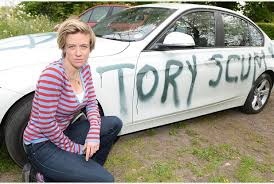
"If you don't vote for Corbyn, you're a TORY SCUM""

I've paid more attention to the Labour leadership contest than perhaps I should. Not because it's unimportant but because (given I've no vote in the matter) it isn't something I can influence. Still it's a fascinating episode in our political history - we're watching one of the UK's dominant parties split into two factions that are, to be mild, aren't getting on together very well.

As an outsider I can only observe that the moderate wing of the Labour Party is experiencing what those of us who really are Tories have experienced for decades - a seemingly unstoppable tirade of, often childish and seldom intelligent, abuse. Those chants of "Tory scum, here we come" still echo and we smile as we watch uncompromising left-wingers applying the term 'Tory' to anyone who is slightly to the right of Dennis Skinner - I'm sure that none of us ever expected people like Harriet Harman, Gordon Brown and Neil Kinnock to attract that epithet.

At the moment the focus is on the fact that these abusive left-wingers are 'Corbyn supporters' making their relentless offence on Labour's mainstream part of that campaign, a sort of pressure on MPs, councillors and others seen as representatives of the Party. The message is consistent - you're not properly committed to 'change' or 'progressive politics' unless you publicly come out in support of Jeremy Corbyn. And this cavalcade of baseless personal attack is accompanied by those very same supporters posting Corbyn's repeated claim that he "doesn't do abuse". Truth is that Corbyn doesn't have to do personal attacks, character assassination and trolling of Labour members who don't support him because he has an army of unpleasant folk who will do that work for him.

And these extremists don't just stop at abuse they extend this to a direct threat:

She revealed that one Labour councillor, who she declined to name, had been threatened with deselection for supporting her. “You cannot have people being threatened because they have different views or support different candidates. That is unacceptable,” she said.

When someone as dependably left-of-centre as Karl Turner gets this treatment you know that the Party has a problem. And it's a problem that won't go away once the leadership question is settled - too much insult, vitriol and threat has been thrown about (overwhelmingly by the hard left supporters of Corbyn) for the wounds to heal easily. Are those Corbyn supporters currently directing abuse at a councillor who has come out in support of another leadership candidate going to turn out in the rain to deliver his leaflets, knock on doors and make the case for someone they think is a Tory?

The sad fact in all this is that, as a real Tory for forty years, I understand entirely how the left behaves - the lunatic fringe is violent, vulgar, aggressive, judgemental and bigoted and the rest of the left smile benignly at all this as they secretly punch the air at this sort of quote:

No amount of cajolery, and no attempts at ethical or social seduction, can eradicate from my heart a deep burning hatred for the Tory Party. So far as I am concerned they are lower than vermin.

Those same Labour supporters who downloaded 'The Witch is Dead" when Margaret Thatcher died are now getting upset because some more-left-wing-than-thou comrades as spewing the same insulted in their direction. The left indulges its aggressive, violent bigots but now the campaign is inside the Labour Party those same people who used to polish their anti-Tory credentials by quoting Nye Bevan or Clement Attlee find themselves attacked as 'Tories'. As I wrote a while back:

You see Nye Bevan was wrong. Comprehensively wrong about almost everything. But this did not matter as this man could wallow in ignorance and bigotry, could opt for the insult above the evidence and could paint his opponents as evil. And his Party loved him for it. Loved him for his insults, for his uncompromising hatred of not just the Conservative Party but of Conservatives.

Men like Bevan set the tone for the manner in which Socialists debate - not just the 'lower then vermin' gibe but the genesis for "Tory scum, here we come". All this ferocious insult mixed in with hyperbolic predictions of gloom and despondency - or what the layman might term "outright lies".

The aggression, the insults, the damning caricatures - all these things cover up the fact that the far left's agenda is an agenda of despair and, as we know from Russia, from Cuba, from Venezuela, from any number of African countries, a recipe for poverty, economic chaos and oppression. The far left sanctifies racist murderers like Che Guevara, idolises terrorist apologists like Sinn Fein, and defines its position on the basis of hating Conservatives. And proposes state confiscation of private property accompanied by the economics of the madhouse - price controls, protectionism, high taxes on investment and the effective hounding out of anyone brave enough to try and create new value or new wealth.

Those Labour moderates with their head in their hands dreading the prospect of a Jeremy Corbyn leadership need to remember that it is their indulging of the nasty, bigoted far left that made it possible. Whether its laughing at Dennis Skinner's snippy little comments or hosting Cuba solidarity events, the moderate left failed to remove the nasty cancer of extreme socialism. Now those moderates see the far left for what it is - extremely unpleasant. As a Tory, I've known this for forty years. Welcome to the club.

....

Sunday, 26 July 2015

At least with Pete Seeger you could enjoy the music - Jeremy Corbyn and the politics of protest


There's a bit in Pete Seeger's version of 'We Shall Overcome' where, talking ahead of the next verse, Seeger talks about learning lessons from 'the young people':

"The most important verse is the one they wrote down in Montgomery, Alabama. And the young people taught everybody else a lesson to all us older people who had learned to take it easy, lead their lives and get along - leave things as they were - the young people taught us all a lesson, we are not afraid."

Watching Labour leadership contender, Jeremy Corbyn undergoing a gentle, chatty Sunday morning interrogation from Andrew Marr, I was struck by the manner in which Corbyn returned again and again to 'young people'. Not just in talking about student fees, welfare or employment but as a central aspect of his campaign. Observations like this:

‘The entryism I see is lots of young people who have hitherto not been very excited by politics coming in for the first time and saying ‘yeah, we can have a discussion, we can talk about our debts and our housing problems.’

Now I don't have the age profile (or indeed any demographics at all) of the new members and supporters piling into the Labour Party so as to vote in the forthcoming leadership election. And I suspect that Corbyn doesn't have a great deal more information. Nevertheless it is central to his politics that young people are the drivers of change - the heart of the 'social movement' he refers to repeatedly.

Pete Seeger and that whole American folk and protest revival of the 1950s and 1960s may seem a little naff to many today but Corbyn's politics uses the same slightly folksy rhetoric, the same disconnected slogans intended to cheer the audience and draw on the instinct we all have for compassion. So, faced with a serious question about national debt or economic growth, Corbyn summons up a series of statements - about tax dodging companies, high rates of tax and an 'overemphasis on orthodox economics' - that touch on the subject but don't actually address the question. This is followed by a glib conclusion - something like '..but tax isn't the real issue here, the big question is what sort of society we want'. You can almost hear Pete Seeger and Joan Baez tuning up ready to launch into 'We Shall Overcome' or 'Joe Hill'.

And this is the problem with such folksy socialism - it has a genuine appeal to many of us. I get an emotional jolt from Woody Guthrie singing 'Vigilante Man' or 'Tom Joad' and, though others may not share my enthusiasm for American folk music, many will point to song, story or images that echo that shout of pain and cry for justice. We really do care and politics like Corbyn's build on the exploitation of that compassion - coupled with a sort of poverty pornography an endless emphasis on failure that's essential to the making of political myth.

The problem - it's striking that Corbyn only ever talks of industry never business, public investment not private capital - is that we know that the solutions being offered don't work. Most importantly they work least well for the very people who Corbyn and others like him claim to care most about - the poor, sick and excluded. The economic catastrophe that follows from nationalisation, regulation, high taxation and rent or price controls - and it does without question - damages the poorest, weakest and sickest most quickly and most extensively.

Corbyn's appeal to 'young people' is an appeal to the most naive amongst the caring, to those who are most likely to join his mission to create that 'social movement'. The constant reference to student fees reminds us of that audience - these are overwhelmingly the children of the middle classes not the poor. There is a delicious irony that the taxes of an eighteen-year-old shelf stacker will, in Corbyn's world, go in part to pay for the education of a new generation of lawyers, social workers and bankers who will earn a load more in their lifetime than that shelf stacker.

There's a place - a need even - for Corbyn's politics. Protests and campaigns for justice are good and right. But the solution offered isn't one that will work - far better for that protest to stay in those songs and stories where, as these things do, it will act as a constant reminder that we should consider poverty, exclusion and the abuse of power at all times.

Turning the politics of student protest into a programme for government will result in disaster. And, by focusing on young people to the exclusion of everyone else, Corbyn seems oblivious to the real fact that most voters aren't young, aren't on welfare, aren't unemployed and aren't poor. They're just regular sorts - what Americans call the 'middle class' - going about their lives, doing the best for their children, making ends meet most of the time and squeezing as much pleasure and enjoyment from life as they can. It is these people that Corbyn wants to crush, it is their culture he wishes to destroy, it is their society he wants to change.

As a Conservative a little bit of me wants to see Jeremy Corbyn elected as Labour leader. But because I know a lot of Labour people - and like a fair few of them - I think electing a man who thinks the politics of Bolivarian socialism are a good thing would be an act of arrant stupidity, a triumph for unthinking ignorance and bigotry disguised as a caring agenda. Protest is great and it's a central part of what the left does but making it the entire purpose of the Labour Party - what Corbyn means when he says he wants a 'social movement' - sets up that party for permanent opposition rather than as a credible alternative government.

I know Labour Party members have a lousy choice but choosing the candidate who sees the party as a protest movement is just plain stupid. Jeremy Corbyn comes across as Pete Seeger without the banjo - well-meaning, caring, committed to change and - in political terms - utterly, utterly wrong. The difference is that, as least with Pete Seeger you could enjoy the music.

....

Friday, 22 May 2015

A reminder why the left is losing...

****

Perhaps not everywhere and not in every intellectual argument. But the left is losing - perhaps for the first time in fifty years - the cultural battle. And it's losing because too many of its adherents are nasty.

I am not saying that the political Right is immune from petty name-calling and self-importance. However, looking at my social media accounts alone, I lost count of the number of times I saw the words “moron” and “scum” used in reference to Conservative or Lib Dem voters. I didn’t see anything of the sort emanating from the political centre or the Right.

There has been a lot of talk of late of “shy Tories” being responsible for the electoral outcome. Is it any wonder that people had to be shy about their voting intentions when any admission of Tory solidarity would have resulted in the social media version of public stoning?

Enormous effort is invested in explaining how anyone not suitably "progressive" is motivated by evil, self-interest, greed, arrogance and a lack of compassion. All accompanied by that preening prattle about "values", "morals" and "ethics".

Out in the big bad world there are a lot of ordinary folk. People with jobs, mortgages, children to feed and school, and the regular trickle of painful bills to pay. The left - the Labour Party in the UK - offers nothing to these people except lectures about values, judgemental sermons on behaviour and the sanctifying of people those ordinary folk view as exploiters of our compassion and good nature.

The Labour Party will continue to lose support - and fans - until it offers something to these workers, stops demonising profit, ceases portraying the private sector as a bad place peopled by sharks or thieves and above all packs in with insulting those who disagree with them. We're not morons, we're not scum and were not without care or compassion. Today - and the Labour Party better get used to this - we are the party of workers, of those people with regular private sector jobs, mortgages and a desire for a better life.
....

Sunday, 10 May 2015

How the Conservatives became the workers' party.


There are 79 seats in the "south east region" and all but five of them are held by Conservatives. While we've been talking about Scotland, London and the North, the Conservative Party has consolidated its control of the growing part of Britain. The Labour Party is vanishing across the South and has been for decades - the decline was briefly stemmed by the Blair landslide but is now returned. And Labour offers nothing to the aspiring private sector workers who live in those blue seats.

Most Conservatives I know have greeted the election result with what amounts to an unbelieving sigh of relief. We'll be pinching ourselves repeatedly for the coming few weeks as we realise that it wasn't a happy dream but reality - we really do have a Conservative government with an overall majority. All that effort was, for once, absolutely worth it.

Perhaps understandably given their unexpected defeat, the Labour Party's cheerleaders in the London media have started to chew over the reasons for that inexplicable loss. The anguish in their analysis is palpable and not helped by Peter Mandelson pointing out that Tony Blair was right when he said that with a traditional Labour manifesto you get a traditional result.

While all this is going on a few hundred idiots decided that daubing vulgar signs with "Tory Scum" and "Fuck Austerity" was the way to respond, a decision made worse by one of their number choosing to fight austerity by vandalising a war memorial on the 70th Anniversary of VE Day. This may feel like sticking it to the man but many many people will look on, nod and feel absolutely assured that voting Conservative - often for the very first time - was the right choice.

The analysis we have seen so far is, as is often the case at this stage, more a case of 'how dare these people not vote for us' combined with the desire to pin the entire blame on Ed Miliband and his core vote strategy. It's true that this was always a vanity campaign in which the Labour establishment gathered in a echo chamber and persuaded itself that there's a 'natural progressive' majority, that all those nice Liberal Democrats would vote for Labour this time, and that Ed merely had to sit still until polling day to collect the keys to Number 10.

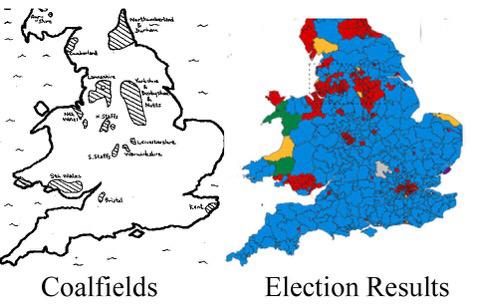
I suspect that, in their quieter moments, many Labour people understand the Party's problem. They can pick up the map and look at how Labour has shrunk back to what we might (a little cruelly) call 'Rust Belt England'. One image doing the rounds compares Labour's seats to an old map of England and Wales' coalfields - an image used to suggest, rather daftly, that somehow all the Party has left is the eternally loyal miners. The real picture is very different because that old working class isn't the main source of Labour's votes any more.

We know, for example, that most members of Unite (the union) probably didn't vote Labour last Thursday and I'd speculate that those Unite members working in the private sector overwhelmingly rejected Labour's message. You'll remember during the campaign that Ed Miliband had a difficult encounter with one of these skilled workers.  We also know that perhaps as much as half of Labour's vote in England is from ethnic minorities - look at where Labour gained seats (London, Bradford, Dewsbury, Birmingham) and look at the Party's remaining handful of seats in the South (Luton, Slough, Bristol). This is as much of a problem for the Conservatives but Labour's working class vote is now increasingly a working class BME vote.

However, Labour isn't run by these people, it's run by its absolute core constituency - public sector workers. When I look across the chamber of Bradford Council, I see fewer and fewer working class faces (and those that are working class are Asian). Instead the faces I see are those of well-educated, middle-class public sector and 'third' sector workers. The very same sorts of faces we saw time and time again on Thursday waiting to hear election results. There's nothing wrong with this except that it gives the Party a very skewed view of the issues and perpetuates a romantic myth of manual labour as a noble calling.

The truth is that the working class don't hew coal from the living rock, pour hot steel or bash metal into shape. We have machines that do that stuff for us these days. Today's working class answers telephone calls, serves you in shops and restaurants, processes transactions and drives delivery vans (often white ones). And there are still skilled manual trades - mostly self-employed. These people look at the Labour Party and see privileged public sector workers with higher wages and better pensions earned doing fewer hours. Labour polled just 15% amonst tradesmen.

Last week those working class people looked at Britain and decided that, however caring and compassionate Labour's message might appear, they would vote to make sure that the slow improvement in their standard of living would continue. And if this means a little more tightening of the funding screw in government then so be it - these aren't wealthy people just middling sorts with mortgages, fuel bills and taxes to pay every month. The Conservatives won because they talked directly to these people instead of creating a false bogeyman of austerity or accusing them of self-interest (and worse).

For me the most telling comment - one we will hear again and again in the next few years - was this;

Grant Shapps, the party chairman, will stand alongside Sir John Major, the former champion of the "classless society", to announce that the Tories are now determined to show they want to spread – and not defend – privilege.

Speaking at the new Conservative campaign headquarters, the Tory chairman will say: "The Conservatives are the Workers' party and we are on your side."

The problem for Labour is that this is pretty nearly true. Unless Labour reaches out to the private sector and people working in the private, stops treating profits and business as evils, and embraces its role in delivering public services it will continue to fail in meeting its mission as a party of labour.

For my party, we have returned again to our mission - the objective set for us by Disraeli all those years ago: to improve the condition of the worker. Long may it stay that way.

....

Monday, 4 May 2015

Why farmers won't be voting Labour...

****

I've commented before how without EU subsidy and the benefits system we wouldn't have much of a farming business - or at least the sort of farming business us townies like to gawp at on Countryfile. Yes there are some rich farms with million pound plus incomes but the average farm income (that's farm income not farmer income remember) isn't anything close to that.

Still Labour politicians think farmers are nasty people who want to kill badgers and chase vermin like faxes off their land - so they're fair game for policy attack. And it's right between the eyes of some of the country's lowest earners:

The thing that is far more likely to sway farmers is a new Labour policy that has received scant publicity. This is the policy to remove the agricultural exemption from business rates for farm land and buildings and, effectively to tax farms in the UK as if they were out of town shopping centres. If implemented, this policy would have the immediate effect of reducing the average farming income in Britain from £46,635 (in 2012/13) to £40,137 overnight. That is a drop of 14%. It would affect some of the poorest workers in the country who are least able to afford it.

The Labour Party is happy to celebrate townies trampling all over someone else's land without a by-your-leave, to treat the farmed countryside as if it's some sort of playground for urban public sector workers with £200 boots and £500 anoraks. And to screw over the farmer.

,,,

Campaign hustings and the hierarchy of equalities

****

Back in 2001 I stood for parliament in the lovely constituency of Keighley and Ilkley. I didn't win but then not many Conservatives did win that year. During the course of the campaign the candidates were invited to a hustings organised by the two largest mosques in the town. This meeting, held at Victoria Hall, was segregated with women in a separate room adjacent to the main hall which was full of men - plus Anne Cryer the Labour candidate. I recall a slight discomfort at this blatant segregation but, having been involved in Bradford politics, I'd been along to many a meeting where the audience was entirely male. Added to this was a slight annoyance that Mrs Cryer could go and speak directly to the women whereas I was not permitted to do so.

I say this by way of context for talking about the Labour rally in Birmingham and about wider issues relating to campaigns in the UK's Muslim communities. In one respect the audience pictured represents progress - a decade ago it is likely that such a meeting would have had no women present (unless one or more of the candidates addressing the event was female) - but from another perspective it reveals that context is everything in political campaigns. And the context here is that Labour's success in inner city Birmingham depends, to a large extent, on the Muslim vote which means that people who would usually be quick to pounce on misogyny can wave away criticism of gender segregation because of the 'cultural' context.

Imagine what would be the response had one of those Labour candidates, instead of sitting like bored lumps on the platform, had confronted the organiser and insisted that the de facto segregation end, made the point of sitting with those women or invited men to intermingle. It may not be such an issue once the challenge is laid down - I went to the launch of a Conservative campaign in Bradford East where men and women sat intermixed (until it came to eating when they were separate again which I didn't understand).

The unconfronted truth here is that, for all the efforts of some women, too many Muslim men remain deeply uncomfortable with the reality of women's equality. I recall speech after speech from Imran Hussein, Bradford's current Council Deputy Leader, where he shouted that 'we' (by which he mean the Council leadership I guess) take equalities seriously - 'it's not just a tick box exercise' he would exclaim. Yet the truth is that, when Imran speaks of equalities, he has a hierarchy of sensitivity that has race and faith at the top and gender, disability, age and sexual preference lower down the pecking order.

This isn't because Imran is a sexist homophobe - I know him well enough to be sure he isn't - but because the realities of politics in Bradford makes some equalities issues more 'in your face' than others.

When Bradford's Corporate Scrutiny Committee looked at the Council's 'Equalities Action Plan' the most striking thing about the report was that it didn't mention LGBT issues except in the list of protected characteristics under the Equalities Act. Which isn't to say that the Council does nothing about these matters but rather that the dominant equalities issues - the priorities for our Labour politicians - relate to race and faith because this is where they are being challenged (indeed this sense of racial and religious victimhood, and especially the latter, is the absolute essence of George Galloway's pitch to voters).

None of this is to suggest that prejudice against Muslims doesn't exist - I don't know a single Muslim who hasn't experienced such attitudes - but it is to say that, if we believe sexism and homophobia to be a problem, we need to confront these too. And if such attitudes are too common in the Muslim community then it behooves politicians who position themselves as champions of equalities to challenge those prejudices - especially when they have the privilege to be from that community.

The irony here is that three of the world's biggest Muslim countries - Pakistan, Bangladesh and Indonesia - have elected women as leaders, so there is clearly no essential obstacle to female participation. I suspect it just takes a little bit of guts to tell event organisers that there won't be any segregation. This doesn't end deeply rooted sexist views about the role of men and women within a given community - we've had fifty years of women's liberation campaigns in the UK and we still see examples of cringeworthy sexism almost daily - but it does begin to question the acceptance of gender segregation and entrenched homophobia within institutions within those communities.

And the place to start for us politicians is with those things we absolutely control - our own events, meetings and campaigns.

...

Friday, 1 May 2015

Labour and the politics of hate


Aneurin Bevan the sainted father of 'Our NHS' was a bigot. A man whose politics wasn't driven by care or compassion but by hatred. This man - lauded and celebrated daily by the Labour Party - hated me, hated my father and hated my grandfather. Such is the bitter and warped nature of Labour's politics - that you can buy a t-shirt emblazoned with the message above tells you everything that is wrong about Labour. It is a Party steeped in hatred, in a loathing for others merely because of where they're from, how they talk and above all what they believe.

I have been involved in politics for nearly 40 years now and can say that, while there are one or two people who I'd be happy never to see ever again, nobody I have met is worthy of hate. Yet the Labour Party celebrated the politics of this nasty man driven to hate others by a twisted ideology. And today I watch as educated, middle-class socialists carried along by this malignant view repeat this mantra of hatred.

I do not hate the Labour Party or the men and women who are its members. I believe - deeply and profoundly - that their ideology is wrong and damaging to the interests of the working people Labour folk claim to represent. It is time for that Party to put aside the hate and recognise that people who hold to a different ideology are not uncaring, not without compassion and just as concerned for bettering the lives of ordinary people as Labour folk.

It is time for Labour to stop ascribing false motives to business people and people who support the interests of those people. It is time for Labour to stop characterising those who believe the answer to social problems is different to the left's view as spiteful, uncaring or motivated by personal greed. And it is time for Labour to stop exploiting hatred in order to attract support, feeding the monster of class hatred.

They won't of course. But I live in hope. Meantime this sort of stuff happens.

....

Sunday, 29 March 2015

Taking us for mugs - Labour, immigration and a panic about kippers


Seeing this delightful mug I thought back through all my years of active involvement in politics - from smuggling Monday Club Tory, Sir Patrick Wall into a meeting of Hull students (in his own constituency) through any number of local and national elections all of which have featured at some point the implication, nay insinuation, that saying we need to 'control' immigration is tantamount to racism. Indeed that we didn't really mean 'control immigration' but rather that this was code for something worse, something nasty and sinister, something racist. Saying we needed less immigration was always portrayed by Labour as but a short step from 'send the blacks home' or some other similarly unpleasant and bigoted policy.

That was until UKIP arrived on the scene. Up to this point Labour had stuck to its guns on immigration - pointing out that, mostly and most of the time, it's good for the nation and good for the economy. Whatever we may have thought about the issue, Labour's approach and its policy while in government was very clear - even when confronted with popular concerns about too much immigration:


It is the duty of government to deal with the issues of both asylum and immigration. But they should not be exploited by a politics that, in desperation, seeks refuge in them.

There is a position around which this country can unify; that we continue to root out abuse of the asylum system, but give a place to genuine refugees; that we ensure immigration controls are effective so that the many who come, rightly and necessarily, for our economy, to work, study or visit here can do so; but that those who stay illegally are removed; but that we never use these issues as a political weapon, an instrument of division and discord.

This view - that people come here 'rightly and necessarily' - was widely supported across the country and especially welcomed by a business community struggling for skilled recruits. In simple terms Labour was pro-immigration but against the abuse of the system. Today this has changed - the Party's position (albeit a little vague) has shifted noticeably away from 'follow the rules, play by the system, and you're welcome' towards the point where control - for which we will always read reduce the numbers - outweighs and rational discussion of migration. Labour is in a panic about kippers.

Labour got things wrong on immigration in the past. But Ed Miliband has set out a new approach: controlling immigration and controlling its impacts on local communities. Britain needs immigration rules that are tough and fair.

The Tories have let people down on immigration. David Cameron promised to get immigration down to the tens of thousands, “no ifs, no buts”, but net migration is rising, not falling. It’s now at 260,000, higher than it was when David Cameron walked into Number Ten, and the Tories’ target is in tatters.

The position here is rather different - it is the Conservatives that have failed because of those (rather dumb) net migration targets and Labour will, by implication, stop the tide. But the real drive in the Labour Party for this dramatic shift in immigration policy hasn't been some sort of Damascene conversion - or maybe just a cynical one - but rather the threat perceived in some Labour heartlands from UKIP.

Ukip are not about to overturn dozens of Labour’s northern heartlands. But the result in Heywood is further evidence of the threat that Ukip poses Labour. It is one rooted in much more than the charisma of Mr Farage, but the disconnect between Labour (and all main parties) and the working-class. In 1979, there were 98 manual workers and 21 people who worked primarily in politics in Parliament. In 2010, 25 manual workers were elected to Westminster - and 90 people who had worked primarily in politics before becoming an MP. Average turnout was just 58 per cent in Labour’s 100 safest seats in 2010.

I say the threat is perceived because I see little prospect of UKIP winning any seats - they've an outside chance in Grimsby but it's a long shot - from Labour in May. But Labour activists feel the challenge - the local councillors in Bradford who saw their majorities in safe seats dwindle to a handful, the activists who get berated by ex-Labour UKIP supporters at the working man's club or the trade unionists reporting how many of their manual labour members are making UKIP sort of noises at work.

Last year in Rotherham UKIP won 10 seats in that classic Labour rotten borough of Rotherham. We know the reasons but we overlook the wider reality - across those rotten boroughs like Barnsley, Wakefield and Doncaster UKIP moved into second place and became the main challenger to Labour. And the traditional response to the "far right" (as Labour folk insist on calling nationalists) didn't work. People didn't think UKIP were racist - or at least no more racist than the Tories - and did think they had a point about immigrants, about political correctness and about local community.

The Labour people in these places had never been challenged. Or rather the challenge came from that nice bloke who owns a garage and always stands for the Conservatives. Now Labour felt threatened - branch meetings were dominated by people talking about what UKIP were doing. The poor quality (if shiny) leaflets from that party were give to councillors by folk with slightly shaking hands - "look, look - what are we going to do" exclaims the leaflet-finder. The MP is involved and, while reassuring local activists, heads off to London where he meets others with the same tales.

"We have to respond" these MPs say. "We can't be caught out on immigration. UKIP can win where the Tories never could". Party strategists (knowing full well that there's little or no chance of UKIP winning and that it's the Tories and SNP that Labour should worry about) sooth fretful MPs and dutifully inform higher-ups about their concerns. With the result that proper working-class policies are developed about 'controlling immigration' - local campaigners can point to the policy and persuade those disgruntled folk in Rawmarsh or Royton that they're best sticking with Labour.

Plus a mug. A mug that means people like me can point to Labour and say "you bunch of no good, low down hypocrites - after all those years of attacking Conservatives for wanting to control immigration, you come up with a policy important enough for you to emblazon it on a mug."

Or as someone called it - the racist mug.

The odd thing is that Labour know the numbers. They know they're not threatened by UKIP - indeed that in some places that Party's support holding up increases the chances of Labour winning. But because lots of ill-informed and panicky local councillors and activists are on about it, the Party has placed immigration controls at the heart of its election campaign. And of course on that mug.

....

Wednesday, 25 February 2015

You'd have thought a prospective MP would have through about this before applying?

****

"I am the mother of two children and, despite my best efforts to make arrangements to bring them to Bradford for the next 70 days, particularly as one of them is doing her GCSEs, this would have caused massive disruption at a critical time.

"I would not be able to do justice to the members of Bradford West CLP [constituency Labour Party] and the people of Bradford."

If this is the reason for withdrawing then that's fine. But - if moving up to Bradford was so disruptive to her family - why did Amina Ali apply for the job in the first place?

...

Monday, 26 January 2015

“A book is a loaded gun.” So ban them or burn them.


One of the first targets of Adolf Hitler and his Nazi organization were books. This began in 1933, shortly after Hitler seized power in Germany. He ordered leaders of the regime to confiscate and destroy any literature deemed subversive to the National Socialist agenda. The elimination of these documents was carried out in a ceremonial fashion. Public book burnings were held for all the citizens to view. These demonstrations were held in both Germany and Austria. All works authored by Jewish, communist, pacifist, socialist, anarchist and classic liberals were fair game.

It does seem that we have learnt nothing. Here - in the latest example of Labour's selective memory about free speech - is a proposal to ban Hitler's turgid racist tome, Mein Kampf:

“Of course Amazon – and indeed any other bookseller – is doing nothing wrong in selling the book. However, I think that there is a compelling case for a national debate on whether there should be limits on the freedom of expression,” writes Docherty to Javid.

Of course Docherty is very careful to tiptoe around making a specific proposal to ban Mein Kampf but the very fact that he can countenance such a ban (or a limited ban where only a few specially licensed academics can view Adolf's incoherent racist ramblings) reveals just how much of a problem the left has with the idea of free speech.

The question for Docherty is where the line is drawn. Do we draw it, as he suggests around the idea of 'hatred' and if so what do we mean by hatred? Do we consider the consequences of a given writing - in which case Das Kapital is just as much a candidate for Docherty's Ban with its fomenting hatred of enterprise, initiative and free choice. And what are we do do about religious books like the Koran or Bible with their incitement to kill infidels, execute gays, stone adulterers and slice chunks off burglars? Do we ban them too?

What should worry us most isn't merely the fact of a Labour MP calling for books to be banned but the concluding rational that Docherty puts up:

Docherty said that the reality today is that if “someone puts the contents of Mein Kampf on to a blog, the police would knock on their door …

This is maybe true. And if it is, it is a damning observation of our supposedly free society. It scares me just how close we are to banning books simply because they promote ideas we find discomforting, disturbing or contrary to the current 'truth' and 'wisdom'. We need books - all of them, good and bad:

“There was always a minority afraid of something, and a great majority afraid of the dark, afraid of the future, afraid of the past, afraid of the present, afraid of themselves and shadows of themselves” 

So wrote Ray Bradbury in his passionate defence of the book, Fahrenheit 451. Docherty and the other banners or burners are scared, fearful the good men will be corrupted by words on the page. That we won't see through to the evil or some ideas - whether from Trotsky or Hitler, Guevara or Goebbels. Docherty and all the anti-free speech left are wrong. We are stronger, better and more decent than that - and we deserve the right to know evil for what it is.

....