Showing posts with label idiots. Show all posts

Friday, 8 February 2019

Yes. People really are this stupid...


In the Guardian obviously:
I don’t know whether the left has been sleeping, but there has been a dominant narrative that has remained quite unchallenged in the media. This narrative suggests that there is no connection between the super-rich and abject poverty, that you can keep getting richer and richer, and this has nothing to do with people getting poorer. And it wasn’t always like that, people in the past have known that maximising at the top means you are depriving somebody else further down.
Now Karl Marx got a lot of things right but the lump of labour idea wasn't one of them. The painful truth for these numpties is that the "super-rich", by creating new wealth ake everyone better off - Facebook and Google and Amazon may seem trivial things but they have provided enormous additional value to the lives of people across the world. And something like 2-3% of that additional value goes to the people who created those firms. The thing is that 2-3% of trillions of dollars is an awful lot of money.

For a non-stupid commentary on the "abolish billionaires" rubbish read this...

....

Tuesday, 3 October 2017

The Great Left Wing Intellectual Debate: A Guide


I read this article. I'd share it with you but I can't find it. Thing is it said that the level of intellectual debate on "the right" (whatever that may actually mean because it beats me how people can find anything in common between me and the frothing loon who runs Prison Planet - yet apparently we're both right wing) is pretty poor. And that the left is - as it has always claimed - filled with beautiful, intelligent people engaged in fascinating policy debates.

I will summarise these left wing debates for you (so you don't have to hurt your eyes looking at the shining ones):

"Neoliberalism. Tories. Bad."

"Yes. Bad. Poor people. Food banks. Neoliberalism."

"Absolutely! Scum. Neoliberalism. Corbyn. Young People. Rally."

"Socialism." (Everyone breaks off to shout and sing "Oh Jeremy Corbyn")

"Nationalise. Magic Money Tree - ha ha ha! Young people. Poverty. Food banks. Neoliberalism."

"Tory scum. Brexit. Young people. Council houses. Neoliberalism."

"Boris Johnson. Buffoon - ha ha ha! Racism. Theresa May. Tory scum. Neoliberalism."

"Thatcher. The miners" (Everyone breaks off to sing chorus of "The Witch is Dead")

"Big bosses. Poverty. Neoliberalism. Brexit."

"Universal Basic Income." (Everyone oohs and ahs - then sings new song "Free Stuff, Freee Stuff. Free Stuff for Young People")

"WASPIs?" (Free stuff for them too - new verse added to Free Stuff song)

"Neoliberalism. Tories. Bad." (Repeat ad nauseum).

....

Tuesday, 8 November 2016

How would Satan vote?


The one thing that has struck me most forcibly about the Donald Trump campaign is the extent to which it is a coalition of conspiracy theorists. From 2011 "truthers" and Obama "birthers" the entire campaign has been littered with sinister accusations, allegations and suggestions of dark conspiracy on behalf of The Donald's opponents. This evening, reading the torrent of Tweets about the US election there's a steady trickle of "the voting machines are fixed" suggestions from Trump's supporters - the US equivalent of "use a pen".

From among this seething pit of madness it's hard to plump for just one conspiracy about Hillary Clinton, Democrats or the election that sums up the depressing ignorance of Trump's campaign. Until that is, the "Clinton is a Satanist" line arrived. This didn't so much as jump the shark as do a double back somersault over a vast tank of piranha. But here it is at Trump's Conspiracy Theorist-in-Chief's Infowars blog:

Hillary Clinton’s ties to satanic rituals and the occult have been well-documented for decades.

Clinton insider Larry Nichols told Infowars that Hillary Clinton used to attend a “witch’s church” in Los Angeles during Bill’s presidency.

And a source claimed many FBI agents consider Clinton to be “the Antichrist personified.”

And Alex Jones (the conspiracy mane who runs Infowars) goes on to provide link after link, video after video each one madder than the previous and all purporting to 'prove' Hillary is a Satanist (which she isn't - I bet she's never even rolled a 20-sided dice). The source of all this stupidity is a particularly odd artist called Marina Abramović who is the modern performance art equivalent of a 'shock-jock':
Her work explores the relationship between performer and audience, the limits of the body, and the possibilities of the mind. Active for over three decades, Abramović has been described as the "grandmother of performance art." She pioneered a new notion of identity by bringing in the participation of observers, focusing on "confronting pain, blood, and physical limits of the body."
It's an acquired taste (as anyone who has seen her cake would know) but Abramović is a recognised - even acclaimed artist. The hoo-hah here results from an email (it would be an email, wouldn't it) inviting John Podesta to a showing of 'Spirit Cooking':
“Spirit Cooking” is an Abramović piece supposedly inspired by famous Satanist Aleister Crowley’s occultist rituals. It involves the artist painting the walls with menstrual blood, breast milk, and other bodily fluids.
It may not be all that wholesome but it's just art (and John Podesta's bother Tony is a big time art dealer and collector) with as much connection to Satanism and Black Magic as that 20-sided dice I mentioned earlier. Yet Alex Jones and other Donald Trump enthusiasts lap this up - indeed a depressingly large number seem even to believe Hillary Clinton is some sort of Satanist witch literally hell-bent on destroying the city on the hill that is America.

There's only one word for all this - bonkers.

.....  

Monday, 4 April 2016

The Tale of Peter Who Thought Things Weren't Made In Britain

****

The alarm rings and our economic nationalist awakes - we'll call him Peter. Rising from slumbering in his Silentnight bed (made in Barnoldswick in that bit of Lancashire that used to be Yorkshire), Peter stumbles across the room to the shower to conduct his morning ablutions.

Peter's a traditional sort of chap and likes good old-fashioned soap - Imperial Leather (made by Cussons in Manchester). It's the day of the week for hair washing and Peter lathers up with Head & Shoulders (from those nice Proctor & Gamble folk in Newcastle) and then shaves with products developed in Reading for Gillette.

His ablutions complete, Peter dresses in clothes nicely washed and pressed by his attentive wife. She uses an Ebac machine (made in Newton Aycliffe up in County Durham) and the washing powder is made by Unilever in the delightfully named Port Sunlight on Merseyside (as is the conditioner that makes everything soft and pleasantly odoured).

Coming downstairs Peter smiles as he ponders today's incisive commentary - a paen to a lost past of British manufacturing. But first it's breakfast - coffee (from Kenco at Banbury in Oxfordshire) with milk and sugar (from British Sugar's plant in Bury St Edmunds), a bowl of cornflakes (made by Kellogg's at Trafford Park) all followed by toast (Warburton's bread from Bolton) with butter (Country Life fresh from Nuneaton) and Baxter's jam (made by the eponymous family business in Moray).

Before leaving the house, Peter sits in the living room (on a sofa made by DFS in Leeds) and flicks through the papers, tutting all the while at the demise of Great Britain as a manufacturing nation. Slipping on his Church's brogues (from Northampton of course) he walks down the garden path and gets into his shiny Jaguar (made at Castle Bromwich in the lovely city of Birmingham) to drive into town.

Arriving at his desk, Peter nurses another coffee (from Nescafe's UK factory at Tutbury in Derbyshire) and gazes out the window (a PVC unit made for Everest in Sittingborne, Kent) trying to get the right combination of words for a corruscating and telling article about how Tory government means Britain no longer makes anything. Peter breaks off for a couple of meetings across the corridor in the big room. There are biscuits (made by United Biscuits up in Carlisle) and more coffee (Nescafe again from Derbyshire) which is served on the fine table (made by Hands in High Wycombe).

Peter returns to his desk - he knows the words he'll use now:

How I miss the old names of trusted brands, and the knowledge that these things had been made for generations by my fellow countrymen.

It is a terrible thing indeed that Britain no longer makes anything except for sale in "absurdly expensive luxury shops".

....

Friday, 11 March 2016

This is it? Seriously? Devolution should be about a whole lot more than buses and new taxes

****

Some chap from IPPR North has bunged his challenge to 'metro mayors', you know the powerful folk who'll be elected once all these devolution deals are done. And Luke tells us these mayors should "shake up" their cities.

So what exactly does this shaking up involve for our Luke? Well firstly there's buses - yes folks, buses:

Mayors could connect their more deprived citizens with the jobs they need with new bus routes;

That's right, this IPPR chap puts creating new bus routes (something that existing public transport authorities can already do) as a great win for our new elected mega-mayors.

Next Luke says mayors can raise lots of new taxes - that's right, the economic underperformance of Manchester, Newcastle, Leeds and Bradford is because the citizens of those cities don't pay enough tax;

To do so they will need to invest, and that means raising revenue from the right sources. Each city is different and will require a different approach. But the candidates should first look at the powers they're already set to have: workplace parking levies, congestion charges and the 2p business rate premium.

But central government should enable them to go further. Whitehall should make implementing these charges far easier, and lift the cap on the business rate premium. It should allow mayors to spend this money on whatever mix of transport investments their city needs.

Forgive me for being completely underwhelmed here and frankly a bit concerned that, given all the things that could be done, this clever bloke can only come up with more buses and more taxes.

....

Saturday, 12 September 2015

The Labour Party may be dead. All the noise and flag-waving means we haven't yet noticed.


The Labour Party


Part of me wants to crack open the champagne, let off party poppers and party the night away - after all I'm a Conservative. The rest is just a little more circumspect. The Labour Party - one of Britain's two great parties - has taken collective leave of its senses and set itself on the path to oblivion. And so long as it proceeds zombie-like to lurch across the land there's no room for a sensible, intelligent left-of-centre opposition to the current Conservative majority government.

Perhaps I'm wrong about this. Maybe Jeremy Corbyn will show himself to be a pragmatic, responsive politician able to bridge the gap between the worried public sector workers and students who've elected him and the bedrock of labour support. But Corbyn's record over a lifetime of political activism doesn't indicate that this is very likely. We're going to get opposition based solely on the politics of protest and the championing of the Left's unique sense of moral entitlement.

Corbyn is the man who signed a motion that said this:

"Humans represent the most obscene, perverted, cruel, uncivilised and lethal species ever to inhabit the planet and [we look] forward to the day when the inevitable asteroid slams into the earth and wipes them out, thus giving nature the opportunity to start again"

More than the fraternising with terrorists and murders, more than the knee-jerk anti-Americanism, more than the hugging of communist dictators in attractive and warm South American countries this little quote sums us the utter childishness of Corbyn's politics. For this man it's not a serious business of try to manage a complex system of government so as to better the lives of ordinary folk, rather its a long march to an infantile socialist paradise. And we know the cost of these marches - they take us tramping to penury and oppression than striding, as if in some Soviet poster, into a future of freedom and wealth.

Strong opposition isn't about taking to the streets. It's not about direct action or strikes or signing endless petitions calling for something or other to happen or not happen. Strong opposition isn't about unyielding adherence to a line even when it's clear that line means nothing and does nothing to get closer to government. Good opposition is about holding the government to account - debating and questioning its policies, amending and adapting its bills, and above all setting out a credible and believable agenda for government.

However much I try, I can see none of this good opposition in Jeremy Corbyn. All we see is posture, flag-waving, an echo chamber of left-wing indulgence, and the complete refusal to engage even slightly with the concerns of the British public. This may seem like a revolution to starry-eyed students and like revenge to a bunch of old trots and useful idiots but it's actually a stake rammed through the heart of the Labour Party.

And for all my smiles at the prospect of another ten years of Tory government, I can't help but feel sorry for those good people on the centre-left of British politics who've seen their Party taken away from them by the very forces of reaction that tried to destroy it thirty years ago. As a very good friend posted:

I am taking a break from Facebook. After 34 years as an active labour member and 36 years as a labour supporter and voter I can't watch an old friend commit political suicide.

....

Monday, 27 April 2015

In Praise of Idiots Redux


Michael White, that most Guardianista of Guardianistas, has had a pop at the electorate:

But millions more, not just the poor and demoralised, will forget, shrug or even boast “I never vote” before turning back to something that seems more important: football, golf, Spotify, Britain’s Got Talent. They don’t bother to engage, let alone to make the connections between what happens to them and the difficult policy choices that bring it about, good or bad.

This, in the intense minority sport of being a Guardian reader is a terrible sin. Only topped by thinking The Sun is a rather better written newspaper and certainly a better read. The electorate shouldn't be going about their lives as normal (or as normal as us politicians allow them to live). No those electors should be "engaged".

I beg to differ. Indeed back in 2009 I wrote this piece in praise of idiots (the word deriving from those ancient Athenians who chose not to engage in politics):

Now the good left-wing liberals at the Guardian think this grumpiness, this disengagement, this disinterest is a problem. And that’s where I disagree – the core consideration is the extent to which we are able to live as Greek idiots. Quietly, privately, without bothering our neighbours with our problems – and when such people want change they will get up from their armchairs, walk away from the telly and vote. The idea that not being bothered with voting most of the time makes them bad people is a misplaced idea – they are the good folk.

Above all we should listen quietly to what this “apathy” calls for – it is less bothersome, less interfering, less hectoring and more effective government. Such people want government to be conducted at their level not to be the province of pompous politicians with overblown and lying rhetoric. And they want the language of common sense, freedom, liberty and choice to push away the elitist exclusivity of modern bureaucratic government.

Above all today’s idiots want to be left alone to live their lives as they choose. For me that’s the essence of politics – I praise these idiots and applaud their apathy. 

And yes, I do think people should vote. Yes I think people should take the trouble to understand what's being offered to them by politicians. But I also think this obsession with 'engagement' and 'participation' is misplaced - if people want to be engaged they will get out from those armchairs. A year or so before I wrote that piece, over 400 residents of Denholme had crammed themselves into the Blue Room of the Mechanics Institute. They did this because something was happening that mattered to them - Bradford Council working with developers was planning to dump the city's rubbish in a hole just outside the village. They didn't want this to happen (and it didn't).

The wealthier we get - collectively and individually - the less important politics becomes and the more important it is that politicians are humble enough to recognise this fact. When we consider something to be fundamental or existential then we are engaged - look at the turnouts in the Scottish referendum last year. But even though this current election is unusual and hard to call (as the pundits put it), the result will be a government. And that government will change some things and tinker with other things but for most people the worst outcome will be mild irritation. There'll still be a school down the road, a hospital in the city and policemen driving around. Buses and trains will still run. The supermarket will still be open.

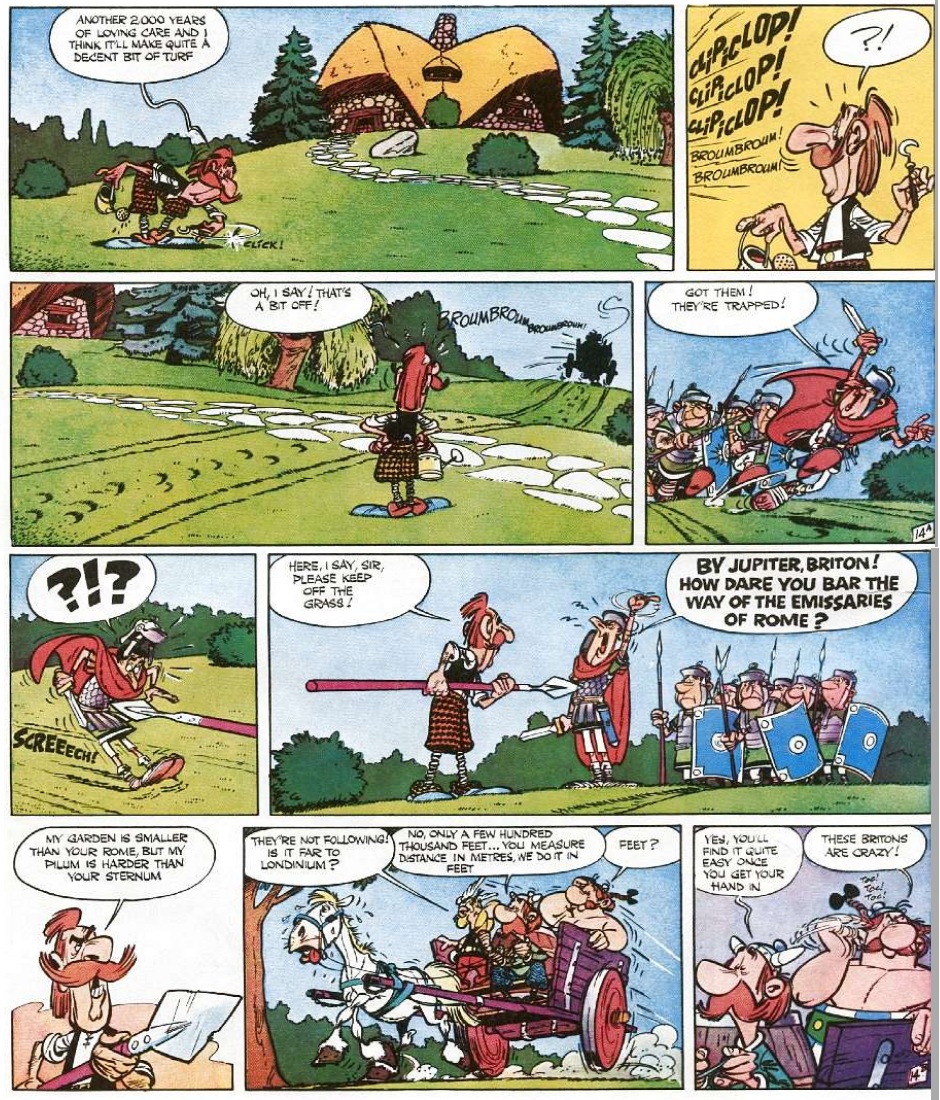
There's an image in Asterix in Britain of an Ancient Briton stood on his (prized) lawn with a spear pointed at the Roman soldier. "My garden is smaller than your Rome but my pilum is harder than your sternum" says the Briton as the soldier orders him out of the way. Until that tipping point is reached, people - in the tradition of those Greek idiots - will look to family, friends, colleagues and neighbours long before they consider politicians and the antics we get up to.

Here's to those idiots. And Down with The Guardian.

....

Thursday, 20 February 2014

On blocking access...a slight rant

****

I sent an email entitled "a slight rant". It went like this:

Hi,

Corporate Overview & Scrutiny are running a review of drugs and alcohol work in the district. The Council spends some £12 million every year on this work with similar amounts spent by health services. That's a lot of money and some important services.
 
However, if I want to do a little research into drugs policy - look at the case for deregulation or at some of the work being done by charities and health services maybe...
 
...I can't because the Council blocks just about every site and I'm not going to keep sending requests to the 'infosec' address.
 
I'm a grown up. I am not about to start up a drugs peddling site nor am I about to use council IT to make or promote the illegal purchase of drugs. The presence of drugs references - or alcohol or smoking, for that matter - on my screen is not about to turn me into some sort of crack-addled speed freak.
 
What exactly are we doing? Who exactly are we protecting? And how am I to do my job?
 
Many thanks
 
Simon

Nothing to add to this but am I alone in finding this stuff utterly maddening.

....

Monday, 10 February 2014

In which I angrily disassociate myself from most Tory MPs

"It's for the children" they cry and reel out carefully pre-packaged statistics showing how millions of kids are killed, maimed, left with brain damage and generally corrupted by their mum or dad having the occasional gasper whilst fighting the traffic on the school run. So-called facts are wheeled out about how smoke inside a car is so very much more damaging than any other sort of smoke resulting in ugly, pasty-faced children who fail all their maths exams.

And MPs clamber onto a bandwagon constructed from these lies - I guess if enough lie tissue is laid down it results in a solid structure ideal for politicians to demonstrate how much they care about "the children". These self-serving MPs then pontificate, nay compete, about how much they care, about how "the time is right" despite knowing the law is virtually unenforceable and utterly pointless. Indeed one such idiot MP - the public health minister no less - even said that it doesn't matter that the law can't be enforced.

This is bonkers. A sort of post-modern demon has captured the minds of our MPs and twisted them to believe that passing unenforceable, divisive and ugly laws is somehow a good thing - "for the children". These bizarre human beings, trapped in the glamour of a local paper headline, argue that banning smoking in cars will somehow change behaviour and that will be all fine and hunky-dory.

What we'll actually see is that nice middle-class mums and dads won't smoke in their cars (mostly because very few of them actually smoke) whereas the same people who use mobiles phones on the move, don't make sure their kids wear seatbelts (or indeed wear on themselves) and have been known to drive along with a five-year old on their lap - these people will carry right on smoking.

The people who voted for this have voted to open a new avenue for health fascism. It will be only a short time before social housing landlords are urged to ban smoking in their homes. And when they don't a law will be passed banning such smoking - housing officers will become like sniffer dogs hounding ordinary folk to the edge of despair for the terrible crime of having a fag while watching the late night movie on a Friday night.

And then we'll get the ban on smoking in houses - any houses - with children. Granting the health fascists right to smash into your privacy - "for the children".

There is no defence, no justification, no sense to this proposal yet nearly 400 of our MPs cheerfully voted for the amendment. And they did so knowing they could brag about how much they care - "for the children" you know, "for the children".

....


Thursday, 30 January 2014

Why the default political action should be to do nothing...

****

“Don’t let us forget that the causes of human actions are usually immeasurably more complex and varied than our subsequent explanations of them.”

Dostoevsky (from The Idiot)

One of my very earliest pieces on this blog was to write in praise of idiots, to explain and celebrate the growth of apathy:

Above all we should listen quietly to what this “apathy” calls for – it is less bothersome, less interfering, less hectoring and more effective government. Such people want government to be conducted at their level not to be the province of pompous politicians with overblown and lying rhetoric. And they want the language of common sense, freedom, liberty and choice to push away the elitist exclusivity of modern bureaucratic government.

The point I was trying to make was that these people were quietly getting on with their lives and the actions of politicians and bureaucrats served mostly to impede that quietly getting along. And that it is wrong to tell such folk that somehow they are bad citizens for not bothering to attend the village hall on voting day.

The thing with politics today - or rather our dominant political ideology - is that it believes there are always things that government can do to "fix" the problems of society. There is a belief - bordering on hubris - that if only the right levers are pulled, the right taxes levied, the proper regulations in place and the appropriate leadership employed, if only these things are done then everything will suddenly be better.

The problem is that we really haven't the first idea what we're doing. I listened today to a public health person telling us that inequality creates inequality - it took him longer to say it but this was the gist of his philosophising. There was no logic to this man's argument (although it contained enough buzzwords to get the audience nodding and making little grunts of assent) but it referenced the greatest societal sin of modern thinking - inequality.

The problem is that there isn't any consistent or robust evidence saying that inequality is the problem let alone ways of solving the "problem" of inequality that don't involve throwing the baby out with the bath water. To help us understand this, here's Michael Huemer from the University of Colorado:

Voters, activists, and political leaders of the present day are in the position of medieval doctors. They hold simple, prescientific theories about the workings of society and the causes of social problems, from which they derive a variety of remedies – almost all of which prove either ineffectual or harmful. Society is a complex mechanism whose repair, if possible at all, would require a precise and detailed understanding of a kind that no one today possesses. Unsatisfying as it may seem, the wisest course for political agents is often simply to stop trying to solve society’s problems.

Except, of course, that every day one or other (often self-interested or self-serving) agitator pops up on the radio, TV or in the newspapers explaining, usually with carefully selected facts and figures, that this is terrible and that something must be done. The relevant minister, QUANGO boss or council leader is dragged blinking into the studio to explain just why they hadn't done something and when they plan on doing that particular something.

The problem is that - as Huemer describes - the experts prescribing the 'somethings' that must be done really aren't very good:

Unfortunately, when it comes to descriptive social theory, even the experts’ knowledge is unimpressive, as demonstrated recently by the social psychologist Phillip Tetlock. Tetlock conducted a fifteen-year study in which he collected tens of thousands of predictions from hundreds of political experts concerning matters within their areas of expertise (for example, would the economy slide into recession, would the Soviet Union survive, who would win the next Presidential election, and so on). Tetlock’s finding, in brief, was that the best experts did only slightly better than chance at predicting outcomes. When asked to assign probabilities to their predictions, experts proved systematically overconfident; for example, events predicted with 100% confidence happened less than 80% of the time.

So when the latest policy wonk (from right, left or centre, it doesn't matter) sounds off on the Today programme or pontificates on Newsnight bear this failure in mind, head for your kitchen cupboard and take an appropriate (not too much because those 'experts' say it's bad for you) amount of salt with the wonk's opinion.

So what should we be doing if there isn't some sort of social scientific unified theory of everything? The answer is perhaps two-fold:

1. A great deal less than we do at present - as my idiots know, people just getting on with their lives and not interfering too much in the lives of others is as good a solution as any other.

2. Simpler, more understandable things done locally - those same idiots also want to understand things and the best way to do this is for those things to be discussed in a manner they understand and at a scale they appreciate.

This approach may be a little bit untidy. It may lead to folk popping up on radio, telly and in the papers talking about "postcode lotteries" or "place inequalities" but it has the merit of allowing nearly everyone the chance to be involved. Just as importantly that essential principle - "if it ain't broke, don't fix it" - applies. And most of society's problems are more a consequence of us trying to fix things than of things needing to be fixed.

In the end our default political action should be to do nothing. Sadly the imperative of today's politics demands that this default political action is something. The result is failure and misery not a better society.

....

Sunday, 21 July 2013

Is anyone paying attention....

****

Over the years I've remarked often that most people, most of the time, simply aren't remotely interested in politics. More to the point those people not only aren't interested, they aren't paying attention. Yes we can grab their attention by putting a big headline in front of their eyes - to which they'll respond with an "oh yes, terrible" sort of remark and then return to chatting about the football or the latest celebrity divorce. Or more likely, what their children are doing at school and the latest gossip about colleagues at work.

It may pain us political types but all that effort to 'dominate the media narrative' or other such tommy-rot of the spinners world is just that, tommy-rot. People aren't paying attention. Here's Populus' weekly poll that asks people what stories they've noticed:

Only the NHS story among these is relevant to UK politics and just 8% 'noticed'. People really aren't paying attention to the news (even where they're watching the news programmes, I suspect this flitters through people's lives like background noise).

Now some of the politically-obsessed will now be heard muttering about 'apathy' and 'engagement', even 'participation'. These anoraks miss the point - the point is that wealth and comfort makes politics less and less relevant to people. And this is a good thing, it represents a little more withering away of government - another step towards us not actually needing government at all.

Now I appreciate that, right now, we have the most intrusive government since we decided that the king wasn't a god and didn't own all the stuff as of right. But this covers over the fact that most people's connection with government comes through one or all of health, education, welfare or having the bin emptied. And so long as they're not actively annoyed or upset by one of these, they have few problems with government.

The shift here is from government being something that is actively done to us to us being consumers of government. It really doesn't matter whether we pay directly or through taxes, we perceive ourselves as customers rather than subjects. And the debate around politics is about us exercising our consumption role rather than choosing someone to "run the country". Elections are the point at which we can choose different strategies for managing those services - it may not be the best way to do this but it's the way, for now, we've chosen. So when the Conservatives were rambling on about financial sovereignty and other such grand matters, Tony Blair talked about 'schools and hospitals' and won the election.

For me the importance of this change from subject to customer is that it suggests that government is not necessary - at least not on its current scale - to the delivery of what we currently (and wrongly) see as 'public goods'. There is a reducing need for us to provide, for example, healthcare or education through the medium of government, it is a choice that we make because it seems to us better, fairer or more effective.

The big winners in this sort of politics are those who - as Blair did - focus on what, when I was a student activist, called "soft loo-paper politics". Rather than endeavouring to change the world (or even Hull University) the successful political leader focuses on getting better services - health, education, filling in potholes. And the politician - the MP or councillor - bends his efforts to dealing with these issues, to be someone who badgers away at the minutiae of constituency problems. The old sort of MP - a grand fella who lives grandly in London and descends on the constituency for the AGM, the annual dinner and a couple of (reluctant) weeks at election time - no longer fits the bill however valuable the contribution of those men might have been.

A good few years ago I wrote in praise of 'idiots'  - those people who didn't engage, weren't involved and only (at best) reluctantly turned out to cast a vote in elections:

Round here they’re probably in their thirties or forties, employed at a middle management level in business and industry. They worry about how well their kids do at school, they concern themselves with making their family safe, they grumble a bit about paying taxes but have enough cash afterwards for it not to really matter. Such folk are ordinary, hard-working and inherently conservative. But they also see little or no link between the act of voting in a politician from one party or another and the significant things in their lives.

Or to put it another way, these people aren't paying attention. And isn't that wonderful, cheering and independent!

....

Wednesday, 5 June 2013

Robots are great and we need more of them to make stuff for us...

****

I get ever more irritated by the bonkers notion that technological advance and improvement is a bad thing for the economy. You see it churned out all over, mostly (but not always) by the good thinking Guardian left. These folk just don't get it:

It's about technology taking jobs, about what it can and can't provide. Hoskyns quotes Jaron Lanier's new book Who Owns The Future?, in which he argues: "Capitalism only works if there are enough successful people to be customers." Lanier, a computer scientist and a musician, is rightly called a visionary because he sees what is happening, when everything is live-streamed but no one knows the name of the person who made the music any more. Content is free.

This is just plain daft. Free is good. We like free - not only is it a magic word but, more to the point, it's an improvement on 'costs so much only people such as Guardian journalists can afford it'. Now in one respect, Lanier is right but his emphasis is still on production rather than consumption. We aren't here to produce stuff, we're here to consume stuff - even if we love our fabulous creative industries job, that's consumption (we're eating up the pleasure).

So yes robots and digital wizardry will "destroy jobs" (this translates as 'makes things a whole lot cheaper because you don't have to pay wages') but all the while new playthings are being invented - think how many people are scraping an adequate living from creating stuff to make use of that digital wizardry, for example. And, so long as the idiot protectionist lefties don't get to control things, stuff gets cheaper so we don't have to work as hard as we do now to get the good stuff. Brilliant!

So no, it's simply not the case and never has been the case, that technical innovation is bad for the economy. Protectionism, subsidised overmanning and the refusal to embrace technology - that was what caused China's 500 year stagnation. And if we adopt the same approach, we will stagnate, there really won't be the jobs we need and future Suzanne Moore types really will be scraping by in some rat-plagued garret.

So let's grab that technology, let's get it working for us, let's shove aside the barriers - unions, business oligopolies, MPs and silly Guardian writers - and get the robots working. We'll all be richer, less frazzled by work and more able to have a bloody great time with the few years we get living on this wonderful planet.

.....

Sunday, 14 August 2011

Educating future lawyers...

****

Let me introduce you to Dr Ian Grigg-Spall:

Dr. Ian Grigg-Spall is Director of Studies of all undergraduate law courses at the University of Kent, and solicitor of the Senior Courts of England and Wales. He also acts as the liaison officer with the English Law Society and Bar. He taught previously at the University of Cambridge, and at the Boalt Hall School of Law, Berkeley, California.

And - courtesy of Samizdata:

The Left needs to defend the riots; not to valourise the burning of grannies’ cars, but to make clear that we reject the whole bourgeois construction of events, that we stand in solidarity with the oppressed and that, when it comes to it, we will, without hesitation, join the “rioters” to overthrow the legitimised exploitation, state-sanctioned violence and sham “democracy” that oppress us all.

Hey, I might be wrong but I bet he went to public school!

...

Thursday, 4 August 2011

Why? (Now updated - with the answer)

***

Graham has an e-cigar - part of his ongoing endeavour to stop smoking. And the Assocation of Conservative Clubs have "advised" their member clubs not to allow e-cigarettes and e-cigars.

Why?

.....

Update: Having written to the ACC they provided an admirably prompt reply:

Thank you for your email.

The Club’s approach to these devices is probably based on a question and answer we placed into the ACC’s Magazine some years ago which I am including here for your information.

Q.  A Member has asked whether the new style electric cigarettes are legal to be used in the Club.  Apparently they have a small cartridge inserted which gives the impression of smoking and are actually been retailed as an aid to give up cigarettes.  I am assured there is no nicotine or toxins included in the device.

A.  I would strongly suggest that the Committee do not allow such a device to be used. I am not entering into an argument that the device is not a cigarette and is therefore not illegal, my advice is based purely on the fact that the device looks exactly like a cigarette and therefore will either give the wrong impression about the Club and may give rise to complaints being made, or it may indicate to other members or guests that the Club permits smoking and that as a result they light up a real cigarette which could create serious problems for the Club.

Whilst we appreciate the points you raise and it is for each individual Conservative Club to make a final determination on the matter our advice is not to allow these types of devices to be used inside the Club’s premises.  It is important for a clear approach to be taken regarding any type of smoking inside a Club’s premises whether it be tobacco smoking, herbal smoking or electronic cigarettes which mimic smoking.  By simply stating no smoking or smoking type devices will be permitted inside the Club the Committee are making it clear that any type of smoking is unacceptable and this avoids any debate on exactly what is permitted or not permitted under the Smoking Ban. 

Please let us know if we can be of any further assistance on this matter. 

Yours sincerely,

Charles Littlewood
Assistant to the Secretary
ACC

....

Wednesday, 25 May 2011

Economics quote of the day

****
From @MediocreDave on twitter:

Think it's deeply flawed to suggest there is objective evidence for competition providing better results.

The problem with the left is that they believe this rubbish.


....

Alcohol Concern Cymru - the most ignorant of nannying fussbuckets

****

Although BBC Wales does its best to make Alcohol Concern Cymru not seem like a bunch of idiots even they can't quite manage it with this story:

An alcohol charity claims there a "silent epidemic" of heavy drinking among elderly people in Wales

But Alcohol Concern Cymru's (AAC) report quotes statistics that have been challenged by drinks industry body The Portman Group. The group argued overall trends showed "a positive and continuing decline in the rates of excessive drinking".

Andrew Misell of AAC said there was anecdotal evidence from elderly support workers to back their claim.

All your typical row until you get to look at why AAC issued their scary press release:

The paper compares figures from Welsh Government-commissioned Health Surveys of 2003/4 and 2009 as "evidence that the proportion of older people drinking more than the recommended amount is rising".


AAC said the number of over 65s who said they had drunk more than the recommended maximum in the previous week rose from 22% (men) and 7% (women) in 2003/4 to 34% (men) and 17% (women) in 2009.

See scary - a huge increase in wrinkly boozing is evidenced from the surveys. Except that - as the BBC eventually explain:
 
However, BBC Wales understands that as a result of changes in methodology adopted by the compilers of the Welsh Health Survey in 2006 the two sets of statistics are not comparable.


Ah, there you are you see! No increase in drinking. However AAC keep wriggling:

When challenged on the paper's use of statistics Mr Misell said: "Those statistics were taken as an illustration. It's certainly the case that more work needs to be done in terms of finding out what exactly is the pattern of drinking among older people.


"The point of the paper is that it's a hidden problem. If you talk to people working with older people they will say there's quite a lot of anecdotal evidence to support the fact that alcohol is a problem."

The problem is so hidden that the statistics can't pick it up and are showing old folk drinking less rather than more. Something must be done!

....

Wednesday, 20 April 2011

Are national newspaper journalists really, really stupid?

***

Cigarette may have started M1 blaze


Look it's pretty simple, we get a huge blaze in a scrap yard that closes the M1. And it wasn't caused by someone lobbing a fag end out the window. There is not the slightest - not even a miniscule - chance of this being the case. None. Zilch. Zero.

So why do journalists on national newspapers write this bollocks?


Wednesday, 16 March 2011

"Rubbing two sticks together" - the Green Party's energy policy

****

Britain's Green Party - led by that nannying fussbucket, Caroline Lucas - have an energy policy.

1. Investment in renewable sources – sun, wind, water power and biogas – must be hugely increased. Use of fossil fuels should be massively reduced, and phased out altogether where possible.

2. An end to nuclear power. It is expensive and dangerous, risking catastrophic accidents that could damage our health, environment, and economy for generations.

3. More efficient energy use, better conservation and insulation measures, and a massive increase in recycling – with stronger incentives to switch to renewable energy and use energy more efficiently.

4. Energy should be generated, stored and distributed more locally.

5 Action to end 'fuel poverty' subsidising insulation and conservation measures to make fuel bills affordable for all.

So we have a policy that focuses on expensive, inefficient means of generating electricity - a combination of unreliable wind power, the destruction of habitats to allow wave power and Dave installing a windmill on his roof. At the same time the Greens want to end fuel poverty - presumably through some sort of rationing system since the rest of their policy can only result in higher energy costs. Assuming, of course, the we're actually able to generate all the electricity we need from windmills and compost heaps.

This policy is stupid and irresponsible, will make energy more expensive and is likely to lead to brownouts and even power cuts while we try to make generation match demand (all those electric cars you like so much, Caroline). Yet we give this idiot airtime to expound her lunacy without challenge - even to the point of conflating the deaths in Japan's terrible earthquake with the nuclear power plants at Fukushima:

"1351 is the estimated death toll so far, but there are perhaps tens of thousands people missing in Miyagi alone. Four million people have been left without electricity amid the destruction in Tokyo.

"Clearly, the nuclear incidents at Fukushima, and elsewhere in Japan since the earthquake, are collectively one of the worst in the 50-year history of the international nuclear industry."


Well certainly the incidents are serious - indeed, Ms Lucas seems more concerned about these that with the unfolding humanitarian disasters - but so far no-one has been killed, injured or made ill by the situation at Fukishima. As environmentalist James Lovelock put it in the Guardian:

"There is a monstrous myth about nuclear power. I would make a strong guess that of the tens of thousands of people killed in Japan, none of them will be from nuclear power."

He said that people were "prejudiced" against nuclear power unreasonably. "It is very safe," he said. Chernobyl, for instance, was "an idiotic mess-up that could only have occurred in the Soviet Union", and according to UN estimates had killed only about 56 people. More people are routinely killed in oil refineries and coal mines, he pointed out.

But this doesn't stop Caroline's line of "nuclear, scary, scary":

The Green MP Caroline Lucas said the Japanese accident strengthened the case against new nuclear construction. "You will never be able to completely design out human error, design failure or natural disaster," said Lucas, whose party backs energy efficiency and more renewable energy to meet Britain's energy and climate change goals.

So no fossil fuels - have to stop that "runaway global warming" - and no nuclear. It really does look like Ms Lucas and her Green Party want us to live in rude huts and rub sticks together for our energy needs!

....

Monday, 20 September 2010

We are all idiots: thoughts on democracy and representation

Since the lovely Anna Raccoon featured my ancient little piece praising idiots on her blog recently I feel inspired to a little update on the philosophy of idiocy – and its goodness. At least in part this is because a thought struck me – namely that representative democracy is looking a little old and tired these days. Or rather our Western European version of representative democracy has become rather like grandma’s stair carpet – fine at a glance but decidedly threadbare on closer examination.

In Europe (and for that matter in places like Canada, New Zealand and Australia) we choose representatives through the proxy of the party system. In most places political parties have sufficient brand equity to be able to prevent the system becoming too fragmented. And even where the nature of the electoral system encourages schism and division, the election of representatives is predicated on them being from a political party. Yet – and I really think this is very important – nearly everybody isn’t a member of a political party. Our representatives are – in effect – chosen by a tiny number of people who happen to have paid across £25 or so to their favoured party.

Which brings us to our good idiots – let me remind you:

So let’s look at our typical idiots. Round here they’re probably in their thirties or forties, employed at a middle management level in business and industry. They worry about how well their kids do at school, they concern themselves with making their family safe, they grumble a bit about paying taxes but have enough cash afterwards for it not to really matter. Such folk are ordinary, hard-working and inherently conservative. But they also see little or no link between the act of voting in a politician from one party or another and the significant things in their lives.

The final sentence here is central to the argument – the act of choosing a representative and the deeds of government are not connected. Our representatives – MPs, MEPs and Councillors – really aren’t in charge. And just to stress this point let’s remind ourselves how decisions are made:

The truth is that decisions in local government aren’t taken in the manner most ordinary people – including quite well-informed ordinary people – believe is the case. Us councillors no longer sit on various committees in numbers reflecting the political balance of the council. Eight or ten councillors make up a (usually) one-party executive – often pompously called the ‘cabinet’ – and it is here that the decisions are taken. But understand that any discussion takes places away from the scrying eyes of the public – in Bradford we had a thing called “CMT” consisting of Executive Members and the Council’s “Strategic Directors” where the real decisions were made. You must also understand that most of the decisions are made under “delegated authority” by one or other ‘strategic director’.


The particular flavour of Councillor you elect doesn’t really matter and, even if you are lucky enough to have a “cabinet” member as your representative, most of the everyday decisions that affect you aren’t made by Councillors and only get our attention when you’re upset enough to shout at us.

So what should we be doing? Can we fix representative democracy – by, for example, banning political parties – or is it all rather too late and has the sheer scale of Government got too much for any effective system of representative government to manage? Certainly, those anarcho-capitalist folk would argue that we should abolish such indulgences as elections in favour of that most efficient of choice-based systems – the free market. However, despite a degree of sympathy with this view, I am not convinced of its merit and am convinced of the need for there to be a guarantor of the rules – which you may choose to call ‘government’.

I am also convinced of the need for this guarantee of fairness (by which I mean the equal application of the rules) to be provided by citizens rather than by experts. Hence common law, juries, parish councils and elected officials (as opposed to elected representatives). And in this system there is no real need for members of a parliament who take up their role on a permanent basis – in times past we selected parliaments for a specific purpose and on a time limited basis (just as we did with judges) and can do so again.

Our current system is broken – when barely 50% of those who can vote did vote in the most tightly fought election for decades and where local by-elections are decided by less than 15% there is something wrong. And it isn’t ignorance, apathy or idleness – they’ve rumbled us. They’ve worked out that the system is ramped up to favour political apparatchiks, they’ve spotted that, however people vote, the same nannying, interfering decisions get taken and it’s dawned on them that democracy isn’t all it’s cracked up to be. And who are they? They are the good idiots the ones who, to quote George Bailey “…do most of the working and paying and living and dying in this community.”

.....

Tuesday, 25 May 2010

Idiots revisited (again)

***

A while ago I wrote in praise of idiots about those ordinary people who don’t partake of politics:

The ancient Greeks used their word for ‘private’ as a derogatory term for someone who took no part in “public affairs”. That word ἴδιος (idios) is the root for our term for a stupid person – idiot. Today – in the Greek sense – most of us are idiots and I think this represents progress rather than a problem. That barely more that a third of Bingley Rural electors took the opportunity to vote last time I stood isn’t a disaster and those people are well aware of the purpose and value of voting - which I guess is why most of them don’t bother

I also made the point that these folk don’t take part because they don’t see the point. What exactly is going to change in their lives if one patronising besuited politician is replaced by a different patronising besuited politician wearing a different badge? Now not everyone agrees with me – here’s Dick Puddlecote:

As someone who engages with many everyday working people on a daily basis, both professionally and in my spare time, THE most oft-repeated phrase I hear is "I don't do politics".

They'll all advance their thoughts about the ills of the world, though. After all, it's human nature. Van drivers, bricklayers, checkout girls, roofers, teaching assistants, spark's mates, cabbies, labourers, nursery nurses, road workers, cleaners, and the unemployed - they all have opinions. And most of them feel totally ignored.

But then again, a lot of them say they 'don't do politics'.


Dick worries that this active disengagement results in politicians directing their efforts to a more reliable (so far as turning up is concerned) group of voters – and that group of voters will not do anything for the ‘poor’. I have some sympathy with that viewpoint – why else to we subsidise opera and not the club circuit and prioritise sports like rowing and sailing ahead of boxing or rugby league?

However, this recent election – the most tightly fought, attention-grabbing, important, change-making (select your own superlative) – reinforced what I said and, in its way, Dick’s concerns as well. Despite the leaders’ debates, despite a sense that there was a chance to change something, despite wall-to-wall media coverage of Cleggmania – despite all this the turnout at the election was still lower than at every election since 1945 bar 2001 and 2005.

Thirty-five out of every hundred electors didn’t make it to the polls – were either disinterested, disengaged, uninspired or simply not bothered. And this covers up staggering levels of non-registration – people who don’t even give themselves a chance to vote at all. Here’s the Electoral Commission report on the subject:

Evidence available from electoral statistics and surveys of levels of response to the annual canvass of electors suggests that there was a decline in registration levels from the late 1990s to 2006. The same evidence base suggests that the registers have stabilised since 2006, although it is likely that the completeness of the registers has declined since the last national estimate in 2000.

In the late 1990s around 10% of people weren’t registered – the Commission say the situation is now worse. In some places up to 20% of people are not registered to vote and concerns about false registration are making local authorities tighten up registration by removing non-respondents more quickly from the register. And, not surprisingly, the three groups most likely not to register are young people (over half of 17-26 year olds are not registered), private sector tenants (49%) and immigrant groups (31%).

So if 20% aren’t registered and only 65% of the remainder bother voting the real turnout in the election was just 52% - barely half the population bothering with the most closely-fought election in 30 years. Says it all really!

....