Showing posts with label Guardian. Show all posts
Showing posts with label Guardian. Show all posts
Monday, 3 December 2018
Matthew d'Ancona is the bigot, not me
One time cameronista now born again as a righteous Guardian writer, Matthew d'Ancona has written one of those lazy journalist articles about how those people who voted to leave the EU back in 2016 are bigots and, anyway, were manipulated (one unpleasant chap on Twitter called it 'gaslighted') into that vote by a sinister elite. d'Ancona's contention is two-fold - firstly that wanting to control immigration is ipso facto bigoted and that marginal advances in economic prosperity are enough to justify the undermining of culture and community. It is the very essence of the Remainer case that economic advancement is everything and that "the most important metric was economic prosperity".
The problem, and in different guises this is repeated again and again across Europe, is that the public simply don't see it that way. Indeed, many people remain convinced (the evidence supports them poorly here) that immigration is economically damaging - they'll point to the lack of affordable homes, the waiting lists at hospitals, the over-subscribed primary schools and the persistent low pay in unskilled and semi-skilled manual jobs. It's not enough to exclaim how the NHS depend on immigrant labour or is needed for "...affordable decorators..." or "...your Tesco and Amazon deliveries arriving on time." Out there in the real world away from d'Ancona's wealthy internationalist bubble people do their own decorating and don't see a job delivering parcels as something requiring cheap imported labour but rather as a job their son, nephew or neighbour might be doing.
It is this outlook, a sort of sniffy dismissal of jobs like cleaning hospital loos, delivering parcels and mopping floors as things only foreigners can do because we're all doing much grander things, that defines d'Ancona and his fellow Guardian elite as bigots. It's one with the equally common - I call it "Naomi Kline Snobbery" - view that, while posh clever folk who support progressive causes are immune, those common sorts are manipulated by big business and advertising into the terrible "consumerist" world. And by consumption they don't mean uplifting (and over-priced) novels, avant garde theatre or lovely evenings with friends in that brilliant little restaurant just off the common. No we mean very big plastic toys, McDonalds, discounted boxes of Stella and multi-packs of own brand crisps. It means shopping at Aldi - not to ironically buy cheap wine because a review told you to - but because week-on-week the basket is cheaper.
This bigotry is the bigotry that likes minimum unit pricing for booze (it won't affect folk like d'Ancona of course just common people), vaping bans ('well it's a bit naff, isn't it') and sugar taxes ('we have to think of the children'). The argument is that people don't know any better or they're conned by "Big Booze" or "Big Sugar" or "Big Food" or it's for their own good. But in the core of this belief - and it's the same as dismissing concerns about immigration as bigotry - is the idea that the sort of working class, provincial, horny-handed people that voted to leave the EU cannot be trusted to make decisions without the guiding hand of Matthew d'Ancona and his friends - more intelligent, more worldly-wise, better informed. And, course, these Philosopher Kings won't make decisions in their own self-interest, they are above all that, they read the Guardian for heaven's sake!
Some leavers are bigots, just as some Guardian readers think about the lives of people outside the charmed circle of wealthy, London-based progressive life. But in both cases it's a minority. It seems to me - as a leaver who is largely pro-immigration, supports free trade and would just like the option, and a means, to kick the bastards running Europe out - that, far from Brexiteers being bigots, the real bigots here are those progressive, Remainer, pseudo-centrist, selfish, short-termist, judgemental, know-all people like Matthew d'Ancona.
....


Tuesday, 13 February 2018
Obesity policy - snobbery dressed up as healthcare
So, yet again, the Guardian lays into the choices of normal people:
A ban on junk food advertising before the 9pm watershed is long overdue. It should be supplemented by a ban on promotions and price cuts for “sharing” bags of chocolates, as Action on Sugar urged last month. And the sugar tax on drinks could be extended to food products, with the revenue channelled into initiatives making fruit and vegetables more affordable and attractive to consumers. The government’s failure to force change means that the rest of us will pay the price – in ill health and higher taxes – as big food rakes in the profits.I've given up pointing out that obesity hasn't risen for over a decade, that how we define obesity (BMI of 30+) has no scientific basis, or that individual ingredients - sugar, fat, salt - are not the reason why folk today are fatter than they were in the 1970s (when they ate a lot more sugar, fat and salt).
Now I'm just cross and irritated by the snobby, self-righteous people who write editorials in the Guardian, pontificate on daytime telly, and fill the minds of young doctors with utter tripe about diet and health. It really is the case that what these fussbuckets believe is that your choices - especially if you're one of McDonalds' 3.5 million daily customers in Britain - are wrong. Worse these snobby judgemental nannies want to slap on taxes, bans and enforced 'reformulation' - to take away your pleasure in food - simply because what you like doesn't match what they like (assuming they get any pleasure at all from their sad diets of spiralised vegetables, quinoa and bean sprouts).
It really is time that the vast majority of people who eat a decent diet - including sugary snacks, fizzy drinks, pizza and burgers - tell snobby Guardian writers and public health officialdom to take a hike. Obesity really isn't the number one health problem facing the UK and slapping on controls, bans and taxes that might (but probably won't) result in all of us losing a handful of pounds will not improve the overall health of the nation one iota. Most people - 95 to 97 out of 100 - are not unhealthily overweight and, if we want to do something about obesity, we need to direct the resources towards the relatively few for whom it is a serious issue. Right now we're squandering millions on a fool's errand of reducing the whole population's weight when, quite frankly, the whole population doesn't have a weight problem.
The truth, of course, is that grand public health fussbuckets have decided that, because they disapprove of the eating habits (and drinking habits for that matter) of less well off people, those people should be forced to pay more for their food. It's just snobbery dressed up as health care.
....
Monday, 27 April 2015
In Praise of Idiots Redux

Michael White, that most Guardianista of Guardianistas, has had a pop at the electorate:
But millions more, not just the poor and demoralised, will forget, shrug or even boast “I never vote” before turning back to something that seems more important: football, golf, Spotify, Britain’s Got Talent. They don’t bother to engage, let alone to make the connections between what happens to them and the difficult policy choices that bring it about, good or bad.
This, in the intense minority sport of being a Guardian reader is a terrible sin. Only topped by thinking The Sun is a rather better written newspaper and certainly a better read. The electorate shouldn't be going about their lives as normal (or as normal as us politicians allow them to live). No those electors should be "engaged".
I beg to differ. Indeed back in 2009 I wrote this piece in praise of idiots (the word deriving from those ancient Athenians who chose not to engage in politics):
Now the good left-wing liberals at the Guardian think this grumpiness, this disengagement, this disinterest is a problem. And that’s where I disagree – the core consideration is the extent to which we are able to live as Greek idiots. Quietly, privately, without bothering our neighbours with our problems – and when such people want change they will get up from their armchairs, walk away from the telly and vote. The idea that not being bothered with voting most of the time makes them bad people is a misplaced idea – they are the good folk.
Above all we should listen quietly to what this “apathy” calls for – it is less bothersome, less interfering, less hectoring and more effective government. Such people want government to be conducted at their level not to be the province of pompous politicians with overblown and lying rhetoric. And they want the language of common sense, freedom, liberty and choice to push away the elitist exclusivity of modern bureaucratic government.
Above all today’s idiots want to be left alone to live their lives as they choose. For me that’s the essence of politics – I praise these idiots and applaud their apathy.
And yes, I do think people should vote. Yes I think people should take the trouble to understand what's being offered to them by politicians. But I also think this obsession with 'engagement' and 'participation' is misplaced - if people want to be engaged they will get out from those armchairs. A year or so before I wrote that piece, over 400 residents of Denholme had crammed themselves into the Blue Room of the Mechanics Institute. They did this because something was happening that mattered to them - Bradford Council working with developers was planning to dump the city's rubbish in a hole just outside the village. They didn't want this to happen (and it didn't).
The wealthier we get - collectively and individually - the less important politics becomes and the more important it is that politicians are humble enough to recognise this fact. When we consider something to be fundamental or existential then we are engaged - look at the turnouts in the Scottish referendum last year. But even though this current election is unusual and hard to call (as the pundits put it), the result will be a government. And that government will change some things and tinker with other things but for most people the worst outcome will be mild irritation. There'll still be a school down the road, a hospital in the city and policemen driving around. Buses and trains will still run. The supermarket will still be open.
There's an image in Asterix in Britain of an Ancient Briton stood on his (prized) lawn with a spear pointed at the Roman soldier. "My garden is smaller than your Rome but my pilum is harder than your sternum" says the Briton as the soldier orders him out of the way. Until that tipping point is reached, people - in the tradition of those Greek idiots - will look to family, friends, colleagues and neighbours long before they consider politicians and the antics we get up to.
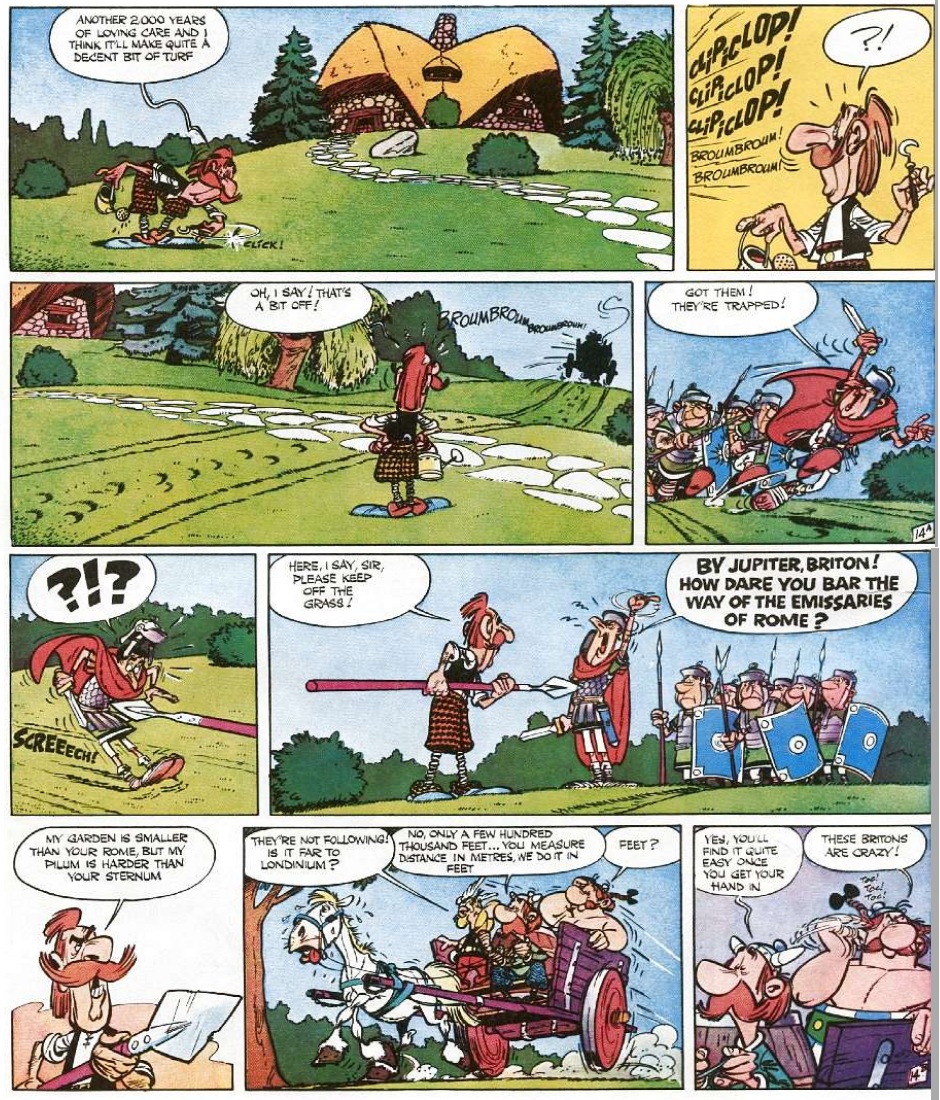
Here's to those idiots. And Down with The Guardian.
....
Monday, 29 December 2014
There is no evidence linking sports sponsorship with children drinking
****
A few days ago "...a group of medical leaders, public health campaigners and health charities" wrote to The Guardian calling for the banning of sports sponsorship by drinks companies:
The lead signatory of the letter was Professor Sir Ian Gilmore perhaps the UK's leading temperance campaigner and a man who has never knowingly missed the opportunity to exaggerate, embellish and invent statistics to promote his mission to limit, perhaps to prohibit, drinking. And our natural instinct to protect children is a high value trump card to the likes of Sir Ian.
So - given that drinks brands have been advertising their brands on the shirts of football, rugby and cricket teams for a couple of decades, we'd expect there to be more teenage boozers drinking more alcohol. The problem is that this isn't true (pdf see page 122):
This comes from a detailed longitudinal study by the Department for Education which makes it pretty reliable as evidence. So over the period when drinks brands have been sponsoring high level sport the consumption of alcohol by children and young people has fallen by around 40%. This suggests that Sir Ian and his pals have absolutely no evidence to support their argument. Not that this makes any difference to them using the argument.
....
A few days ago "...a group of medical leaders, public health campaigners and health charities" wrote to The Guardian calling for the banning of sports sponsorship by drinks companies:
Our children deserve a better future and we must take the opportunity to give it to them. Self-regulation of alcohol advertising isn’t working when it allows drink brands to dominate sporting events that attract children as well as adults, creating automatic associations between alcohol brands and sport that are cumulative, unconscious and built up over years. Evidence shows that exposure to alcohol advertising leads young people to drink more, and to drink at an earlier age.
The lead signatory of the letter was Professor Sir Ian Gilmore perhaps the UK's leading temperance campaigner and a man who has never knowingly missed the opportunity to exaggerate, embellish and invent statistics to promote his mission to limit, perhaps to prohibit, drinking. And our natural instinct to protect children is a high value trump card to the likes of Sir Ian.
So - given that drinks brands have been advertising their brands on the shirts of football, rugby and cricket teams for a couple of decades, we'd expect there to be more teenage boozers drinking more alcohol. The problem is that this isn't true (pdf see page 122):
Thirty two per cent of young people reported having had an alcoholic drink. This represents a significant drop-off from LSYPE1, when 55 per cent of young people reported having tried alcohol. This fall appears to have taken place across almost all groups of young people.
This comes from a detailed longitudinal study by the Department for Education which makes it pretty reliable as evidence. So over the period when drinks brands have been sponsoring high level sport the consumption of alcohol by children and young people has fallen by around 40%. This suggests that Sir Ian and his pals have absolutely no evidence to support their argument. Not that this makes any difference to them using the argument.
....
Tuesday, 8 April 2014
The Guardianista solution to food waste - reintroduce rationing!
****
There are times when the Guardian reads like a parody of itself. So part of me wants to roll about laughing at the woman who is so concerned about food waste she wants rationing back.
But then I stop and think - a national newspaper (with a growing international reach) has given this person space to write an article that opens with this:
And this wasn't just some sub-editor getting carried away - the writer, one Michele Hanson, really means it:
The whole (blessedly brief article) reeks of that smug superiority the Guardian does so well. Telling the proles out there that they are victoms of something called 'consumerism', that they are fat and greedy, and that they would be better off if people like Michele Hanson stood over them to make sure they rendered down bones for stock.
As it happens I was brought up to dislike wasting food. But that's my choice. If another person wants to buy loads of food and then throw it away that's there prerogative - the secret is in the word 'buy'. This amazing innovation means that the food becomes the property (another term foreign to Guardianistas) of the buyer. And if they want to sit and watch it rot in a bowl, they can do just that. It has absolutely nothing at all to do with the EU, the House of Lords, the Guardian or Michele Hanson.
....
There are times when the Guardian reads like a parody of itself. So part of me wants to roll about laughing at the woman who is so concerned about food waste she wants rationing back.
But then I stop and think - a national newspaper (with a growing international reach) has given this person space to write an article that opens with this:
Nobody does as they're told unless they're forced to...
And this wasn't just some sub-editor getting carried away - the writer, one Michele Hanson, really means it:
Don't they realise that hardly anyone does as they're told unless they're forced to? Especially if it means less money and less of what they like. I long for a strict nanny state, to bring back rationing, so no one would be allowed to over-stuff themselves with great slabs of meat daily, or waste their crusts or peelings, reject twirly cucumbers or knobbly fruit and veg.
The whole (blessedly brief article) reeks of that smug superiority the Guardian does so well. Telling the proles out there that they are victoms of something called 'consumerism', that they are fat and greedy, and that they would be better off if people like Michele Hanson stood over them to make sure they rendered down bones for stock.
As it happens I was brought up to dislike wasting food. But that's my choice. If another person wants to buy loads of food and then throw it away that's there prerogative - the secret is in the word 'buy'. This amazing innovation means that the food becomes the property (another term foreign to Guardianistas) of the buyer. And if they want to sit and watch it rot in a bowl, they can do just that. It has absolutely nothing at all to do with the EU, the House of Lords, the Guardian or Michele Hanson.
....
Monday, 13 January 2014
Misinformation, ignorance and prejudice masquerade as a serious article about obesity.
****
A friend of mine at university once described articles written by the likes of Enoch Powell or Tony Benn as superficially works of logical completeness and coherence that, on closer examination, reveals a huge leap of what can only be faith half way through the article.
This article on obesity lacks the intelligence, wit or wisdom of Enoch or Tony but it suffers the same problem. It starts like this:
Now I'm not about to defend the quality of McDonald's food (although - and we'll return to this - there isn't any proven link between fast food and obesity) but we know where the author is coming from. We have a problem with obesity and, our author argues, it isn't enough to say that it's a matter of personal choice.
It's an argument - one I don't agree with but an argument nevertheless. And we do have a problem with obesity. However, the author loses me with this single line:
Note what has been done here. We were talking about obesity - being grossly and unhealthily overweight - and suggesting that perhaps the morbidly fat really do have a problem resisting food. But now all of a sudden we're talking about obese and overweight. We have, to use that piece of sociological jargon, 'problematised' being overweight by implying that it falls in to the same health category as being obese.
And, to put it bluntly, this simply isn't true. Here's the science:
This is not some little study either but:
Essentially the research is saying that having a BMI of between 25 and 35 doesn't represent a health problem - overwhelmingly the people our author is talking about fall into this category.
So what is the actual scale of the problem? If we take morbid obesity as the essential measure (in the UK this is defined as a BMI over 40) then currently around 1.5% of men and 3.5% of women are morbidly obese. Now this is a lot of people - about 1.5 million - so we shouldn't ignore it as a problem but it isn't anything approach the scary 63% that our author cites. Even if we add those with a BMI between 35 and 40 the numbers only rise to 5% or so - between 3 and 4 million.
And this brings us back to fast food. Quite simply there isn't a strong connection between takeaways and obesity (which isn't to say that fat people don't eat in McDonald's but to say that's not why they're fat):
Our author concludes that we are all victims of:
The overconsumption point is an interesting one for, as our author should know but doesn't, overall calorie consumption has been falling. We're still fatter but it's too simple to blame advertising, fast food, offers of chocolate oranges or Big Sugar for the problem. A proper assessment would pick up these facts and ask questions about our sedentary lifestyle, about the support given to very fat people and medical interventions that are possible.
Instead Ben Brooks (an arts/law student or so his biography tells us) chooses to play silly games with the statistics - the evidence, the truth, if you prefer - in order to make his snide little prejudice against McDonalds into a public health point.
Update: some more practical evidence that it's not McDonald's but our broader food choices that matter are on view in this fascinating student project.
...
A friend of mine at university once described articles written by the likes of Enoch Powell or Tony Benn as superficially works of logical completeness and coherence that, on closer examination, reveals a huge leap of what can only be faith half way through the article.
This article on obesity lacks the intelligence, wit or wisdom of Enoch or Tony but it suffers the same problem. It starts like this:
McDonald’s cookies have an energy density comparable to hydrazine. Hydrazine is a rocket fuel used to manoeuvre spacecraft in orbit. It was astonishing, then, to watch a small child graze through two boxes of the desiccated biscuits in one sitting. His parents watched on, preoccupied with their own colossal meals: a noxious amalgam of meat, grease and sugar.
Now I'm not about to defend the quality of McDonald's food (although - and we'll return to this - there isn't any proven link between fast food and obesity) but we know where the author is coming from. We have a problem with obesity and, our author argues, it isn't enough to say that it's a matter of personal choice.
It's an argument - one I don't agree with but an argument nevertheless. And we do have a problem with obesity. However, the author loses me with this single line:
Over 63% of Australian adults are overweight or obese.
Note what has been done here. We were talking about obesity - being grossly and unhealthily overweight - and suggesting that perhaps the morbidly fat really do have a problem resisting food. But now all of a sudden we're talking about obese and overweight. We have, to use that piece of sociological jargon, 'problematised' being overweight by implying that it falls in to the same health category as being obese.
And, to put it bluntly, this simply isn't true. Here's the science:
Relative to normal weight, both obesity (all grades) and grades 2 and 3 obesity were associated with significantly higher all-cause mortality. Grade 1 obesity overall was not associated with higher mortality, and overweight was associated with significantly lower all-cause mortality.
This is not some little study either but:
...97 studies were retained for analysis, providing a combined sample size of more than 2.88 million individuals and more than 270,000 deaths.
Essentially the research is saying that having a BMI of between 25 and 35 doesn't represent a health problem - overwhelmingly the people our author is talking about fall into this category.
So what is the actual scale of the problem? If we take morbid obesity as the essential measure (in the UK this is defined as a BMI over 40) then currently around 1.5% of men and 3.5% of women are morbidly obese. Now this is a lot of people - about 1.5 million - so we shouldn't ignore it as a problem but it isn't anything approach the scary 63% that our author cites. Even if we add those with a BMI between 35 and 40 the numbers only rise to 5% or so - between 3 and 4 million.
And this brings us back to fast food. Quite simply there isn't a strong connection between takeaways and obesity (which isn't to say that fat people don't eat in McDonald's but to say that's not why they're fat):
When the researchers weighed these children they found something rather interesting. Here are the average body mass index (BMI) figures for each group by frequency of visits to fast food outlets. Bear in mind that a 'healthy weight is 18.5 to 25:OK this is for children but it makes the point - quite remarkably showing a negative relationship between regular fast food consumption and obesity. It's whats in the fridge at home and the drawer in the office that's the problem not Burger King or the kebab shop.
Weekly visits BMI
Every day: 17.8
4-6 times: 18.3
2-3 times: 19.6
Once: 20.3
Less than once: 21.4
Our author concludes that we are all victims of:
...the roots of overconsumption: cost of living, manipulative marketing, nutritional misinformation and – often overlooked – simple palatability.
The overconsumption point is an interesting one for, as our author should know but doesn't, overall calorie consumption has been falling. We're still fatter but it's too simple to blame advertising, fast food, offers of chocolate oranges or Big Sugar for the problem. A proper assessment would pick up these facts and ask questions about our sedentary lifestyle, about the support given to very fat people and medical interventions that are possible.
Instead Ben Brooks (an arts/law student or so his biography tells us) chooses to play silly games with the statistics - the evidence, the truth, if you prefer - in order to make his snide little prejudice against McDonalds into a public health point.
Update: some more practical evidence that it's not McDonald's but our broader food choices that matter are on view in this fascinating student project.
...
Sunday, 8 December 2013
Freedom, choice, Nigel Farage and the unpleasantness of The Guardian
****
The nannying fussbuckets have been in full cry what with plain packs, banning smoking on hospital grounds and the, almost certainly untrue, estimate that 600 children a day start smoking. Indeed the good thinking folk who advocate that public health is good for us are bouncing around all chipper as government slips down the slope to a controlled, constrained and, incidentally, crime-filled future of health intervention.
This brings me to an especially unpleasant piece of ad hominem in The Guardian. Don't get me wrong, I think Nigel Farage has become something of a self-parody, a sort of avatar for the pub know-all but this attack is unpleasant and incorrect in equal measure:
So the article begins, continuing in this vein with the author (in her left-wing nastiness) seeking to imply that not only does Nigel want us all to die but that this is the essence of 'libertarianism'. The word is used in almost every paragraph until the author realises her argument is pretty thin and decides to deepen it by invoking 'Godwin's Law' - suggesting that Nigel is really a 'fascist' (on the basis of a couple of uncorroborated stories about his youth).
What depresses me most isn't that The Guardian is publishing an attack on Nigel Farage that is so shallow as to be almost dried up but that the basis of this attack is that he is a libertarian. Not just because - as his party's policies on immigration and gay marriage show - Nigel is anything but a 'libertarian' but because the author suggests that there is something terrible about a belief in personal choice.
And this is the divide. The Guardian and its friends (that, in this matter, include The Daily Mail) do not believe in personal choice and personal consequence. They believe - completely without evidence - that the dark evil of Big Tobacco, The Drinks Industry, The Food Industry and their accomplices in Advertising are combining to force children into smoking, drinking and eating the sort of food a Guardian reader would never allow in the house (far too common).
The truth of this is that Nigel Farage thinks you should be able to drink, eat and smoke legal products without being ostracised, taxed to the hilt or banned. However, he doesn't think people should be able to marry who they wish or that freedom includes free movement.
The Guardian, on the other hand is fine on the marrying bit but doesn't think working-class people are able to make choices about drinking smoking or eating and should be told what to do. The Guardian is also opposed to free movement - especially in Cuba.
Given a forced choice, I'd back Nigel over The Guardian. But there must be a better choice than between 'nanny knows best' social democracy and the slightly xenophobic world vision of Nigel Farage? I read and hear people saying the right things - some right, some left, some muzzy middle - about choice and freedom (that they are rights not privileges granted us by some benign authority) but see too little of this arriving in public policy. There I just see more reasons to interfere with choice and freedom, more of the man in Whitehall knowing best, more regulation, more tax.
And the result is less choice, less freedom, less opportunity and more poverty.
....
The nannying fussbuckets have been in full cry what with plain packs, banning smoking on hospital grounds and the, almost certainly untrue, estimate that 600 children a day start smoking. Indeed the good thinking folk who advocate that public health is good for us are bouncing around all chipper as government slips down the slope to a controlled, constrained and, incidentally, crime-filled future of health intervention.
This brings me to an especially unpleasant piece of ad hominem in The Guardian. Don't get me wrong, I think Nigel Farage has become something of a self-parody, a sort of avatar for the pub know-all but this attack is unpleasant and incorrect in equal measure:
Nigel Farage's cigarettes are often depicted as one of the most appealing things about him. To date, his deployment of crafty or, occasionally, cheeky ciggies, while all around him conform to public health advice, has been a remarkably well-received token of his libertarian vision.
So the article begins, continuing in this vein with the author (in her left-wing nastiness) seeking to imply that not only does Nigel want us all to die but that this is the essence of 'libertarianism'. The word is used in almost every paragraph until the author realises her argument is pretty thin and decides to deepen it by invoking 'Godwin's Law' - suggesting that Nigel is really a 'fascist' (on the basis of a couple of uncorroborated stories about his youth).
What depresses me most isn't that The Guardian is publishing an attack on Nigel Farage that is so shallow as to be almost dried up but that the basis of this attack is that he is a libertarian. Not just because - as his party's policies on immigration and gay marriage show - Nigel is anything but a 'libertarian' but because the author suggests that there is something terrible about a belief in personal choice.
And this is the divide. The Guardian and its friends (that, in this matter, include The Daily Mail) do not believe in personal choice and personal consequence. They believe - completely without evidence - that the dark evil of Big Tobacco, The Drinks Industry, The Food Industry and their accomplices in Advertising are combining to force children into smoking, drinking and eating the sort of food a Guardian reader would never allow in the house (far too common).
The truth of this is that Nigel Farage thinks you should be able to drink, eat and smoke legal products without being ostracised, taxed to the hilt or banned. However, he doesn't think people should be able to marry who they wish or that freedom includes free movement.
The Guardian, on the other hand is fine on the marrying bit but doesn't think working-class people are able to make choices about drinking smoking or eating and should be told what to do. The Guardian is also opposed to free movement - especially in Cuba.
Given a forced choice, I'd back Nigel over The Guardian. But there must be a better choice than between 'nanny knows best' social democracy and the slightly xenophobic world vision of Nigel Farage? I read and hear people saying the right things - some right, some left, some muzzy middle - about choice and freedom (that they are rights not privileges granted us by some benign authority) but see too little of this arriving in public policy. There I just see more reasons to interfere with choice and freedom, more of the man in Whitehall knowing best, more regulation, more tax.
And the result is less choice, less freedom, less opportunity and more poverty.
....
Sunday, 3 November 2013
Chris Huhne and the reality of rehabilitation
****
Chris Huhne, ex-con, liar, cheat and former cabinet minister seems to have landed on his feet. The Guardian, that collector of left-liberal flotsam, has given him a nice column to spout his platitudinous cant. No, I'm not going to link to it.
I have no doubt that Huhne will collect a set of cosy little sinecures, will snuggle onto the speaker circuit and will pop up plugging some sort of renewable energy scam in exchange for loads of cash. It is utterly shameless but precisely what we might expect.
Now don't get me wrong here, I'm all in favour of rehabilitation, of wrongdoers serving their time and returning as useful members of society. And there might be an outside chance of Chris Huhne doing something useful with his undoubted intelligence and (as we now know) unquestioning contacts.
Instead of sounding off in the Guardian perhaps he'd be better served rolling up his sleeves and doing something to help those who have more of a problem with rehabilitation. Most ex-cons don't have mates running national newspapers who'll bung them a favour with a weekly column. They have to go and try getting a job - any job - in a tough old labour market.
And frankly when you've a criminal record, don't read and write so well, maybe suffer from depression and drink just a little too much, getting a job isn't a matter of wringing up the editor of the Guardian. It's hard - really hard. And there's not much help. I don't mean the benefits sort of help - that's there. I mean the real help that takes you from the mess your life's in to the chance of a better place. That will persuade employers to take a chance on an ex-con. And will sit alongside that ex-con, hold his hand a little, as he gets into the job.
This is the reality of rehabilitation. It's hard as Kate Belgrave describes:
So Chris, rather than warming yourself with a nice sinecure - get out and help some of your fellow ex-cons. It might make the world think a little better of you.
....
Chris Huhne, ex-con, liar, cheat and former cabinet minister seems to have landed on his feet. The Guardian, that collector of left-liberal flotsam, has given him a nice column to spout his platitudinous cant. No, I'm not going to link to it.
I have no doubt that Huhne will collect a set of cosy little sinecures, will snuggle onto the speaker circuit and will pop up plugging some sort of renewable energy scam in exchange for loads of cash. It is utterly shameless but precisely what we might expect.
Now don't get me wrong here, I'm all in favour of rehabilitation, of wrongdoers serving their time and returning as useful members of society. And there might be an outside chance of Chris Huhne doing something useful with his undoubted intelligence and (as we now know) unquestioning contacts.
Instead of sounding off in the Guardian perhaps he'd be better served rolling up his sleeves and doing something to help those who have more of a problem with rehabilitation. Most ex-cons don't have mates running national newspapers who'll bung them a favour with a weekly column. They have to go and try getting a job - any job - in a tough old labour market.
And frankly when you've a criminal record, don't read and write so well, maybe suffer from depression and drink just a little too much, getting a job isn't a matter of wringing up the editor of the Guardian. It's hard - really hard. And there's not much help. I don't mean the benefits sort of help - that's there. I mean the real help that takes you from the mess your life's in to the chance of a better place. That will persuade employers to take a chance on an ex-con. And will sit alongside that ex-con, hold his hand a little, as he gets into the job.
This is the reality of rehabilitation. It's hard as Kate Belgrave describes:
“I’ve had my ESA suspended. I was using a care-of address, but they got me down at the social as actually living there. I’ve had no money for the last eight weeks.” That basically left him with his goal. “I’m getting on an emergency script next week. They’ve got me on these meetings – anger management and self- awareness. Then, I’m going to rehab. This time, I’m taking it.”
The tent Darren didn’t mind, although he wanted to move on from it. “I stink of fire all the time (and he did smell of smoke). I’m not usually like this. I’m only dirty, because I’m sleeping on the streets and because of the [cooking] fire. The police come and do a body count [every now and then] and as long as the fires are only under control, they’re not too bothered. I do need to get off the streets – that’s a priority really.”
So Chris, rather than warming yourself with a nice sinecure - get out and help some of your fellow ex-cons. It might make the world think a little better of you.
....
Tuesday, 10 September 2013
I'd have got away with it, if it hadn't been for the newspapers!
****
This is the message from Chris Huhne albeit one wrapped up in a coating of self-righteous excuse-making:
Got this folks. If Chris hadn't said something mildly critical of Rupert Murdoch he'd have got away with lying about speeding points while cheating on his wife (as he presented himself to voters as a proud 'family man'). The saddest thing is that a few people (mostly at the ever more egregious Guardian) will be taken in by this cant. I'm sorry folks but Chris Huhne's career ended because he cheated on his wife and lied about speeding. All the newspapers did was uncover these facts.
I'm a politician, I've had some challenging press coverage. But I consider that the press have every right to report this stuff. If we fall from grace, it's usually our fault. And almost never the fault of the press.
....
This is the message from Chris Huhne albeit one wrapped up in a coating of self-righteous excuse-making:
The News of the World sparked the end of my marriage, but another Murdoch title, the Sunday Times, then groomed my ex-wife until she told them about the speeding points.
Got this folks. If Chris hadn't said something mildly critical of Rupert Murdoch he'd have got away with lying about speeding points while cheating on his wife (as he presented himself to voters as a proud 'family man'). The saddest thing is that a few people (mostly at the ever more egregious Guardian) will be taken in by this cant. I'm sorry folks but Chris Huhne's career ended because he cheated on his wife and lied about speeding. All the newspapers did was uncover these facts.
I'm a politician, I've had some challenging press coverage. But I consider that the press have every right to report this stuff. If we fall from grace, it's usually our fault. And almost never the fault of the press.
....
Wednesday, 5 June 2013
Robots are great and we need more of them to make stuff for us...
****
I get ever more irritated by the bonkers notion that technological advance and improvement is a bad thing for the economy. You see it churned out all over, mostly (but not always) by the good thinking Guardian left. These folk just don't get it:
This is just plain daft. Free is good. We like free - not only is it a magic word but, more to the point, it's an improvement on 'costs so much only people such as Guardian journalists can afford it'. Now in one respect, Lanier is right but his emphasis is still on production rather than consumption. We aren't here to produce stuff, we're here to consume stuff - even if we love our fabulous creative industries job, that's consumption (we're eating up the pleasure).
So yes robots and digital wizardry will "destroy jobs" (this translates as 'makes things a whole lot cheaper because you don't have to pay wages') but all the while new playthings are being invented - think how many people are scraping an adequate living from creating stuff to make use of that digital wizardry, for example. And, so long as the idiot protectionist lefties don't get to control things, stuff gets cheaper so we don't have to work as hard as we do now to get the good stuff. Brilliant!
So no, it's simply not the case and never has been the case, that technical innovation is bad for the economy. Protectionism, subsidised overmanning and the refusal to embrace technology - that was what caused China's 500 year stagnation. And if we adopt the same approach, we will stagnate, there really won't be the jobs we need and future Suzanne Moore types really will be scraping by in some rat-plagued garret.
So let's grab that technology, let's get it working for us, let's shove aside the barriers - unions, business oligopolies, MPs and silly Guardian writers - and get the robots working. We'll all be richer, less frazzled by work and more able to have a bloody great time with the few years we get living on this wonderful planet.
.....
I get ever more irritated by the bonkers notion that technological advance and improvement is a bad thing for the economy. You see it churned out all over, mostly (but not always) by the good thinking Guardian left. These folk just don't get it:
It's about technology taking jobs, about what it can and can't provide. Hoskyns quotes Jaron Lanier's new book Who Owns The Future?, in which he argues: "Capitalism only works if there are enough successful people to be customers." Lanier, a computer scientist and a musician, is rightly called a visionary because he sees what is happening, when everything is live-streamed but no one knows the name of the person who made the music any more. Content is free.
This is just plain daft. Free is good. We like free - not only is it a magic word but, more to the point, it's an improvement on 'costs so much only people such as Guardian journalists can afford it'. Now in one respect, Lanier is right but his emphasis is still on production rather than consumption. We aren't here to produce stuff, we're here to consume stuff - even if we love our fabulous creative industries job, that's consumption (we're eating up the pleasure).
So yes robots and digital wizardry will "destroy jobs" (this translates as 'makes things a whole lot cheaper because you don't have to pay wages') but all the while new playthings are being invented - think how many people are scraping an adequate living from creating stuff to make use of that digital wizardry, for example. And, so long as the idiot protectionist lefties don't get to control things, stuff gets cheaper so we don't have to work as hard as we do now to get the good stuff. Brilliant!
So no, it's simply not the case and never has been the case, that technical innovation is bad for the economy. Protectionism, subsidised overmanning and the refusal to embrace technology - that was what caused China's 500 year stagnation. And if we adopt the same approach, we will stagnate, there really won't be the jobs we need and future Suzanne Moore types really will be scraping by in some rat-plagued garret.
So let's grab that technology, let's get it working for us, let's shove aside the barriers - unions, business oligopolies, MPs and silly Guardian writers - and get the robots working. We'll all be richer, less frazzled by work and more able to have a bloody great time with the few years we get living on this wonderful planet.
.....
Monday, 3 June 2013
"Microlives": I'm pretty certain this is utter tripe...
****
...from the Guardian (where else) with some people's wonderful new 'live forever' theory:
This seems to me to be ignorance squared - taking averages (I guess 'norms') and using them as a predictor of individual life expectancy is not either good maths or good science. Maybe that's not what the book says - the good professor is, after all, a statistician. But it is what the Guardian says the book says - essentially that we can quantify the effect on our individual health of actions where the effect is based on estimates of how much the action adds or subtracts from our lifespan.
The problem is - and if we thought about it for a second we'd know this - that the estimates are open to question. We really haven't much of a clue about the impact of eating red meat on life expectancy even if we do have a general (if challenged) idea that a diet of red meat isn't ever so healthy. For sure, where there's a known dose-response effect (e.g. with smoking - note the word is smoking not tobacco - or alcohol) there's perhaps a bit of a case. But for things such as exercise there is little evidence that getting sweaty on the treadmill extends life - the the adding of microlives on the rowing machine is probably nonsense.
What we have here is extending the general to the specific (from the whole population average to little old me or you) combined with evidence that, to put it mildly, is open to question and perhaps not epidemiologically sound.
But I guess that the gullible Guardianistas are looking for a 'Spirit Level' for personal health and these authors have delivered! However, such tripe is best served with onions and accompanied by a good claret.
....
...from the Guardian (where else) with some people's wonderful new 'live forever' theory:
The Norm Chronicles, a new book by journalist Michael Blastland and Professor David Spiegelhalter that has a neat idea which turns all these abstract dangers into a concrete figure.
It centres on this idea: once you hit adulthood (or, being more precise, 22 for a man and 26 for a woman) you can expect to live for around 500,000 more hours – or a million half-hours. Each of those 30 minutes of life is a "microlife".
By working out the average effect of, say, smoking or eating red meat, we can figure out a cost in microlives for different habits. A portion of red meat, for example, costs you a microlife – in the words of Blastland, it's "a 30-minute chip off your stock of adult life".
This seems to me to be ignorance squared - taking averages (I guess 'norms') and using them as a predictor of individual life expectancy is not either good maths or good science. Maybe that's not what the book says - the good professor is, after all, a statistician. But it is what the Guardian says the book says - essentially that we can quantify the effect on our individual health of actions where the effect is based on estimates of how much the action adds or subtracts from our lifespan.
The problem is - and if we thought about it for a second we'd know this - that the estimates are open to question. We really haven't much of a clue about the impact of eating red meat on life expectancy even if we do have a general (if challenged) idea that a diet of red meat isn't ever so healthy. For sure, where there's a known dose-response effect (e.g. with smoking - note the word is smoking not tobacco - or alcohol) there's perhaps a bit of a case. But for things such as exercise there is little evidence that getting sweaty on the treadmill extends life - the the adding of microlives on the rowing machine is probably nonsense.
What we have here is extending the general to the specific (from the whole population average to little old me or you) combined with evidence that, to put it mildly, is open to question and perhaps not epidemiologically sound.
But I guess that the gullible Guardianistas are looking for a 'Spirit Level' for personal health and these authors have delivered! However, such tripe is best served with onions and accompanied by a good claret.
....
Monday, 28 January 2013
Yep, the Guardian does want poor people to stay poor.
****
As I observed the other day after a piece of nonsense about Peru and asparagus, the Guardian really does think that poor folk in the developing world should stay poor. A position they share with Oxfam and much of the international aid vampires.
The Guardian has confirmed this belief:
You see, the great and good daren't criticise the "100 charities and religious organisations" - they are sainted, above criticism. Were a prime minister, EU commisar or business leader to suggest that maybe a little more capitalism would be a better idea - that we apply the thing that made us rich to the task of making Africans rich - then a torrent of criticism and abuse would rain upon them.
The problem is that those "100 charities and religious organisations" are wrong and my (imaginary) prime minister is right. The prescription of the aid mafia is to subsidise poverty - to keep poor peasants as poor peasant. Whereas I know that capitalism made us rich and it will make Africans rich too.
....
As I observed the other day after a piece of nonsense about Peru and asparagus, the Guardian really does think that poor folk in the developing world should stay poor. A position they share with Oxfam and much of the international aid vampires.
The Guardian has confirmed this belief:
And it is pushing in an established direction of travel. At Davos last week, the World Economic Forum launched a report, Achieving the New Vision for Agriculture, advocating supporting subsistence farmers as "change agents". The peasant, declared dead only a year or two back, has been miraculously revived.
You see, the great and good daren't criticise the "100 charities and religious organisations" - they are sainted, above criticism. Were a prime minister, EU commisar or business leader to suggest that maybe a little more capitalism would be a better idea - that we apply the thing that made us rich to the task of making Africans rich - then a torrent of criticism and abuse would rain upon them.
The problem is that those "100 charities and religious organisations" are wrong and my (imaginary) prime minister is right. The prescription of the aid mafia is to subsidise poverty - to keep poor peasants as poor peasant. Whereas I know that capitalism made us rich and it will make Africans rich too.
....
Wednesday, 16 January 2013
So folk who read the Guardian want poor people to stay poor?
****
Or so it seems:
There's the clue - "food security". You think that's all about people staying alive, about ensuring supply and such important stuff don't you? You're wring - food security is all about keeping peasants as peasants. Indeed, this is the problem with that Andean agriculture:
Get this folks - rather than scraping a bare existence with subsistence agriculture those Andean peasants are making a decent living instead selling us rich folk trendy cereals. The tripling of the quinoa price is a huge boost to the Andean economy. It is a good thing - people in these places (assuming they can escape from their hideous socialist governments) have the chance to do something else with their time, to create new ideas, new businesses and new sources of wealth.
What these ridiculous, protectionists in the Guardian propose is that it's better for Andean peasants to scrat a subsistence living than for the economy of these places to thrive because we want to pay silly money for barely edible grain products. They would rather such folk starved to protect their precious misconception of peasant agriculture.
These ghastly lefties want poor people to stay poor. Probably so they can patronise them.
....
Or so it seems:
But in the case of quinoa, there's a ghastly irony when the Andean peasant's staple grain becomes too expensive at home because it has acquired hero product status among affluent foreigners preoccupied with personal health, animal welfare and reducing their carbon "foodprint". Viewed through a lens of food security, our current enthusiasm for quinoa looks increasingly misplaced.
There's the clue - "food security". You think that's all about people staying alive, about ensuring supply and such important stuff don't you? You're wring - food security is all about keeping peasants as peasants. Indeed, this is the problem with that Andean agriculture:
Averaging $3,115 (£1,930) per tonne in 2011, quinoa has tripled in price since 2006. Coloured varieties fetch even more. Red royal quinoa sells at about $4,500 a tonne and the black variety can reach $8,000 per tonne. The crop has become a lifeline for the people of Bolivia's Oruro and Potosi regions, among the poorest in what is one of South America's poorest nations.
Get this folks - rather than scraping a bare existence with subsistence agriculture those Andean peasants are making a decent living instead selling us rich folk trendy cereals. The tripling of the quinoa price is a huge boost to the Andean economy. It is a good thing - people in these places (assuming they can escape from their hideous socialist governments) have the chance to do something else with their time, to create new ideas, new businesses and new sources of wealth.
What these ridiculous, protectionists in the Guardian propose is that it's better for Andean peasants to scrat a subsistence living than for the economy of these places to thrive because we want to pay silly money for barely edible grain products. They would rather such folk starved to protect their precious misconception of peasant agriculture.
These ghastly lefties want poor people to stay poor. Probably so they can patronise them.
....
Sunday, 4 November 2012
How 'denormalisation' works...the case of drinking
****
You start with a little anecdote:
We are shocked especially when the article is accompanied by a rather old photograph of some young men drinking shots. How can this be happening! The writer continues with a sweeping statement - supported only by the anecdote - about (in this case) drinking:
We are consuming more and more booze and it is killing us! Something must be done! But the evil producers of the deadly product are using their "power" to stop action:
See! Look! This international cartel of booze peddlers can buy a whole country's parliament!
At no point in this discussion is there any dispassionate appraisal of the facts. This is because the facts are not helpful. Take the uncomfortable fact that, for 16-24 year olds, 36% of men and 47% of women report not having had a drink at all in the week prior to survey and not a single young person reported drinking every day. And drinking rates are declining:
But you won't read this facts in a story promoting the denormalisation cause - they prefer scare stories and sensationalism:
Well no, that isn't common ground. We did something. We promoted an adult approach - great licensing flexibility, rises in duty and a public health strategy centred on "inform and persuade". And this has worked - consumption of alcohol has fallen and continues to fall.
For the denormalisers, the temperance campaigners and the prohibitionists to win the day it is necessary for drinking - or for that matter eating burgers or chocolate bars - to be causing a 'crisis' that requires something to be done. And since the statistics don't support the case, the nannying fussbuckets resort to anecdote. The next stage will be simply making stuff up. Just watch.
....
You start with a little anecdote:
On a Friday night in the City a young professional woman collapses on the floor of the bar where she has been drinking with colleagues. She vomits, then passes out, and when an ambulance crew arrives they are verbally abused by the patient's friends, as the emergency service refuses to turn itself into a chauffeur to take the party home.
We are shocked especially when the article is accompanied by a rather old photograph of some young men drinking shots. How can this be happening! The writer continues with a sweeping statement - supported only by the anecdote - about (in this case) drinking:
This is all part of a British reality that refuses to conform to the cafe culture: the ideal that was supposed to emerge following the relaxation of UK licensing laws.
We are consuming more and more booze and it is killing us! Something must be done! But the evil producers of the deadly product are using their "power" to stop action:
The challenge in Scotland has been spearheaded by the Scotch Whisky Association – a trade body whose policy-making council is dominated by major drinks groups such as Johnnie Walker-owner Diageo, Pernod Ricard's Chivas Regal and Edrington, the home of Famous Grouse. Meanwhile, EU wine producers, concerned about how their exports to Britain will be hit, have launched their own campaign in Europe, albeit one that caused eyebrows to arch when the initial objection came from the seemingly unlikely quarter of Bulgaria. Conspiracy theorists even pondered if the former communist state challenged British policy with the assistance of the global drinks industry lobby.
See! Look! This international cartel of booze peddlers can buy a whole country's parliament!
At no point in this discussion is there any dispassionate appraisal of the facts. This is because the facts are not helpful. Take the uncomfortable fact that, for 16-24 year olds, 36% of men and 47% of women report not having had a drink at all in the week prior to survey and not a single young person reported drinking every day. And drinking rates are declining:
There has been a long-term downward trend in the proportion of adults who reported drinking in the week prior to interview. In 1998, 75% of men and 59% of women drank in the week prior to interview compared to 68% and 54% respectively in 2010. Similarly, the proportion of adults drinking on 5 or more days in the previous week has also decreased since 1998; in 1998 24% of men drank on 5 or more days in the previous weeks, compared to 17% in 2010, the equivalent figures for women were 13% and 10% respectively.
But you won't read this facts in a story promoting the denormalisation cause - they prefer scare stories and sensationalism:
If one piece of common ground exists, it seems to be this: when it comes to Britain's out-of-control drinking culture, some one needs to call time, gentlemen and ladies, please.
Well no, that isn't common ground. We did something. We promoted an adult approach - great licensing flexibility, rises in duty and a public health strategy centred on "inform and persuade". And this has worked - consumption of alcohol has fallen and continues to fall.
For the denormalisers, the temperance campaigners and the prohibitionists to win the day it is necessary for drinking - or for that matter eating burgers or chocolate bars - to be causing a 'crisis' that requires something to be done. And since the statistics don't support the case, the nannying fussbuckets resort to anecdote. The next stage will be simply making stuff up. Just watch.
....
Thursday, 6 September 2012
So folk music is conservative after all!
“Almost everything appertaining to the circumstances of a nation, has been absorbed and confounded under the general and mysterious word government. Though it avoids taking to its account the errors it commits, and the mischiefs it occasions, it fails not to arrogate to itself whatever has the appearance of prosperity. It robs industry of its honours, by pedantically making itself the cause of its effects; and purloins from the general character of man, the merits that appertain to him as a social being.”
But we are so much wiser now than Thomas was. The champion of liberty paved the way, we're told, for the progressive view of government. Indeed, the very men who promote the idea of governmental good see Thomas as their man - a man of the left.
So when a grungy folkie pops up speaking, in his own way, the language of Thomas Paine, the left are shocked - not quite to silence unfortunately:
Browsing on a music messageboard earlier today, I came across a thread devoted to Frank Turner, which linked to an interview he gave last year. Turns out his libertarianism and belief in the power of the people to resist oppression aren't of the leftist sort. They're of the rightist sort.
How dare this man be in such a trendy profession as folk music and not be left wing! How dare he say such things as:
"What I think we should do instead is concentrate on ways of minimising the impact on ordinary people's lives and allow them to get on with their lives and not be bothered by the state. Then you've suddenly got a range of things to talk about that are achievable. Like everything from not having ID cards and trying to dismantle the surveillance system we've put together in this country on the one hand, trying to remove government from peoples lives, social services. Letting people be freer, health and safety, whatever it might be."
Perhaps Frank lacks Thomas Paine's eloquence but he's saying the same thing. Government isn't a good thing but, at best a necessary evil, something to be tolerated at the fringes of our lives not the centre of everything.
Regardless the whole episode cheered me - a particular fan of folk music despite its reputation for leftiness. And in the comments to that Guardian piece I found a still more curious comment about folk music:
I've said this in other threads before but there is something horrifying, fascist and awful about this neo-folk music that is like the worst of Nazi return-to-origins propaganda. The Mumfords and the horrifying affectation of a pastoral netherworld with their neo-folk clothing. Even if the musicians themselves were lefties, the music has such a strong conservative streak that it cancels out any progressive views. In a way it's easier to pick on this one musician but conservatism in music is a bigger subject than his tweeter views.
I must admit to a little grin at this observation as a right winger who likes folk music. And who recognises that, in the end, the idea of land, soil and the national culture are (unlike national socialism but that's a different story) distinctly conservative in feel and sentiment. Kipling would have loved the sentiment, if not the sound of grungy folk music:
His dead are in the churchyard—thirty generations laid.
Their names were old in history when Domesday Book was made;
And the passion and the piety and prowess of his line
Have seeded, rooted, fruited in some land the Law calls mine.
Not for any beast that burrows, not for any bird that flies,
Would I lose his large sound council, miss his keen amending eyes.
He is bailiff, woodman, wheelwright, field-surveyor, engineer,
And if flagrantly a poacher—'tain't for me to interfere.
"Hob, what about that River-bit ?" I turn to him again,
With Fabricius and Ogier and William of Warenne.
"Hev it jest as you've a mind to, but"—and here he takes command.
For whoever pays the taxes old Mus' Hobden owns the land.
....
...
Wednesday, 5 September 2012
Advice to the Internet from an old mail order guru
****
I was reading an incredibly complacent interview with Alan Rushbridger, the Guardians editor. There was a hint - indeed the very faintest of hints - that the newspaper's on-line business model might not be a sturdy cash generator:
And here lies the rub, not just for the Guardian but for much of the 'world wide web' - Rushbridger touched on it by saying:
At which point I recalled some sage words from a real life mail order guru - my former colleague John Hinchcliffe. We were discussing the strategy (or rather John was discussing and I was doing what might be called 'intelligent listening') options faced by the Freeman's brand following its acquisition by (I think) Littlewoods. Now Freeman's were the only big book mail order company that didn't give new agents a (significant) free gift with their first order and John was considering whether to bring the brand in line with the main Littlewoods brand. This brought the observation:
The Internet wasn't listening to John (perhaps it should have been) but this is precisely the problem that we face - not just news providers but social media platforms, music sellers, book retailers and any number of folk supplying software stuff. We gave stuff away for free. As Rushbridger argues (somehow I suspect this is more post hoc rationalisation than the honest truth) this was about embedding yourself in the wonders of the on-line world.
However, it was still giving stuff away for free. And we now have a generation of web wanderers who assume that it's all free and that this is the right way for it to be. Weaning them off that free stuff (especially when so many bely their degree level qualifications and actually believe it is free) is a massive challenge.
John was right. Giving away free stuff was always risky and the Internet is about to discover this truth!
....
I was reading an incredibly complacent interview with Alan Rushbridger, the Guardians editor. There was a hint - indeed the very faintest of hints - that the newspaper's on-line business model might not be a sturdy cash generator:
I think you’re putting the cart before the horse. I think it’s better if you embed yourself in this new world of information and work out what it is what we can do that they can’t do and vice versa. If at some point in the future it looks as though some form of payment is going to work, we’re not going to set ourselves against it
And here lies the rub, not just for the Guardian but for much of the 'world wide web' - Rushbridger touched on it by saying:
There would have been no point in 1997 or 2000 saying that we don’t like the idea of this all being free...
At which point I recalled some sage words from a real life mail order guru - my former colleague John Hinchcliffe. We were discussing the strategy (or rather John was discussing and I was doing what might be called 'intelligent listening') options faced by the Freeman's brand following its acquisition by (I think) Littlewoods. Now Freeman's were the only big book mail order company that didn't give new agents a (significant) free gift with their first order and John was considering whether to bring the brand in line with the main Littlewoods brand. This brought the observation:
Once you start giving away free gifts you can't stop
The Internet wasn't listening to John (perhaps it should have been) but this is precisely the problem that we face - not just news providers but social media platforms, music sellers, book retailers and any number of folk supplying software stuff. We gave stuff away for free. As Rushbridger argues (somehow I suspect this is more post hoc rationalisation than the honest truth) this was about embedding yourself in the wonders of the on-line world.
However, it was still giving stuff away for free. And we now have a generation of web wanderers who assume that it's all free and that this is the right way for it to be. Weaning them off that free stuff (especially when so many bely their degree level qualifications and actually believe it is free) is a massive challenge.
John was right. Giving away free stuff was always risky and the Internet is about to discover this truth!
....
Saturday, 7 July 2012
The Guardian don't seem to know the meaning of democracy...
****

The
Guardian is once again burbling about democracy, this time on the back of a
report by some people called Democratic Audit. My problem with all this isn’t
that British representative democracy is a little creaky or that the public not
only see politicians as a bit dodgy but often fail to see much point in voting
for a different set to pretend to run things. No, my problem is the things that
The Guardian and Democratic Audit see as defining “democracy” – things like
compliance with human rights rules, membership of trade unions, gender balance
and how much we give in international aid.

I'm prepared to accept that how many people vote and press freedom - probably corruption and perceptions of corruption too - are pertinent to the debate about democracy. But none of the other things are - they amount to little more than a progressive lefty wish list.
Any way, I don't think democracy is threatened by apathy. People have the right to vote and choose not to do so. That's entirely their business. Political parties and politicians may fret a little at these levels of engagement but they do not indicate the death of democracy or even its terminal decline. It's true that Britain's political parties are in decline - sustained only by state support and the purchasing of influence by rich people, businesses and trade unions. But I see that decline as pretty healthy, as the demise of tribal politics - unless, of course, corporatists like those nice folk at the Guardian get their way and we have state-funded parties.
Instead of these old-fashioned measures we should look at other activities - the number of writers focusing on politics and political debate, the growth of petitioning, direct democracy and the willingness of the voting public to consider support for independent and independent-minded politicians. Democratic Audit and The Guardian represent an old, somewhat discredited and collectivist attitude where democracy is defined through institutions and public compliance. That and they don't seem to understand the definition of democracy.
....
Saturday, 21 April 2012
On taxes, morals and practicality
****
Once again tax has become a matter of moral debate. Rather than asking the sensible and practical questions – “how do we raise the amount of money we need to deliver those ‘vital’ public services?” or “what is so ‘vital’ about this or the other bit of public spending?” – we are debating whether it is or isn’t morally repugnant for a person to use the rules to minimise the amount of tax they pay.
And the target for all this is “the rich”, a group of ill-defined, nameless, faceless individuals onto whom we must heap opprobrium if they have the audacity to move their money around so as to pay a little less tax. Every now and then one self-righteous newspaper hack or other latches onto a particular person or a specific company and calls down the anger of the gods upon them – how dare they not hand over nearly all their income and most of their wealth to the government, how dare they!
And so the game goes – today The Guardian latches onto a dead man so as to have a pop at that dead man’s son. Nobody is suggesting that the son has done anything wrong but the sins of the dead man – reducing his tax bill by moving his money around – must mean that the son is a sinner too! And, sadly, the response of many is not to castigate the values that led to such an attack on a dead man but to accuse the paper (and others) of hypocrisy since they too indulge in such international money management for the purposes of tax minimisation.
This way madness lies! We do not have taxes as some form of punishment for those who have the gall to be very rich. Nor do we have taxes so as create some form of “morally beautiful” status of equality. We have taxes to pay for government. That’s it. No other reason is remotely defensible. And the job of the government is to raise those taxes efficiently.
Nowhere in this is there any matter of morals. Merely a set of practical issues: what is the best rate of income tax; what should the balance be between direct and indirect taxes; should reliefs be offered for desired actions such as philanthropy, business investment or saving for retirement?
However, those who cheer at the attack on a dead man choose to make this a debate about morals. So let's respond.
I do not believe that we have any more moral duty in paying taxes than to comply with the rules set down by the government. And if that means that a very rich man can avoid paying tax at the same rate as a much poorer man, the fault lies with those who set the rules not with the man avoiding paying the tax.
Instead we should ask why it is that very rich men – and others who are far from very rich – put such effort into avoiding taxes? Could it be, perhaps, that these men feel that rates of taxation are too high? Perhaps – and it’s hard to take issue with this sentiment – the very rich man believes that it is wrong for the government to seize more than half what he earns? Maybe, the very rich man believes it to be morally wrong for government to take such a large proportion of someone’s income?
We have got ourselves into such a state – with politicians forced into publishing tax returns and hints that ministers will be expected to do the same. I cannot but think that the idea of a very rich man giving public service – as rich men have been wont to do throughout history – is likely to become just that, history. Why should that man bother when his reward will be sneering attacks on him for the apparent sin of being rich? Instead, the man heads to his private island or grand house, shuts the gates and perches on his pile – having first ensured that only the smallest possible part of it goes to the government in taxes.
And the fault for this separation from public service will not be the rich man’s. The fault lies first with government for demanding too much of that man’s income and secondly with the frothing mob led by hypocritical journalists who castigate him and his sort – even beyond the grave – merely for having money.
Attacking the rich may make some of us feel a little better, perhaps more able to tolerate less pleasant personal circumstances. But it does not help the government in that task of raising taxes efficiently and it is not the championing of some moral righteousness. Taxation must be a matter of practicalities not moralities. If we get to the stage of shouting about morals then the only conclusion is that our tax system is not fit for its purpose of raising the money the government needs for its business.
And so it is. Taxes are too high on the rich and too high on the poor. In the former case we can see they are too high because of the lengths that rich men go so as to avoid those high rates. And in the latter case because we have to tax the poor because the rich aren’t there to be taxed.
I don’t know the right answer – the system that would work – but I do know that the current debate misses the point entirely. Taxation must be a practical matter if it is to work. Moralising about it just makes things worse.
....
Monday, 19 December 2011
The lunatics are definitely in charge at the Guardian!
****
Communism wasn't all bad, you know. Forget the mass murder, the suppression of dissent, the imprisoning of opponents, and the impoverishment of millions. There is this:
People at the Guardian still believe this rubbish?
...
Communism wasn't all bad, you know. Forget the mass murder, the suppression of dissent, the imprisoning of opponents, and the impoverishment of millions. There is this:
Havel's anti-communist critique contained little if any acknowledgement of the positive achievements of the regimes of eastern Europe in the fields of employment, welfare provision, education and women's rights. Or the fact that communism, for all its faults, was still a system which put the economic needs of the majority first.
People at the Guardian still believe this rubbish?
...
Subscribe to:
Posts (Atom)