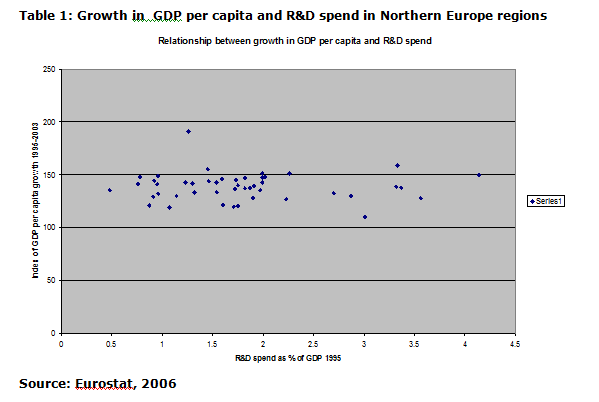
Science is wonderful. I'll sign up to government investing in basic science every day. But I don't think it's a growth panacea. Lots of people do though:
The private sector can’t do it alone. We rely on companies to translate scientific discoveries into products. But federal investment in research and development, especially basic research, is critical to their success.
Now the author of those words is a physics professor and former scientific advisor to President Clinton so we might say he has an interest. But his view is widely held - investment in science, technology and maths by governments is a surefire route to growth. The problem is that there's precious little link (at least in the medium term) between investment in basic science and economic growth.
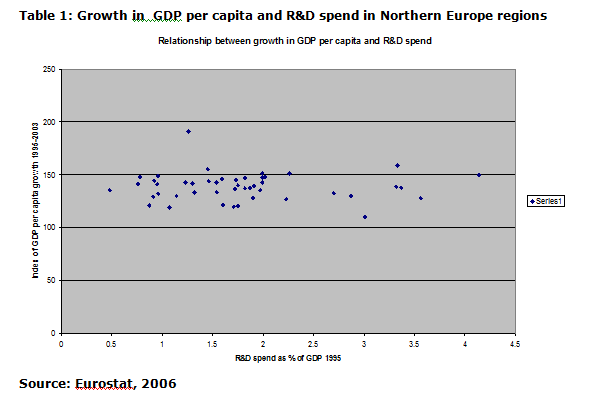
You see folks. Spending money on scientific research in universities doesn't cut the mustard as a growth strategy. A while ago in a different circumstance I wrote this:
We need, therefore, to examine what other (ideally measurable) inputs might improve our assessment of innovation. Some authors identify ‘learning-by-doing’ as a factor in innovation (Iyigun 2006) while others argue for exogenous factors such as the size of the (innovating) population (Jones 1995). This latter measure suggests that a better proxy for innovation activity might be the number of ‘knowledge workers’. Such an approach would capture R&D workers and other workers involved in innovative activities.
It seemed to me then that government is better placed investing in creating scientists, engineers and mathematicians rather than spending money on basic research in those subjects. At least if they want to generate growth. And for those regions that want to shift their economies they need to get lots of these people to live and work there. That means they aren't stuck with the one employer of those skills or forced to flit from one end of the country to the other so change jobs. And more importantly there will be plenty of people to partner with in developing and actioning innovative ideas.
This was a central failing of the UK's Regional Development Agencies (RDAs). All of them had innovation strategies but all of these strategies were, in effect, captured by higher education. Rather than focusing on innovation in business the RDAs spent their cash instead on funding research institutes and university-led strategies sited too close to their research.
There is evidence to suggest that university-led innovation strategies focusing on collaboration and the spinning off of businesses from HEIs leads to a misplaced focus on scientific research rather than business growth (Jones 1995, Frenz & Oughton 2005). Perhaps the most effective way to generate effective innovation at the level of the firm (where it has a direct impact on economic performance) is to reduce the barriers to innovation. The biggest of these barriers is cost and econometric models suggest that reducing innovation costs is more effective that investing in R&D or building innovation networks and systems (Martin 1999).
In the long-term scientific research does help drive the technological advances that lead to economic growth. The problem is that, in the short- to medium-term, it's very difficult to spot the beneficial effects of such research especially when compared to the promotion of in-firm innovation.
References (yay, I don't do this often!):
Frenz M. & Oughton C. (2005), ‘Innovation in the UK regions and devolved administrations: a review of the literature’ presentation of report for DTI and ODPM, London, DTI
Iyigun M. (2006), ‘Clusters of invention, life cycle of technologies and endogenous growth’ in Journal of Economic Dynamics and Control, Vol. 30 pp687-719, New York, Elsevier
Jones C I, (1995), ‘R&D-based models of economic growth’ in Journal of Political Economy, Vol. 103 No. 4 pp759-783, University of Chicago
Martin P. (1999), ‘Public policies, regional inequalities and growth’ in Journal of Public Economics Vol. 73 pp 85-105, New York, Elsevier
....