Showing posts with label innovation. Show all posts

Saturday, 6 January 2018

Of course....


Your want more creativity and innovation? Here's how you do it...
"...the emergence of city institutions protecting economic and political freedoms facilitates the attraction and production of creative talent."
I'd have thought this was pretty obvious - not funding, not institutions, not 'cultural strategies', just giving people the chance to do, say and think the things they want to do, say and think.

....

Saturday, 18 February 2017

Things are seldom as simple as they seem...


I'm discussing Council budgets and we get to the matter of shared services and specifically sharing back office functions (things like receipts and payments, payroll, tax collection and so forth). Now these are things that every local council does with the same intention and the same outcome. So, on the face of it, sharing such things ought to be a doddle.

The problem is (and it's not insurmountable since quite a few councils have merged back office with other councils) that, for all the apparent obviousness, things aren't that simple. Even if I allow for a certain amount of bureaucratic sucking of teeth - "ooh, Councillor, I don't think that's possible" - there remains the matter of systems. And unless you merge the systems you really don't realise, other than a bit of saving in senior management, much benefit from sharing.

The problem is that merging large and complicated systems is not straightforward. By way of illustration, our former Spanish bank (Banesto) was taken over by another bank (Santander) but the actual back office systems for the two banks remain - or did in October 2015 - separate to the extent that Santander operators were unable to sort out problems, these had to be done by the former Banesto people who "understood the systems".

Integrating two complicated back office systems - say those of Leeds and Bradford Councils - is only possible given time, money and a plan. To make such a merger worthwhile, we need also to know that the net savings exceed, in a reasonable time frame, the money invested in the merger. It is, while not impossible, pretty challenging to make this calculation with a high degree of confidence. Such a lack of confidence isn't really a problem if the costs are low and the savings are high. But this really doesn't seem to be the case for such back office mergers (or so I'm told).

This problem with complex systems, how they stay in place because changing them is uncertain and expensive, is repeated time and time again. Here's Jon Worth on European railways (quite literally):
After having been stuck again this morning due to lack of collaboration between EU rail firms, I started to wonder: can liberalisation of EU rail actually ever work? And, were it to ever work, what are the prerequisites to making it work?
Jon goes on to set out seven factors about the system (information, accountability, ownership, cohesion, customer rights, maintenance and ticketing) that need resolution through system design if a liberalised railway is to be delivered. Jon concludes, unsurprisingly, that:
So then, that’s the little list of issues to solve. Will the EU, and its Member States, be ready to go that far to make a liberalised railway work? And to foot the costs of doing so? I rather doubt it…
The problem for us is that, given the significance of our legacy systems (in government, transport and finance especially) and the rate of innovation in these areas, we run the risk of economic sclerosis unless we begin to grapple with the challenge of replacing those systems with new ones. There are technical solutions to all of Jon's questions but the current infrastructure (physical and social) is largely unable to carry those technical solutions. The result of this is that people find 'get-arounds' - those railways, instead of sleek transport systems of the future become anachronistic and inefficient systems superceded by driverless vehicles, drones and communications technology.

Too often this is an argument against doing anything or for merely doing things that don't impact the established order - an interactive screen here, an app there rather than having some idea how the system will look when everything is done. For all my liberal instincts, I can't help but think things are seldom as simple as we like to think they are whatever William of Ockham might have said!

....

Wednesday, 3 August 2016

"Gimmicks" - or transport innovations at they're known outside West Yorkshire


Tomorrow's driverless taxi?

The West Yorkshire Combined Authority is going out to consultation on its transport strategy. This is a strategy and plan intended to set the direction for transport in West Yorkshire up to 2036. In doing this, the WYCA is acting quite properly - transport schemes are expensive, slow to develop and take a long time to implement so a twenty year planning horizon is sensible. You can contribute to the consultation through the page on WYCA's website.

At the recent WYCA full meeting - where the leaders of West Yorkshire's five councils plus a couple of others tagged on for good measure (like me, for example), we discussed this transport strategy. Not in much detail - these meetings are never big on detail - but enough to get a feel for what it's proposing. And it's not very good.

The strategy is linear seeing challenges such as congestion, air quality and connectivity as solvable only with existing technology - trains, buses - and new infrastructure (roads, bike lanes and so forth) within the existing spatial circumstances. Thus we are keen on HS2 and HS3 (or Northern Powerhouse Rail - NPR - as afficionados will now call it) as transformational schemes and we bemoan the lack of foresight at the Department for Transport in not allowing us to build our exiciting and innovative new 'bus-on-a-string'. As if the 19th century technology of the trolley bus is somehow a solution to 21st century transport challenges.

In setting objectives, the strategy focuses on modal shift, getting journeys shifted from nasty bad cars onto lovely buses, trains and bicycles. The strangest thing about this policy is that it is essentially backwards looking in seeking to move people from a 20th century transport system (the car) onto 19th century systems (rail, bus, bike). And while this is all fine it represents another triumph for anti-invention green strategies.

In our discussions, I mentioned emerging transport technologies - autonomous vehicles, drones, zero-emission vehicles - and wondered why, given the strategy runs to 2036, none of these emerging transport systems was considered worthy of even consideration in our planning? The chairman of the WYCA's Transport Board and the Leader of Kirklees Council dismissed this suggestion. The former thought the 'holy grail' would be to have an integrated ticketing syste across rail and bus by 2036. For Londoners, this is us taking 20 years to introduce the Oytster card system you guys already have.

For the latter, Cllr David Sheard, these new technologies are "gimmicks" and we should focus on "real-time data" (which we already have through the Metro phone app) and "smart ticketing" (those Oyster cards again). The extent of West Yorkshire's transport innovation will be to introduce a system London already has and to improve another system already available in West Yorkshire. And we want to be some sort of powerhouse? With this sort of thinking we'll be lucky to keep up with Manchester let alone close the gap with London.

So, for the benefit of my colleagues on the West Yorkshire Combined Authority, here are some of those gimmicks being introduced elsewhere in the world.

Singapore is gearing up to become the world's first "smart nation", with another deal to bring self-drive taxis to the city.

The city authorities signed a deal with start-up nuTonomy to test autonomous vehicles in March.

Now Delphi Automotive will also offer a small fleet of automated taxis to carry passengers around a business park.

The driverless cabs could reduce an average $3-a-mile ride to 90 cents, the firm said.

Initially, the cars will have drivers, ready to take over if the system fails but the plan is to gradually phase the human out in 2019.

And - even more creative:

A drone that can transport humans has been given the go ahead to carry out trials in the US.

The Ehang 184, which was first unveiled at CES 2016, is a small, personal helicopter that can transport a single passenger. Rather than one large rotor above the body, the "taxi drone" has four rotors underneath the body, resembling a remote control drone.

Ehang will start running tests in Las Vegas later this year in the hope that it could eventually be used as part of the state's transport system, according to a local publication.

Buses might not be so dull:

A driverless electric bus is set to be trialled in Perth in a test run for the use of autonomous vehicles on West Australian roads.

The staged trial is being conducted and funded by WA's RAC later this year using a French-made electric shuttle bus.

With no driver, it will use three-dimensional sensing technology to carry 15 passengers at speeds up to 45 kilometres per hour.

And there's autonomous delivery systems:

"Whilst driverless vehicles once sounded like science fiction, it's now within our grasp," said Domino’s Pizza UK marketing director Simon Wallis. "Harnessing this innovation for pizza delivery opens up a new world of opportunities for us."

The vehicles navigate via GPS technology and feature an onboard Pizza Interface (PI) that calculates the fastest route to the customer.

Plus drone delivery of course:

Amazon will step up its drone tests in UK airspace after winning approval from the Government to lift strict flying restrictions in a major boost to its plans for unmanned delivery aircraft.

The Civil Aviation Authority (CAA) has granted the internet retailer special permission to test its aerial vehicles without several of the rules that typically bind drone pilots.

The agreement will see Amazon move a step close to Jeff Bezos’s dream of fleets of drones delivering small packages directly to shoppers within 30 minutes.

Or, on a bigger scale, semi-autonomous freight trains:

Six convoys of semi-automated “smart” trucks arrived in Rotterdam’s harbour on Wednesday after an experiment its organisers say will revolutionise future road transport on Europe’s busy highways.

More than a dozen self-driving trucks made by six of Europe’s largest manufacturers arrived in the port in so-called “truck platoons” around midday, said Eric Jonnaert, president of the umbrella body representing DAF, Daimler, Iveco, MAN, Scania and Volvo.

And the landing of drones in drone ports:

Foster + Partners has unveiled the first full-scale prototype of its Droneport concept at the Arsenale, which is designed to transport medical supplies to remote regions in Africa using unmanned flying vehicles (+ slideshow).

The structure is the inaugural project from the Norman Foster Foundation, set up by the British architect to anticipate technological advances in the field, respond to humanitarian needs and encourage a more "holistic" view of architecture.

All this is before we've got to a world where autonomous and semi-autonomous vehicles begin to replace the car as the dominant form of personal transport. This requires us to think about ownership, to look at the way in which we licence taxis, road safety and pedestrianisation. Instead we're going to fuss about installing better bus stops and holding interminable meetings to discuss ticketing arrangements between trains and buses. And instead of infrastructure investment paving the way for autonomous vehicles, drones and other innovations, we'll spend it on trying to shift one-in-thirty journeys from the car to some other form of transport.

With the collapse of the tram and trolley bus proposals for Leeds, there's the opportunity to step over our obsession with trains and buses and to plan for the future that emerging technology is taking us to. Sadly, the leaders of West Yorkshire think that's just "gimmicks". Seems to me we need some new ones - leaders that is, not buses and trains.

.....

Tuesday, 17 February 2015

The World's Most Important Thinkers...discussed (and they aren't economists)


Over at a magazine called Prospect (which badges itself rather self-importantly as "The Leading Magazine of Ideas") they're having a fun little poll asking who the world's most important thinkers might be - just follow this link to vote. I would recommend opting for Russell Brand - mostly for the laughs.

However, the list of great thinkers from which we must choose - carefully chosen by Prospect's team of contributors "whether they agree with them or not" (very big of them that) - set me to thinking about what constitutes an 'important thinker'. But first the make up of Propsect's list as this contains an important truth about what the punditry consider important.

The dominant category is 'economist' with thirteen entries in the list of 50 followed by the general term 'activist' with eight entries (ten if you include a lone feminist and someone listed as 'activist and tech theorist') and writers - journalists, novelists, authors -  also with eight entries. The rest of social science and historians musters twelve entries and there's one each of diplomat, surgeon and lawyer. The remaining four entries are scientists - two physicists and two biologists.

What we see here is the increasing hegemony of economics alongside a continuing hero-worship of sexy and attractive activists. The list doesn't contain a single engineer, entrepreneur, chemist or - and this is striking given the importance of the debate - climatologist. There are no artists, designers or architects, no urbanists, no geographers. Given the importance of business and the management of business it is shocking that the only thinker on business issues (as opposed to economics) is Naomi Klein who promotes an anti-market, anti-business message.

I suppose that all this reflects the current bias in how we seek to understand the world and the continuing botheration about the world's economy. So the preference for economists - and the list isn't especially biased to left or right in its choices - reflects the belief (a misfounded belief) that their musings can help us understand what needs to be done to put things that are wrong with the economy right. But settle back for a moment and ask yourself what message Prospect's 'team' are sending by selecting so few scientists?

Economics, and especially 'grand unified theories of everything' (© M. Piketty) economics, has become something of a fetish with the punditry. The discipline has indulged this - partly with the twee (think Freakonomics) and partly with creating a parallel universe where people continue to kid themselves that national economy models will actually explain the real world rather than simply play games with ever more sophisticated arithmetic.

The most important thinkers aren't those trying to square the circle by pretending there's a way to have a store of value without creating the value in the first place. Rather the important thinking is being done by those working out how to colonise Mars, how to extract more efficiency from the machines that capture energy, and how to feed the world's population as it continues to grow. The important thinking isn't about money or wealth but about technology, creativity and art - yet Prospect have chosen a list utterly dominated by the immediate botheration of national budgets, international relations and, in the case of Russell Brand and Naomi Klein, baying at the moon.

Look ahead at the things that will transform the world - like driverless cars, 3D printing, nanotechnology, hybrid engines, photovoltaic technologies, intelligent surfaces and bio-engineered fungi - none of these things are the stuff of economists, activists and writers. Rather they are the stuff of scientists, engineers and entrepreneurs - I may be none of these things but I'm sure that the most important thinking being done right now is being done in laboratories, test sites and boardrooms not in newspaper offices or wherever it is that economists gather to peddle their myths.

....

Friday, 18 July 2014

Micro-housing: a little bit of living space innovation...

If you're looking for imaginative responses to housing problems how about:

The students, together with professors and alumns, have designed and built three 135-square-foot ‘SCADpads’ — fully equipped micro-dwellings that fit the size of a standard parking space. The pop-up parking garage village also contains communal open areas, such as a Groovebox community garden, a living room, and work spaces.

You can see more here. Micro-housing is a thing - you can read a load at this blog including:

Micro-housing is one of the fastest-growing housing trends in Seattle for its affordability and sustainable lifestyle. But the problems have to do with neighborhood fabric and taxes. Put up a micro-housing complex and people who have lived in the neighborhoods for years suddenly have 40-100 new strangers on the block, depending on how many units are in the building. Many find this threatening to the fabric of their communities. 

Interesting stuff.

....

Tuesday, 30 October 2012

Science and growth. It really isn't as simple as all that...

****

Science is wonderful. I'll sign up to government investing in basic science every day. But I don't think it's a growth panacea. Lots of people do though:

The private sector can’t do it alone. We rely on companies to translate scientific discoveries into products. But federal investment in research and development, especially basic research, is critical to their success.

Now the author of those words is a physics professor and former scientific advisor to President Clinton so we might say he has an interest. But his view is widely held - investment in science, technology and maths by governments is a surefire route to growth. The problem is that there's precious little link (at least in the medium term) between investment in basic science and economic growth.


You see folks. Spending money on scientific research in universities doesn't cut the mustard as a growth strategy. A while ago in a different circumstance I wrote this:


We need, therefore, to examine what other (ideally measurable) inputs might improve our assessment of innovation.  Some authors identify ‘learning-by-doing’ as a factor in innovation (Iyigun 2006) while others argue for exogenous factors such as the size of the (innovating) population (Jones 1995).  This latter measure suggests that a better proxy for innovation activity might be the number of ‘knowledge workers’.  Such an approach would capture R&D workers and other workers involved in innovative activities. 

It seemed to me then that government is better placed investing in creating scientists, engineers and mathematicians rather than spending money on basic research in those subjects. At least if they want to generate growth. And for those regions that want to shift their economies they need to get lots of these people to live and work there. That means they aren't stuck with the one employer of those skills or forced to flit from one end of the country to the other so change jobs. And more importantly there will be plenty of people to partner with in developing and actioning innovative ideas.

This was a central failing of the UK's Regional Development Agencies (RDAs). All of them had innovation strategies but all of these strategies were, in effect, captured by higher education. Rather than focusing on innovation in business the RDAs spent their cash instead on funding research institutes and university-led strategies sited too close to their research.


There is evidence to suggest that university-led innovation strategies focusing on collaboration and the spinning off of businesses from HEIs leads to a misplaced focus on scientific research rather than business growth (Jones 1995, Frenz & Oughton 2005).  Perhaps the most effective way to generate effective innovation at the level of the firm (where it has a direct impact on economic performance) is to reduce the barriers to innovation.  The biggest of these barriers is cost and econometric models suggest that reducing innovation costs is more effective that investing in R&D or building innovation networks and systems (Martin 1999).  

In the long-term scientific research does help drive the technological advances that lead to economic growth. The problem is that, in the short- to medium-term, it's very difficult to spot the beneficial effects of such research especially when compared to the promotion of in-firm innovation.

References (yay, I don't do this often!):


Frenz M. & Oughton C. (2005), ‘Innovation in the UK regions and devolved administrations: a review of the literature’ presentation of report for DTI and ODPM, London, DTI

Iyigun M. (2006), ‘Clusters of invention, life cycle of technologies and endogenous growth’ in Journal of Economic Dynamics and Control, Vol. 30 pp687-719, New York, Elsevier

Jones C I, (1995), ‘R&D-based models of economic growth’ in Journal of Political Economy, Vol. 103 No. 4 pp759-783, University of Chicago

Martin P. (1999), ‘Public policies, regional inequalities and growth’ in Journal of Public Economics Vol. 73 pp 85-105, New York, Elsevier


....

Thursday, 27 September 2012

A brief thought about innovation strategies and growth...

****

The innovation strategy - or innovation-led growth -  isn't usually about "innovation" but is about government investment in science and in manufacturing industry. Stuff like:

A £200m fund for early-stage ventures; freedom to raise money for the Green Investment Bank, and a new business bank to lend to growth sectors including advanced manufacture and life sciences.

..and

Invest the proceeds of the forthcoming 4G spectrum auction - estimated at £4bn - in science, technology and innovation.

Plus...

Higher education funds for radical inventions around knowledge creation - putting design thinking at the heart of the new Catapult centres.

All good stuff and "targeted" at the things that made regions "competitive" - at innovation. Or so we're told. The truth is that innovation - or a great deal of it - isn't about science but about boring things like systems and distribution. Amazon's success is as much built on getting super swift logistics as it is about whizzo techie wonderments. But it's the latter that suck up the innovation funding from governments.

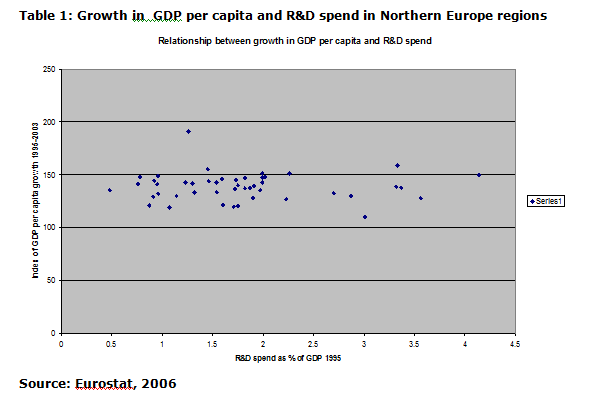
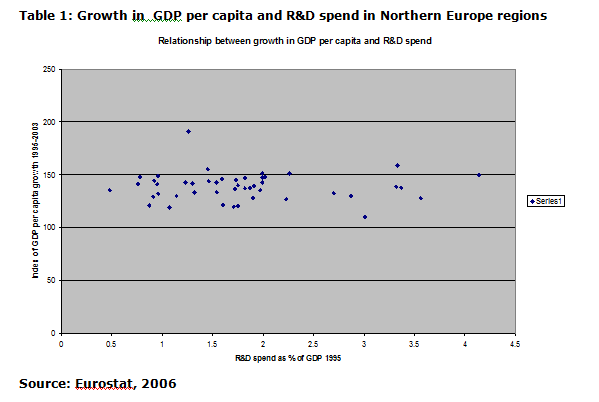
The problem is that, while innovation is awfully important at the firm level, at the macro level there's not much evidence that R&D spending impacts on growth:

And here lies our problem. We know that innovation generates growth (by reducing costs, by creating new products and so forth) but we can't capture that growth by looking at the sort of investments that typify government innovation strategies. Indeed, if a firm only innovates because of grant-funding (or 'soft loans' which amount to the same hill of beans) then we have to question whether the innovation is real or merely staged to secure the funding.

It seems to me - and there is some evidence to support this - that the real benefits lie in:

  • Concentrations of private sector knowledge workers (think Thames Valley)
  • Low (or no) taxes on capital gains
  • A focus on service/process innovation (services are 80% of our economy after all)
  • Active incentives (such as reduced taxes) for business innovation
  • Similar incentives for individual investors in innovation (tax reliefs or lower personal taxes)

What is clear however is that schemes predicated on the activities of universities - clutching another batch of government funding to their chests - do not deliver innovation and do not benefit growth.

....

Saturday, 15 September 2012

How the state still wants to crush banking innovation...

****

Or something like that;
 
Ethan Clay, 31 years old, opened Whalebone Café Bank seven months ago in his shop, Oh Yeah!, a year and a half after he was hit with $1,600 in overdraft fees from a local bank where his account was overdrawn by a series of checks.

Mr. Clay says he wants to offer an alternative banking experience, and has accepted small deposits and made small loans. He claims he isn't subject to banking rules because his operation is a gift-card savings account.

"It's a strange case, we don't have the authority to go close an ice-cream store," said Ed Novak, spokesman for the Pennsylvania Department of Banking. "But we are going to do something. You can't mess with people's money."

Those people with their money - they've a choice between Mr Novak's approved (and failed) bank system and Mr Clay's creativity.

...customers who make deposits earn interest in the form of "exclamation dollars." A $100 deposit is worth $5.50 a month that can be spent on ice cream, waffles and coffee in his store. It works out to be a straight 5.5% monthly interest rate, he said.

Whalebone Café Bank also loans money. Two weeks ago, Ryan Howard, a 33-year-old designer and photographer who occasionally works for Mr. Clay, said he needed $510 to attend a therapy workshop. He borrowed the money from Whalebone Café Bank, and is paying the money back at $60 a month, and will be charged $25 for the loan.

Mr. Clay said he has $550 from depositors and has loaned $1,700, an amount that includes some of his own seed money. "My goal is to get to $100,000 in deposits by Dec. 21," he said. "This is the prototype, but I hope to become the neighborhood bank."

This innovation and creative - capitalism at its finest - must be crushed by the grand alliance between the big banks and big government. A pox on them!

....


Sunday, 3 July 2011

The Space Age is Over...Long Live the Space Age!

In one of those well-informed polemics that The Economist does so well, we are told that the ‘Space Age’ is over:

Their dream was for man to venture farther into the solar system and beyond, into interstellar space. Many people feel that these imaginings have been dashed. It is quite conceivable that 36,000km will prove the limit of human ambition. It is equally conceivable that human space flight, long the stuff of science fiction, will return to fantasy.

Just maybe. And just as maybe The Economist are wrong to be quite so sniffy about private initiative:

...the private ventures of people like Elon Musk in America and Sir Richard Branson in Britain, who hope to make human space flight commercially viable. Indeed, the enterprise of such people might do just that. But the market is uncertain. Space tourism is a luxury service that will probably not to go beyond low-Earth orbit. And ferrying satellites and other kit to the Earth's extended "technosphere" is hardly boldly going where no man has gone before.

The assumption in all this is, of course, that the conquest of space – the stretching of that final frontier – is something only possible with the resources and leadership of governments. And the statements about a “luxury service” are achingly reminiscent of the famous comments from crystal ball gazers about telephones (one per town), computers (a world market of five or six) and much else that is innovation.

For the record, Simon’s prediction is that we do indeed have a new space race, it will involve the commercial exploitation of space and it is between the western entrepreneur and the state-directed exploration of the Chinese. It’s likely that the moon’s next human visitors will be either western tourists or Chinese miners.

....