Showing posts with label universities. Show all posts

Tuesday, 10 April 2018

Is the problem technocracy not postmodernism?


The idea of a university as a circle of professorial peers, each with apprentices and each practicing a craft, tends to be replaced by the idea of a university as a set of research bureaucracies, each containing an elaborate division of labor, and hence of intellectual technicians. For the efficient use of these technicians, if for no other reason, the need increases to codify procedures in order that they may be readily learned.
I was struck by this observation - from C. Wright Mills, "The Sociological Imagination". It feels an essential truth, a description of the university's journey from a collegiate environment where knowledge is explored to a complex bureaucracy dedicated to the production of research. There are a lot of people culpable in this journey - Mills points to what others called the 'military-industrial complex' (with a side swipe at research-driven advertising agencies) and to 'human engineers' in bureaucracy:
To say that ‘the real and final aim of human engineering’ or of ‘social science’ is ‘to predict’ is to substitute a technocratic slogan for what ought to be a reasoned moral choice. That too is to assume the bureaucratic perspective within which—once it is fully adopted—there is much less moral choice available.
We hear from Jordan Peterson and others that the problem is postmodernism and relativism. I've a little inkling that empiricism, an obsession with uncontextualised data, is perhaps more of a problem. Technocracy is far more the core ideology of the 'liberal elite' than is postmodernism - it is the idea that bureaucracy can discover a solution through the collection and analysis of data without reference to any moral foundation that sits at the heart of our disconnection with government.

.....

Thursday, 8 September 2016

The cocoon of diversity


In my lifetime the cause of civil rights has transformed the lives of millions in what we now call 'minorities'. From the gradual liberation of women and allowing gay people to actually live free lives through to the insistence on equal treatment for people with different skin colours, we live in a very different, and more civilised, society than we did when I was born.

I also know that prejudice continues - from the laughable idea that someone can't be English because they've a slightly darker skin through to the casual way in which women, gay people and the disabled are excluded. In some ways what we do goes too far - positive discrimination tends to favour those individuals from minorities who probably need the least help and the straightjacket of 'protected characteristics' leaves some groups facing prejudice without recourse to the protection offered to others.

Now the problem is that, with all this placing of people into discrete groups - ethnicity, disability, gender, sexual preference, age - we have allowed groupthink to take over with the result that far from an inclusive, united and open society we have one characterised by self-segregation, exclusion and mistrust. A sort of self-imposed apartheid is growing from this corrupted soil:

Robert Lopez, a spokesman for the university, confirmed to The College Fix that the students’ demand for housing specifically for black students had been met, saying that the school’s new Halisi Scholars Black Living-Learning Community “focuses on academic excellence and learning experiences that are inclusive and non-discriminatory.”

What sort of world have we come to where intelligent, educated young people want to segregate themselves from others purely on the basis of their skin colour? Don't get me wrong here - if a bunch of black students (or for that matter brown, yellow, red or white students) choose to live together that's entirely their business. But to demand, as students at California State University in Los Angeles did, that the college authorities set aside a place purely for this purpose is to make diversity a protective cocoon rather than a chance to realise that all those other folk - men, women, gay, straight, black, white, able-bodied, disabled - are just other human beings.

This process of segregation - shocking given the history of racial oppression in the USA - is spreading across college campuses even to the extent of segregated induction and segregated staff:

UW-Madison’s Multicultural Student Center held meetings separated by race July 11. “The center held two distinct sets of ‘processing’ meet-ups. First, two ‘processing circles,’ one for white staff and another for non-white staff, were held in the morning, followed by racially separated ‘processing meet-ups’ for students in the evening,”

It seems that, far from seeking engagement in society, a section of black America is trying to create parallel structures and organisations simply to prevent any risk of 'microaggressions' resulting from sharing space with white people. This attitude is not only very disturbing but, worse still, acts to reinforce the unpleasant view that black people don't want to be part of wider American society. Put simply, all the work done - from Rosa Parks and Martin Luther King onwards - to get a society where minorities have equal rights is unfurling as these students, indulged by college authorities, recreate a world where group characteristics like skin colour, gender or disability are what defines a person not the 'content of their character'. And rather than this being a consequence of others prejudice it is rather the desire of these groups to avoid any place where words or actions might offend - a cocoon of diversity.

....

Friday, 26 August 2016

Heterodox Academy - challenging left-wing hegemony in academia


A long overdue initiative to challenge the domination of academia - and especially academic social sciences - by a narrow left-wing ideology:

HeterodoxAcademy.org was founded to call attention to this trend and the problems it is causing for scholarship, particularly in the social sciences and related fields (such as law and public policy). The word heterodox means “not conforming with accepted or orthodox standards of beliefs.” We chose that word to contrast with “orthodoxy,” which refers to conforming with accepted norms and beliefs. Orthodoxy has religious connotations, but it can be applied to any view that becomes dogma or dogmatic, such as “orthodox Marxism,” “social constructionist orthodoxy,” or “progressive orthodoxy.”

It will be a long hard road and I wish those involved - all American, so focused in issues in US institutions. The study of human institutions, of society and of how we behave is too important for one ideology to dominate discourse and debate.

...

Sunday, 29 November 2015

So most academic research is pointless?

****

This was really striking:

In his new book “Higher Education in America,” former Harvard president Derek Bok notes that 98 percent of articles published in the arts and humanities are never cited by another researcher. In social sciences, it is 75 percent. Even in the hard sciences, where 25 percent of articles are never cited, the average number of citations is between one and two.

We are conducting research because the system says you must research. We are publishing - and supporting a vibrant academic publishing industry - simply because we're measuring performance on that basis.

We privilege academics as specially clever people but the reality is that many of them spend their time doing things that serve no real purpose, conducting research that no-one (bar the journal editor and the academic's mum) will read about.

...

Tuesday, 21 July 2015

How left wing academics are killing the business school


****

For many years business schools and management faculties were the bastions of sanity in academia. Places where such concerns as robust research methods, consistency and applied knowledge were more important that ideology or the revolution. Business schools were, so to speak, the engineers or social science - sensible places producing graduates who could actually contribute something to the world once they left the groves of academe.

Sadly this is now under threat. A thing called 'critical management studies' has grown like a sort of parasitical maggot within the body of the business school:

As an umbrella research orientation CMS embraces various theoretical traditions including anarchism, critical theory, feminism, Marxism, post-structuralism, postmodernism, postcolonialism and psychoanalysis, representing a pluralistic, multidisciplinary movement. Having been associated mainly with business/management schools in the United Kingdom and Scandinavia earlier, CMS as a research approach has presence all over the world and is not confined to management/business schools. This suggests that CMS is an approach to doing research rather than a school or tradition, and there is no particular 'right' way of doing CMS.

I am reluctant to do anything more than just peek at this hideous growth upon an otherwise sensible part of our higher education system. But that peek reveals the usual - and more-or-less incomprehensible - left wing wibble. We encounter a world focused on 'alternatives to growth driven neo-liberal capitalism', on 'critical performativity' (whatever that might be), and on 'challenging the...power structures in the university workspace'.

And in doing this work, such ordinary stuff as scientific method and detached, dispassionate research are to be dismissed:

We do not believe that good social science is always detached, objective and quantitative in its approach. Nor do we think it should routinely borrow from the natural sciences in its investigations. Instead we favour the use of a wide range of methods in attempting to understand and unpick management and organisations. This is why the School of Management at the University of Leicester houses the largest body of heterodox researchers across the core disciplines of accounting and finance, marketing and organisation studies in the world.

We are now beginning to churn out from university management schools the same deluded, evidence-light, ideological research (I call it research because I'm kind) has we've seen for generations from sociology and social studies departments. This isn't to say that left wing views have no place in the study of business and management but rather to observe that the application of that ideology seems to trump any reasoned or rational consideration of the things being taught and studied.

What we see here is the continued debasement of academia as the unchallenged hegemony of 'progressive' delusions gradually infects the whole body of research. To be fair there's a way to go before the UK's business schools are so corrupted by the sort of ideological non-research those unfortunate students at Leicester are suffering. But, just as there is no space for any challenge to this progressive hegemony across much of the social sciences, it seems that it will be only a matter of time before the BSc in management becomes just as uselessly impractical as the typical BA in Sociology or Social Policy is today.

The most frightening thing about the progressive left isn't just that it is out of touch with reality but that its academics reject structured, quantitative research methods (mostly because - as I was told by my research methods lecturer - 'maths is hard') in favour of the recycling of shared opinions and the gradual translation, without any real evidence, of those opinions into a 'research' corpus. Worse, if organisations are recruiting new managers infected by this 'business is bad' ideology, then instead of new and improving techniques in business adminsitration we will see the corruption of our businesses from within.
....

Tuesday, 30 October 2012

Science and growth. It really isn't as simple as all that...

****

Science is wonderful. I'll sign up to government investing in basic science every day. But I don't think it's a growth panacea. Lots of people do though:

The private sector can’t do it alone. We rely on companies to translate scientific discoveries into products. But federal investment in research and development, especially basic research, is critical to their success.

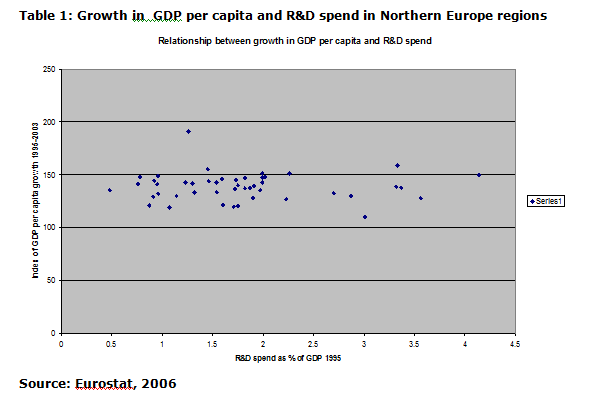
Now the author of those words is a physics professor and former scientific advisor to President Clinton so we might say he has an interest. But his view is widely held - investment in science, technology and maths by governments is a surefire route to growth. The problem is that there's precious little link (at least in the medium term) between investment in basic science and economic growth.


You see folks. Spending money on scientific research in universities doesn't cut the mustard as a growth strategy. A while ago in a different circumstance I wrote this:


We need, therefore, to examine what other (ideally measurable) inputs might improve our assessment of innovation.  Some authors identify ‘learning-by-doing’ as a factor in innovation (Iyigun 2006) while others argue for exogenous factors such as the size of the (innovating) population (Jones 1995).  This latter measure suggests that a better proxy for innovation activity might be the number of ‘knowledge workers’.  Such an approach would capture R&D workers and other workers involved in innovative activities. 

It seemed to me then that government is better placed investing in creating scientists, engineers and mathematicians rather than spending money on basic research in those subjects. At least if they want to generate growth. And for those regions that want to shift their economies they need to get lots of these people to live and work there. That means they aren't stuck with the one employer of those skills or forced to flit from one end of the country to the other so change jobs. And more importantly there will be plenty of people to partner with in developing and actioning innovative ideas.

This was a central failing of the UK's Regional Development Agencies (RDAs). All of them had innovation strategies but all of these strategies were, in effect, captured by higher education. Rather than focusing on innovation in business the RDAs spent their cash instead on funding research institutes and university-led strategies sited too close to their research.


There is evidence to suggest that university-led innovation strategies focusing on collaboration and the spinning off of businesses from HEIs leads to a misplaced focus on scientific research rather than business growth (Jones 1995, Frenz & Oughton 2005).  Perhaps the most effective way to generate effective innovation at the level of the firm (where it has a direct impact on economic performance) is to reduce the barriers to innovation.  The biggest of these barriers is cost and econometric models suggest that reducing innovation costs is more effective that investing in R&D or building innovation networks and systems (Martin 1999).  

In the long-term scientific research does help drive the technological advances that lead to economic growth. The problem is that, in the short- to medium-term, it's very difficult to spot the beneficial effects of such research especially when compared to the promotion of in-firm innovation.

References (yay, I don't do this often!):


Frenz M. & Oughton C. (2005), ‘Innovation in the UK regions and devolved administrations: a review of the literature’ presentation of report for DTI and ODPM, London, DTI

Iyigun M. (2006), ‘Clusters of invention, life cycle of technologies and endogenous growth’ in Journal of Economic Dynamics and Control, Vol. 30 pp687-719, New York, Elsevier

Jones C I, (1995), ‘R&D-based models of economic growth’ in Journal of Political Economy, Vol. 103 No. 4 pp759-783, University of Chicago

Martin P. (1999), ‘Public policies, regional inequalities and growth’ in Journal of Public Economics Vol. 73 pp 85-105, New York, Elsevier


....

Wednesday, 24 October 2012

No surprises here then...

****

Among full-time faculty members at four-year colleges and universities, the percentage identifying as "far left" or liberal has increased notably in the last three years, while the percentage identifying in three other political categories has declined. The data come from the University of California at Los Angeles Higher Education Research Institute, which surveys faculty members nationwide every three years on a range of attitudes.

Sadly the article doesn't explain how academics got so removed from common sense!

....

Thursday, 31 May 2012

A thought on social mobility - and my Uncle Ray...

****

My late uncle Ray was a judge - not a grand high court version of that beast but a more humble sort sitting in County Courts. But then I'm a Tory politician, you'd expect me to have at least one uncle sitting as a judge!

My uncle didn't go to university. Indeed he left school at fourteen and got a job in a solicitor's office doing odds and bits of jobs around the place. By dint of application and night school (not to mention working every hour god sent) Ray got to be a solicitor, then a partner and then a judge.

So Ray, from an ordinary working-class background in South London, ended up in the most bewigged of middle-class professions. All without spending time in and around the dreaming spires, redbrick halls or tatty '60s blocks of a university. And there are plenty of others of Ray's generation who took the same route - school, office job, night school or correspondence college and hard work.

So it rather galls me (someone who swanned from school to university without much thought) when people speak of university access as if it were the only means to resolve issues of social mobility. And I am struck by Alan Milburn's observation about the professions:


"The question posed by this report is whether the growth in professional employment is creating a social mobility dividend for our country - the short answer is not yet. In fact, the lack of progress on opening up the professions to a wider pool of talent risks squandering that enormous opportunity for social progress."

In times past plenty of lawyers, accountants and bankers learnt their skills while doing the job. It was a recognised and celebrated route to the top. For sure, the grand still paraded from Harrow to Oxford to a posh chambers in London but that was not the only route.

It is not just a matter of getting into university but persuading those professions - law, accountancy, nursing and so forth - that a vocational route is as valid for them as it is for quantity surveyors, marketing directors and bakers.

....

Thursday, 12 April 2012

Morality, booze and political correctness on campus - welcome to London Met

****

Some people think alcohol is "immoral"? Or so says the man who runs London Metropolitan University:

The vice-chancellor of London Metropolitan University is considering banning the sale of alcohol in some parts of the institution's campus because a "high percentage" of his students consider drinking to be "immoral".

Now let's consider some other things that a devout Muslim might consider "immoral":

Homosexuality -  "When a man mounts another man, the throne of God shakes."
Extra-marital sex -  "Muslims are advised to behave in a way and avoid circumstances that could potentially result in extra- or pre-marital sex"
Eating bacon - plus many other haraam (forbidden) foods and food preparations

I'm guessing that our vice-chancellor isn't about to ban gays or sex from his campus - let alone bacon! So why is he picking on alcohol? There's a clue in his comments:

Malcolm Gillies (our vice-chancellor) said he was "not a great fan of alcohol on campus"

We're getting there now - this is a man who likes a ban, who wants to control. Perhaps?

Or maybe it's a marketing ploy for a university struggling to fill its courses so has chosen to target. You see most of the university's muslim students are women and:

"...can only really go to university within four miles of home and have to be delivered and picked up by a close male relative"

So much for liberation! "Have to be delivered..." - what sort of world do we live in where we think that is an acceptable, healthy attitude towards women? Yet our vice-chancellor would change the rules for everyone to accommodate such an attitude!

.....

Thursday, 24 November 2011

Nick Clegg is wrong about black students....

****

...but sadly he completely misrepresents the educational achievements of Britain's ethnic minorities:

What Mr Clegg is claiming:

Nick Clegg will today warn that hundreds more young black men are in jail than at top universities, in an explosive attack on race relations in Britain.

And what the proper facts say:

Based on detailed analysis of both the Office of National Statistics’ Labour Force Survey and the Higher Education Statistics Agency’s ‘HESA Student Record’, the report, ‘Race into Higher Education’, sets out how almost one in six (16.0%) of UK university students are from a Black Asian and Minority Ethnic (BAME) background. This is up from 8.3% in 1995-96, the year in which Business in the Community founded Race for Opportunity. This increase is virtually in line with the growth in the BAME population from 7.7% of 18 to 24 year olds in 1995-96 up to 14% in 2007-08.

Even if we assume that the Russell Group universities do less well - say 10% from BAME communities - that's still 16,000 black students. If they achieve at 16%, that's over 25,000 black students - more that the 22,000 black people in our prisons.  The UK's student population as a whole is well over 2 million - meaning that there are at least 400,000 black students. This is four times the size of the entire prison population.

So Nick's just using carefully crafted statistics to mislead us. Typical Liberal Democrat!

....

Thursday, 17 November 2011

So when will universities cotton on then?

****

Technology is changing how we learn:

Live online learning technologies - such as virtual meetings and classrooms, and video-conferencing - are becoming increasingly popular, with more than three-quarters of employers using them in 2011.

This is according to the benchmark study carried out by learning-technology provider Towards Maturity, which found that e-learning courses were the most popular learning technology this year, used by 80% of employers.

So when will universities start using these methods?

....

Monday, 6 June 2011

'Vanity of vanities, all is vanity, says the preacher..."


This time though the vain preacher is an atheist:


Gifted students will be able to apply to the New College of the Humanities in central London to take degrees in a range of subjects such as law, economics and philosophy. The college – which will open next year – will become only the second fully private university to be established in Britain after Buckingham. Prof AC Grayling, the philosopher and famed atheist, will be the college's first Master. 

The announcement has brought a torrent of negative comment from the world of academia and in the pages of their house journal, The Guardian:

What would prevent most of us from doing so is the nausea which wells to the throat at the thought of this disgustingly elitist outfit. British universities, plundered of resources by the bankers and financiers they educated, are not best served by a bunch of prima donnas jumping ship and creaming off the bright and loaded.
 
Now part of me hopes - even expects - the project, with its self-importance, inflated fees and expensive faculty to fail but not because it is a private initiative.  Indeed, the option of becoming private should be a consideration for our elite universities - rather than passing pointless motions of no confidence in government ministers, academics at Oxford and Cambridge would be better served forcing that minister's hand by threatening to go private, to break away from the state's clammy, controlling hand.

No, what is wrong with this project is, as one observer points out, its vanity:

This is not a College but a branding exercise: the use of big academic names to gloss straightforward London University degrees and charge the courses out at five times the cost using the same facilities.

Almost all the contentions made on the College’s website are misconceived, or do not seem to be substantiated. All this is clear with the application of the critical thinking and an evidence-based approach which the humanities should actually promote and celebrate.

This College is not any academic breakthrough. This College does nothing real to help the humanities in this country.

It is instead AC Grayling’s Folly.

Maybe the college has a substantive, worked through business plan that will show how an institution can charge twice what Britain's only other private university charges. However, I suspect that they've merely added up the cost of Professor Grayling's expensive friends, divided it by the number of students these friends will deign to tutor and arrived at the figure of £18,000.

My personal view is that Britain needs private universities - I would cheer if most of the Russell Group of "elite" universities escaped from the State's clutches and set their sights on competing with the top American academic institutions. But Grayling's little scheme seems to be an indulgent, formless vanity project. And that's why it will fail.

....