Showing posts with label Islam. Show all posts

Sunday, 4 June 2017

"Enough is enough" - responding to Islamism


Quite understandably there has been a fairly frantic response to the terrible and terrifying events last night on London Bridge and in the Borough. As ever the story is one of shock mixed in with tales of bravery from police, medics and the public. It will have refreshed the barely faded memory of Manchester in those recently scarred by that atrocity and reminds us that Islamist terrorism is a real and substantial threat in the UK as well as across Europe.

The Prime Minister responded and did so in a more robust, almost angry, manner when compared to the statement after Manchester - 'enough is enough' was the message as she talked about 'safe spaces' online, the continuing problems with ISIS's insurgency in Syria and Iraq, and the need for a renewed counter-terrorism strategy. The response suggests a subtle shift in what happens in the UK on this issue and indicates that the Prevent strategy becomes more significant in that overall counter-terrorism strategy:
"But it also means taking action here at home. While we have made significant progress in recent years, there is – to be frank – far too much tolerance of extremism in our country. So we need to become far more robust in identifying it and stamping it out – across the public sector and across society. That will require some difficult and often embarrassing conversations, but the whole of our country needs to come together to take on this extremism – and we need to live our lives not in a series of separated, segregated communities but as one truly United Kingdom."
The challenge is, as always, to transform this rhetoric into some sort of strategy that works on the ground and which has the buy-in (not mere 'support') of local government, education and police establishments - I'm guessing that this is what the Prime Minister alludes to when she says 'across the public sector'. Right now strategies to identify and respond to nascent extremism are widely disregarded, even opposed, by local political and bureaucratic leadership especially in those places where the strategy is most needed and important. This situation needs addressing and represents a failure in the strategy as well as a continuing preference of those elites for political posturing and cultural indulgence rather than the tough job of challenging extremism especially within Muslim communities.

Some are saying the right thing but, I suspect, aren't thinking about their response when the actions they propose are carried out:


I'm guessing that I'm a councillor in a city that might be considered one of those 'breeding grounds of terror', certainly a place that will feature in the thinking of those drawing up a new counter-terrorism strategy. The question I have for Kevin Holland and many others suggesting that we need to get into the communities where Islamist ideology is transmitted is whether they are prepared for the reaction from those communities to our 'interference'.

The Prevent strategy is pretty mild. It doesn't single out Islamism as its sole target - referrals through Prevent into the wider 'Channel' anti-terror programme show that just over half are Muslims referred as a result of activity linked to Islamist extremism. This hasn't stopped some politicians arguing, in effect, that Prevent is some sort of national anti-Muslim policy:
The government's anti-extremism programme Prevent should be paused, Baroness Warsi has said.

The former foreign office minister said the scheme had "huge problems", including the quality of its training, and said its "brand" had become "toxic".

She called for an independent review to look into where the programme had failed or proven successful.
It is true that the image of the Prevent strategy in Muslim communities - at least in Bradford - is pretty poor but we should appreciate that this is a consequence of many Muslim commenters echoing a dominant Islamist discourse. Here's writer Sara Khan:
While there are legitimate concerns about the delivery and effectiveness of Prevent, I evidence how British Islamist organisations have led on delivering a highly effective campaign in deliberately misinforming not only British Muslims but wider society about what Prevent is and is not. These Islamists have not only partnered with teaching unions, students, lawyers, teachers and academics in an attempt to end Prevent, they have sought to malign the many Muslim organisations who do support it creating a “toxic” climate where many Muslims do not want to openly admit their support for Prevent. As a result the loud anti-Prevent lobby end up dominating the discourse – and narrative about Prevent.
You only need look at the persistent vilification of moderate Muslim voices like Maajid Nawaz - by both Islamist apologists and left-wing opponents of US and UK foreign policy to appreciate how this works:
But Murtaza Husain at Glenn Greenwald’s Intercept site felt so aggrieved, so agitated, so angry at my decision to talk to those with whom I disagree, about my own religion, that he posted a photo of Sam and me in conversation using the words “nice shot of Sam and his well-coiffed talking monkey.” When challenged the writer doubled-down, deciding that I was in fact a “native informant,” and nothing but Sam’s “porch monkey.”
This doesn't means Nawaz is right in all he proposes but he does represent a voice that sees Islam within a pluralist, liberal world rather than as an absolute truth to be imposed on the unbeliever, by force if necessary. I've a feeling that most UK Muslims (if not those in some parts of the Middle East and South Asia) would rather be in this place but find it difficult to endorse such a position with an Islamic academe dominated by Wahhabi and Deobandi traditionalism.

So when an actual Muslim arguing for a more moderate understanding of Islam is reviled as some sort of Muslim 'Uncle Tom' those arguing that politicians like me should 'take to the streets in the breeding grounds of terror' need to be ready to provide cover for us when we're called Islamophobic, bigoted and racist by both the Islamist apologists and also a set of left-wing agitators who support Islamism because it positions itself against the 'neoliberal' world order.

ISIS have a concept of the 'grey zone' - where Muslims and non-Muslims coexist more-or-less peacefully - and the destruction of this 'grey zone' is close to the centre of their ideology. Here's another moderate Muslim writer, Nafeez Ahmed:
The imperative now is for citizens around the world to work together to safeguard what ISIS calls the "grey zone" – the arena of co-existence where people of all faith and none remain unified on the simple principles of our common humanity. Despite the protestations of extremists, the reality is that the vast majority of secular humanists and religious believers accept and embrace this heritage of mutual acceptance.
The extremists on the new right who call for expulsion, internment and limitations of Muslims in Europe or the USA are straightforwardly doing precisely what ISIS want the West to do - here in the terrorists own words:
“The Muslims in the West will quickly find themselves between one of two choices, they either apostatize and adopt the kufrī [infidel] religion propagated by Bush, Obama, Blair, Cameron, Sarkozy, and Hollande in the name of Islam so as to live amongst the kuffār [infidels] without hardship, or they perform hijrah [emigrate] to the Islamic State and thereby escape persecution from the crusader governments and citizens... Muslims in the crusader countries will find themselves driven to abandon their homes for a place to live in the Khilāfah, as the crusaders increase persecution against Muslims living in Western lands so as to force them into a tolerable sect of apostasy in the name of 'Islam' before forcing them into blatant Christianity and democracy.”
The whole point and purpose of Prevent (and other anti-extremism programmes) is to prevent - get it - this polarising of Islam and Not Islam in our society. And in doing so to allow Muslims to confront the evident division between the majority who are content to live in a plural, liberal society and the minority who want to create an absolutist, sharia-led polity. It isn't our job to try and control or direct that debate within Islam but rather to insist that we remain an open culture and a free society in which Muslims are welcome. And that we will act firmly to protect pluralism, liberty and secularism.

This will be a long slow process and I will close with a Tweet from historian Tom Holland that reminds us this is a theological debate as much as it a political challenge.


....


Monday, 20 March 2017

If Birmingham's a 'jihadi breeding ground' it's not a very good one


Islamist terrorism is undoubtedly a problem. And, perhaps unsurprisingly, the UK's home grown Islamist terrorists nearly all come from with the Muslim community. This means that the largest such communities - Birmingham, Bradford, Luton and so forth - are more likely to produce terrorists.

Here's the Daily Mail:
Sparkbrook has become synonymous with Islamic extremism; one in ten of all Britain’s convicted Islamic terrorists, we now know, have come from Sparkbrook (population 30,000) and four adjoining council wards.

In total, these highly concentrated Muslim enclaves, occupying a few square miles of the city, have produced 26 of the country’s 269 known jihadis convicted in Britain of terror offences.
Over a fifth of Birmingham's population identified as Muslim in the 2011 census - that's about 250,000 people. And they are, as with most immigrant populations, concentrated:


That population - one of England's largest concentrations of Muslims - has produced just 10% of terrorists and the number (26) of those terrorists represents just 0.01% of the population. We should be vigilant, carry on working to prevent and protect, but this really doesn't tell us that Muslim communities are rife with budding terrorists and more than Jo Cox's murderer living on a council estate makes such places riddled with Nazi-sympathising nutters.

Confusing the dominant Deobandi version of Islam in Britian's Kashmiri population with ISIS is wrong, if at times understandable. Deobandi beliefs are very traditional and include very definite views about the role of women (and how they should dress), a reverence for the physical Qu'ran rather than its contents and an increasingly assertive approach to other Muslims who don't adhere to these positions. So when the Daily Mail describes Sparkbrook, it shows a scene that is familiar to anyone from my city of Bradford:
Visit the area and you’ll inevitably pass along Ladypool Road, the neighbourhood’s bustling main artery, at the centre of the Balti Triangle, so named because of the number of curry houses that line the pavement.

The shops are largely Islamic, too. There’s Only Hijab, the Islam Superstore and Kafe Karachi, to name a few. Dotted around Ladypool Road are 22 mosques, dominated by the twin minarets of Birmingham Central Mosque.
None of this suggests that somehow terrorists are being created by the presence of curry houses, hijab shops and an Asian cafe. Yet that is somehow the impression that is given - tens of thousands of perfectly ordinary Birmingham residents being categorised as some sort of problem because a tiny handful of men from that place committed terrorist offences.

The Mail is right to point at the manner in which Labour politicians pander to pressure from Deobandi organisations - Cllr Wazeem Jaffar and the four-year-old in the headscarf is a shocking example of indulging religious fundamentalism. But then the same politicians play a game of community politics unrecognisable to those of us campaigning in the rest of the country. And, yes, this is a problem - from electoral fraud through to grant-farming and favour-mongering - but it is not creating the basis for young men becoming Islamist terrorists.

In discussing the threat of Islamist terror - and there is a threat - we need to get away from the from the idea that mainstream Islam in the UK is promoting that terrorism. We should remember, and perhaps Birmingham is a good place to do this, that throughout its existence the IRA exploited sectarian sympathies and enjoyed the support of some Catholic priests. But this didn't make the rest of the Catholic population of England and Ireland complicit in the IRA's murder and terror. Islamist terror groups are no different, they exploit Muslim grievance (just as those Birmingham Labour councillors exploit the same grievances) and find some sympathetic voices. But what comes across most strongly is that so few - a tiny group - Muslims from Birmingham get involved in the world of Islamist terrorism.

....

Sunday, 20 March 2016

Endless war...

****

As Joe Haldeman wrote:

“The 1143-year-long war had begun on false pretenses and only because the two races were unable to communicate."

So while you can't stop fighting just because you've decised to stop fighting, you can (while the fighting's going on) address yourself to the communication. Or not as this reminder of how limited many spies and spooks are in their thinking:

There may be no end to the war against terrorism that the US is leading, according to former CIA employee Paul R.Pillar. And one of the main reasons would be a misinterpretation of the notion of “terrorism”.

Now this might be true if we take the broadest definition of terrorism but that's not what Pillar is on about. He's speaking specifically about Sunni Islam as if it is inevitable that this particular faith will continue to churn out terrorists so long as it's around. Especially given that, for most of Sunni Islam's history, it hasn't been churning out said terrorists.

So we need to develop two sorts of communication - firstly one with Sunni Islam that doesn't start from the premise that this set of beliefs is culpable in the creation of terrorism, that somehow the prosecution of terror is inherent to Islam. And secondly one with the very small number of Sunni Muslims who are attracted, for whatever reason, by the violent Islamism of Daesh.

There really aren't very many terrorists of any sort but we really don't need very many to have a disproportionate impact on people's feelings of security, on attitudes to Islam and on the policies of governments in the West. The sort of situation that leads to this kind of story:

The National Crime Agency (NCA), which was critical in the operation to arrest the suspects in that case, had reportedly been given new orders amid fears of a Paris-style attack involving terrorists returning from Syria using heavy weaponry.

The unnamed minister was quoted as saying: “We used to plan for three simultaneous attacks but Paris has shown that you need to be ready for more than that.

“We are ready if someone tries with seven, eight, nine, ten.”

This manages to reinforce our worries about terrorism, show a 'tough' government response and suggest that the culprits in these putative attacks will be Muslims. None of this is to suggest that government shouldn't be prepared but rather that the strategy seems incomplete without recognising that Islam is - whether we like it or not - a significant religion in the UK and that nearly all its adherents are not terrorists or ever likely to be terrorists.

....

Monday, 30 June 2014

On the evolution of misogyny...

****

When we see Muslim women clothed from head to toe, we assume that this has something to do with the religion itself rather than a particularly misogynistic interpretation of the religion that reflects more on male attitudes to women than it does on man's relationship with god. Indeed, when we see devout Muslim women who aren't shrouded from head to toe, we can see that there is more to this than simply the strictures of a given faith.

Here is a quotation attributed to a 17th century English sailor:

"The men that are married are given much to jealousy, and will not permit any stranger to come where their wives are, much less to see them, but will keep them out of sight as much as they possibly can...all their women, both married and unmarried, go with a black veil over their heads and reaching down to their legs, all being covered except their eyes."

The sailor wasn't visiting a Muslim country but the very Roman Catholic country of Portugal and the covering of women was cultural rather than religious - the practice was common across all faiths, indeed the quotation was put in the context of how Jewish migrants from Lisbon to Amsterdam were seen by the more 'enlightened' Dutch.

My point in making this observation is to make clear that it is perfectly possible to oppose the practice of requiring women to be fully covered without being 'Islamaphobic' since this practice was widespread in Catholic Europe almost into living memory. Indeed, I remember elderly Spanish and Italian women attending my church wearing a mantissa, the last vestiges of the shrouding of women in Roman Catholicism.

But the separation of women from public life (in the broadest sense of the word) is more than just the requirement that they are covered in public. The book the above quotation is taken from - a life of Spinoza - goes on to describe the attitude of Portuguese Jews and Catholics to the education of women:

"Dom Francisco of Lisbon held that for women 'the best book is the cushion and the embroidering-frame', and Rabbi Eliezer warned that 'who teaches the Torah teaches her nonsense', implying that she could make nothing of its wisdom."

This is the problem that is, I fear, covered up by our debating the veil - it is often a reflection of misogyny rather than a reflection of belief. Nor is this to suggest that our western world is free from people who believe women to be essentially inferior - you only need hear the typical middle-aged petrolhead talking about women drivers to know this - but to observe that misogyny evolves. This evolution has taken us from a world where men considered literacy to be an affront to female modesty to one where a school headteacher responds to female dress (or, it seems, 'undress') in this manner:

More than 250 girls were taken out of lessons at a secondary school because their skirts were too short and the headmaster wants to prepare them for the “world of work”.

Teachers at Ryde Academy on the Isle of Wight either sent home the girls, aged between 11 and 18, or took them out of their classrooms to be placed in an isolated hall. 

Two important facts here demand our attention - firstly that girls are being prepared for 'the world of work' rather than a role as wife and mother. And secondly that we are still uncomfortable as a society with women exposing too much leg. I would add, in this school's defence, that they sent home boys for wearing the wrong shoes (and I hope required them to button their shirt and tie their tie correctly).

In concluding we need to return to Spinoza who was a philosopher obsessed with the idea of reason. Yet, Spinoza's view of women was still partly trapped in the culture he was born into - as, Margaret Gullan-Whur, this biographer observes:

"...we find, starting around 1661-2 and hardening over the course of his lifetime, negative pronouncements on their wimpering, partiality, foolish pity, superstition, inconstancy, deceptiveness, weakness and mental inferiority."

At times the response to perceived misogyny seems excessive, as if the accuser is seeking out something sexist in everything, but we should not consider that this means misogyny isn't real and that people are not right to challenge what they see as reflecting misogyny. But I think we need to make a distinction between the bloke at the bar who says women shouldn't be allowed to drive and people with religious or secular authority who would deny women a place at the table, a public voice and, worst of all, an education. I'm not sure seekers after misogyny always do make this distinction which, I fear, does little for women denied a school, a voice or a choice.

....

Monday, 24 March 2014

What Sharia says about leaving your wealth to the cats home

****

It's OK folks I'm not channelling some Muslim scholar or even Karl Sharro. But I am bothered by the kneejerk reaction to the Law Society's guidance on sharia wills:

The Law Society was accused of giving its stamp of approval to discriminatory practices after it published advice on writing wills which deny women an equal share and exclude “illegitimate” children or unbelievers. 

My problem is that wills are intended to be discriminatory and, more to the point, it's the testator's wealth not society's. This means that the person making the will can do so on whatever basis he or she wants. We do not need the permission of parliament to write a will in which:

“The male heirs in most cases receive double the amount inherited by a female heir of the same class. Non-Muslims may not inherit at all, and only Muslim marriages are recognised. Similarly, a divorced spouse is no longer a Sharia heir, as the entitlement depends on a valid Muslim marriage existing at the date of death.” 

This may offend you - it certainly offended ex-Conservative MP, Lousie Mensch - but there is nothing in English law to prevent people from ordering their affairs in this way.

By way of comparison, why no faux-offence at the regular decisions made by worshippers of Bast:

When the much-loved British actress Beryl Reid died, she left her £1 million home to her four cats, all of which had been strays that she had rescued.

Hamish, Coco, Boon, Tuffnel and Eileen continued to live in luxury even after their besotted owner’s death.

Is this not as egregious a decision as deciding that the strictures of an ancient religion will determine who gets what?

As a society we have two choices here: we either believe that people can decide how their wealth is distributed after they die or else we don't. And in the latter case (which those so agitated by Sharia wills seem to have adopted) we would have to accept some intervention of the state to determine how the money is divided. Tell me folks, do you want parliament to decide how you organise your estate?

If you believe in a free society where we may order our affairs as we wish then you have to accept that some people wish to live according to the rules set by their faith. And for a devout Muslim this means Sharia. This doesn't mean that we can require people to order their affairs in this way merely that, if this is what a person chooses, they've every right - in England have always had every right - to do that unhindered by the intervention of the state.

And for those who adhere to other faiths, criticising the rules set by Sharia is, to put it mildly, monumental hypocrisy.

I am still unsure though what Sharia says about leaving your wealth to the cats home?

....

Tuesday, 28 January 2014

Quote of the day...

****

Absolutely:

I am free not to be offended by a cartoon I did not draw. If my prospective constituents do not like me not being offended, they are free not to vote for me. Other Muslims are free to be offended, and the rest of the country is free to ignore them. I will choose my policies based on my conscience. As such, I will continue to defend my prophet from those on the far right and Muslim extremes who present only a rigid, angry and irrational interpretation of my faith.

We need more to challenge intolerance of free speech in this manner.

....

Monday, 23 September 2013

How the UN works...

....

In this case to undermine free speech:

When, in March 2008, I attempted to challenge this falsehood in the Council by pointing out the incompatibility of the Cairo Declaration with the UDHR, I was silenced on a point of order by the Pakistani delegate who said: ‘it is insulting to our faith to discuss the Sharia in this Council’. Sadly the president agreed, banning from that point on any ‘judgmental statements regarding any system of law’. In June 2008, the Egypt delegate brought Council proceedings to a halt for almost an hour when he insisted that no reference could be made to Islam, Sharia law or fatwas. Faced with a vote that could have overturned his decision to let the speaker continue, the president backed down, and when the meeting resumed he told the Council that ‘we do not need to discuss religion in this Council, nor shall we’. Islam had won a free pass and is now officially absolved of any responsibility for any human rights abuse carried out in its name.

Why do we tolerate this corrupting and shocking organaisation?

....

Sunday, 12 September 2010

General Specific - thoughts on Islam and society

****

"O mankind! We created you from a male and a female and made you into nations and tribes that you may know and honor each other (not that you should despise one another). Indeed the most honorable of you in the sight of God is the most righteous." Koran Chapter 49, Verse 13


Yesterday evening’s therapeutic visit to the Club finished with an enjoyable interaction – OK, dear reader, spat – with the neighbour. About Muslims. Or more importantly about General Specific.

The contention is clear – because it says somewhere in the Koran that non-Muslims have to be killed, therefore all people laying claim to being a Muslim subscribe to this and are a threat to our peace and democracy. Now, for the purpose of what follows, I am taking the existence of the offending chapter as a given. In truth I don’t know whether or not such a passage exists, what its context might be and how those who concern themselves with such matters interpret the chapter’s meaning.

My problem with all this is pretty simple. And to illustrate this I will make use of a book I have read – the Bible. Now you all know that the bible says that adulterers should be stoned to death:

If a damsel that is a virgin be betrothed unto an husband, and a man find her in the city, and lie with her; Then ye shall bring them both out unto the gate of that city, and ye shall stone them with stones that they die; the damsel, because she cried not, being in the city. (Deut 22: 23-24)

Now, I’m pretty sure that if I bob along to talk to Cullingworth’s vicar (I think we have one now they’ve rebuild the new vicarage on the site of the nice one they knocked down), he will not be saying that your typical Cullingworth adulteress should by lined up in the Rec and bricked to death. While there may be subscribers to the Old Testament view – perhaps in the wackier outposts of American fundamentalism or in one of the nuttier African churches – I can say with some confidence that almost all Christians reject the requirements of Leviticus and Deuteronomy, at least in respect of stoning.

It’s all right, I’m ahead of you! The Koran also prescribes lapidation as the punishment for adultery and, as we know, in some Muslim countries such punishment is used – most notably and recently in Iran. So perhaps I was wrong in last night’s debate? Perhaps all Muslims do subscribe to the absolute, inviolable truth of every word within the Koran? I do not know but I am sure that those arguing that specific examples – a stoning case, a bearded mullah calling for jihad in a grainy video or a leaflet handed out by over-enthusiastic students – indicate a general position are no better informed.

It may be the case that all ‘proper’ Muslims subscribe to this view. But that makes it tricky for the many Muslims who find the prescription of stoning and the calls for endless, eternal, violent jihad something less than appealing. I do not believe that the good men and women I encounter – some devout Muslims, others Muslim by culture and tradition if rather lax in their practice – are engaged in some lurid conspiracy to destroy freedom and democracy. And I am encouraged by some Muslim writers:

Moderate Muslims aspire for a society – a city of virtue -- that will treat all people with dignity and respect. There will be no room for political or normative intimidation. Individuals will aspire to live an ethical life because they recognize its desirability. Communities will compete in doing good and politics will seek to encourage good and forbid evil. They believe that the internalization of the message of Islam can bring about the social transformation necessary for the establishment of the virtuous city. The only arena in which Moderate Muslims permit excess is in idealism.

Now this writer may be a lone voice in the wilderness but what we read more accurately reflects what I see and hear from those Muslims I meet. Indeed that same writer has written this encouragement to progress:

In my opinion, Muslims can modernize without de-Islamising or de-traditionalising. India and Japan have shown that societies can modernize without losing their traditional cultures. Muslim societies today have to distinguish between Islam and culture, retain their Islamic essence and reform dysfunctional cultural habits that hinder development, progress, equality and prosperity.

Muqteder Khan is no more the voice of Islam than is Osama Bin-Laden but his writing demonstrates that there is a pluralism of thought within Islam. And that we cannot take a passage from the Koran and from that extrapolate that every Muslim subscribes to a literal interpretation of that passage – any more than we can for Christians or Jews.

When some young men – acting, as they thought, in the interests of Islam – crashed planes into the World Trade Centre, I was sat in a Bradford Council Executive meeting (in the days when we had an all-party executive) discussing the response to Bradford’s riots of 7th July 2001. The link between the two events – while only slight – was not lost on us. We were discussing how better to involve and integrate a large Muslim community while, through an act of terrorism in another country, some other Muslims set up a huge wall between good men like my neighbour and the City’s Muslim community.

However much I point to the good Muslims and argue that you cannot go from the specific to the general, my good neighbours will point to the twin towers, to the bombs of July 2007 and to the stories of stonings and such. And they will say: “explain that then?” And I will be at a loss for words unable to understand how a faith that speaks so clearly of justice and peace can, at the same time, contain some who promote such barbarism, injustice and violence?

....

Saturday, 7 August 2010

Pakistan, democracy and Islamism - time for a new strategy maybe?

****

The reason for us crawling very slowly up Manningham’s White Abbey Road became clear – several young ladies plus a couple of bearded young men were waving buckets at passing cars to raise some cash for the relief effort in Pakistan. I wound by window down and dropped a couple of quid into the bucket wondering whether this was actually the first time I’d donated to an Islamic charity – in this case Islamic Relief.

This fact got me to thinking – not about whether Islamic Relief was any better or worse than other aid charities with in-your-face religious affiliation such as Tear Fund, Cafod or Salvation Army but about Pakistan, Islamism and the future for what is a pretty dysfunctional place. It seems to me that Pakistan is a nation going backwards – away from the goal of freedom, prosperity and happiness promised by Jinnah and the country’s other founding fathers.

We tend in our assessment of Pakistan’s travails to seek explanations in either geopolitics – the relationship with India, the ongoing problems in Afghanistan and the legacy of colonialism or the ‘Great Game’ – or else in what we have convinced ourselves is the malign influence of Deobandi and Wahhabi Islam. And the people running Pakistan, attached as they are to the clan-like elements of Pakistan’s politics, escape from criticism. These men and women –often corrupt and venal – are feted and protected on the increasingly thin argument that they stand as bulwarks against the triumph of radical Islamism.

Yet we never ask whether the rule of men like Nawab and Zahavi – and those before them like Zia and Bhutto – are ultimately the reason for the attraction of Islamism. And the aggressive – often violent – suppression of Islamist organisations and politicians legitimises the use of violence as a political tool by the Islamists. What Pakistan really needs is a moderate Islamist movement – a Muslim parallel to Christian Democracy rooted in the importance of Islam to national identity but recognising pluralism, choice and justice.

Rather than protecting the failing Pakistani state and through such actions further encourage violent Islamism, could we support the creation of a moderate Islamist movement similar to Turkey’s Justice and Development Party (AKP) or Morocco’s Justice and Development Party (PJD). Or will we continue to view – from our arrogant eyrie – Islam as inherently anti-democratic:

The motives of these parties are often doubted by some political analysts. They argue that the commitment of these parties to liberal democratic principles may be thin and of a purely instrumentalist nature. In other words, they may use the rules of the democratic game to ascend to power, but there is no guarantee that they will continue to play by them when they are established. The fear that the hidden Islamist agenda of moderate Islamic parties may emerge as soon as they gain control of their respective states haunts many European political actors and local secular liberal groups. Although these fears may not be completely unrealistic, the experience of recent years has shown that Islamic political parties that have entered the democratic political game by participating in the parliament or the government have tended to moderate their political agenda and adopt more circumspect positions on relations between Islam and the state rather than attempt to precipitate an Islamist takeover.

It may be too late for Pakistan – generations of corrupt, self-serving government and the use of appeals to Islam as some kind of political Pavlovian tactic may make it too hard to achieve moderate change. I hope not. I hope some of the fine, intelligent, well-educated men and women in Pakistan will take up the cudgel of justice on behalf of the millions sinking further and further into poverty – to a world where the afterlife seems more appealing than the depressing drudgery of subsistence. And I hope the Pakistani diaspora stands up too – making the case for pluralism and arguing strongly that democracy, liberty and justice can reach an accommodation with Islam just as they have with Christianity.

....

Friday, 19 March 2010

Thoughts following a short stay in a Bradford coffee shop

***

Scene: Starbucks.

Present: large numbers of teenagers doing what teenagers do these days – playing with mobile phones, flirting, flitting from table to table. Some are sat in the corner in pairs enjoying young love – one couple even enjoy a surreptitious snog. Others are firmly positioned in groups of boys and girls eyeing the opportunities across the aisle. Girls show off their latest shoes, bags and bangles. Boys chunter about football, cars and, of course, girls.

Nothing unusual about this of course. Perfectly normal teenage behaviour. But for one thing – these kids don’t fit our stereotype. They are Asian. But there’s not a single hat or beard on the boys, not one is in a shalwar kameez with short legs and none of the girls is even wearing a headscarf, let alone a hijab. These are ordinary kids with normal aspirations – good jobs, nice house, decent car, a happy relationship. They are not tomorrow’s terrorists. They are not the thin end of a militant islamist wedge. They are just Bradfordians.

…perhaps we can start treating them as such?

....

Wednesday, 3 February 2010

Wednesday Whimsy: The Moon is more useful than the Sun


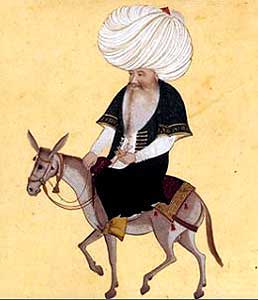
I had planned writing a piece on the Mullah Nasruddin for some while. Partly because I think that our understanding of Islam is so cruelly coloured by the austere extremism of Deobandi and Wahhabi interpretations but mostly because the stories – the jokes as they are so often described – bring back memories of childhood. I remind myself of my father who would use the stories in his speeches to council and who would – at the drop of a hat - launch into a Nasruddin anecdote or make some sweeping Cantona-esque statement such as “They show you the women - and then try to sell you the clothes!".”

On one level the stories are simply jokes and can be treated as such but there is a depth to them that belies merely chortling. Think for a moment on this:

"Once, the people of The City invited Mulla Nasruddin to deliver a khutba. When he got on the minbar (pulpit), he found the audience was not very enthusiastic, so he asked "Do you know what I am going to say?"The audience replied "NO", so he announced "I have no desire to speak to people who don't even know what I will be talking about" and he left.

The people felt embarrassed and called him back again the next day. This time when he asked the same question, the people replied "YES"

So Mullah Nasruddin said, "Well, since you already know what I am going to say, I won't waste any more of your time" and he left.

Now the people were really perplexed. They decided to try one more time and once again invited the Mullah to speak the following week.

Once again he asked the same question - "Do you know what I am going to say?" Now the people were prepared and so half of them answered "YES" while the other half replied "NO". So Mullah Nasruddin said "The half who know what I am going to say, tell it to the other half" and he left!"

Just a joke or something more? Many of the Nasruddin stories are about getting people to think for themselves rather than merely taking the opinion of the “Mullah” as gospel. Again, this is not a regular view we have of Islam – we seem to take it as a religion of absoluteness, unquestioning, stark, definite, without nuance. Yet most Muslims will be more familiar with Nasruddin’s jokes than with the writings and saying of great preachers, imams and Islamic scholars. And as is often the case with these things, the quiet, slightly irreverent, jokey little stories provide a better guide to the outlook of most Muslims that the rather scary, beardedness that is paraded before us by those who would frighten us into compliance.

Whatever. I just like the stories – indeed the titles are often enough to bring a smile and raise a question. So I leave you with this…

“The Moon is more useful than the Sun”

Think about it and enjoy!