Showing posts with label stories. Show all posts

Wednesday, 4 September 2013

Are there deserts in Syria?


"It's perfectly safe, " said the man; "people cross it every day."

He had a beard so who were we to argue. And to get this far we'd passed the signs telling us about poisonous snakes, unstable dunes and not to litter on the beach. What could possibly go wrong!

"You go first," I suggested ignoring the principles of chivaly, "and I'll carry the bags across. You'll be better balanced that way."

So we set out across with each tentative step accompanied by a strange creaking sound and, from between the slats, the occasional scuttling of some beast - a beetle maybe a crab, even a mouse, We didn't look as it might be one of those poisonous snakes.

"Remind me why we're doing this," asked my companion through gritted teeth, "there is some purpose, surely?"

"Ah," I hesitated before plunging into the answer. "We're doing it because it's the only way. And we have to go over there because we're expected."

"Expected?"

"Yes expected," I explained, "we're going there because then we will have done something and those expecting us will be happy with us."

"It will make some sort of sense in the end, won't it?" asked my companion.

"Probably not."

"Huh?"

"But it won't matter because we'll have crossed over by then and the very good and sensible reasons why we shouldn't will be unimportant."

"Are there deserts in Syria?"

.....

Sunday, 19 August 2012

How we'd snigger at the Very Proper Gander!


We would. Snigger that is. After all we're so much more sophisticated than in times past.


Not so very long ago there was a very fine gander. He was strong and smooth and beautiful and he spent most of his time singing to his wife and children. One day somebody who saw him strutting up and down in his yard and singing remarked, “There is a very proper gander.”

An old hen overheard this and told her husband about it that night in the roost.

“They said something about propaganda,” she said.

“I have always suspected that," said the rooster, and he went around the barnyard next day telling everybody that the very fine gander was a dangerous bird, more than likely a hawk in gander’s clothing. A small brown hen remembered a time when at a great distance she had seen the gander talking with some hawks in the forest. “They were up to no good,“ she said.

A duck remembered that the gander had once told him he did not believe in anything. “He said to hell with the flag, too,“ said the duck. A guinea hen recalled that she had once seen somebody who looked very much like the gander throw something that looked a great deal like a bomb.

Finally everybody snatched up sticks and stones and descended on the gander’s house. He was strutting in
his front yard, singing to his children and his wife. “There he is!“ everybody cried. “Hawk-lover! Unbeliever! Flaghater! Bomb-thrower!“ So they set upon him and drove him out of the country.


Yesterday, a twitter fury erupted because the on-line, human equivalent of that old hen misread or misheard the word "snigger" turning it into a terrible racist slur. And I guess that the only thing is for us to take the 'moral' from Thurber's modern fable to heart - having told the Very Proper Gander's tale, our James concludes:


Moral: Anybody who you or your wife thinks is going to overthrow the government by violence must be driven out of the country.


Or off twitter!

....

Wednesday, 6 June 2012

Ray Bradbury remembered...

****


“The October Country” is perhaps the most frightening book I ever read – forget all the jumping out from behind things, zombies and ghosts that make for horror these days, Ray Bradbury was the master. To take you from idyllic, almost perfectly described Elysium to abject terror in one short story – that is writing.

“That country where it is always turning late in the year. That country where the hills are fog and the rivers are mist; where noons go quickly, dusks and twilights linger, and midnights stay. That country composed in the main of cellars, sub-cellars, coal-bins, closets, attics, and pantries faced away from the sun. That country whose people are autumn people, thinking only autumn thoughts. Whose people passing at night on the empty walks sound like rain.”

The reports of Bradbury’s death will doubtless speak mostly of “Fahrenheit 451” and “The Martian Chronicles” – great science fiction. For me Ray Bradbury’s work was far closer to that small town horror we now associate with Stephen King – tales of growing up, loose autobiographical references interlaced with scares, spells and magics. And all written so tightly, with a painful beauty.

I shall go read them again – “Dandelion Wine”, “Something Wicked This Way Comes” and all those wonderful short stories. It would be the best way to remember a great writer who gave us magic, fantasy and science fiction rooted in the lives of ordinary people and showed how that so-often dismissed “genre” fiction is about more than spaceships or dragons.

....

Friday, 6 January 2012

Richard and The Money Tree

****


Richard straightened his papers, placed his pen back in its case and checked that the paper clip part of his desk tidy was properly stocked.

“There’s work to be done,” he muttered to himself, “and I am the man to do it.”

Rising quietly from his desk, Richard turned to the office and said in a loud, firm voice,

“The King’s Men are hiding the truth!”

Bemused looks washed over the office, mumblings were heard: “what’s he on about, now” and “he’s off on one again”.

But Richard wasn’t deterred, indeed such cynicism from his colleagues was inspiring. He’d show them!

“There is a money tree that means everyone can have everything they want. And I shall find it!”

Richard strode to the door, descended the steps and onto the street – the first stop would be the Guild of Economists. Such men would understand and aid his quest.
...

On arriving at the Guild – an imposing, portico’d building – Richard spoke to the robed doorman.

“Show me to the debating chamber of your masters,” demanded Richard, “I must tell them of my quest for the money tree!”

The doorman arched an eyebrow and smiled quietly,

“Come this way.”

Richard followed the robed figure through the Guild’s halls. As he walked past the great paintings of past Guildmasters, Richard choked back his disdain for those men who had conspired with the King’s Men to cover up the truth. Adam, David, Friedrich, Milton –all of them bar the sainted John had hidden the truth about the money tree so as to serve their selfish, greedy purposes.

Richard would show them.

Entering the vast debating chamber, Richard was almost flattened by the cacophony of the place. Arguments were layered over discourse, all conducted loudly and in a language that Richard knew to be part of the great conspiracy that concealed the money tree.

Occult terms flew round the room, “marginal propensity to consume”, "partial equilibrium cost-benefit analyses”, “globalisation”, “government stimulus”, “predictive simulation capabilities” – a veritable cornucopia of the terms of economic magic.

But Richard could handle this!

“Enough of your neo-liberalism, enough of your conspiracy, begone with your spell-making,” cried Richard above the babble of the Guildsmen, “I am here to require your help in my quest for the money tree – a tree you know of but keep hidden at the behest of the King’s Men and the Keeper’s of the Hoard.”

A hush fell on the chamber. Save for one voice.

“Not again! How many times do we have to prove there isn’t a money tree before people like you believe us?”

Richard turned to the voice. It came from what looked like a miner.

“Who’s that?” asked Richard of the nearest Economist.

“That’s Tim,” came the reply, “he lives at The Margins but comes here sometimes for debate.”

“You should silence him, “ said Richard and began his lecture about the money tree. He told how it grew, how the King ordered his men to hide it so the people would suffer while the King’s Men, the Barons and the Keeper’s of the Hoard grew fat on the back of that suffering.

“There is no money tree – it’s a myth,” shouted Tim from The Margins.

Richard ignored the interruption explaining how Robin Hood was now riding against those growing fat on the backs of people’s suffering and how he  - The Courageous One – was now tasked with revealing the location of the money tree.

“There is no money tree and Robin Hood is just a thief!”

Tim from The Margins again but this time his outburst was accompanied by tittering and a few voices repeating Tim’s false claim.

Richard continued, explaining how his researches revealed that the money tree had been taken to a Haven – perhaps on a desert island or maybe in the  mountains. Some of his research suggested there may be more than one Haven of the Money Tree.

“And you, members of the Guild of Economists, must help in this quest. You must reveal your occult secrets. Tell me where this Haven is! Reveal the money tree!”

If it had been cacophony before, the chamber now became chaotic. Some wanted to search again for the money tree – “it may be mythical but who’s to say myths aren’t true”. Others entered into loud debate about Robin Hood and whether he was helping the people or just another thief. And throughout this Tim from The Margins continued mocking Richard.

Turning back to the robed doorman, Richard said,

“Lead me from here. These men are not interested in anything but their neoliberalism and their greed. They will not aid my quest. I shall go to the place of tents where dwell the long-haired ones. The Students of Uncut.”

...

Thursday, 17 November 2011

Myth...


We make a great deal of myth and myth-making. But only in condemnation, in the denial of myth.

Yet myth is more important than we think. It guides us more than we ever admit. And, it is that thing making us human, fallible and wrong:

I would that I might with the minstrels sing
and stir the unseen with a throbbing string.
I would be with the mariners of the deep
that cut their slender planks on mountains steep
and voyage upon a vague and wandering quest,
for some have passed beyond the fabled West.
I would with the beleaguered fools be told,
that keep an inner fastness where their gold,
impure and scanty, yet they loyally bring
to mint in image blurred of distant king,
or in fantastic banners weave the sheen
heraldic emblems of a lord unseen.

We dismiss myth at our peril, for there is truth in it. A deeper truth about ourselves maybe, a truth of longing, of desperation for something finer, but still a truth. By all means stir the air with contending facts, argue away about percentages of this and ratios of that. I will join you knowing, as you know too, that beneath it all lie our culture’s myths – the myths of trade, the legends of business and the stories of England.

To lose all this in some fit of argued rationality would be to lose something grand. It would be to lose the myths that define us, that tell us who we are:

He sees no stars who does not see them first
of living silver made that sudden burst
to flame like flowers beneath an ancient song,
whose very echo after-music long
has since pursued. There is no firmament,
only a void, unless a jewelled tent
myth-woven and elf-pattened; and no earth,
unless the mother's womb whence all have birth.

The sense of wonderment that Tolkein captures here is intended -absolutely - as a defence of myth-making. Its says that without myth, our exploration ceases, the "truth" is settled and man dies.

So let's hear it for myth...

....

Tuesday, 2 August 2011

The Giant Malaysian Killer Chicken - story and the limits of skepticism


Readers may not be aware but Bolton Abbey – more specifically Strid Wood - is the last known habitat of the Giant Malaysian Killer Chicken (you may glimpse it in the picture above if you look carefully). It has been a few years since the last sighting of this elusive avian; indeed some suggest that the Killer Chicken is an invention, an artifice created merely to annoy a small child.

What is important though isn’t the provenance of the bird in question – after all you have to do something to occupy the minds of seven-year-olds who reject the concept of walking, even walking through a glorious English wood. Rather, it is the importance of stories – even stories that the intended target (the seven-year-old) wishes you’d shut up about.

I remember once being told – by a scientist no less – that fiction was a waste of time. Even more that it led to people getting the wrong idea. And, as is so often the case with such sceptical folk, this scientist cited creation stories – or “creationism” as he preferred to call it. Apparently, by teaching these stories to children, we are corrupting them and turning them into anti-science religious maniacs (I exaggerate but only slightly).

Such people struggle – for reasons that escape me – with the ideas that there is more to truth than scientific fact and that stories, even weird creation stories, have a valid truth in them. This one – from Assyrian mythology – is among my favourites since it involves the slaying of a dragon:

So were the enemies of the high gods overthrown by the Avenger. Ansar's commands were fulfilled and the desires of Ea fully accomplished. Merodach strengthened the bonds which he had laid upon the evil gods and then returned to Tiamat. He leapt upon the dragon's body; he clove her skull with his great club; he opened the channels of her blood which streamed forth, and caused the north to carry her blood to hidden places. The high gods, his fathers, clustered around; they raised shouts of triumph and made merry. Then they brought gifts and offerings to the great Avenger.

Merodach rested a while, gazing upon the dead body of the dragon. He divided the flesh of Ku-pu, and devised a cunning plan.

Then the lord of the high gods split the body of the dragon like that of a mashde fish into two halves. With one half he enveloped the firmament; he fixed it there and set a watchman to prevent the waters falling down.  With the other half he made the earth. Then he made the abode of Ea in the deep, and the abode of Anu in high heaven. The abode of Enlil was in the air.

The point of these stories is not merely to explain how the world came to be or even to describe mankind’s role in that world. Rather the story more often seeks to explain how “good” and “evil” interact and how we, as men, are corrupted. So the core of creation stories define a morality – whether this one in which Tiamet, the dragon slain to make the word, has aspects of good (the world’s creatrix) and evil (the serpent) or those we are more familiar with such as the Adam and Eve story.

Fiction - the making up of stories – is important if we are to allow our morals, what we see as ‘good’ or ‘evil’, to be understood. We know that the setting down of rules – the lawyers’ obsessiveness that gave us Leviticus and the accountants’ passion that brought Numbers – do not define our moral purpose or even, in that phrase of Mums everywhere, the difference between right and wrong.

The skeptic rejects story – This goes in part to explain the dry dullness of his chosen belief system – preferring instead the idea (a delightfully fictional idea) that truth and understanding derive from a thing called “empirical enquiry” and from that enquiry alone.

Skepticism ... is an approach to claims akin to the scientific method. It is a powerful and positive methodology (a collection of methods of inquiry) that is used to evaluate claims and make decisions. It is used to search for the (provisional) truth in matters and to make decisions that are based on sound reasoning, logic, and evidence. Skepticism is based on a simple method: doubt and inquiry. The idea is to neither initially accept claims nor dismiss them; it’s about questioning them and testing them for validity. Only after inquiry does a skeptic take a stance on an issue.

I see no place in this for story, for wonderment or for the learning that comes from telling an intelligent seven-year-old that Strid Wood is the habitat of a giant killer chicken. Some will observe the contradiction between arriving at a ‘stance on an issue’ through reasoning and through ‘doubt and inquiry’, via scientific method. But that would be to play games of logic with the core belief of a faith – in this case ‘skepticism’.

Story-making and story-telling must be central to our culture, to deny fiction is to deny an essential element of humanity. To characterise stories as ‘childish’ or ‘misleading’ is to misunderstand the power of those stories, the manner in which speculation, creation and change is driven by dreams and hopes rather than by the dry exploration of something “akin to the scientific method”.

....

Wednesday, 4 August 2010

A little more on Whimsy....

I am – as my more avid and assiduous readers will know – something of a fan of whimsy. If we’re allowed to use such a base word as ‘fan’ to describe the fine work of great writers? I’m never quire sure where to find the finest whimsy – the Americans have always had a knack for it. From way back writers like Mark Twain, Washington Irving and Nathaniel Hawthorne wrote whimsically – capturing that slightly laid back, wide-open-space feeling of Middle America. And this thread runs right through American writing and film – Stephen King’s short stories, Capra’s films and even more recently delights such as “Big Fish” all capture that spirit of wonder.

But it’s not just the Yanks – the “Little World of Don Camillo is a wonder of whimsy created by an Italian, Giovanni Guareschi and there is little to top the joyous whimsy of Idries Shah’s delightful Sufi tales. Nor should we discount the English writers of whimsy – Paul Jennings with “Resistentialism” and "Ub" or Peter Simple’s collection of characters, some satirical, some just providing a great, happy smile. It is all magical, delightful – you can’t read Neil Gaiman’s “Stardust” or “American Gods” without the sorcery of whimsy sparkling through you.

For me it all started with Thurber. With the man who described his writing like this:

“The writing is, I think, different. In his prose pieces he appears always to have started from the beginning and to have reached the end by way of the middle. It is impossible to read any of the stories from the last line to the first without experiencing a definite sensation of going backwards. This seems to prove that the stories were written and did not, like the drawings, just suddenly materialize.”

Thurber wrote biography (or at least what he claimed was biography), stories – you’ll know one or two of them such as “The Secret Life of Walter Mitty” more likely from film versions – and an array of short pieces such as the wonderful ‘Fables for Our Time”. There are occasional moments of laugh out loud but mostly the stories relax you, make you want to sit back, take a sip of whisky, a drag of good cigar and just smile that big smile.

And Thurber – like so many of these writers – was modest about his talents seeming ever grateful that the world hadn’t yet rumbled him. I suspect there might be an element of self-description in the ‘moral’ to “The Owl who was God”:

“You can fool too many of the people too much of the time”

Wednesday, 3 February 2010

Wednesday Whimsy: The Moon is more useful than the Sun


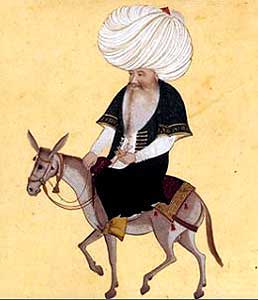
I had planned writing a piece on the Mullah Nasruddin for some while. Partly because I think that our understanding of Islam is so cruelly coloured by the austere extremism of Deobandi and Wahhabi interpretations but mostly because the stories – the jokes as they are so often described – bring back memories of childhood. I remind myself of my father who would use the stories in his speeches to council and who would – at the drop of a hat - launch into a Nasruddin anecdote or make some sweeping Cantona-esque statement such as “They show you the women - and then try to sell you the clothes!".”

On one level the stories are simply jokes and can be treated as such but there is a depth to them that belies merely chortling. Think for a moment on this:

"Once, the people of The City invited Mulla Nasruddin to deliver a khutba. When he got on the minbar (pulpit), he found the audience was not very enthusiastic, so he asked "Do you know what I am going to say?"The audience replied "NO", so he announced "I have no desire to speak to people who don't even know what I will be talking about" and he left.

The people felt embarrassed and called him back again the next day. This time when he asked the same question, the people replied "YES"

So Mullah Nasruddin said, "Well, since you already know what I am going to say, I won't waste any more of your time" and he left.

Now the people were really perplexed. They decided to try one more time and once again invited the Mullah to speak the following week.

Once again he asked the same question - "Do you know what I am going to say?" Now the people were prepared and so half of them answered "YES" while the other half replied "NO". So Mullah Nasruddin said "The half who know what I am going to say, tell it to the other half" and he left!"

Just a joke or something more? Many of the Nasruddin stories are about getting people to think for themselves rather than merely taking the opinion of the “Mullah” as gospel. Again, this is not a regular view we have of Islam – we seem to take it as a religion of absoluteness, unquestioning, stark, definite, without nuance. Yet most Muslims will be more familiar with Nasruddin’s jokes than with the writings and saying of great preachers, imams and Islamic scholars. And as is often the case with these things, the quiet, slightly irreverent, jokey little stories provide a better guide to the outlook of most Muslims that the rather scary, beardedness that is paraded before us by those who would frighten us into compliance.

Whatever. I just like the stories – indeed the titles are often enough to bring a smile and raise a question. So I leave you with this…

“The Moon is more useful than the Sun”

Think about it and enjoy!