Showing posts with label mutuals. Show all posts

Monday, 30 December 2013

Another report on housing that ignores the planning system....

There is a growing number of people who think that the lack of housing - affordable or otherwise - in the UK is some sort of failing of capitalism and that, if we had a different system things would be all fine and dandy.

Here's a fine example of the genre from Michael Bauwens on the P2P Foundation blog:

The high cost of housing is draining money out of the productive economy, mainly through land and house price inflation, with damaging effects for national and individual household budgets. Many new homes are unaffordable to ordinary working people, some offer poor value for money in terms of quality or construction, design and energy performance, and cost pressures frequently drive out good design in the spaces between buildings and in the concept of supporting new neighbourhoods. Many new developments are socially, environmentally and economically obsolete from the moment they are conceived, let alone designed or built.

This is great but the author fails to adequately answer the question as to why housing is so expensive. Instead we have a straw man built for the author to attack:

...in Britain, only 0.6% of the population – 36,000 people – own about half of the land. This is a significant structural reason for soaring housing prices and continuing wealth inequality.

Now this is true but there's a big problem with the argument. This ownership structure has absolutely nothing at all to do with the price of housing. Take a peek at the map of the UK. Most of the land these 36,000 people own isn't about to be used to build housing. Indeed, much of it is of pretty limited value - agricultural land values remain at below £10,000 per acre (in Scotland the value is below £5,000 per acre).

 Residential land values are another matter altogether - in 2010 the English average for residential land was about £950,000 per acre. In simple terms land for building on is nearly 100 times the value of the land for growing stuff. And more to the point, those 36,000 people our author thinks are the problem don't own most of this building land.

The problem isn't a question of market failure but a consequence of intervention in the market. We told in the article how wonderful the garden cities movement was:

The most notable example is the new town of Letchworth, 34 miles north of London, which was created in 1903 when developer Ebenezer Howard acquired 4,000 acres of farmland. He worked with ethical investors, Quakers, philanthropists and others to build a town whose land values would be community owned. 

The essential point here isn't that Howard had a wizard wheeze but that he was able to buy farmland and build houses on that land. And in building houses on the land (and shops, pubs, hospitals, etc.) Howard made it possible to capture (in our author's slightly partisan words):

...both the “unearned increment” of land value increases as well as “economic rent” of land (the excess returns commanded by a finite resource), so that everyone, not just investors, could benefit.

Howard was able to go into the market, buy agricultural land at agricultural land values and then get more value from the land by 'farming' houses rather than wheat or sugar beet. In England today this is not possible for the simple reason that residential land is worth ten times what agricultural land is worth. It doesn't matter whether you're running a co-operative, setting up a 21st century new town corporation or a wicked capitalist developer, you will pay nearly £1,000,000 per acre to the land owner (and a great deal more than that if you're anywhere near London).

The reason for the huge gulf between agricultural land values and residential land values isn't to do with capitalism, it isn't to do with who owns the land and it isn't to do with the uneven distribution of wealth. It's because of this:

In recent years the idea that physical planning should be conceived as a national, rather than a local, responsibility, has gained ground. The establishment of a Ministry of Town and Country Planning in 1943 was followed in the same year and in 1944 by statutes which brought this goal nearer to fulfilment. But the main weaknesses persisted. The 1947 Act seeks to cure them by solving the financial problems of local authorities and at the same time erecting a new structure of planning machinery to ensure that planning will be centrally co-ordinated and also effectively executed. 

There were few planning constraints on Howard's development at Letchworth or the later Welwyn Garden City meaning that the 'collectivist' model he preferred was fundable without government support or involvement. Since the 1947 Town & Country Planning Act and the creation of 'green belts' the model proposed here - an updated garden city movement - is simply not possible.

The reality is that any discussion of housing that doesn't mention the planning system misses the main barrier to lower values and more construction - planning. And we've seen the outcry when pretty minor changes to the planning system are introduced as the National Trust, the CPRE and national media plonk their heavy guns on the government's lawns.

Mutual systems of housing ownership and housing finance are a fine idea (although we should be careful what we wish for) but the real debate should be about how to balance the desire to protect open country and community identity - the reasons for the 'green belts' - with the equally pressing need for new housing, especially in the South East. And any report offering solutions to our housing challenges that ignores the planning system - as our author does here - is simply a waste of paper.

....

Wednesday, 18 December 2013

Democracy is not enough.

****

There are lots of people - from both the left and the right of politics - who like the idea of voluntary, shared or common ownership. In this they see an alternative to the centralising tendency of modern government. For some this is a starry-eyed remembering of past models and idea - the Rochdale Pioneers, the Levellers and mass trespasses on Kinder Scout. Here is a celebration of the co-operative and it still has a powerful voice on the left of politics.

Meanwhile, on the liberal right, we hear of voluntarism, of the charter city and the idea that local government isn't needed - collaboration, market mechanisms and, yes, co-ops will provide voluntary (that is without taxation collected by force of law) management of what we call 'public' services.

There is much to commend both these approaches - by rejecting the big government model they are people-based and, we hope, responsive to needs at the genuinely local, community level. Indeed, in the USA local government is far less constrained by the national political agenda and property ownership rules allow for private collaborative systems that wouldn't be possible under, for example, the UK's laws. The result of this has been the evolution of shared ownership models - co-operative and mutual.

Today some 63.4 million US citizens live in 323,600 places that are members of the Community Associations Institute - that's over 20% of the population living in places where many of the things we associate with local government are provided by a mutual association of members. And:

In a lot of places – probably in most – it’s a sort of government-among-friends, where rules are applied and interpreted with good faith and generosity, where neighbors cooperate on upkeep, and where buildings and communities look better and function better because of it.

Based, as these things are, on some sort of democracy - residents, as members, vote for management committees and these committees commission the services, maintenance and support that everyone needs - cleaning streets, cutting verges, managing shared services and often things such as collecting rubbish. These committees will also set down rules about other things so as to maintain the peace, tranquillity and ambiance of the place.

And it's here where the problems start:

But, in others, homeowners’ associations appear to have more in common with the Soviets than just a communal process.  Writing in The Washington Post, Justin Jouvenal recently reported on a knock-down, drag-out fight over a simple political yard sign placed by a couple on their property during the 2008 election season.  The association’s grievance, apparently, was that the “Obama for President” placard was four inches taller than the association’s covenants allowed. 

Democracy dictates that the collective - or rather fifty percent plus one of that collective - can impose rules (and when you join - buy the property - you sign up to those rules). Thus the row about the political placard. Indeed, the rule-makers in these places determine the 'right' image for the community and act to prevent residents installing solar panels and landscaping gardens:

“Imagine growing a lush, organic garden full of fruit trees and raised beds featuring edible flowers and vegetables. It’s beautiful. And it’s in your backyard. Your slice of heaven. Your respite. The place where you can get your hands dirty growing wholesome, nourishing foods for you and your family.

One day you stroll out to your mailbox to find a letter from your HOA telling you your garden is in violation of HOA rules. According to your deed restrictions, all fruit trees and edible plants should be grown inside a screened in patio. You face $100/day fines for each day that you refuse to tear up your fruit trees and remove your raised beds.”

This is not the action of some brutal uncaring landlord but the imposition of a mutual organisation - cuddly, sharing, democratic.

We discover that democracy isn't enough. It doesn't provide the protection allowing for that resident to do what she wished - plant fruit trees and vegetables in raised beds. The resident could protest, could try to change the rules - but in the meantime that mutual, collective organisation is fining her $100/day.

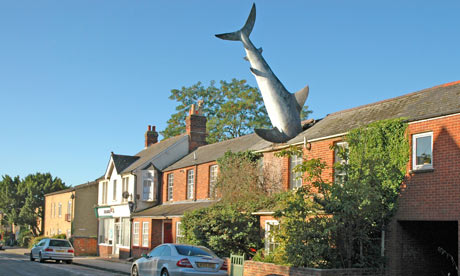
We are reminded that democracy isn't a guarantor of rights. Nor is democracy reasonable, sensible or flexible. On its own democracy wants to enforce conformity with the norm - or what the democrats see as the norm - and to prevent people putting plastic sharks in their roof or replacing a lawn with a water-conserving, drought-resistant garden.

The consequence of shared ownership is that the majority will dictate how that shared property is used. And if you're in the minority what you want is of no consequence. And that majority will impose its will.

Democracy is not enough.

....


Sunday, 24 November 2013

A Co-op memory.


It's 1977. Mum had sent me to buy an iron. I had complete instructions - the particular iron to be bought, how much it was on sale for and where to buy it. So I toddled off to the selected location clutching the cash needed for the purchase - the Co-op on Penge High Street.

I entered the Co-op (for current Penge residents the Co-op isn't there any more but it's next door to the Odeon Cinema that isn't there any more either) and look around for the location of the iron. After a moment's scrutiny of the signs - they weren't especially helpful, I recall - I headed to the most likely spot. You need to appreciate that, at no point in this adventure had there been any human encounter or indeed any encouragement for that encounter to happen.

I found the iron, checked its price and began the next phase of the adventure - trying to buy the blessed thing. From the spot I was stood there was no obvious "pay here" sign and, unlike the supermarket, there wasn't a bank of checkouts before the main doors.

"Aha," I thought and headed for the food section of the store clutching my iron, "they have checkouts there."

So I queued and, once at the front of that queue, presented my iron for payment.

"You can't buy that here, love."

"Oh. Where?"

An arm was waved in the vague direction of the main store (from where I had just come).

"Over there in the store."

I trudged back to the main store. In a distant corner, I spied what might be a shop assistant. I headed that way and it was such a person. They were unpacking a box and placing it's contents on the sales desk. Carefully, one item at a time.

And ignoring me stood shuffling from foot to foot a couple of yards away clutching a ten pound note and an iron. After a while, the assistant looked up and grunted.

"Wanna buy that, mate?"

"Er, yes." I held out the iron and the £10.

"Gotta go to the pay desk for that."

"Er, where..."

"By the lift."

I turned and headed towards the indicated location. And, yes, the pay desk was there. However, there was one small problem, there was no-one behind the desk to actually pay. I stood. I looked around for a bell to ring or maybe some instructions as to where to go in the event that the pay desk was unmanned. Nothing.  So I stood some more.

A older woman shambled over after what seemed an eternity.

"Can I pay for this please, " says I in an ever-so-slightly frustrated tone.

"Ysfffs" mumbles the woman and starts trying to insert a key hanging from a string on her belt into the till. After three or four goes at this, the till finally responds with those little lights and bells the new electronic wonders have to entertain us.

And I can complete my purchase. The woman seems somewhat affronted that someone actually wanted to buy something, as if this was not the reason why the Co-op had a big department store on the High Street.

"Thanks," I said once the sale was complete.

And I walked out from the shop. Not sure I ever went in again before it closed a couple of years later. Didn't seem much point since they didn't really want any customers.

....

Thursday, 24 October 2013

Do mutuals scale?

****

Charles Moore (among many) comments:

More attention should be paid to the failure of the Co-op Bank. It suggests that an ‘ethical’ motivation does not guarantee that the interests of the customer will be well served.

This may well be true, indeed the 'ethical' argument was always more of a positioning statement than something inherent to mutual organisation models.

My question is more fundamental given the problems with the Co-op (and the banking disaster has taken attention away from its underperformance as a retailer and aggressive behaviour as an undertaker) - can mutuals scale up to be large national organisations and maintain business effectiveness?

It seems to me that the problem is one of accountability - the leaders of large mutual organisations (especially those that are consumer mutuals rather than worker mutuals) are not as accountable to their members as joint stock companies are to shareholders. The business cannot go to its 'owners' for more cash and those owners either cannot or do not act to replace the management when it fails (such as by arriving cap in hand asking for the money to clear up mistakes).

Cullingworth Conservative Club is a mutual organisation - it works because having about 800 members who live in the village and use the club means that the leadership is accountable. A national mutual - the Co-op or one of the big building societies - has a leadership that isn't subject to this attention or scrutiny, that isn't really accountable. Perhaps here lie some of the problems?

...

Friday, 24 February 2012

Too few people using The People's Supermarket it seems!

****

There was a flurry of right-on, luvvie commentary about the People's Supermarket a while back:


Arthur Potts Dawson, the mastermind behind The People's Supermarket, is certainly full of what one might loosely define as organic missionary zeal. A tall, youthful and reasonably optimistic chap who set up the London eco-restaurant Acorn House, (and is vaguely related to Mick Jagger, inter alia), Potts Dawson hopes that once his baby takes off, the likes of Tesco and Asda will be as a bad dream. We will all put in our community service and revel in 1970s-style food bills, while the big boys founder.

This is because in return for washing walls at TPS, you will be eligible for a 10 per cent shopping discount, and the ability to buy about 20 special "People's" foodstuffs at artificially low prices. Ordinary shoppers will be able to use the store, but not access the cheaper prices. Only we cleaners qualify for that. 

Eighteen months later it doesn't seem to be working out for them:

Due to financial difficulties, The People's Supermarket has struggled to keep up with the payment of business rates to Camden Council. The People's Supermarket is a Co-operative and Community Benefit Society and operates for the benefit of its members and the community, not in pursuit of profit. For that reason, we ask that Camden Council continue to support us by allowing for the renegotiation of rate payments. In the absence of such support, The People's Supermarket will become insolvent by March 1st.

So when we're getting all excited about different business models, frothing about mutuals, co-ops, co-production and other such wonders, let's not forget the basic truth about the market! If you don't have enough custom, you don't make enough income and you can't pay your bills. With the result that the cap is waved under the council's nose saying "help us out - we're really good even though we're losing money!"

....

Thursday, 9 February 2012

Can we reduce the "poverty premium" without repeating those sub-prime mistakes?

****


Niall Cooper from Church Action on Poverty has written a piece of what he calls “fair pricing”:

And secondly, fair prices.  Much of the ‘logic’ of the way markets have developed in recent years is to move towards ‘risk (or cost) pricing’ and away from shared risk.  Some of the assumptions behind this are extremely dodgy:  The majority of high cost lenders claim that their premium prices are based on the ‘risk’ of lending to low income customers… any yet, when customers pay week after week, year after year, the cost doesn’t go down.  But fundamentally, is it socially (or morally) acceptable to operate ‘cost’ pricing models which force the poorest to pay most?  How can companies square all their talk in recent years of corporate social responsibility, with charging their poorest customers the most?

It has become a mantra of anti-poverty campaigners that poor people pay something they call the “poverty premium”:

Lack of access to the best online prices, bank accounts and managing their budget via cash all adds together to give the poorest families the worst deals around. The result is a poverty premium that costs the poorest families more for the same energy, cookers and household items, credit and insurance than their wealthier peers.

The two prime culprits for this premium are energy and financial services especially lending. In the case of energy this is mostly about methods of payment – the understandable reluctance of people on low incomes to use direct debit as a means of payment. So, in reality, the whole problem is – as Niall Cooper implies – down to financial services. Especially since the ‘food desert’ argument turns out to be a bit of a myth.

“The U.S. Department of Agriculture defines a food desert as a low-income census tract where a large number of residents are more than a mile from a grocery store…. [L]ess than 4.5 percent of the U.S. population [falls into that category].

The question then is how to make is easier for poor people to access affordable financial services given that those poor people are less likely to repay loans, more likely to over draw and live in places where car crime and burglary heighten insurance risks. For this Niall Cooper suggests intervening in the market:

And if individual businesses are unwilling to offer products to low income consumers at fair prices (not least by claiming they can’t do so if their competitors don’t), then is there not a role for market intervention?

The problem is that – certainly where lending is concerned – we have been down this route before. After all mandating lending to high risk borrowers was a central driver in creating sub-prime problems especially in the USA. And if you introduce price caps (as Stella Creasy wants) without mandating lending to poor people then you kill the market entirely. The consequence of this is to create an even bigger problem for which the only solution is unregulated and illegal lending.

Rather than looking at forcing price cuts on suppliers, we should instead consider whether block buying is an option. Social landlords could, for example, purchase energy more cheaply than tenants and have the systems to collect payments in place already. And, certainly for contents insurance, the same should apply. It would be interesting too to look at whether local councils or social landlords could broker other insurances such as third party car insurance helping to spread risks and reduce costs.

If we look to new generation mutuals such as credit unions there are perhaps similar opportunities to reduce costs and spread risks. What we can’t do is wholly eliminate those risks (something the world is finding out very painfully right this minute) meaning that poor people will continue to have problems with access and pricing in financial services. In using co-operative solutions we can ameliorate these considerably and, in market terms, safely. Mandating prices simply takes us back into the financial disaster of sub-prime lending.

...