Showing posts with label property. Show all posts

Saturday, 20 April 2019

Elsewhere - on why big business doesn't own England


At Conservative Home:
For me, the significance of Shrubsole’s work isn’t the ‘look at all those secret, tax-avoiding businesses owning land’ but, rather, the picture he provides of how land investment is skewed by the UK’s planning system. Without housing land supply being controlled by the Government, there would be no need for land banking and no speculative markets in green belt agricultural land.

Moreover, we now know that corporate land ownership is mostly purposeful rather than speculative – companies like Peel Group own things (the Manchester Ship Canal, John Lennon Airport, the Port of Liverpool) that are actively managed, income generating assets, and the same goes for the land ownerships of water companies and other utilities.
The whole piece is here.

Saturday, 12 January 2019

Quote of the day - tax incidence ain't what you think it is...


From John Cochrane's blog:
The top two things our politicians say they want to encourage are jobs and home ownership. Jobs are perhaps the most highly taxed economic activity in the economy, and by this calculation houses come in a close second
So, for all that we want jobs and homes, the tax system makes those jobs and homes more expensive. Cochrane also points out that the incidence of wealth taxes depends on the interest rate - where the level of tax equals the interest rate (or yield or whatever measure of return to property investment you're using) it's effective rate is 100%.

So it makes more sense to tax the returns rather than the sum invested (or indeed its actual, estimated or putative value) and, life being what it is, this is what we do most of the time. Now this might all seem a bit obscure but, if people respond to incentives (like the economists say) then it is the actual incidence of a tax that matters not the rate or the person who writes the cheque.

And, since I'm here and talking about taxes on property, let's talk about business rates. Any, even passing, conversation about business (and especially retail) ends up with a discussion about business rates. Just about everybody says that the tax is to varying degrees unfair, not flexible, and impeding investments. The problem is that every proposal for reform (like this one from Centre for Cities) amounts to tinkering rather than a change to the way in which businesses are taxed.

And we should remember that businesses want to pay less tax because they simply represent a cost to the business with the result that they either reduce returns (see above for why this matters), lower wages or raise prices. As Cochrane pointed out - we want jobs, business and a thriving high street but, at the same time, don't realise that the tax system reduces the incentive for people to do the things that make these investments happen.


....

Monday, 16 April 2018

A note on why land values matter...


This is a really splendid building in Bradford city centre:


As you can see it occupies a large footprint, has three stories and an imposing presence (it's also listed and in a conservation area but those details aren't relevant to my point here). It was recently sold at auction where it was listed at £670,000. I've a feeling it might have gone for less than this despite having good sitting tenants. For less than a flat in Southwark you could have all this magnificence!

The thing is that this price reminds me that land values in central Bradford are essentially zero. Imagine that's a cleared site for a second - could you build a three storey office block (even one that's not natural stone and to a high design quality) there for less than £670,000? Of course not.

The building is, however, there and this means it has value. But the sad - and it is sad - truth is that land in Bradford is pretty much valueless even if the buildings currently sitting on that land can be used and can generate some sort of yield. Forgive me for feeling that it's pretty difficult to have a commercially-driven regeneration strategy if the land values are zero or negative.

Maybe we need a different approach? Like the one here

.....

Saturday, 27 January 2018

London's property market - are the vultures circling yet?


My wife owns a share in an apartment on the Costa del Sol and it's lovely. But as successful investments go, it isn't one. The area between Estepona and San Pedro is littered with the marked out roads, pavements and street lights for what would have been thousands of villas and apartments. Even some of the completed developments are ghosts, mothballed by the developer or the bank against some possible - even mythical - future recovery in the housing market. Don't get me wrong here, there are also thousands of completed developments filled with happy people from all over Europe, it's just that the enthusiasm of developers, the gung ho (and sometimes corrupt) approach of local councils to development and an international property investment industry focused on flipping off-plan rather than housing people resulted in a vast oversupply of development opportunities.

For all that the Costa del Sol is great, the supply of people who want to go and live there is limited especially given the competition from other sunny, cheap and welcoming places like Bulgaria, Malta, Cyprus, assorted Greek Islands, Turkey and Portugal. Not to mention the rest of Spain's Mediterranean coast. I know that 'living there' covers a multitude of options from full time residency through spending winter on the beach to what amounts to extended tourism. But such opportunities limit the demand for such property, even in a world where a two-bed apartment will cost as little as £100-150k.

Imagine then how limited the market must be for two-bed flats that are selling at £2-3m!
There are an extra 14,000 unsold apartments on the market for between £1,000-£1,500 per sq ft. The average price per sq ft across the UK is £211.

Molior says it would take at least three years to sell the glut of ultra-luxury flats if sales continue at their current rate and if no further new-builds are started.

However, ambitious property developers have a further 420 residential towers (each at least 20 storeys high) in the pipeline, says New London Architecture and GL Hearn.
So we already have 14,000 empties and plan on building about 40,000 further properties to go onto this market? Do we not see that this is going to do nothing at all to resolve London's housing problems, will probably bankrupt a couple of developers and will result in a lot of wealthy Londoners stuck in negative equity. Regardless of any Brexit effect, the simple truth the we learned on the Costa del Sol applies here - there aren't enough people who have the cash to buy these apartments and who want to own property in London.
...hundreds of Asian investors who had bought London developments off-plan in 2015-16 in the hope of making a quick profit by selling apartments on closer to completion have instead lost hundreds of thousands of pounds. “They intended to flip [buy and sell on] the apartments and make big profits, but it hasn’t worked out like that, and now they are trying to get out at the smallest possible loss.”
A lot of folk who lounged on Spanish beaches back in 2004 or 2005 will be very familiar with this pitch - it was what the salesmen said back then: "the market's booming, everyone's investing, you only need to put down a deposit, you can't lose!" A loads of people took the punt, sticking down options on, as yet unbuilt, apartments and villas expecting to "flip them". It didn't happen. Most ended up owning an apartment they hadn't expected to own that was worth a lot less than the mortgage. For some it was a financial mess, even a disaster.

In London and for the New London Architecture "shiny city of millionaires" sort of developers, the prospects look pretty grim right now. Not because of Brexit (although that probably hasn't helped) but because if your development strategy is based on there being an increasing supply of people who can pay more than £2m for two-bed flat, then - outwith Venezuelan-style inflation - your strategy is going to crash. London's centralise and densify policies are creating this situation. Indeed, I'm sure the vultures that feed apon unsuccessful capitalists' vanity are circling already.

The problem is that, in every way (not just housing) London is too expensive, not family-friendly and lacking in the essential community that makes places work. Without revisiting the "build it ever higher" strategy - densify, densify, densify - London faces a second property crisis; one of empty mothballed homes owned by anonymous finance houses, crashed property developers, a frantic secondary market of short term lets, and an ever-wondering public asking why the city built things for international investors to 'flip' rather than homes that people might want to live in?

I recall a conversation with a Yorkshire developer about a conversion and new-build scheme in Saltaire. He ended up rescuing the development by creating a rental business for the flats he couldn't sell. Speaking to me he said: "Six months earlier I'd have been pricing up yachts, six months later I'd have been bankrupt." Right now London's 'build it and they will come' development market is looking pretty ropey and it's hard not to conclude that, as ever, avarice and vanity have meant that property developers have ignored the lessons of the Costa del Sol.

Yes, you've got benign local (and national) government keen for you to build. For sure, there are banks from all over ready to throw money at the schemes. But are there actually enough real customers for the things you're building? If there isn't, you need to think again about the strategy. In the case of London, we've maybe reached the point where there isn't.

....

Saturday, 7 October 2017

Let's stop watering down Corbyn's policies and offer a property-owning democracy again


There is a modicum of welcome introspection within my party. Questions about our values, purpose and mission are mixed in with less considered and more tactical debates about getting more support from young people or responding to what Brexit (and Corbyn) "means". Alongside this is a discussion about organisation - whether the party has the structure, membership and organisation to take a positive message to the electorate.

For me, and the apparent success of Corbyn's populism doesn't change this fact, the answer doesn't lie in contention or extremes but rather in consensus and moderation. Don't misunderstand me here, this isn't a rejection of ideology, but rather a recognition that policies drawn from our belief in freedom, community, neighbourliness and self-reliance have to chime with the values of people who we want to vote for us.

So let's start with those values rather than - as we see here from David Skelton - an approach based on opinion polling - little better than a list of bribes (higher minimum wages, housing subsidies, free tuition) aimed at attracting support. This is what we mean when we talk of populism and is precisely the programme that Corbyn espouses - rail nationalisation has big opinion poll support so we propose rail nationalisation. Students say they want free tuition so we give them free tuition. All paid for through another solidly opinion poll tested plan - increasing taxes on big business and "the rich".

What Skelton proposes is a return to what was once called Butskellism, a policy platform based on trying to have as close a policy platform to the other side as possible without quite abolishing any difference. Here's an example:
A reformed Toryism could address the growing disparity between capital and labour and encourage firms to empower their workers with shares and board representation. But that shouldn’t obscure the need for higher wages. The minimum wage should be increased when possible, and companies above a certain size should be expected to report on how they are moving towards paying the voluntary living wage (£8.45 in the UK and £9.75 in London).
If I'd replaced the first three words here with "a Labour government under Jeremy Corbyn" no-one would have batted an eyelid. What we have is a policy platform founded on wording current Labour policies slightly differently and calling it "reformed Toryism":
a new generation of genuinely affordable, low-rent homes,

reducing tuition fees and concentrating the greatest attention on those from poorer backgrounds

hindered by cuts to in-work benefits and anti-trade union rhetoric.
All of this is good stuff but it does not give a single young person (or indeed older person) a solitary reason to switch from voting Labour to voting Conservative. All Skelton - and too many others on the left of my Party - is saying is "be more like Labour by proposing toned down versions of their policies".

So let's start instead with these values:
Wherever you go in the world you'll find people who hold as important such things as family, neighbourliness, independence, duty and effort. That you should work hard, contribute, look out for the neighbours, bring up your family as honest, self-reliant and care for those less fortunate.

And these are conservative values, the building blocks of community. None of them are about government, large or small. None of them see society as greater than the sum of its individual parts. And none of them are predicated on knowing better what is good for your neighbour.
Let's frame a policy platform beginning with the communities we want to represent rather than with centrally-directed proposals determined by opinion-polling. Let's talk about community, about how health, social care, good jobs and much else start with the places we live in rather than with the Bank of England, International Monetary Fund and National Health Service. I like it when Skelton talks about people having a stake, although he makes the mistake of talking about "the economy" rather than "society". As conservatives we need to renew the offer we made repeatedly - in 1959, 1970, 1979 and 1992 - do the right thing, play your part, get an education, work hard and you will have a stake in society. Right now overpriced housing, the pillage of pension funds and disincentives to invest mean that people, especially younger people, struggle to see how they're to get that stake in society - the real cash stake we all believe we were offered.

I'm pretty sure this means some tough choices about policy but we start by renewing the offer - to everyone - of a property-owning democracy. To get there we've to have some tricky converstaions about green belts, care for the elderly and the balance between taxing what we earn and taxing what we spend. We've to embrace the idea of family again - not as some sort of mythical Oxo advert image but the messy, complicated and varied things that are the reality of our lived experience as families. And, above all, we need to start talking about community and getting the decisions about care, health and social support down to that basic building block. You only need look at the benefits system - which can't process a claim in less than seven weeks leading directly to destitution - to see how centralised, national systems really don't work.

I've said before that we should start, as conservatives, with caring about what's right outside our door. It's dull, I know - soft loo paper conservatism as a university colleague called it - but most people are not either interesting in or impressed by fancy dan utopian solutions. Don't get me wrong, we'll respond to a straightforward bribe - free stuff paid for by taxing anonymous others - but conservatives have usually been better than this and, when we are, we change the world for the better.

We won't win by offering watered down versions of Corbyn's policies but by renewing the offer we made to my generation - an offer that was met - of creating a property-owning democracy. Let's do it.

....


Saturday, 3 June 2017

You don't want to live there, do you? A comment on sky-high house prices


I know, I know. You don't want to live on the edge of Woodside, a former council estate on the Bradford side of the Bradford-Halifax boundary. Location, location, location as the saying goes.

But stop and think for a minute. Just recently the resolution Foundation had this to say:
HOME ownership among young people across Bradford and West Yorkshire has halved in a generation.

The findings have been announced by think-tank The Resolution Foundation which said it counters “the popular perception that the struggle to get on the housing ladder is largely confined to London and the South East”.
So here we have three flats that will be sold at auction rather than through the regular market and which will end up in the private rental sector. Yet finding £5,000 for a 10% deposit and borrowing £45,000? Is this really unaffordable to working young couples in West Yorkshire?

Bradford's median full time working income is about £450 per week (was £447.1 in 2014) - let's call that two grand a month between friends. And let's further assume that twentysomethings earn two-thirds of median. A typical Bradford young couple (if such a thing exists) should be able to afford - with comfort - one of these flats.

But then, of course, you don't want to live there do you!

....

Thursday, 21 July 2016

So the Chinese are buying up Sheffield. Tell me economic nationalists where's the outcry?


****

You'll all recall the outcry - much of it pig-ignorant - over the sale of ARM Holdings to a Japanese company. Between people blaming Brexit and a veritiable torrent of slightly leftish economic nationalism we were told that this was a terrible foreign take over. Maybe it is, maybe it isn't (I lean towards the latter - after all I'd be cheering on a British business buying a Japanese company why not the reverse).

What I don't understand it the selective nature of this economic nationalism. I've not picked up anything like the same sort of negative response to this:

In the biggest Chinese investment outside London, Sheffield city council announced that an initial £220m would pay for four or five city centre projects over the next three years and create “hundreds if not thousands” of jobs in south Yorkshire.

The partnership is between Sheffield city council and Sichuan Guodong Construction Group, one of the biggest firms in China’s south-western Sichuan province.

What, dear reader, is the difference between a massive Chinese conglomerate buying up big chunks of Sheffield city centre and the (admittedly larger) inward investment deal that was the ARM takeover? Or for that matter the perennial whining and whimpering about foreign investment in London property? I mean, if you're going to be an economic nationalist - adopt the daft Will Hutton view of industry - then, for heaven's sake, be a consistent economic nationalist.

What we have here is a massive Chinese investment in UK property - celebrated by The Guardian. Just the sort of thing the same paper was railing against a short while ago:

Foreign buyers now own close to 10% of the UK’s housing stock, he claims, and, unchecked, will gobble up much more, increasingly in Manchester, Edinburgh and other regional cities. With the global financial elite numbering at least 15 million, “increasing housing supply can never bring down prices, no matter how much public land and green belt is turned into flats, because the demand for investment returns is almost infinite.”

Thes epeople really do need to make their minds up. Just because this is a snuggly deal between a Labour Council and a big Chinese corporation (with all the lack of accountability that goes with this sort of deal) doesn't make it special or better - it's just as much foreigners buying up British assets as the ARM deal or a thousand other mergers, property investments and stock purchases. All in all a reminder that economic nationalism is stupid.

.....

Thursday, 24 September 2015

Hurrah! The High Street is saved! The man from Savills says so!


The man at Savill's who sells retail property thinks the high street is fine:

There is now a clear consensus that the rise of online retail is not killing the UK high street. In fact, in some cases, the internet is helping to promote the need for retail space as the boundaries between online and bricks and mortar become increasingly blurred.

Now the blog in question is pretty dreadful. It presents some half-baked statistics, carefully selected to suggest that all is just hunky-dory on the High Street. Stuff about the growth in click-and-collect (think about this - why should I go five miles to the high street to collect when there's a convenient shop on the corner) and something called 'O2O' - 'online-to-offline'.

This is, at best, wishful thinking and at worst actively misleading. I don't know which because Sean Gillies, the man from Savills in question, doesn't provide us with any evidence. I mean real evidence about rents, voids and vacancies not vague statements like:

It has also been reported that some retailers have found that opening a new store has resulted in an increase in online sales

Reported where? By whom? And on the basis of what evidence? Not this evidence I guess:

Without doubt this is due to both the challenge of the internet and the convenience of out-of-town locations for click-and-collect as they offer plentiful, accessible parking that is free of charge. Despite this, it is good news that the vacancy rate has increased only slightly, to 10.4 per cent; although the number of retail leases that are due to expire over this year suggests that this could rise further over the coming months - particularly as consumers are now demanding discounts, which squeeze margins and adversely impact profitability and long term business sustainability.

Now it's true that retail space in the better high streets now appeals to the growing market for the shop as a brand marketing tool but this does little or nothing for less appealing locations lacking in the right demographic.

I know Savills have shops to rent but when their head of retail pushes a retail recovery on such flimsy evidence we really should question the credence given to its opinion.

....

Friday, 27 June 2014

Friday Fungus - the mushroom house


A snip at $799,900 you can have:

This rare and premier art icon  home is such an amazing opportunity for the most discriminating buyer!  Commonly referred to as the “Mushroom House”, the architect James H. Johnson actually fashioned this unique dwelling after a stem of Queen Anne’s Lace.  The home’s distinctive retro-modern “pod” design earned it a designation as a Town of Perinton Landmark in 1989!  Additionally, nature is all around you….being adjacent to Powder Mill Park with a beautiful stream and waterfall! 

It is a pretty spectacular property.

....

Wednesday, 18 December 2013

Democracy is not enough.

****

There are lots of people - from both the left and the right of politics - who like the idea of voluntary, shared or common ownership. In this they see an alternative to the centralising tendency of modern government. For some this is a starry-eyed remembering of past models and idea - the Rochdale Pioneers, the Levellers and mass trespasses on Kinder Scout. Here is a celebration of the co-operative and it still has a powerful voice on the left of politics.

Meanwhile, on the liberal right, we hear of voluntarism, of the charter city and the idea that local government isn't needed - collaboration, market mechanisms and, yes, co-ops will provide voluntary (that is without taxation collected by force of law) management of what we call 'public' services.

There is much to commend both these approaches - by rejecting the big government model they are people-based and, we hope, responsive to needs at the genuinely local, community level. Indeed, in the USA local government is far less constrained by the national political agenda and property ownership rules allow for private collaborative systems that wouldn't be possible under, for example, the UK's laws. The result of this has been the evolution of shared ownership models - co-operative and mutual.

Today some 63.4 million US citizens live in 323,600 places that are members of the Community Associations Institute - that's over 20% of the population living in places where many of the things we associate with local government are provided by a mutual association of members. And:

In a lot of places – probably in most – it’s a sort of government-among-friends, where rules are applied and interpreted with good faith and generosity, where neighbors cooperate on upkeep, and where buildings and communities look better and function better because of it.

Based, as these things are, on some sort of democracy - residents, as members, vote for management committees and these committees commission the services, maintenance and support that everyone needs - cleaning streets, cutting verges, managing shared services and often things such as collecting rubbish. These committees will also set down rules about other things so as to maintain the peace, tranquillity and ambiance of the place.

And it's here where the problems start:

But, in others, homeowners’ associations appear to have more in common with the Soviets than just a communal process.  Writing in The Washington Post, Justin Jouvenal recently reported on a knock-down, drag-out fight over a simple political yard sign placed by a couple on their property during the 2008 election season.  The association’s grievance, apparently, was that the “Obama for President” placard was four inches taller than the association’s covenants allowed. 

Democracy dictates that the collective - or rather fifty percent plus one of that collective - can impose rules (and when you join - buy the property - you sign up to those rules). Thus the row about the political placard. Indeed, the rule-makers in these places determine the 'right' image for the community and act to prevent residents installing solar panels and landscaping gardens:

“Imagine growing a lush, organic garden full of fruit trees and raised beds featuring edible flowers and vegetables. It’s beautiful. And it’s in your backyard. Your slice of heaven. Your respite. The place where you can get your hands dirty growing wholesome, nourishing foods for you and your family.

One day you stroll out to your mailbox to find a letter from your HOA telling you your garden is in violation of HOA rules. According to your deed restrictions, all fruit trees and edible plants should be grown inside a screened in patio. You face $100/day fines for each day that you refuse to tear up your fruit trees and remove your raised beds.”

This is not the action of some brutal uncaring landlord but the imposition of a mutual organisation - cuddly, sharing, democratic.

We discover that democracy isn't enough. It doesn't provide the protection allowing for that resident to do what she wished - plant fruit trees and vegetables in raised beds. The resident could protest, could try to change the rules - but in the meantime that mutual, collective organisation is fining her $100/day.

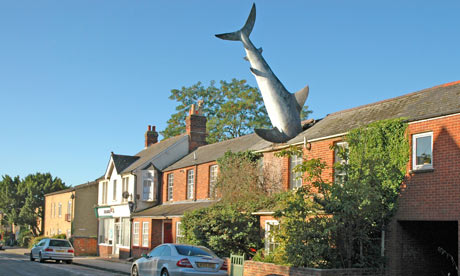
We are reminded that democracy isn't a guarantor of rights. Nor is democracy reasonable, sensible or flexible. On its own democracy wants to enforce conformity with the norm - or what the democrats see as the norm - and to prevent people putting plastic sharks in their roof or replacing a lawn with a water-conserving, drought-resistant garden.

The consequence of shared ownership is that the majority will dictate how that shared property is used. And if you're in the minority what you want is of no consequence. And that majority will impose its will.

Democracy is not enough.

....


Monday, 7 October 2013

Right-to-buy, property rights and the cause of liberty

****

Life, liberty, and property do not exist because men have made laws. On the contrary, it was the fact that life, liberty, and property existed beforehand that caused men to make laws in the first place. ~Frederic Bastiat

In the 1970s some local councils - including Bromley where my Dad was then Chair of Housing - began to explore the sale of Council houses to sitting tenants. These initial 'right to buy' ideas were tentative and limited - Councils lacked to power to incentivise the sale (beyond help with the actual process) and couldn't offer discounts or subsidies. However, these initial ideas led to what I consider - more than headline grabbing controls of trade union misbehaviour or the application of monetarist ideas to macroeconomic management - to be the defining piece of 'Thatcherite' legislation: the Housing Act 1980:

The act nationally implements a scheme of discounts against the market price of houses, to reflect the rent already paid by tenants and to encourage take-up. The scheme gives a generous minimum discount on the market price of 32 per cent for a house or 44 per cent for a flat, increasing each year to a maximum of 70 per cent.

Free market purists quail at this use of public subsidy and the progressive left bewail their loss of control over working-class tenure but this single act signalled a shift from the idea of collective ownership to the liberation that is private, personal ownership. Some 2 million properties transferred from state ownership to the ownership of the people who lived in them. It was the biggest ever transfer of wealth in the history of modern Britain.

The criticisms - leaving aside bien pensant nonsense - always boil down to a view that some people simply can't be trusted with owning things. The truth, however, is that - as even the Joseph Rowntree Foundation have shown:

Eighteen years on, there can be no doubting the impact of the Right to Buy. Some 30 per cent of tenants have exercised the Right to Buy. The majority of these have benefited considerably from the process. The volume of sales and capital receipts has far exceeded expectations.

The residual nature of council housing means that the rate of sale under right to buy has declined  - there were just 3,700 sales of this sort in 2011. However that was still 3,700 families who have moved from the dulling embrace of the council to private ownership. And we know from experience just what this means - new doors are put in, gardens are better kept, the walls are fixed, leaky gutters mended and a sense of difference stamped on the place. All because ownership implies a desire - perhaps even a duty - of care for the property, a care that simply doesn't exist in circumstances of so-called common- or state- ownership.

Those who attack the government for promoting home ownership - all that chatter about bubbles and so forth - miss this point entirely. And to suggest that having a mortgage isn't ownership is to misunderstand the reality. Ask that man with a mortgage whether it's his house? He'll tell you it is and will behave as such - making sure it's looked after, sorting out its problems and defending the value of the property in whatever way he can.

Those who take the problems faced by a minority of homeowners - negative equity, mortgages stretching beyond retirement, foreclosure due to loss of earnings - and use them to condemn the idea of a property-owning democracy are peddling an extremely dangerous myth. The myth that the alternative - renting (I assume from the state out of preference) - is somehow preferable. Or rather preferable for that group of people most likely to get into trouble with mortgages - the people our bien pensants like to patronise.

If we are to have government fund the development of housing - and so long as the planning system remains as it is now this is the only way we will meet housing need - let it be on the basis that those moving into those homes will in the fullness of time get the chance to own those new homes. Instead of subsidised rents being simply a way to reduce housing benefit costs, let's use them to build up the funds to support people on the road to property ownership. And if that means deposit subsidy, tax reliefs and mortgage support so be it.

In the end property ownership makes democracy stronger, promotes independence and takes us another step nearer to a free society. To deny property rights, to claim government knows better or, worse, to assert that rights are created by man is to do the opposite - to take us back towards tyranny.

....


Thursday, 19 January 2012

Some thoughts on toll bridges and copyright


Driving home from City Hall this afternoon I listened to a sweet little interview with a woman who had bought a toll bridge.

Grahame Penny and Maggie Taylor paid £403,000 for the Whitney-on-Wye bridge between Hereford and Hay-on-Wye. The crossing, which comes with a two-bedroom cottage and 1.1 acres, was built in 1779 and was granted exemption from tax by an Act of Parliament as it was privately funded.  It brings in around £2,000 per week but the couple will have to pay for annual maintenance and any staff costs.

It seemed to me that this little property might help us to understand the debate that carries on about copyright and intellectual property. But more of that in a minute – firstly we need to understand that ‘property’ is not a thing but a ‘right’. The access to my house is across land in the ownership of others but that access is my property – I do not own the land but own the right to cross that land so as to reach my house. I cannot parcel up that right but I can, should I wish, sell it -  which is what Bradford Council does with the right to fish in Chellow Dene reservoirs.

Mr Penny & Mrs Taylor own a bridge across the Wye and are permitted by law to charge you for the use of that bridge. When you drive up and hand over the necessary 80 pence, you are permitted – you have bought the right – to cross the bridge. Just once – if you come along tomorrow, you will have to pay again to have the right to cross the bridge.

Similarly, when I go to the cinema I buy a ticket allowing me to watch a particular film once and once only. If I want to watch that film again, I have to pay again just as I do with the toll bridge. And the same applies to a host of other rights to make use of another’s property – railway tickets, amusement parks, football matches and theatrical performances all spring to mind in this regard. Indeed, we even have to pay to use the lavatory.

All of these are examples where the right to use a particular “resource” is granted to the purchaser on a limited basis – most usually one use but it could be unlimited uses for a given period of time or a pre-determined number of uses. Copyright operates under the same principle – when you buy something ‘created’ by someone else it could be for your exclusive use or more typically for your use alone. Just as your 80p gets you one trip across Mr Penny & Mrs Taylor’s bridge, the money you hand over for an e-book to go on your kindle give you the use of that work and no-one else.

Without this protection, how are we to prevent you taking that e-book and selling it yourself? Not just to Mrs Smith next door but to thousands of others – all of whom might have bought the book. Even worse, you may choose to simply give the e-book away to anyone who wants it completely destroying the opportunity for the creator to benefit from his efforts. And it doesn’t really matter whether the creator is a multi-billion dollar film studio or a penniless writer in a damp flat.

If the creator chooses to let you use his work on this basis that is his right. But to suggest that he should have his right curtailed because “information wants to be free” is to create a circumstance where a man cannot profit from his own creativity. There is a case for debating what is covered by copyright – is a musical performance copyright or merely the music itself, for example – but the concept is absolutely central to the success of service economies.

The problem is not one of principle – copyright remains important – but of enforcement. Put simply, the on-line world makes it more and more difficult to police copyright effectively. And, as we have seen with the music industry, this pressure results in a dramatic change in business model. It is safe to bet that the same problem will be faced by the book publishing industry (the journal publishing business started its change and began its debate some twenty years ago) and the film industry.

And the main impact of this will be to make the published, copyright-compliant product much cheaper. Which is as it should be – instead of paying several thousand pounds for a subscription to the Journal of Consumer Marketing, the library now pays the same price for access to over 100 journals in that publishers portfolio. And the same will apply with music, books and films.

But this is not about getting rid of copyright, it is about the business models needed in an environment where the comprehensive policing of copyright simply isn’t an option.

However, we still have to remember that the more free riders, the less likely people are to create. To return to our toll bridge, Mr Penny & Mrs Taylor face competition from free bridges elsewhere on the river but that isn’t an argument for removing their rights.  So why should that fact that the web has led to an increase in free riders mean that copyright owners should lose their rights?

....

Friday, 16 December 2011

Is there really a housing crisis?

****

I'm just not sure how much of a problem we actually do have. For sure in London and some parts of the South East, rents and income have diverged - to the point where their affordability is open to question.

But the "there aren't enough houses" crisis - this would suggest rapidly rising rents everywhere. Which doesn't seem to be the case:


Private rents in England and Wales fell for the first time in 10 months in November, according to the latest buy-to-let index from property services firm LSL.

Average rent dropped by 0.4 per cent to £717 month, down from October’s figure of £720 per month. It is the first time there has been a month-on-month fall since January.


OK there are seasonal factors and rents have risen in some regions - but this doesn't suggest that, right this minute, there's a crisis level shortage of housing.

....

Thursday, 27 October 2011

It's not democratic to stop other people going about their business...

****

Apparently Anne Minton thinks this is terrible (although I’m not sure the ordinary member of the public would think so):

A defining characteristic of privately owned "public" squares and spaces is conditional access. Members of the public are only allowed in if the company controlling the place is agreeable. This is private property in the same way that someone's house is private property, which means that the owner can decide who is or is not allowed to enter and what they are allowed to do there.

These are not democratic spaces. Instead rules and regulations are enforced by uniformed private security and round-the-clock surveillance. A host of seemingly innocuous activities such as cycling, rollerblading and even eating in some places are forbidden. So is filming, taking photographs and political protest.

I struggle to see how this differs markedly from those “democratic” spaces?

Conditional access? Most public spaces these days are subject to conditional access – think of the parks locked after 7 pm, the ‘keep off the grass’ signs, the strictures on busking, begging and drinking. And yes the banning of those “seemingly innocuous activities such as cycling, rollerblading and even eating”. All these are features of the most public of public spaces. Places now policed by a bewildering variety of uniformed officials – street wardens, parking enforcement officers, PCSOs and the occasional really copper all with powers to move you on, fine you and stop you from doing ordinary everyday things like taking photos, having a fag or resting tired feet.

The truth about all this is that privately owned “public” spaces are not a new invention, nor are they the “privatisation” of previously public land – it suits the owner to ensure that the place is managed in the interests of users and, if that means stopping people from “occupying” the space with a load of mostly empty tents then so be it.

The truth is that these “occupations” are intended to prevent other people from engaging in lawful activity, from going about their daily business. It seems reasonable that private owners should seek to prevent this infringement of the liberty of those who wish to use the spaces they own.

Ms Minton says this is undemocratic but does not ask how those people who wish, for example, to attend St Pauls Cathedral can exercise this right when the “occupiers” prevent them from doing so. Indeed, it is profoundly undemocratic for protesters – a few in number – to try and prevent thousands from going about their daily business simply for the sake of a political “protest”.

Of course people have the right to protest, to march and to gather (although I’m willing to bet that Ms Minton will be near the front of the crowd calling for the EDL, BNP or other unpleasant fascist group to be prevented from protesting). But those protesters, marchers and occupiers have no right to prevent others from doing their business or to “occupy” private places without the agreement of the owners.

....

Thursday, 8 September 2011

A note on property rights

****

One of those things about rights is that they don't come about because a kindly king granted them to us. This was the whole point about the Glorious Revolution and subsequently the US Constitution. and this includes property rights:

By the "absolute rights" of individuals is meant those which are so in their primary and strictest sense, such as would belong to their persons merely in a state of nature, and which every man is entitled to enjoy, whether out of society or in it. The rights of personal security, of personal liberty, and private property do not depend upon the Constitution for their existence. They existed before the Constitution was made, or the government was organized. These are what are termed the "absolute rights" of individuals, which belong to them independently of all government, and which all governments which derive their power from the consent of the governed were instituted to protect.

Ownership of property is an inalienable right - unless of course you're Richard Murphy:

"...tax is a legitimate property right created by law like any other but which happens to belong to the gov't."

To the socialist - and others who believe tyranny is the sole way to order society - property rights are granted by a benign government. And therefore the act of taxation is a right granted to itself by government rather than a fee paid for that government's protection.

This is why socialists like Richard are so very wrong. And so very dangerous.

....

Monday, 5 September 2011

To say "property-owning democracy" is tautology - there is no other kind

****

OK, I know that the term "property-owning democracy" refers mostly to houses. And this allows people to write utter nonsense about property:

Yet even though the property-owning democracy idea has achieved neither its social nor its financial goals (the housing market has manifestly not developed in an orderly fashion that seamlessly matches supply and demand), there remains a truculent insistence from the right that somehow it is still interference from the state that is the problem, rather than the lack of it.

Now setting aside that the housing market is so constrained by regulation - be it financial, planning or legal - that to describe it as free is utter claptrap, we need to stop with this critique, catch a breath and ask what exactly is the problem?

The reason this critique is wrong - and verging on immoral - is that you cannot have a liberal democracy without property rights. Whether those rights apply to land, housing, paintings or that old pair of boots in the bottom of the cupboard. What is worse is that we are now telling people that owning property is just something for the rich:

We are, arguably, at another point of potential momentous change: the centre-ground voter is increasingly well-knowing about the foolishness and falsity of the home-owning democracy myth; the actual facts reveal that new home ownership, especially among the young, was steadily declining even before the 2008 credit crunch; and the gradual, tentative, dismantling of the previously cherished RTB has not led to any popular revolt.

The liberalisation of property finance and the "Right to Buy" brought about perhaps the biggest redistribution of wealth in England's history - shifting valuable property from the state and from big landlords into the ownership of ordinary men and women.  There are over 6 million homes in the UK that do not have a mortgage and, for those with a mortgage, there are plenty where it is neither a financial burden nor a significant proportion of spending.

The real question is how we allowed the vested interests within the housing system - landowners, existing householders, finance companies and the government - to fix the system so as to make it ever more expensive to 'get onto the housing ladder'.

What these critiques are telling us is that owning things is for the wealthy - ordinary people should not have such aspirations, should satisfy themselves with the outlook of the serf. Indeed the criticism includes - shock-horror - that some folk don't understand (and by implication shouldn't be allowed to play):

A Shelter UK survey indicates that one in four mortgage holders have no idea what the UK base rate is. These mortgage holders are playing with significant financial risks while being unaware of their exposure. Data from Legal & General indicated that maybe 90% of UK mortgages are on variable rather than fixed rate of interest. That's up from 60% from 2007. In something of an understatement, Shelter UK said that when the Bank of England does raise rates, this could push risk-ignorant owner-occupiers and those assuming permanently low interest rates, into a 'spiral of debt and repossession';


I bet those mortgage holders know what rate they are paying, how much they pay out each month and what their limit is in terms of payment. And - since Shelter are stupid - let's point out that all those poor fools on variable rate mortgages got the full advantage of the lowest interest rates ever, unlike the clever chaps with fixed rate mortgages.
 
Ownership is a good thing. It gives us a real stake, a commitment that renting or living for daily consumption doesn't bring. Ownership allows us to pass things along to our children should we so wish. And ownership stores up value - even if house prices aren't rising I still end up with a valuable property having had the benefit of living in it all the while!
 
Don't get me wrong, there's nothing wrong with renting (although the housing subsidy implicit in social housing is a massive distortion to this market) but we shouldn't go around telling less well off people not to aspire to such wealth. That owning things is not for you working class folk.
 
Yet that is precisely what the Joseph Rowntree Foundation, Shelter and a plethora of left-wing commenters are doing. And not only are they wrong but their arguments erode the central element of a free society - property rights. It really scares me that some see the constraint of property rights as essential to a liberal democracy:
 
Yet, still there remains in place an obstinate refusal to see that, without a determinedly redistributive infrastructure, liberal democracy simply cannot exist
 
The left believe that Government must have the right to confiscate property so as to allow for a liberal democracy?
 
Herein lies the fundamental reason why the left are illiberal. Such arbitrary powers - we cannot predict precisely which property the government plans on seizing so as to "redistribute" - are the short road to autocracy. Whatever the pain of owning property it is preferable to a ghastly socialist world of confiscation, rationing and centrally-planned chaos.
 
For me such a position is immoral, it patronises ordinary people and it maintains the myth that if it all goes wrong it's someone else's fault. And the government will bail us out.
 
this is the myth that got us into this mess. For heaven's sake let's not do it again.
 
....

Monday, 4 July 2011

So doctors aren't in it for the money then?

****

It seems that our noble doctoring profession - the one that wants to maintain cosy little local monopolies rather than expose itself to competition - has other ways for its members to make huge amounts of money at the taxpayers expense:

The taxpayer-funded “notional rent” scheme allows GPs to buy buildings for their surgeries which they then “rent” back to the Department of Health for more than the mortgage repayments, according to the report.

Surgeries are then sold off when the GP retires and they are allowed to keep the profits from the sale of the building.

A nice little earner I think this is called:

The NHS paid GPs £630m in rent for their privately-owned surgeries last year, an increase of 70 per cent since 2004, when the figure stood at £370m.

The total cost to the Department of Health in the past five years has been £2.5bn.

But, as we know, the doctors aren't in it for the money - this is just a way of getting better premises - or so say the Department of Health (should we not rename it the department of making doctors even richer?):

"This system incentivises GPs to expand and improve services so that people have proper access to modern facilities. It represents the cost to GPs of renting or owning the premises, and is a cost that would met by government direct if GPs did not." 

So we pay more than the borrowing cost to GPs and allow them to keep the capital gain - all sounds a bit like how another "professional" group feathered their nests!

....

Tuesday, 28 September 2010

"I can't dig the garden like I used to..." - some thoughts on getting older.


I thought that, for a change, I’d write about getting old. And how our attitude to age – and the process of getting older – changes and evolves. But first a little story from my Mum.

Many years ago – back in the 1970s – my Mum delivered meals-on-wheels in and around Penge. On one of the rounds there was a couple called Mr & Mrs Squirrel. Rest assured that these are human squirrels rather than the beady-eyed, bushy-tailed variety. Now Mr & Mrs Squirrel were well into their nineties – which back then was deifinitely a ripe old age – and lived in a sizeable house in Sydenham (or rather that bit of Penge that folk liked to call Sydenham so as to avoid using the ‘P’ word).

On one occasion, my Mum was delivering Mr & Mrs Squirrel’s dinner and she got to chatting with Mister. He explained how – it being a nice day and all – he had been out in the garden pottering about. After a few minutes chatting about the garden (my Mum being an especially keen gardener), Mr Squirrel complained that:

“I can’t dig the garden like I used to.”

And therein lies the point. This elderly – very elderly – gentleman refused to accept that the things he did in days past were no longer possible. Digging the garden may take a little longer, he might not be able to dig as deep or turn as much soil but we’re going to dig! And so it should be.

However, as we age, society still expects us to become less able and more dependent until we reach a point when in our dribbling, dotage others must care for us entirely. And much planning for this seems to assume that old age begins at 50.

I’m not joking here – nor am I moaning about the rapidity at which my 50th birthday approaches. Planning for services assumes that someone aged 51 has similar needs to someone aged 97 (ceteris paribus). Housing strategies for older people begin at 50. Saga holidays begin at 50. We are old at 50!

Except we’re not. Old that is – not even remotely old. Most 50 year olds in England can expect to live at least another 30 years – nearly all of those years independent and active. While three of my four grand parents were dead by the age of 76, my son’s grandparents are all alive and all past that age (with three passed 80). And all those people are living in their own homes, driving their own cars, feeding themselves and getting on with enjoying life. In truth they place a little more of a burden on health services – the jokes about rattling with pills do apply – but they are not old in the way previous generations were old.

All this is a good thing – unquestionably. But costly. The entire system of pensions, healthcare and social care is predicated on most people dying in the ‘70s rather than – as will be more and more the case – in their ‘80s or even ‘90s. And, as medical and surgical interventions allow (wonderfully) further extension to active life, those costs will continue to rise.

The question for us all is how much longer the present system can last until it breaks beyond repair. We can’t carry on with the assumption that our property assets will remain undisturbed by the costs of old age. And we have to recognise that pension schemes beginning at ages below 60 are unsustainable. We must also question why we have not raised the retirement age for the ‘active’ professions – police, fire, army and so forth. Finally, we will get used to the idea of people working well into their ‘70s – perhaps not full time but working nonetheless.

The market – as we see from adverts, new products and the images of older people used therein – has already got there. Sadly, the public sector – and the delivery of its services – remains stuck in the 1970s. Time to catch up I guess?

....