Showing posts with label Oxfam. Show all posts

Tuesday, 20 December 2016

A truth about international aid


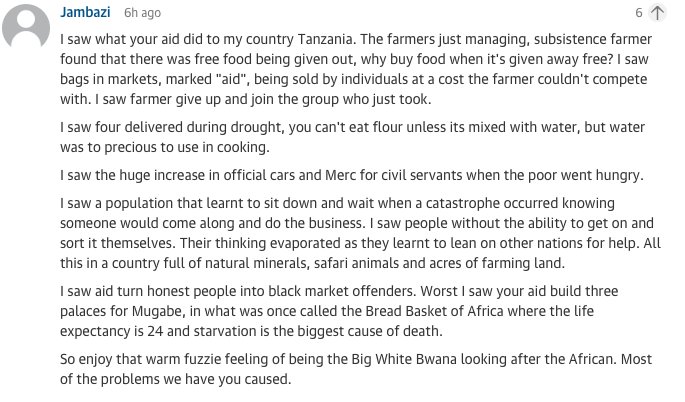
This was posted by a Tanzanian in response to a Guardian editorial extolling the virtues of international aid. It tells its own story.


I recall a friend returning from a period working in West Africa who declared that she would never again give a single penny to international aid charities other than for specific disaster relief.

The international aid business, from the well-paid folk who work for government agencies to the globe-trotting poverty-mongers of Oxfam, is a total shambles. It's not simply, as the Guardian commenter observed, that the aid is misspent or abused but that these agencies actively support policies specifically designed to maintain the 'rural economy' - in effect to keep subsistence farmers as subsistance farmers. I see this as active intervention by rich countries aimed as keeping poor people in poor countries poor.

....

Wednesday, 10 August 2016

Don't give a single penny of your hard-earned, post-tax income to Oxfam


It's always a little depressing when you read something from a university - an elite university to boot - that is really dumb. And even more depressing when you discover that the author of the dumbness isn't some over-idealistic second year student but the "Director for UK Poverty" at international development charity, Oxfam.

Yes I know, I know. You all though Oxfam was all about feeding starving folk in war-torn Africa. Well think again. Oxfam's connection to its original mission of relieving famine is tenuous at best. This 'charity' (and I place it in scare quotes deliberately) has ceased to be one dedicated to such a purpose but has become instead a lobby organisation using its income to create jobs such as "Director for UK Poverty" that have precisely zero connection to the idea of relieving poverty and everything to do with promoting an odious - and discredited - political position.

Here's a taster:

So, even if it is difficult to see how people can escape from poverty without working, it is also increasingly difficult to claim with any degree of understanding that work is the route out of poverty. Lots of jobs which are essential to our society and economy – and indeed to bigger business – need wider support.

By wider support, Oxfam mean higher taxes and more welfare benefits. And the idea that there is any - even the tiniest - comparison between children growing up in the soft embrace of the UK's welfare system and children growing up in, say, Congo or Laos is utterly, criminally wrong. The life chances of UK children with access to free healthcare, free education, generous welfare payments and extensive social services is better than those for most of the world's children. Yet this man from Oxfam wants us to believe that, in global terms, what he calls poverty in Britain is comparable to actual elsewhere in the world.

The article continues for some time in this vein, presenting selected facts and gratuitously exploitative graphical comparisons all wrapped about with references to 'social justice' - as if that actually means anything. And the solution? The pathetic, risible, thoughtless, ill-informed and crass solution? The 'social justice'?

Take more money off someone else, live up to the adage, "there's always someone, somewhere not paying enough tax and it isn't me". It sickens me that the only response to inequality these people can dream up is higher taxes on an undefined group of "tax avoiders". And, in this case it reminds me why we should not give a single penny of our hard-earned, post-tax cash to Oxfam.

....

Monday, 19 January 2015

Capitalism will eliminate poverty if we let it (and ignore Oxfam)

****

The world's plutocrats are gathering in Davos. And, in its annual tradition Oxfam has issued an update of its report on how us evil capitalist bastards are responsible for all that death and starvation in Africa. If only we would tax ourselves more and give the good folk at Oxfam more aid money then things would be fine. The problem is that Oxfam is utterly committed to promoting policies that sustain poverty - its stated aim is to make subsistence farming "sustainable" thereby keeping those peasant farmers just above the point of starvation through the use of aid money.

This article argues that policies used by middle and high-income countries are unsuitable for poorer, agricultural countries; it recommends instead that these nations promote broader access to land and raise land productivity. The authors explain why instruments used by richer countries, such as those that control prices and cheapen food, fail in poorer countries. They describe the features of smallholder farmers in poorer countries, drawing upon evidence from India, Peru, and Guatemala to demonstrate how subsistence farming can be part of policy responses to the distress of a food crisis in both the short and medium term. They call upon donors to improve their understanding of and support for small-scale, subsistence-oriented farming.

What Oxfam are saying here is that it's different in these poor countries and that the thing that made us western folk rich - capitalism - isn't going to work. Indeed, it is utterly shocking that Oxfam support policies that lead to more expensive food, less efficient agriculture and the maintaining of abject poverty in poor countries. So when you reach into your pocket for some change to put in that Oxfam tin or sponsor some well-meaning niece in her swimming or running, think for a second where that money is going. I'm not talking about administration costs here or even the buying of top end 4x4s for aid workers but the policies - policies that sustain poverty in Africa - that Oxfam supports.

The truth is that, not only is Oxfam wrong, but their support for protectionist policies at Davos actively advances the very agenda of those plutocrats and prevents Africa from challenging the dominance of the west. Instead of wibble about taxation or the liberal use of the word 'neoliberalism' what Oxfam needs to demand is an end to agricultural protection in the developed world, a more open banking system and the wider promotion of property rights, free markets and free trade.

Over the past three decades that neoliberalism - the thing Oxfam wants to blame for the ills of the world - has resulted in a billion people escaping abject poverty. Better still, for many of that billion the escape from poverty has been an escape from the tyranny of dirt-scrabble farming. They've moved to the city from where they can play a small part in creating exciting, free and innovative societies - just as happened in the west. Oxfam and its fellow travellers stand - using our cash - between people and the realisation of this dream.

I wrote this a while back - it is still true:

Sit back, put a smile on you face - punch the air with joy. You and me - capitalists both - have sat getting a little richer for thirteen years while a billion folk have escaped absolute poverty. All the international trade, all those businesses and those business folk filling the posh seats in aeroplanes flitting across the world - they've done that, they've lifted those people out of poverty.


Tell Oxfam to either get out of the way or get with the neoliberalism that is ending poverty more quickly that at any time in human history.


....


Wednesday, 11 June 2014

Oxfam - knowingly misleading us about wealth and income

****

I don't take the view that Oxfam's charitable purposes prevent them from raising concerns about poverty in the UK. Indeed, you can look at the charity's purposes here:

OXFAM'S OBJECTS ARE TO PREVENT AND RELIEVE POVERTY AND PROTECT THE VULNERABLE ANYWHERE IN THE WORLD.  OXFAM FURTHERS ITS OBJECTS THROUGH INTERLINKED ACTIVITIES OF HUMANITARIAN RELIEF, DEVELOPMENT WORK AND ADVOCACY AND CAMPAIGNING.

You may feel that the way in which the charity interprets these objects can be challenged - I'm guessing this lies behind Conor Burns' decision to report Oxfam to the Charity Commission yesterday. You may also feel that Oxfam, in the minds of the public at least, is there to respond to the humanitarian crises that blight humanity and to support programmes to lift the poor out of poverty. And that publishing adverts that are more-or-less indistinguishable from the current campaigns of the Labour Party is less than wise. You'll definitely feel that the ad hominem attacks on Conservatives by Oxfam are also unjustified even if those Conservatives are critical of the charity's work.

But none of this contravenes Oxfam's purpose. What we should be more concerned about - other than Oxfam's focus on rural environments and the immoral sustaining of poverty-creating subsistance farming - is the manner in which the charity uses a dissembling approach (some might say deliberately misleading) to promoting its point:


Let's dissect this tweet. What Oxfam wants you to think is that the inequitable distribution of wealth links to the inequitable distribution of income and, therefore, to the creation of poverty.  Now it is undoubtedly the case that wealth is unevenly distributed but it is also the case that this has little or no connection to income. Indeed it is perfectly possible for a person to have a significant income but no wealth. By way of example consider a thirtysomething couple who have just bought a London flat for £250,000. To do this they've borrowed 90% of the money from a bank or building society and, in a lot of cases, the rest of the money from the bank of mum and dad. They'll have a car on a lease agreement, credit card debt and perhaps the remnants of some student loans. They have no wealth, they're part of that 54% in the Oxfam tweet. But they will have income - probably a household income significantly above the national average. They are not poor.

Oxfam want us to believe that the lack of wealth equates to poverty because it suits their argument. But it is completely false to suggest that we have food banks because half the population have little in the way of wealth. To be clear, if you've no debts and a fiver in your pocket you are wealthier than a large chunk of the population - best part of 2 million full-time students for a start.

What Oxfam's campaigns don't tell us is why we have food banks, how zero hours contracts came about, why prices have risen (if indeed they have) and what lies behind extortionate childcare costs. The charity don't mention that food banks are needed mostly because the administration of benefits is a shambles rather than because of benefit cuts. We aren't told that half the increase in the cost of energy results from cross-subsidy to support 'green' energy - most of this going to wealthier land- and home-owners. And we aren't told that the high tax on fuel results in additional costs for food, clothing and household goods.

Levels of poverty (and this is relative poverty not the absolute poverty that calls for food banks) are falling in the UK, perhaps not fast enough but falling nonetheless. But it doesn't suit Oxfam's message to explain how this is happening or to note that liberalising employment and reducing regulatory burden on the private sector is what will succeed in reducing poverty over the long haul. Instead, Oxfam prefer to misuse statistics - as we see above - to create an impression that poverty is a bigger problem. And Oxfam also want to perpetrate the myth that someone being rich - in wealth or income - is the reason for someone else being poor.

Oxfam know that world poverty has plummeted over the last couple of decades, falling faster than ever before. A billion people have been lifted out of absolute poverty. OK they're not yet up to our western standards of living but they're headed that way. And Oxfam also know the reason for this fall in poverty but choose to ignore it and promote the keeping of peasants on barely sustainable subsistence farms through subsidy. Oxfam know that it is free market capitalism that gets people out of poverty. But Oxfam tell the public something else - Oxfam lie to us.

.....

Monday, 17 March 2014

In which Oxfam deceive and Huff Post (and the Guardian) publish without question.

****
Here's the headline:

Income Inequality Soars With Five UK Families Wealthier Than Bottom 20%


We begin with a confusion between 'wealth' and 'income' (wealth is a stock and income is a flow). The author then digs her hole of ignorance (or maybe deception) a little deeper:


The UK's five richest families have more cash between them than the poorest 20% of the entire population, 12.6 million Britons, with new research showing the chasm between rich and poor is growing wider.

The truth is that Jessica Elgot, who wrote the article has simply lifted the lies straight from the Oxfam press release without thinking - churnalism at its worst. At the top of the 'rich list' here is the Duke of Westminster with £13 billion in assets. I'm prepared to bet that, while the Duke's not short of cash, that £13 billion is nearly all land and property - and Ms Elgot put in the word cash not Oxfam.

What it isn't is income, which makes the next line of the press release (and the articles) deceptive:

Oxfam's figures also show that over the past two decades the wealthiest 0.1 percent have seen their income grow nearly four times faster than the least well off 90 percent of the population. 

This may be true but it hasn't got anything to do with wealth, with those assets that the Duke owns. Oxfam (not for the first time) are suggesting that the imbalance in wealth equates directly to an imbalance in income when it doesn't.

Whatever the political differences over inequality, we really shouldn't be making the arguments in this sloppy (or deceptive) and ignorant (or misleading) way.

....

Thursday, 20 February 2014

A glimpse of another Africa

Nairobi

You're all familiar with the Oxfam picture of Africa. The starving children, the smiling farmers kept from death's door by the good work of one or other 'aid programme', the wells dug and the women with bundles on their heads.

This is the Africa of development charity marketing and of the politicians' justification for the international aid budget. It's a rural, poor Africa where food crises are only a dry month away and where fair trade evangelists bring the good news - you can stay on your smallholding barely scraping a living for another year!

And the image is something of an insult - dare I say it, a rather neo-colonial insult. The implication is that, without the expertise of us rich, clever Europeans those Africans are condemned to a life of malnutrition, disease and desolation. It is wrong.

Think back to the terrible events in Kenya back in October - not the terrorism but the target of the terrorists. It was a Westfield shopping mall. Hardly the Oxfam image of Africa. This is another Africa, an urban Africa that isn't filled with subsistence farmers and big-eyed hungry children but with trade, with making, buying and selling things and with entrepreneurs:

I present to you Africa’s brightest young entrepreneurs. These are the ones who are making the most dramatic impact in Africa today in manufacturing, technology, real estate, media & entertainment, financial services, agriculture, fashion and the service industry. They are impatient to explore new possibilities and slowly but surely, they are building empires. 

OK, it's a bit gushing but this is a positive, exciting, growing Africa not the supposed basket case that the likes of Oxfam would have us believe. An Africa with people like Christian Ngan:

After working in financial services in France, first as an analyst at French investment bank Quilvest Group and as an associate at Findercord in Paris, Christian Ngan returned home to Cameroon to start his own business in 2012. With $3,000 of his savings, he founded Madlyn Cazalis, an African hand-made bio cosmetic company that produces body oils, natural lotions, creams, scrubs, masks and soaps. Madlyn Cazalis products are sold and distributed across more than 30 chemist stores, beauty institutes and retail outlets in Cameroon and neighboring countries in Central Africa. 

And with Seth Akumani:

Akumani, 30 is a co-founder of ClaimSync, an end-to-end claims processing software that enables hospitals, clinics and other healthcare facilities all over the world to automate patients’ medical records and to process records electronically. Claimsync’s solution allows these healthcare providers to easily prepare medical claims and send electronically to health insurance companies. In 2013 ClaimSync was the sole African company to participate in the high-profile, IBM, Novartis, GlaxoSmithKline backed Accelerator program HealthXL in Dublin. ClaimSync was recently acquired by GenKey, a Dutch-based biometrics company.

These men and women - more than all the international aid, fair trade campaigns and guilt-tripping charity appeals - are the future hope for Africa. But we never talk about them preferring instead our cosy little colonial myth. Believing it when we're told - again and again - that Africa is filled with poor farmers whose only protection and hope is the caring, kind and white face of Oxfam. That somehow the sort of society we enjoy - of urban wealth rather than rural poverty - is not something Africa can attain.

Africa has a long way to go - it's still too rural and too poor. But the answer isn't propping up poverty with subsidy but rather promoting business, entrepreneurship and trade. Backing the continent's entrepreneurs to do what entrepreneurs did for Europe, Japan and the USA - make us all, compared to today's Africans - rich.

....

Tuesday, 21 January 2014

Oxfam are wrong (again)

****

Oxfam are wrong.

OK this isn't a surprise since we're talking about a large, wealthy, powerful organisation that dedicates itself to keeping poor people poor (although they don't quite put it that way).

Oxfam are wrong:

Working For the Few, published ahead of this week’s World Economic Forum in Davos, details the pernicious impact that widening inequality is having in both developed and developing countries, helping the richest undermine democratic processes and drive policies that promote their interests at the expense of everyone else. 

It all sounds good and caring. It reads like the good folk at Oxfam really do have the interests of "the world's poorest" at heart. The problem is that it's not inequality that's the problem, at least not in getting "the world's poorest" out of abject poverty.

I know this. And it's why Oxfam are wrong:


There you go Oxfam. While all those rich folk have been piling up the cash, billions of people who used to be really, really poor stopped being really really poor. OK, they're not as rich as us yet but far fewer of them - freed from the death sentence that is subsistence farming - are starving to death because they are too poor.

I know it's hard to admit. I know that Oxfam's world view doesn't allow for the idea that it's capitalism and free markets that get people out of poverty.

But it's true. We know it's true. Forty years of that awful 'neoliberalism' stuff shows us that it's true.

So, as I wrote last year when Oxfam published their "get into the papers ahead of Davos" report:

Sit back, put a smile on you face - punch the air with joy. You and me - capitalists both - have sat getting a little richer for thirteen years while a billion folk have escaped absolute poverty. All the international trade, all those businesses and those business folk filling the posh seats in aeroplanes flitting across the world - they've done that, they've lifted those people out of poverty.

....

Sunday, 8 December 2013

On liberty and poverty...

****

We are frequently told that intervention by government is necessary for the elimination of poverty. And even that this poverty is a consequence of inequalities or other misfunctions of the market.

Here's a quote (via Don Boudreaux) that questions all this, rather suggesting that economic liberalism is the route to eliminate poverty rather than the mercantilist, directed economy preferred by our masters:

If bourgeois dignity and liberty are not on the whole embraced by public opinion, in the face of the sneers by the clerisy and the machinations of special interests, the enrichment of the poor doesn’t happen, because innovation doesn’t.  You achieve merely through a doctrine of compelled charity in taxation and redistribution the “sanctification of envy,” as the Christian economist the late Paul Heyne put it.  The older suppliers win.  Everyone else loses.  You ask God to take out two of your neighbor’s eyes, or to kill your neighbor’s goat.  You work at your grandfather’s job in the field or factory instead of going to university.  You stick with old ideas, and the old ferry company.  You remain contentedly, or not so contentedly, at $3 a day, using the old design of a sickle.  You continue to buy food for your kids at the liquor store at the corner of Cottage Grove and 79th Street.  And most of us remain unspeakably poor and ignorant.

This is the thinking that gives us the Oxfam approach to international aid - keeping subsistence farmers as subsistence farmers through grant aid. It also underlies the idea that rich people are rich because poor people are poor - therefore you remove money from the rich to give it to the poor and everything is fine. Markets aren't seen as social, engaging and cooperative things but as exploitative. But the examples cited - banks, farming, energy, housing, healthcare - are the very areas where government intervention and regulation is greatest (ergo where the efficient operation of the market is most compromised).

Hardly a day passes without a new call for regulation - to make prices lower, to protect inefficient distribution systems, to reduce competition, to do a multitude of things vaguely defined as 'protecting consumers'. And each of these intervention makes the market less able to work, less able to make its magic, ineffective at doing what it does best.

And the result of all this fussing, all this knowing betters, all these attempts to fix what isn't broken? Stuff is more expensive and because it's more expensive there is more poverty.

....

Saturday, 26 January 2013

Hunger will disappear IF...we stop subsidising poverty and promote free trade

****


This year, many of the world’s most powerful leaders will meet in the UK. They must change the future for millions of people who live with the day to day struggle against hunger. But that will only happen IF we get together and make them act.


So goes the blurb from the latest campaign to feed the starving and hungry. As ever, the campaign has roped in a cavalcade of the great and good – Desmond Tutu, Bill Gates and even pretty pop boys, One Direction. And we are enjoined – nay, demanded – to take part in the great campaign to feed the hungry! To take this message to the G8 – that hunger will disappear if:


    • IF we give enough aid to stop children dying from hunger and help the poorest families feed themselves
    • IF governments stop big companies dodging tax in poor countries, so that millions of people can free themselves from hunger
    • IF we stop poor farmers being forced off their land and we grow crops to feed people not fuel cars
    • IF governments and big companies are honest and open about their actions that stop people getting enough food
      All sounds pretty good stuff doesn’t it folks! Until of course you actually think about it for a minute.

      Firstly, this is 100 organisations – NGOs they like to call themselves until they ask us for money when they suddenly become charities – that are very interested in how much aid is given. And, of course, most of the aid does very little to “stop children dying of hunger” since governments prefer instead to prop up badly managed national budgets, lecture poor countries about climate change and, more of this in a minute, keep subsistence farmers trapped in subsistence farming.

      Corporate tax-dodging is the issue du jour – no progressive campaign would be complete without a call for action on tax-dodging by “big” companies. It may be the case that large companies aren’t paying enough tax in Kenya or Peru but where is the connection with getting people out of hunger? Unless you live in a sort of Stalinist world where only the benign state can feed people (which didn’t work in the Ukraine or China, I seem to recall).

      Now we get to the big issue – those big companies, secretly backed by the World Bank “behind the scenes”, as Oxfam put it, are buying up land and forcing farmers off that land so they can grow commercial crops (too many of which, because of our bonkers response to climate change are bio-fuels). Yes folks, you’ve guessed it – the reason for all those taxes is so we can pay poor farmers to stay poor farmers.

      This is a monumentally stupid proposal – that very subsistence farming, dirt-scrabble and back-breaking, is the main reason why people in these places fall repeatedly into famine and starvation. We should be encouraging more efficient farming – after all Oxfam and their mates aren’t suggesting that we G8 residents step away from our computers and return to the land! Nor are these NGOs proposing that the big British or Canadian farms are broken up and handed out in parcels to city dwellers – doubtless with a hoe, a horse and a plough.

      So why on earth do these organisations want to condemn this and future generations of Africans to live a short, unpleasant life scraping a bare existence from a tiny farm? Why do Oxfam and others believe that subsidising subsistence is the way to proceed? Why do all the great and good – the bishops, pop stars and philanthropists – think it fine for them to live a comfortable life with soft hands but that those Africans cannot aspire to be web designers, software writers or management consultants?

      Why does this alliance for good not campaign for the G8 to make some changes that really will help those Africans out of poverty – things like removing agricultural tariffs and trade barriers, ending the subsidising of industrial agriculture and promoting trade rather than the dependence of aid?

      I can only conclude that these campaigners believe Africans to be somehow different – that free markets and free trade won’t make them rich as they made us rich. Only through state direction and intervention will people be fed and the resources for this feeding will come from our taxes distributed to the grateful peasants of Ethiopia and Laos through the agency of Oxfam and others in the aid industry.

      So I won’t be supporting this “If...” campaign – not because I don’t care but because the best way to stop Africans – and other poor people around the world – from starving is to do business with them, to set them free from the tyranny of subsistence and to promote free enterprise and free trade.

      ....
      Saturday, 19 January 2013

      Why Oxfam is wrong...

      ****

      Ahead of the annual boondoggle in Davos, international development organisation, Oxfam has made a series of statements about inequality, poverty and development - all contained in a report entitled The Cost Of Inequality: How Wealth And Income Extremes Hurt Us All. This contains observations such as:

      ...efforts to tackle poverty were being hindered by an "explosion in extreme wealth".

      The richest one per cent of the world's population had increased its income by 60% in the last 20 years, Oxfam said.

      It reported that while the world's 100 richest people enjoyed a net income of $240bn (£150bn) last year, people in "extreme poverty" lived on less than $1.25 (78p) a day.

      We are, of course, expected to be shocked - deeply shocked - at the injustice of all this, at how there are some very rich people while others are starving. What Oxfam wants us to believe is:

      "Concentration of resources in the hands of the top 1% depresses economic activity and makes life harder for everyone else - particularly those at the bottom of the economic ladder."

      And that top 1% isn't you and me we're led to believe - it's those evil billionaire capitalists who are stealing the very bread from the mouths of the starving children. Let's leave aside the fact that poverty is largely unrelated to inequality - people do not become rich by making others poor, however often Oxfam want to pretend that this is so. Instead let's remind ourselves who the 1% are in terms of world development and poverty:

      The truth is that the entry level income for the world's top 1% of earners is:
      $34,000
      That's it, in real money not a great deal more that £20,000 a year gets you into the 1% club - sits you among the world's filthy rich, among those to blame for all the sins and evil of the world. Capitalist scum.

      Most of you reading this blog are in the top 1% sucking up all those resources - depriving the poor in Africa and elsewhere of the chance to grow, to get out of poverty.

      Except you're not. Sit back, put a smile on you face - punch the air with joy. You and me - capitalists both - have sat getting a little richer for thirteen years while a billion folk have escaped absolute poverty. All the international trade, all those businesses and those business folk filling the posh seats in aeroplanes flitting across the world - they've done that, they've lifted those people out of poverty.

      Oxfam are wrong. Neoliberalism is making all the world richer. Even the UN celebrates that neoliberal success:

      "For the first time since records on poverty began, the number of people living in extreme poverty has fallen in every developing region, including sub-Saharan Africa. Preliminary estimates indicate that the proportion of people living on less than $1.25 per day fell in 2010 to less than half the 1990 rate..."

      This is what capitalism does. Isn't it wonderful.

      ....


      Thursday, 26 July 2012

      No austerity for Oxfam!

      ****

      It has been a bumper year for top international aid charity, Oxfam:

      The charity's accounts for year end 31 March 2012, published today, show that the overall total combined income rose to £385.5m from £367.5 the previous year. 

      Wonderful news - great to discover that, despite trying economic times, the British public continue to dig deep into their pockets to help the third world. Or rather have their pockets dug into by government:

      While voluntary income decreased by almost 7 per cent from £138.4m to £129.7m, resources from the government, institutional donors and other public authorities rose by almost 16 per cent from £138.1m to £159.8m. 

      You didn't know that over half of Oxfam's income comes from the government did you? Or that this amount has increased year after year? That nice lady in the shop didn't tell you. The chugger didn't tell you. The tear-jerking ads didn't tell you.

      And they certainly didn't tell you that much of that increase in Oxfam's funding comes from the EU (the British government cut its funding of the charity) - doubtless in exchange for becoming yet another mindless cheerleader for Euro-babble. And I guess that Oxfam don't care now that the Common Agriculture Programme kills more folk in Africa than the EU saves through its 'generosity' with taxpayers money.

      ...

      Thursday, 2 June 2011

      Into the woods - some thoughts on reforestation

      I was all ready to tear into the nonsense that is Oxfam's "Growing a Better Future" - how these organisations get to the point of presented half-truths, inaccurate analyses and daft solutions I'll never understand. However the point was made very clearly here:

      This is much less a report about the iniquities of the international food system and the perils of climate change than it is a report about what happens to food prices as we abolish absolute poverty and destitution.

      More people with more money means higher food prices - simple really!

      So I'm going to talk about wood instead - after all wood is very important. Across most of the world it is the dominant source of fuel for heating and cooking - indeed this is one of the reasons why we've seen so much deforestation in Africa:

      Developing countries rely heavily on wood fuel, the major energy source for cooking and heating. In Africa, the statistics are striking: an estimated 90 percent of the entire continent's population uses fuelwood for cooking, and in Sub-Saharan Africa, firewood and brush supply approximately 52 percent of all energy sources.


      And you've guessed it - that fuelwood gathering doesn't rely on "sustainable" sources. Moreover, the clearance of forests is further accelerated by the persistence of low labour productivity farming - the very farming systems preferred by Oxfam and the ludicrous proponents of "fair trade".

      England's woods of oak and birch were destroyed for much the same reason - to provide fuel, to build houses (and famously ships) and to make room for agriculture. System shocks like Dutch Elm disease added to the decline and the poisoned landscapes - like the face of the moon as the song goes - of mining destroyed still more old woodland. Strangely enough - although you'd not believe this to hear the NIMBYs cry sometimes - not much of our woodland was felled to make room for houses.

      And woods recover - forest cover is now at its largest extent since 1750:


      The amount of woodland in the UK now stands at 11,200 square miles, 11.8 per cent of the total land area. The growth, attributed in part to a boom in individuals branching out into forestry because of tax breaks, was greeted with cautious optimism by woodland historians. So much new forest is being planted that some areas could even reach the 15 per cent of woodland recorded in England by the Doomsday Book in 1086, the figures suggest. 

      And much of the growth in woodland is private planting - nothing to do with all that public forest so many people fussed about recently:

      The new Forestry Commission report, conducted for the UN’s food and agriculture department, disclosed that the amount of woodland owned by individuals now accounts for almost half of all our tree cover, having grown by 22 per cent in 15 years.
       
      In an advanced society, free from the need to burn wood and no longer trapped in subsistence or semi-subsistence agriculture, woods are an asset that it treasured, managed and valued. Perhaps there's a lesson in this for the Oxfam's of this world - but don't hold you breath!
      ....