Showing posts with label lies. Show all posts
Showing posts with label lies. Show all posts
Thursday, 2 November 2017
Trust me, I'm a politician...
There's a section in the Vietnam War documentary currently showing on BBC4 (watch if you can) where they're reporting on the fall out from the Pentagon Papers leak and the realisation that Kennedy and LBJ had lied through their teeth to the American people. We now know, and lots of Americans suspected at the time, that Richard Nixon lied through his teeth about Vietnam too.
There's a marine veteran speaking to camera who says something along the lines that, prior to the Pentagon Papers, people instinctively trusted the President and his advisors on matters of great importance - war, peace, life, death. Afterwards no-one trusted politicians - the assumption was that all of us lied.
It seems to me that this simple observation from a former soldier summed up the long-term political effect of Vietnam for the USA. For all the winning and losing, elections and campaigns, there is a grumbling view that underneath it all they're probably lying about something. And are prepared to lie about everything up to and including sending young men to the other side of the earth to get killed. So much of what we see played out today in US politics reflects this moment - from low turnouts in elections through endless rounds of campaigning funding reforms to the current suggestions of sinister conspiracy involving Russians, Facebook and shadowy data companies.
For us in Britain, we had to wait a while longer for this epiphany of lies. When Tony Blair stood in Parliament to argue for us to back a US invasion of Iraq, most of us believed that no Prime Minister would bend and warp the evidence - in effect lie - in order to get parliament to back a war. Yet that is what happened, we backed a war because we believed it when Blair said the threat was real, urgent and significant. There are a lot of people who, like that Vietnam veteran from 1971, had the scales fall from our eyes as we realised that, yes, our politicians were prepared to see men die on the basis of deliberate misinformation.
Our politics is better and worse for this epiphany. Better because the public are less prepared to take their leaders simply on trust when it comes to big and important decisions. Although some of the 'wanting to know' around Brexit is little more than spoiling, the public's support for wanting to know is because, frankly, they don't trust politicians not to sell us down the river.
Politics is worse, however, because decent and honest politicians aren't believed - and most politicians, despite the epiphany of lies, are decent and honest. Worse still, politics becomes even more shallow and unpleasant because the media, reflecting public distrust, treats politicians as dodgy, something to be exposed rather than as a set of folk wrestling with getting the right policies and with making the right decisions.
Every time I see Alistair Campbell on telly, in the papers or Tweeting, I want to scream that he was the warped spider sat in the centre of a web of lies - 'spin' they called it - that resulted in hundreds of dead British troops and untold thousands of dead Iraqis. All done to indulge Tony Blair's desire to be America's best buddy. There is no going back, in most folks' minds politicians will forever be liars and deceivers. Most of us aren't, lying's too much like hard work but, because of men like Kennedy, Nixon and Blair, people start with the opinion that we are. Trust me on this, I'm a politician.
....


Saturday, 2 September 2017
Ten common lies about about free markets, capitalism and liberal society
Every day - in the papers, on the telly and all over social media - a bunch of people tell a pack of lies about free markets, capitalism and the liberal enlightenment that made us all rich, is still helping make the poor less poor and the rich happier. The Clerisy, as Deirdre McCloskey calls them, having got themselves secure, often tax-funded positions spend their time sneering at the things that made their comfortable lives possible. Hipsterish, right-on web-design consultants and the like go on about the evils of capitalism while plying their lucrative businesses in that capitalist world.
This makes me angry. It's not the hypocrisy, we've all a tendency that way. It's not the smugness, annoying though it often is. And it's not that, as my Dad was wont to say, "they can afford to be socialists". No, it's the lies. Here are ten of them.
The First Lie - Free markets are a bad thing.
Please explain which part of the word 'free' is a bad thing? If you don't like free markets, what you want is markets that aren't free. Markets where only some privileged people can trade. Markets where someone else (usually the government) sets the price. Markets where their effectiveness is determined not by the actions of those in the market but by who is most effective at lobbying - for which read bribing, corrupting - government. If you fetter free markets (which given you always go on about the free market being "unfettered" is what you want) what you create are winners and losers, privileged and unprivileged, rather than having a system where people seek co-operation and mutual benefit. Freedom is a good thing. Free markets are a good thing. So stop lying about this and undermining the liberty of your neighbour.
The Second Lie - Capitalism is exploitative
We hear this all the time. Whether it's about the planet, the workers or some vague and general exploitation. Well it ain't so. Capitalism is a simple concept where things are owned by the people who stump up the resources for those things to be there. Not just cash but ideas, innovation, skills and enthusiasm. No-one's being exploited here and capitalism delivers returns to investors - in doing so it helps make those innovations succeed and those free markets make us all richer.
The Third Lie - We are rich through exploiting other humans
Quite the reverse. The thing that the liberal enlightenment did was demonstrate that the best way to get rich is to help make other folks' lives better. That was Adam Smith's great insight, not the 'invisible hand' but rather the realisation that personal self-interest operating in a free system leads to social betterment. When people point, quite rightly, to the horrors of colonialism and imperialism they are wrong to see in them the reason for our wealth. Some people made money screwing over Africans and Indians but this money was - even at the height of Lord Clive's egregious pillage of India - marginal to England's wealth and economic growth.
The Fourth Lie - Government creates wealth
We need government to protect the liberal society that allows free markets and capitalism to work. The ancient - and it is ancient - system of contracts, laws and administration that protects property was turned (mostly but not always) away from protecting the landed and towards supporting that free society and its mundane trading transactions. But government doesn't create wealth - we had hundreds of years of contract law, the Magna Carta and all that jazz without seeing the transformation wrought by capitalism and free markets. And we had plenty of government inventions during that time - from gunpowder to haute cuisine - without those inventions making the mass of people rich.
The Fifth Lie - Capitalism kills people
All the time you're talking about 'capitalism's death toll' without ever pointing to the bit when liberal society, free markets and capitalism killed these people. Indeed quite the opposite. All the advances in medicine, sanitation and safety made possible by being richer - that's the fruit of capitalism even if we choose to organise these things through government. Since the millennium a billion people have been lifted out of extreme poverty because of those free markets, free trade and capitalism. Capitalism saves lives.
The Sixth Lie - Capitalists are greedy
Again quite the opposite is true. Capitalism expects that, instead of swimming backstroke in his gold pile, Scrooge McDuck invests his cash. Some of this is invested in boring old working capital and some in high risk, exciting, sexy, hipster innovation. You and I prefer the safe stuff because we've not much to spare let alone risk but Scrooge McDuck can take bigger risks because losing a bit is less of a big deal. Those filthy rich plutocrats (the anonymous pinstriped banker ones are the worst) you rile against are stumping up the investment needed to deliver economic growth, health, wealth and happiness. Moreover they're putting off having something now (spending all that gold) to take a risk hoping that they'll get a bigger return in the future. Because of this all those exciting, innovative businesses happen. This is not greed.
The Seventh Lie - Small businesses aren't capitalists
Now this lie is more inferred that explicit. Bad capitalism is about faceless, distant businesses not our friend's web design business or the trendy coffee shop where you meet to discuss revolution and the evils of free markets. Sorry to disappoint but you're all capitalists and it's in all your interests for that capitalist system to operate as openly and freely as possible.
The Eighth Lie - Trade is something permitted by government
This lie sits behind all the talk of trade deals and the nonsense about a 'global race' so loved by politicians and pundits. Trade is quite simply the process of exchange in a free market (or even in a not-so-free market). We want government to back up our exchange by protecting property rights, preventing theft and ensuring we can enforce a contract. But we don't want the government to say who can and cannot trade or when and where they can trade. Trade is more often prevented by government than enabled. If we want more growth, more riches, the way to go is less prevention and more enablement.
The Ninth Lie - The rich are rich because others are poor
Free markets prevent this from happening. It used to be so before we woke up and realised that posh folk owning all the land and getting peasants to scrat in it wasn't the best way to a wealthy, healthy and successful society. We used to have a system - called it feudalism, oikocracy, whatever - that meant some folk were rich because others were poor. It had lasted from the first cities in the middle east through to the Dutch Republic. Then some places realised (partly government, partly people thinking about a better world) that the way to get rich was to try and make everybody better off. And it worked. We call this system liberal capitalism.
The Tenth Lie - Free marketeers don't care
How often to you say this? Every time something fails, most usually some or other government administrative system. This because of capitalism, we're told. Free markets did this. Because they don't care. If they cared nothing would ever fail. No-one would be poor. This is the biggest of these lies. Free marketers do care. That's why we're capitalists. We want everyone to be healthier, wealthier and happier. And because free markets work people in Britain are vastly healthier, wealthier and happier than our forebears.
By all means disagree. Feel free to stick with your faith that there is some sort of Utopia, some system - True Socialism maybe - that will give even more social benefit, wealth, health and happiness than free markets, capitalism and our liberal society. But stop lying about free markets, capitalism and that liberal society. Stop fibbing that it's anything other than the more successful, more effective and long-lasting means of bettering the lives of ordinary people.
.....
Thursday, 16 February 2017
Cause and effect - how falsehoods are created
While the precise nature of truth isn't straightforward, we should be much clearer about falsity and the unethical use of data to present something that may not be true:
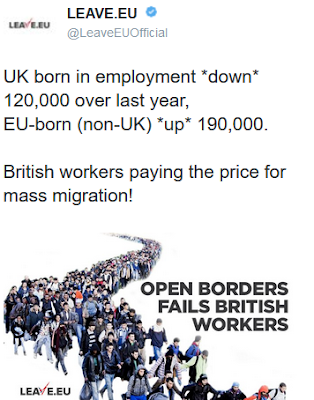
Firstly, of course, Leave.EU don't provide a source for the claim. The source is the latest ONS population digest:
And there are other equally plausible reasons for the decline such as 'baby boomers' retiring, the decline in public sector employment leading to early retirements, increased numbers of people staying in full-time education, more women opting to remain as housewives. Unless all these possible reasons - and maybe others I've not thought of - are shown not to be the reason, we cannot make the claim that Leave.EU make. It is, regardless of the source's quality, a falsehood.
....
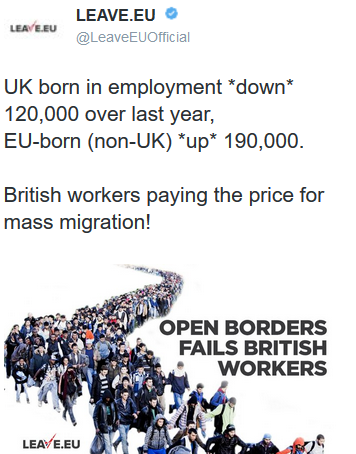
Firstly, of course, Leave.EU don't provide a source for the claim. The source is the latest ONS population digest:
Looking at the estimates by country of birth, between October to December 2015 and October to December 2016:The inference that Leave.EU make is that the reasons for this decline in the number of UK born people working is migration - 'British workers paying the price for mass migration'. And this could, indeed, be the reason for the decline. The problem is that neither the ONS data not Leave.EU provide the information needed to establish whether or not migration does put UK born people out of work.
- UK born people working in the UK decreased by 120,000 to 26.37 million
- non-UK born people working in the UK increased by 431,000 to 5.54 million
And there are other equally plausible reasons for the decline such as 'baby boomers' retiring, the decline in public sector employment leading to early retirements, increased numbers of people staying in full-time education, more women opting to remain as housewives. Unless all these possible reasons - and maybe others I've not thought of - are shown not to be the reason, we cannot make the claim that Leave.EU make. It is, regardless of the source's quality, a falsehood.
....
Sunday, 6 November 2016
Article 50 Case: Incompetence, lies and the importance of free speech
I may have been misunderstood. Not because of anything I said but because of how some people decided they knew what I'd said or because they knew what I really meant. The starting point was that, following the High Court decision about invoking Article 50 of the Lisbon Treaty, I was angry. Indeed, I was as angry as I had ever been about something political.
Now if people had noted what I said, they'd have spotted how my anger wasn't directed at those three judges (however much I might think their decision egregious) but rather at the Government. After all they'd proposed and got support for (overwhelming support as it happens) a proposal to have a referendum on our membership of the European Union - something that had been in the manifesto that government stood on in May 2015:
That’s why, after the election, we will negotiate a new settlement for Britain in Europe, and then ask the British people whether they want to stay in the EU on this reformed basis or leave. David Cameron has committed that he will only lead a government that offers an in-out referendum. We will hold that in-out referendum before the end of 2017 and respect the outcome.So my expectation was that the result of the referendum (and whether you like it or not, we voted to leave) would be implemented. The Government even wrote to us all telling us just that:

All pretty unequivocal. It seems, however, that this isn't really the case, at least as far as those three judges are concerned. Not only was the Government incompetent in proposing a referendum bill that didn't do what it said in the manifesto, they then compounded this by issuing a false statement that this was so. Put simply the Government led by David Cameron was either incompetent or it lied (maybe even both). I feel entirely justified in being as angry with this as I was with Tony Blair's government when it sent young men to die in Iraq on the basis of what turns out to have been a lie. Just as subsequent enquiry revealed Blair's duplicity, the three judges last week revealed the incompetence (or lies or both) of David Cameron's government.
Although I may not be angry with the judges, I do have a great deal of sympathy for the many people - including those writing the front page headlines in some newspapers - who were explosively cross with the decision and those who made it. And I find the reaction of too many, especially lawyers clucking round their superiors, to these headlines deeply concerning. All this stuff about the headlines "intimidating" the judges (by writing in a newspaper - how spineless are they?) and wanting some sort of unspecified action from the Government to deal with the offending editors simply represents an attack on press freedom and free speech. Do we really think a headline in the Daily Mail is going to destroy the independence of the judiciary, however unpleasant and intemperate that headline might be?
The thing with free speech is that it's loud, messy and often pretty unpleasant (trust me on this - I get that same bile directed at me as those judges got). But no part of our state's institutions should be immune from robust criticism - even when that criticism is ill-informed or ignorant. It is disturbing that the Bar Council and a parade of "Important Legal People" think judges should be privileged by newspapers being punished in some way if they dare to criticise. The law - just like other institutions - needs broad public support. If the law's leadership is too thin skinned to make good decisions because a newspaper might have a go at those decision, then perhaps we need to get better leaders?
If the law is excluded from exposure to free speech because of 'judicial independence' then we have a problem. Law in all its forms - and the decisions lawyers and judges make - is central to our lives. If we're not permitted to challenge those laws, those lawyers and those judges then our liberty is compromised. The law becomes vainglorious, privileged and its practitioners untouchable. In a nation that values freedom and the idea of democracy, this cannot be so.
....
Thursday, 26 March 2015
More media lies about sugar and processed food...
 |
| Some healthily presented sugar and fat |
Writing in Spectator Health, Janna Lawrence continues the war on cheap, accessible and nutritious mass-produced food by claiming - entirely without evidence - that it is this stuff that is responsible for a range of health problems (you know the list - cancers, diabetes, obesity and so forth):
Regardless of whether you buy into the concept of food addiction, the results of eating unhealthy, high-energy foods are self-evident. A quarter of adults in England are obese. Admissions to hospital with a primary diagnosis of obesity increased nine-fold between 2003 and 2013. That’s an astonishing statistic. Obesity is reckoned to cost our economy £47 billion a year. But while selling cocaine is illegal, selling sugar and fat is fine, apparently.
Janna Lawrence has simply absorbed the latest example of egregious pseudo-science and wrapped it up in some scary statistics to suggest that somehow we are eating loads more sugar and fat but don't know it because it's secretly loaded into 'processed food'.
Let's deal with some of the facts. Firstly total calorie consumption per capita has fallen in the UK. And, alongside this, consumption of fats and especially saturated fats has fallen significantly. Plus, of course, our consumption of sugars - that's all sugars not just the white stuff in bags - has fallen too. This includes all Ms Lawrence's evil processed foods.
The DEFRA survey (conducted annually since the 1970s) also contains data on per capita consumption of different sources of calories...(and) shows a decline in the consumption of ‘total sugars’ of sixteen per cent since 1992 (and) a decline in saturated fat consumption of 41 per cent since 1974. Consumption of protein, cholesterol, sodium and carbohydrates (of which sugar is one) have all declined since 1974.
So while we've been piling on the pounds and making new notches in our belts, our consumption of the things Janna thinks are responsible has been falling. It is quite simply a lie to say that the obesity problem and its associated health consequences is a result of increased consumption of sugars and fats.
Yet people persist in promoting the idea that our obesity problem is a consequence solely of diet when the evidence says strongly that it isn't - our ever more sedantary lifestyle is the real culprit. Moreover rates of obesity stopped rising sometime around 2004 - they've not fallen much but this is not, as some suggest, an accelerating problem but rather a stable one. Because so much has been invested by the public health industry in problematising overweight there's a reluctance to admit to this stabilising of obesity rates. It's also true that the increase in obesity is overstated:
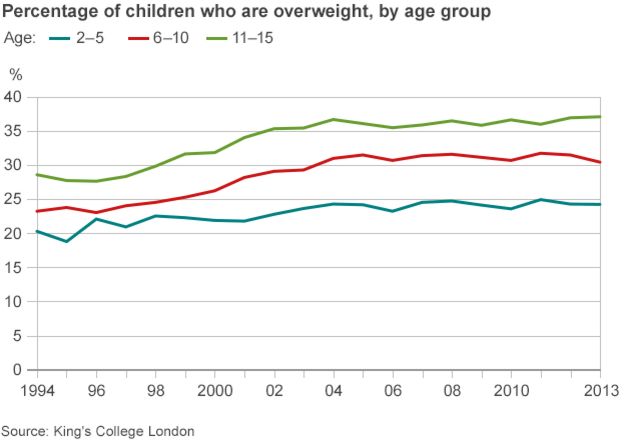
Overall, the research shows gradual increases in the average BMI over time, from 25.6kg/m2 to 27.5kg/m2 in men; and from 24.5kg/m2 to 26.5kg/m2 for women. Most of this increase occurred before 2001, after this there has been a much slower rate of increase.
This - over a thirty year period - represents a seven per cent increase in average male BMI and an eight per cent increase in average female BMI. As ever the problem isn't really a 'whole population' issue but rather that we have a segment of that total population who, for whatever reason, are unhealthily obese. This means that the ghastly health fascist solution proposed by Janna Lawrence is not only illiberal (she admits to that) but also completely unnecessary. Rather than introducing sugar taxes, banning advertising and paying benefits in food stamps only redeemable against produce approved by the likes of Ms Lawrence, we should instead target our resources towards the million or so people with a real weight-related health problem.
....
Sunday, 31 August 2014
Malnutrition - public health people are lying to us about its incidence
****
The Guardian writes this:
From this you would conclude, would you not, that there are hordes of starving children with distended stomachs filling up our hospitals? Whether the author did this deliberately is unclear but the truth is that all of that increase in malnutrition relates to the elderly. Every year, for as far as records of malnutrition go back, there are around 200 children admitted to hospital with conditions related to malnutrition.
The main reason - here from 'fullfact' -is this:
So the Faculty for Public Health (and Tracey McVeigh in The Guardian) are misleading us about malnutrition because it suits their political agenda. There has been no increase in child malnutrition and the numbers are very small (200 hundred cases in a cohort of nearly 12 million) but we continue to be told that there is a problem. That is, of course, when the Faculty for Public Health isn't telling us that all our children are obese because of "junk food" and fizzy drinks.
....
The Guardian writes this:
Doctors and hospitals are seeing a rise in children suffering from ailments caused by poor diet and the faculty has linked the trend to people's inability to afford quality food. Latest figures show there has been a 19% increase in people hospitalised in England and Wales for malnutrition over the past 12 months but experts say this is only the extreme end.
From this you would conclude, would you not, that there are hordes of starving children with distended stomachs filling up our hospitals? Whether the author did this deliberately is unclear but the truth is that all of that increase in malnutrition relates to the elderly. Every year, for as far as records of malnutrition go back, there are around 200 children admitted to hospital with conditions related to malnutrition.
The main reason - here from 'fullfact' -is this:
People with certain long-term health conditions can’t always retain all the nutrients they need – particularly the elderly, who might also struggle to make the trip to the supermarket. With this in mind, the higher incidence of malnutrition might also reflect broader demographic trends, including the fact that the UK’s population is ageing. The most recent Nutrition Screening Survey showed that those aged 65 plus were more likely to be malnourished than those who were younger. In addition, it may also be that hospitals are now more likely to screen a patient for symptoms of malnourishment.
So the Faculty for Public Health (and Tracey McVeigh in The Guardian) are misleading us about malnutrition because it suits their political agenda. There has been no increase in child malnutrition and the numbers are very small (200 hundred cases in a cohort of nearly 12 million) but we continue to be told that there is a problem. That is, of course, when the Faculty for Public Health isn't telling us that all our children are obese because of "junk food" and fizzy drinks.
....
Thursday, 29 May 2014
Public health - might some truth be getting though at last?
****
One swallow doesn't make a summer. But there are two current news items that suggest that the truth is gradually seeping through to one or two bits of the public health world.
Firstly there's a letter from fifty odd doctors, researchers and public health folk urging the WHO not to regulate e-cigs out of existence. As one pointed out:
Progress (although it didn't stop the BBC running a ghastly phone-in essentially to plug some egregiously misleading documentary it's planning to air on tobacco - at the presenter said to one smoker who called: "that's basically the tobacco industry line" as that chap explained why he wanted leaving alone).
And then the radio headlines were filled with news that we aren't drinking quite so much:
This was all part of a slightly scaremongering report (so typical of health fascists to wrap up good health news in scary stories about girls drinking) but Radio 5 Live ran a couple of substantial items focused on the core fact - on average, we drink a hell of a lot less than we did ten years ago and the latest cohort of teenagers are the more abstemious since the 1950s.
It may be a false dawn - yesterday I was told by one of Bradford's public health consultants that 'hazardous' drinking would increase in Bradford without 'further intervention. This - as I pointed out - is simply untrue yet these people carry on with the misinformation. Still, though it's a long way to go, I am reassured that some of the truth might just leak into the public health debate for a change.
....
One swallow doesn't make a summer. But there are two current news items that suggest that the truth is gradually seeping through to one or two bits of the public health world.
Firstly there's a letter from fifty odd doctors, researchers and public health folk urging the WHO not to regulate e-cigs out of existence. As one pointed out:
"If the WHO gets its way and extinguishes e-cigarettes, it will not only have passed up what is clearly one of the biggest public health innovations of the last three decades that could potentially save millions of lives, but it will have abrogated its own responsibility under its own charter to empower consumers to take control of their own health, something which they are already doing themselves in their millions."
Progress (although it didn't stop the BBC running a ghastly phone-in essentially to plug some egregiously misleading documentary it's planning to air on tobacco - at the presenter said to one smoker who called: "that's basically the tobacco industry line" as that chap explained why he wanted leaving alone).
And then the radio headlines were filled with news that we aren't drinking quite so much:
Between 2005 and 2012 the percentage who drank alcohol in the week before being interviewed fell from 72% to 64% for men, and from 57% to 52% for women.
The survey also shows that the percentage of men who drank alcohol on at least five days in the week declined from 22% to 14%.
The percentage of women who drank frequently fell from 13% to 9%.
This was all part of a slightly scaremongering report (so typical of health fascists to wrap up good health news in scary stories about girls drinking) but Radio 5 Live ran a couple of substantial items focused on the core fact - on average, we drink a hell of a lot less than we did ten years ago and the latest cohort of teenagers are the more abstemious since the 1950s.
It may be a false dawn - yesterday I was told by one of Bradford's public health consultants that 'hazardous' drinking would increase in Bradford without 'further intervention. This - as I pointed out - is simply untrue yet these people carry on with the misinformation. Still, though it's a long way to go, I am reassured that some of the truth might just leak into the public health debate for a change.
....
Monday, 17 March 2014
In which Oxfam deceive and Huff Post (and the Guardian) publish without question.
****
Here's the headline:
We begin with a confusion between 'wealth' and 'income' (wealth is a stock and income is a flow). The author then digs her hole of ignorance (or maybe deception) a little deeper:
The truth is that Jessica Elgot, who wrote the article has simply lifted the lies straight from the Oxfam press release without thinking - churnalism at its worst. At the top of the 'rich list' here is the Duke of Westminster with £13 billion in assets. I'm prepared to bet that, while the Duke's not short of cash, that £13 billion is nearly all land and property - and Ms Elgot put in the word cash not Oxfam.
What it isn't is income, which makes the next line of the press release (and the articles) deceptive:
This may be true but it hasn't got anything to do with wealth, with those assets that the Duke owns. Oxfam (not for the first time) are suggesting that the imbalance in wealth equates directly to an imbalance in income when it doesn't.
Whatever the political differences over inequality, we really shouldn't be making the arguments in this sloppy (or deceptive) and ignorant (or misleading) way.
....
Here's the headline:
Income Inequality Soars With Five UK Families Wealthier Than Bottom 20%
We begin with a confusion between 'wealth' and 'income' (wealth is a stock and income is a flow). The author then digs her hole of ignorance (or maybe deception) a little deeper:
The UK's five richest families have more cash between them than the poorest 20% of the entire population, 12.6 million Britons, with new research showing the chasm between rich and poor is growing wider.
The truth is that Jessica Elgot, who wrote the article has simply lifted the lies straight from the Oxfam press release without thinking - churnalism at its worst. At the top of the 'rich list' here is the Duke of Westminster with £13 billion in assets. I'm prepared to bet that, while the Duke's not short of cash, that £13 billion is nearly all land and property - and Ms Elgot put in the word cash not Oxfam.
What it isn't is income, which makes the next line of the press release (and the articles) deceptive:
Oxfam's figures also show that over the past two decades the wealthiest 0.1 percent have seen their income grow nearly four times faster than the least well off 90 percent of the population.
This may be true but it hasn't got anything to do with wealth, with those assets that the Duke owns. Oxfam (not for the first time) are suggesting that the imbalance in wealth equates directly to an imbalance in income when it doesn't.
Whatever the political differences over inequality, we really shouldn't be making the arguments in this sloppy (or deceptive) and ignorant (or misleading) way.
....
Tuesday, 4 March 2014
The Chief Medical Officer misleads parliament about sugar and obesity...again
****
This is 'normal service':
I sorry but it simply is not true - not even a tiny little bit - that sugar is addictive. Except in the 'it's very nice and we like to eat it' sense of addiction. The 'research' as the Chief Medical Officer is already there - lots of it - and it says that sugar isn't addictive. Here's Jan Ulbrecht, associate professor in biobehavioral health and medicine in the College of Health and Human Development at Penn State University arguing that sugar isn't addictive:
The idea - commonplace amongst the purveyors of New Puritan junk science - is that, because sugar stimulates the brain to produce dopamine in the same way as cocaine therefore it is addictive.
The central issue here, however, isn't about addiction but about obesity - firstly whether we have increasing levels of obesity and secondly whether that obesity is caused by our increasing dependence on sugar.
Both of these things are false.
On the growth in obesity - here's a chart of mean BMI (body mass index) for the UK 1993-2007:
 On average we really haven't got much fatter. And we know that childhood obesity is falling something that probably reflects the other unhelpful fact for anti-sugar campaigners - children are consuming less sugar (in every form).
Indeed sugar consumption has fallen - all forms of sugar not merely the white stuff in the sugar bowl but the scary 'hidden sugar' the campaigners keep telling us about. Our consumption of 'non-milk extrinsic sugars' has fallen by more than half since the 1970s and by 10% over the past decade. Sugars now represent about 16% of our total energy intake compare to about a third three decades ago. If there's a single culprit for the increased levels of obesity it isn't sugar. Indeed nothing other than fruit and fruit juices has increased compared to 1970.

So why, given the availability of this real information - that there isn't an 'obesity epidemic' and that sugar consumption has halved - does the Chief Medical Officer make out to MPs that sugar is a problem that requires regulation or a new tax?
....
This is 'normal service':
She said she believes "the research will find sugar is addictive" and that "we may need to introduce a sugar tax".
I sorry but it simply is not true - not even a tiny little bit - that sugar is addictive. Except in the 'it's very nice and we like to eat it' sense of addiction. The 'research' as the Chief Medical Officer is already there - lots of it - and it says that sugar isn't addictive. Here's Jan Ulbrecht, associate professor in biobehavioral health and medicine in the College of Health and Human Development at Penn State University arguing that sugar isn't addictive:
"Since the human body does not become physically dependent on sugar the way it does on opiates like morphine and heroin, sugar is not addictive,"
The idea - commonplace amongst the purveyors of New Puritan junk science - is that, because sugar stimulates the brain to produce dopamine in the same way as cocaine therefore it is addictive.
The central issue here, however, isn't about addiction but about obesity - firstly whether we have increasing levels of obesity and secondly whether that obesity is caused by our increasing dependence on sugar.
Both of these things are false.
On the growth in obesity - here's a chart of mean BMI (body mass index) for the UK 1993-2007:
Indeed sugar consumption has fallen - all forms of sugar not merely the white stuff in the sugar bowl but the scary 'hidden sugar' the campaigners keep telling us about. Our consumption of 'non-milk extrinsic sugars' has fallen by more than half since the 1970s and by 10% over the past decade. Sugars now represent about 16% of our total energy intake compare to about a third three decades ago. If there's a single culprit for the increased levels of obesity it isn't sugar. Indeed nothing other than fruit and fruit juices has increased compared to 1970.
So why, given the availability of this real information - that there isn't an 'obesity epidemic' and that sugar consumption has halved - does the Chief Medical Officer make out to MPs that sugar is a problem that requires regulation or a new tax?
....
Thursday, 9 January 2014
Sugar consumption is falling...we seem to have missed this fact
****
A great deal of nonsense about sugar - topped by the atrocious nonsense in The Independent - requires a little balance. You would after all be expected to believe that we are in a sort of drug-addled feeding frenzy of sugar consumption.
So here are some facts about the consumption of "non-milk extrinsic sugars" (this is all the added sugar as well as honey) in the UK. The figures come from the National Nutrition and Diet Survey (NNDS) conducted by the Government to provide a nationally representative snapshot of the nutritional intake and status of the UK population.
In 2000/01 NMES consumption in daily grammes was:
Male: 79
Female: 51
In 2008-20011 the average is:
Male: 70
Female: 50.1
So our sugar consumption has fallen. And this includes ALL forms of added sugar - the scary hidden stuff in processed food and the spoonful of lovely honey you stir into your hot toddy. Other than for women over 65 every category of consumption has fallen - with the biggest fall being among children.
It is worth noting also that the average total energy consumption (those pesky calories) has fallen by around 10% in this period - hardly an indicator of an "obesity pandemic".
Maybe sugar is bad for us - certainly eating too much of it can contribute to poor health and we perhaps should pay a little more attention to what's actually in the food we eat. But this "sugar is a poison", "we're addicted to sugar" argument is quite simply a complete fabrication. It just isn't true.
....
A great deal of nonsense about sugar - topped by the atrocious nonsense in The Independent - requires a little balance. You would after all be expected to believe that we are in a sort of drug-addled feeding frenzy of sugar consumption.
So here are some facts about the consumption of "non-milk extrinsic sugars" (this is all the added sugar as well as honey) in the UK. The figures come from the National Nutrition and Diet Survey (NNDS) conducted by the Government to provide a nationally representative snapshot of the nutritional intake and status of the UK population.
In 2000/01 NMES consumption in daily grammes was:
Male: 79
Female: 51
In 2008-20011 the average is:
Male: 70
Female: 50.1
So our sugar consumption has fallen. And this includes ALL forms of added sugar - the scary hidden stuff in processed food and the spoonful of lovely honey you stir into your hot toddy. Other than for women over 65 every category of consumption has fallen - with the biggest fall being among children.
It is worth noting also that the average total energy consumption (those pesky calories) has fallen by around 10% in this period - hardly an indicator of an "obesity pandemic".
Maybe sugar is bad for us - certainly eating too much of it can contribute to poor health and we perhaps should pay a little more attention to what's actually in the food we eat. But this "sugar is a poison", "we're addicted to sugar" argument is quite simply a complete fabrication. It just isn't true.
....
Monday, 18 February 2013
Dear doctors, if you're going to be fussbuckets can you at least get the facts right
****
The media is all afroth with the latest press release from "The Doctors" about us getting a little chubby. This is accompanied by images of podgy middles being manhandled and reams of self-righteous judging of other folks' lifestyles.
I mind greatly about doctors wanting new taxes, controls and so forth - nannying fussbucketry is not just wrong it's immoral. But I mind even more about the facts - and these doctors can't even be bothered to get these right.
Firstly there's the epidemic - well there isn't one. This is an epidemic:
These are doctors for heaven's sake, surely they care just a little about the precision in using medical terms? Or am I crediting the fussbuckets with giving a damn? Obesity isn't infectious - I'm not going to catch it from the fat person round the corner however hard I try. I'm going to get fat if I eat too much food and exercise too little - nothing catching at all.
Then there's the line that obesity is "getting worse". This too is wrong - here's the Joseph Rowntree Foundation (not a regular enemy of nannying fussbuckets) on the subject:
So we're fatter than we were in the 1980s but not actually getting even fatter.
So those doctors have misused (quite deliberately) the term 'epidemic' and lied about obesity getting worse. They also ignore the pesky research showing that being a bit chubby isn't a problem - it might even be good for us:
Has anyone considered that what we call "normal weight" is, in truth slightly underweight?
Even if we accept the (plainly wrong) we're all getting fatter argument, the nannying fussbuckets are after the wrong targets - fizzy drinks and burgers:
Doesn't look like full fat coke's to blame - the burgers then?
Blast - it's not the burgers either.
This is the problem - there is a problem but the doctors are too fussed about nannying us to ask why and what might be done. Here's our friends at JRF again:
Spotted that - I'm sure you have on your high street. Let's call it the Jack Sprat Principle. But why? Why are working class women so much more likely to be obese - trying to understand this might be a whole load more valuable than banning advertising or taxing fizzy drinks.
This is the problem with public health - too terrified to target risky groups, our fussbuckets find it simpler to propose whole population solutions to problems that, in truth, affect only a minority of that population.
However, the biggest lie today is the idea that the solution lies in ever more draconian controls, more taxes and taxpayers money poured into unpleasant and aggressive "public health" campaigns. And all because - we're told without evidence or foundation - that slightly less than 3% of NHS resources goes to deal with the health problems contingent on obesity.
....
The media is all afroth with the latest press release from "The Doctors" about us getting a little chubby. This is accompanied by images of podgy middles being manhandled and reams of self-righteous judging of other folks' lifestyles.
In a report spelling out the problem in stark terms, the academy says doctors are "united in seeing the epidemic of obesity as the greatest public health crisis facing the UK.
I mind greatly about doctors wanting new taxes, controls and so forth - nannying fussbucketry is not just wrong it's immoral. But I mind even more about the facts - and these doctors can't even be bothered to get these right.
Firstly there's the epidemic - well there isn't one. This is an epidemic:
A widespread occurrence of an infectious disease in a community at a particular time.
These are doctors for heaven's sake, surely they care just a little about the precision in using medical terms? Or am I crediting the fussbuckets with giving a damn? Obesity isn't infectious - I'm not going to catch it from the fat person round the corner however hard I try. I'm going to get fat if I eat too much food and exercise too little - nothing catching at all.
Then there's the line that obesity is "getting worse". This too is wrong - here's the Joseph Rowntree Foundation (not a regular enemy of nannying fussbuckets) on the subject:
Over time, there is little sign of the inexorable rise in obesity that underlies some of the concern about the issue. Rates for children did rise and peak in 2004 but have since fallen and are now no different to what they were in the late 1990s.
So we're fatter than we were in the 1980s but not actually getting even fatter.
So those doctors have misused (quite deliberately) the term 'epidemic' and lied about obesity getting worse. They also ignore the pesky research showing that being a bit chubby isn't a problem - it might even be good for us:
Results showed that overweight people were six per cent less likely to die during the average study period. Mildly obese people had a five per cent lower rate of premature death.
The research showed that men and women hold an equal advantage when it comes to being overweight, and that the conclusion was not affected by age, smoking status, or region.
Has anyone considered that what we call "normal weight" is, in truth slightly underweight?
Even if we accept the (plainly wrong) we're all getting fatter argument, the nannying fussbuckets are after the wrong targets - fizzy drinks and burgers:
Over the last 10 years, the consumption of soft drinks containing added sugar has fallen by 9%, while the incidence of obesity has been increasing. And 61% of soft drinks now contain no added sugar.
Doesn't look like full fat coke's to blame - the burgers then?
...there was no significant association between increasing takeaway and fast food consumption and obesity as measured by BMI corrected for age and gender. This is not a new finding. For example, French and colleagues found no significant relationship between frequent consumption of fast food and being overweight in their analysis of a cohort of 11-18-year-old boys and girls. Similarly, Simmons et al found no correlation between increasing takeaway consumption and obesity measured by either BMI or waist circumference.
Blast - it's not the burgers either.
This is the problem - there is a problem but the doctors are too fussed about nannying us to ask why and what might be done. Here's our friends at JRF again:
There is also a difference for adults with a clear social gradient for women (with 31% of the poorest being obese compared with 19% of the richest) but pretty much equal rates for men across all incomes (between 24-29%).
Spotted that - I'm sure you have on your high street. Let's call it the Jack Sprat Principle. But why? Why are working class women so much more likely to be obese - trying to understand this might be a whole load more valuable than banning advertising or taxing fizzy drinks.
This is the problem with public health - too terrified to target risky groups, our fussbuckets find it simpler to propose whole population solutions to problems that, in truth, affect only a minority of that population.
However, the biggest lie today is the idea that the solution lies in ever more draconian controls, more taxes and taxpayers money poured into unpleasant and aggressive "public health" campaigns. And all because - we're told without evidence or foundation - that slightly less than 3% of NHS resources goes to deal with the health problems contingent on obesity.
....
Tuesday, 29 January 2013
How academic public health deceives us...
****
Yes folks, that our public health folk - the facts don't fit what you want? Just ignore them!
....
But the most significant aspect of this story is that the paper is reporting a conclusion based on data which demonstrate the opposite. The paper reports that heart attacks declined after the smoking ban, but the data show that heart attacks did not decline after the smoking ban.
Yes folks, that our public health folk - the facts don't fit what you want? Just ignore them!
....
Friday, 9 November 2012
Public health - in which truth takes second place
....
Sometimes people say the most worrying things:
So if these exercises are not capable of producing truth as we know it, do they serve other functions that are useful if not scientifically credible?
Read that carefully, at least three times. Ponder on its meaning.
Now read the next bit:
In a democracy, politicians and policymakers often need to be shamed into doing the right thing, and costs to society have the ability to shame, blame and even defame.
So the figures used by public health people are not true but it doesn't matter because we need to be "shamed into doing the right thing".
And that right thing is prohibition of course. Denormalising choices made by ordinary people. Banning and restricting our choices.
Despite the "science" being a lie. A lie justified on the basis of a specious "public good" by a man who claims to be a scientist:
Dr. Babor spent several years in postdoctoral research training in social psychiatry at Harvard Medical School, and subsequently served as head of social science research at McLean Hospital's Alcohol and Drug Abuse Research Center in Belmont, MA. In 1982 he moved to the University of Connecticut School of Medicine. He has served as the Scientific Director at the Alcohol Research Center and the interim Chair of the Psychiatry Department before moving to Community Medicine in 1998.
Welcome my friends to the world of "public health".
....
Wednesday, 3 October 2012
Poor fact-checking and shoddy research - an everyday story of the BBC's health reporting
****
Others have posted about the BBC's embarrassment at Panorama's dodgy statistics on the impact of minimum pricing:
There are two aspects of this story that I find disturbing and a third that begs a question about the value of retractions.
The first aspect is the utter credulity of BBC researchers and programme-makers when faced with information from "academic" sources. The 50,000 figure was so obviously inaccurate yet no-one on the Panorama team saw fit to ask for it checking. Indeed it became the hook around which the scare-mongering story was constructed. Even to the point of getting one of their favourites - Joan Bakewell - to front up the delivery of this punchline. That this figure is so completely inaccurate beggars belief but its ready acceptance by Panorama's producers underlines the core problem with public health reporting - the lies of the campaigners are almost always taken without question, without any challenge.
The second disturbing aspect of the story is the way in which researchers - in this case at Sheffield University - circumvent any peer challenge. Indeed, when a researcher from Panorama rang them with the programme idea the School of Health and Related Research at the University of Sheffield jumped at the opportunity to push their work by appearing on a prime time TV documentary. The "research" commissioned by Panorama reaches the ears and eyes of the SoHRR team's audience - public health professionals, political decision-makers and the concerned public - without the pesky process of peer review. The BBC may now have corrected the error but SoHRR remain unchallenged as the leading proponent of minimum pricing for alcohol as a public health tool.
Wherever we look the public health fanatics appear to be more-or-less making stuff up - third-hand tobacco smoke, fizzy drinks making you fat, e-cigarettes being carcinogenic and minimum pricing for alcohol saving lives while not affecting the drinking pleasure of anyone. As Chris Snowden puts it:
As to that human error - it strikes me that this is poppycock. The SoHRR team were so cock-a-hoop at the Panorama request that they bunged out the more sensational, headline-grabbing research without bothering to test, check, cross-reference or apply the most basic of common-sense. And they did this knowing that Panorama would swallow any set of spurious "facts" they sent through. Perhaps we need to get in touch with Sheffield University's grandees and ask them to look into this "error". Although, if the University of Sterling are a guide, the reaction will be to use every means to prevent full public disclosure.
Finally we should ask what gain will come from the BBC's correction? Hundreds of thousands watched a Panorama documentary founded on a lie. A few hundred of those people will see the retraction or will watch the new version of Joan Bakewell's endpiece. Add to this those who saw the reference on the BBC main news, read articles in the Daily Mail, Guardian and Daily Telegraph and we can see that the BBC's quiet little correction represents a victory for the liars in our public health industry. I fully expect variations of the 50,000 figure to crop up in reports, documents, advice leaflets and a host of other sources. And for the medical mafia to roll it out verbally - without any challenge - again and again.
....
Others have posted about the BBC's embarrassment at Panorama's dodgy statistics on the impact of minimum pricing:
It's quite incredible that Panorama's fact-checkers are so shoddy that they didn't see that claiming 50,000 old people dying is quite laughable when their source has previously declared - experts as they are - only 3,060 in the entire population!
There are two aspects of this story that I find disturbing and a third that begs a question about the value of retractions.
The first aspect is the utter credulity of BBC researchers and programme-makers when faced with information from "academic" sources. The 50,000 figure was so obviously inaccurate yet no-one on the Panorama team saw fit to ask for it checking. Indeed it became the hook around which the scare-mongering story was constructed. Even to the point of getting one of their favourites - Joan Bakewell - to front up the delivery of this punchline. That this figure is so completely inaccurate beggars belief but its ready acceptance by Panorama's producers underlines the core problem with public health reporting - the lies of the campaigners are almost always taken without question, without any challenge.
The second disturbing aspect of the story is the way in which researchers - in this case at Sheffield University - circumvent any peer challenge. Indeed, when a researcher from Panorama rang them with the programme idea the School of Health and Related Research at the University of Sheffield jumped at the opportunity to push their work by appearing on a prime time TV documentary. The "research" commissioned by Panorama reaches the ears and eyes of the SoHRR team's audience - public health professionals, political decision-makers and the concerned public - without the pesky process of peer review. The BBC may now have corrected the error but SoHRR remain unchallenged as the leading proponent of minimum pricing for alcohol as a public health tool.
Wherever we look the public health fanatics appear to be more-or-less making stuff up - third-hand tobacco smoke, fizzy drinks making you fat, e-cigarettes being carcinogenic and minimum pricing for alcohol saving lives while not affecting the drinking pleasure of anyone. As Chris Snowden puts it:
It is garbage. Not just the usual 'this sounds like a bad guess' garbage, but full-on 'no amount of squirming can get us out of this, we're going to have to retract it and re-edit the programme' garbage. The figure is more than four times larger than their dubious methodology can allow—a difference of some 38,500 lives—and thanks to the efforts of one of Dick Puddlecote's readers, the Sheffield University team have confessed to "human error". Take this with as much salt as you like, but they claim that someone accidentally put the wrong figures into the computer when Panorama commissioned the research. Truly a case of garbage in, garbage out.
As to that human error - it strikes me that this is poppycock. The SoHRR team were so cock-a-hoop at the Panorama request that they bunged out the more sensational, headline-grabbing research without bothering to test, check, cross-reference or apply the most basic of common-sense. And they did this knowing that Panorama would swallow any set of spurious "facts" they sent through. Perhaps we need to get in touch with Sheffield University's grandees and ask them to look into this "error". Although, if the University of Sterling are a guide, the reaction will be to use every means to prevent full public disclosure.
Finally we should ask what gain will come from the BBC's correction? Hundreds of thousands watched a Panorama documentary founded on a lie. A few hundred of those people will see the retraction or will watch the new version of Joan Bakewell's endpiece. Add to this those who saw the reference on the BBC main news, read articles in the Daily Mail, Guardian and Daily Telegraph and we can see that the BBC's quiet little correction represents a victory for the liars in our public health industry. I fully expect variations of the 50,000 figure to crop up in reports, documents, advice leaflets and a host of other sources. And for the medical mafia to roll it out verbally - without any challenge - again and again.
....
Wednesday, 12 September 2012
So how much do you trust the police now?
****
Especially when they did this:
The next time you hear the police saying they are accountable remind them of this appalling action. And that it took 23 years for the truth to be revealed. For those police officers responsible to face any form of accountability.
If having elected police commissioners takes us closer to an accountable police force that is welcome. I hope it will be so and we won't simply get the same old friendly placemen. For me, having been brought up to like and respect the police, I'll struggle to take future police statements on trust. And I know I'm not the only one.
.....
Especially when they did this:
The officers' statements, presented as official police accounts to the subsequent inquiry by Lord Justice Taylor, were changed to delete criticism of the police themselves on the day, and, largely, emphasise misbehaviour by supporters. The panel found that the operation went as deep and extensive as 116 of 164 statements being amended "to remove or alter comments unfavourable to South Yorkshire police".
The next time you hear the police saying they are accountable remind them of this appalling action. And that it took 23 years for the truth to be revealed. For those police officers responsible to face any form of accountability.
If having elected police commissioners takes us closer to an accountable police force that is welcome. I hope it will be so and we won't simply get the same old friendly placemen. For me, having been brought up to like and respect the police, I'll struggle to take future police statements on trust. And I know I'm not the only one.
.....
Friday, 7 September 2012
Lies, damned lies and public health
****
It beats me why those promoting public health campaigns feel the need to (how do I put this) make stuff up.
I understand that some people have a nannying, controlling, interfering world view. They're brought up to believe it OK to go around telling other people that their choices are wrong. It's a world view I hate but why do its adherents feel the need to tell massive porkies all the time?
Don't believe me? Here are a couple of recent examples:
And from the same set of public health campaigners and even worse lie:
So you've never heard of the European Respiratory Society. How about the BBC?
Let's be clear about these statistics. They are utter rubbish. Complete and absolute tosh. Yet the BBC proposes to broadcast them without challenge. Here are the facts on alcohol related deaths (or a close as we can get using the entirely questionable approach preferred by public health people). The figure - allowing for estimates of homicides, suicides and drownings - is around 13,000 per year. And declining.
The BBC wants us to believe that introducing a 50p per unit minimum price will result in 5,000 fewer of these deaths. That's a 40% drop. More to the point these statistics mean that nearly every single death of someone aged over 65 currently listed as 'alcohol-related' is eliminated. This is complete nonsense as a moments perusal of the actual statistics would show.
I think you get the picture. On everything - from smoking in cars to the effect of salt consumption the public health lobby simply makes stuff up. And repeats it time and time again until everyone assumes it is correct. Policy affecting millions of people and their choices is being made on the basic of dodgy science, misrepresentation of statistics and, it seems, outright lies.
....
It beats me why those promoting public health campaigns feel the need to (how do I put this) make stuff up.
I understand that some people have a nannying, controlling, interfering world view. They're brought up to believe it OK to go around telling other people that their choices are wrong. It's a world view I hate but why do its adherents feel the need to tell massive porkies all the time?
Don't believe me? Here are a couple of recent examples:
The rest of the story is that the European Respiratory Society is lying to the public. The Society claims that electronic cigarettes were developed by the tobacco industry. This is false. The tobacco industry played no role in the creation of electronic cigarettes and for the past four years, has had no involvement at all in the electronic cigarette industry. It was only recently, when Lorillard acquired Blu cigs, that the tobacco industry entered the electronic cigarette market. The claim that electronic cigarettes were developed by the tobacco industry is an outright lie.
And from the same set of public health campaigners and even worse lie:
The claim that electronic cigarettes cause cancer is without scientific evidence. While it is true that trace levels of tobacco-specific nitrosamines have been detected in electronic cigarettes, similar trace levels are also present in nicotine gum and nicotine patches. If electronic cigarettes can be said to cause cancer, then so can nicotine replacement therapy.
There is simply no scientific evidence that NRT causes cancer, because it is unclear that the trace levels of tobacco-specific nitrosamines in these products have any clinical significance, are capable of inducing cancer, or that there has ever been a human case of cancer caused by NRT.
Similarly, there is simply no scientific evidence that electronic cigarettes cause cancer, because it is unclear that the trace levels of tobacco-specific nitrosamines in these products have any clinical significance, are capable of inducing cancer, or that there has ever been a human case of cancer caused by electronic cigarettes.
So you've never heard of the European Respiratory Society. How about the BBC?
Programme makers asked Sheffield University to model the effects of a 50p per unit minimum price, which would push the price of the cheapest bottle of vodka from about £9 to £13.
Statisticians estimated the effect would be 50,000 fewer alcohol-related deaths in England among over 65s, over the course of 10 years.
The current affairs programme, to be broadcast on BBC One at 7.30pm on Monday, examines problem drinking among Britain’s ever-growing population of older people.
Let's be clear about these statistics. They are utter rubbish. Complete and absolute tosh. Yet the BBC proposes to broadcast them without challenge. Here are the facts on alcohol related deaths (or a close as we can get using the entirely questionable approach preferred by public health people). The figure - allowing for estimates of homicides, suicides and drownings - is around 13,000 per year. And declining.
The BBC wants us to believe that introducing a 50p per unit minimum price will result in 5,000 fewer of these deaths. That's a 40% drop. More to the point these statistics mean that nearly every single death of someone aged over 65 currently listed as 'alcohol-related' is eliminated. This is complete nonsense as a moments perusal of the actual statistics would show.
I think you get the picture. On everything - from smoking in cars to the effect of salt consumption the public health lobby simply makes stuff up. And repeats it time and time again until everyone assumes it is correct. Policy affecting millions of people and their choices is being made on the basic of dodgy science, misrepresentation of statistics and, it seems, outright lies.
....
Wednesday, 18 July 2012
#Greenpeacefail...
****
If, say, a lobby group for forestry interests did this there would be the most enormous outcry:
Yet environmental campaign group Greenpeace are revelling in their media manipulation, lies and misrepresentation. Indeed as the New Statesman (hardly the most anti-green bunch) have put it:
There is a limit to the bounds of campaigning. For me, Greenpeace crossed it years ago when they forced Shell to adopt a less environmentally sensible disposal of a redundant oil rig for the sake of cheap headlines and the 'kerching' of the organisations cash register. But this really is stepping even further beyond those bounds:
....
If, say, a lobby group for forestry interests did this there would be the most enormous outcry:
The event was a hoax, and so was the follow-up email and the website with its often hilarious-if-it-wasn't-true fake...marketing copy.
Yet environmental campaign group Greenpeace are revelling in their media manipulation, lies and misrepresentation. Indeed as the New Statesman (hardly the most anti-green bunch) have put it:
The real villain here is Greenpeace. This is an NGO that thinks it is acceptable to lie to the public, to lie to bloggers and journalists, and to then intimidate writers with threatening emails warning of legal action. This absolutely is not okay. I don’t care if you’re saving the Arctic, rescuing kittens from YouTube’s vicious pet-celebrity training camps, or training pandas to pull famine-ridden children out of earthquake debris; to behave in this deceitful way demonstrates an astonishing amount of contempt for the public - not least for environmentalist supporters who spread their message in good faith only to find themselves forced into embarrassing retractions.
There is a limit to the bounds of campaigning. For me, Greenpeace crossed it years ago when they forced Shell to adopt a less environmentally sensible disposal of a redundant oil rig for the sake of cheap headlines and the 'kerching' of the organisations cash register. But this really is stepping even further beyond those bounds:
“Even if you think Shell is evil and will lie to achieve their goals, now you know Greenpeace is the exact same way.”
....
Sunday, 27 November 2011
Hey Lib Dems, you could try truth and liberalism for a change?
****
Nick Clegg - I'm guessing the party has a new marketing boss or something - has been told that he needs to "rebrand" the Liberal Democrat Party.
Aha, not a marketing director - worse, an accountant!
And the strategy appears to be that old Lib Dem stand-by - taking credit for things they didn't do (a sub-set of their usual dissembling and unpleasantness). Starting with the abolition of slavery:
And let me just correct the Daily Telegraph there - Wilberforce was, of course, a Tory.
However, in the interests of a coalition partner, let me suggest how the Liberal democrats might resolve their problem. It seems to me, a humble observer, that the party might do better if it:
....
Nick Clegg - I'm guessing the party has a new marketing boss or something - has been told that he needs to "rebrand" the Liberal Democrat Party.
Last week, Liberal Democrat MPs were summoned to a meeting to be told that "external brand experts" had been hired to try to boost the party's standing with the next general election still more than three years away.
In a further internal move, Mr Clegg has recruited a party donor and millionaire accountant, Neil Sherlock, to run his Cabinet Office team with the title of director of government relations.
Aha, not a marketing director - worse, an accountant!
And the strategy appears to be that old Lib Dem stand-by - taking credit for things they didn't do (a sub-set of their usual dissembling and unpleasantness). Starting with the abolition of slavery:
MPs should also, they were told, claim more credit for "Liberal" achievements of the past such as the abolition of slavery - even though the leading abolitionist, William Wilberforce, was an independent MP.
And let me just correct the Daily Telegraph there - Wilberforce was, of course, a Tory.
However, in the interests of a coalition partner, let me suggest how the Liberal democrats might resolve their problem. It seems to me, a humble observer, that the party might do better if it:
Stopped laying claims - whether locally, nationally or historically - to things it had no hand in (this applies equally to the filling in of potholes, the abolition of slavery and the introduction of universal suffrage)
Started being a liberal party - you know one that actually believes in liberalism rather than the statist, social democratic, nanny state party it is at present
....
Wednesday, 16 November 2011
In which the British Medical Association lie to you again...

Smoking in all cars across the UK should be banned to protect people from second-hand smoke, doctors say. The British Medical Association has made the call following research that shows the level of toxins in a car can be up to 23 times higher than in a smoky bar.
This is, of course, a complete fiction - no, a lie:
In a study in the Canadian Medical Association Journal entitled 'Second-hand smoke in cars: How did the “23 times more toxic” myth turn into fact?', MacKenzie and Freeman showed that the "fact" was entirely without scientific evidence and stemmed from a, obscure quote in a local newspaper in 1998 (as I had revealed on this blog two months earlier).
Doesn't stop them using it, does it!
....
Tuesday, 2 August 2011
There isn't an epidemic of drinking - that is a lie, Panorama
****
Last night's Panorama - and a great deal of the coverage elsewhere on the telly and in the newspapers - represents a triumph for the New Puritans. I had planned to take you all though the errors and omissions in the programme (once I'd watched it in its entirety without throwing stuff at the telly) but needn't bother as Chris Snowdon has done an excellent job at VGIF:
Do read the rest of Chris's piece - he reminds us that we are not drinking at historically high levels, that alcohol consumption is falling and that our alcohol prices are not higher that in the past nor are our tax levels lower than elsewhere in the world.
There isn't a epidemic of drinking. That is a lie.
....
Last night's Panorama - and a great deal of the coverage elsewhere on the telly and in the newspapers - represents a triumph for the New Puritans. I had planned to take you all though the errors and omissions in the programme (once I'd watched it in its entirety without throwing stuff at the telly) but needn't bother as Chris Snowdon has done an excellent job at VGIF:
Exceptional policies like these require exceptional circumstances and Panorama spent thirty minutes telling the viewer that Britain is indeed in crisis. Enormous quantities are being drunk at exceptionally low prices, they said, therefore prices need to rise. Something must be done.
Pretty much every assumption in this narrative is wrong. Whether judged by the standard of other countries or by the standard of previous eras, this country is not in the grip of an alcohol epidemic.
Do read the rest of Chris's piece - he reminds us that we are not drinking at historically high levels, that alcohol consumption is falling and that our alcohol prices are not higher that in the past nor are our tax levels lower than elsewhere in the world.
There isn't a epidemic of drinking. That is a lie.
....
Subscribe to:
Posts (Atom)