Showing posts with label woods. Show all posts

Thursday, 2 June 2011

Into the woods - some thoughts on reforestation

I was all ready to tear into the nonsense that is Oxfam's "Growing a Better Future" - how these organisations get to the point of presented half-truths, inaccurate analyses and daft solutions I'll never understand. However the point was made very clearly here:

This is much less a report about the iniquities of the international food system and the perils of climate change than it is a report about what happens to food prices as we abolish absolute poverty and destitution.

More people with more money means higher food prices - simple really!

So I'm going to talk about wood instead - after all wood is very important. Across most of the world it is the dominant source of fuel for heating and cooking - indeed this is one of the reasons why we've seen so much deforestation in Africa:

Developing countries rely heavily on wood fuel, the major energy source for cooking and heating. In Africa, the statistics are striking: an estimated 90 percent of the entire continent's population uses fuelwood for cooking, and in Sub-Saharan Africa, firewood and brush supply approximately 52 percent of all energy sources.


And you've guessed it - that fuelwood gathering doesn't rely on "sustainable" sources. Moreover, the clearance of forests is further accelerated by the persistence of low labour productivity farming - the very farming systems preferred by Oxfam and the ludicrous proponents of "fair trade".

England's woods of oak and birch were destroyed for much the same reason - to provide fuel, to build houses (and famously ships) and to make room for agriculture. System shocks like Dutch Elm disease added to the decline and the poisoned landscapes - like the face of the moon as the song goes - of mining destroyed still more old woodland. Strangely enough - although you'd not believe this to hear the NIMBYs cry sometimes - not much of our woodland was felled to make room for houses.

And woods recover - forest cover is now at its largest extent since 1750:


The amount of woodland in the UK now stands at 11,200 square miles, 11.8 per cent of the total land area. The growth, attributed in part to a boom in individuals branching out into forestry because of tax breaks, was greeted with cautious optimism by woodland historians. So much new forest is being planted that some areas could even reach the 15 per cent of woodland recorded in England by the Doomsday Book in 1086, the figures suggest. 

And much of the growth in woodland is private planting - nothing to do with all that public forest so many people fussed about recently:

The new Forestry Commission report, conducted for the UN’s food and agriculture department, disclosed that the amount of woodland owned by individuals now accounts for almost half of all our tree cover, having grown by 22 per cent in 15 years.
 
In an advanced society, free from the need to burn wood and no longer trapped in subsistence or semi-subsistence agriculture, woods are an asset that it treasured, managed and valued. Perhaps there's a lesson in this for the Oxfam's of this world - but don't hold you breath!
....


Sunday, 29 May 2011

Get off my pond!

Yesterday featured a meander around Ogden Water a Yorkshire Water reservoir managed as a country park by Calderdale Council. And the Council do a good job of managing - we met a litter picker on the path so they're keeping up to it at the weekend and the place is well kempt with paths and fences right for the rural setting. And we didn't mind too much that it was spitting with rain and rather breezy. Especially since in the woods that's broken up through the trees.

So there we were meandering through, breathing in the great smell of a damp pine wood, listening to the chaffinches shouting their heads off (it always amazes me that such a loud noise can come from such a tiny body) and we arrive at the little pond beyond the bridge at the head of the reservoir. Last time we were there it was a lovely domestic scene with mum and half-a-dozen ducklings swimming about in the still water.

This time it was a different picture, the cute bliss of the ducklings had gone and was replaced with this chap:

And when a couple more mallard drakes arrived his response was:

Get off my pond!

....

Saturday, 30 April 2011

The temple in the woods

It stands there. A temple to nameless - or merely just forgotten - spirits of the country. A cage of pillars at the end of an avenue of flowers. As you approach your stride falters a little - not for any conscious reason but perhaps a hesitancy born from those faintly remembered godlets. This is England after all, a land where those spirits of tree, of water, of wind and flower are but a faint echo. A country where the magic of place is almost crushed by the sound and fury of modern life, a land of contradiction in which millions turn their backs on the magic of wood and field.

But we have that magic still - it is recorded by the poets:

Youth of delight, come hither,
And see the opening morn,
Image of truth new born.
Doubt is fled, & clouds of reason,
Dark disputes & artful teazing.
Folly is an endless maze,
Tangled roots perplex her ways.
How many have fallen there!
They stumble all night over bones of the dead,
And feel they know not what but care,
And wish to lead others, when they should be led. 

And at the head of the avenue there is a temple in the woods.

...

Tuesday, 5 April 2011

An Echo of Old Magic and Old Song

A good firm path - dry, with a good surface. Firm, secure fencing. Someone cares for this place - or cares enough to separate me from the woods. Perhaps the steepness of the slope and the looseness of the surface motivates that someone - he or she would rather those passing through didn't slide, tumble and crash into the river below. Or maybe there are beasts in the wood.

I hope there are beasts - or at least the memory of beasts. The wolves, bears and boars who once owned these woods - and the magic folk too. The trolls, the gnomes - and is that flash of white a glimpse of the unicorn. It can't be a wind blown supermarket carrier bag, can it!

On a wild night you must stay even more firmly on this path. Or else suffer the fate of Tam Lin - perhaps without a true love to save you from that mad ride into the gates of Hell.

gloomy was the night
and eerie was the way.
this lady in her green mantle
to miles cross she did go.

with the holy water in her hand
she cast the compass round.
at twelve o'clock the fairy court
came riding o'er the mound.

first came by the black steed
and then came by the brown.
then tam lin on the milk-white steed
with a gold star in his crown.

she's pulled him down into her arms
and let the bridle fall.
the queen of fairies she cried out
young Tam Lin is away.

The darkness is always close by - the legends are part of our heritage. The magic of these places - however safe they're made - is the deep magic of England. Step off the path and into the woods and listen carefully - you may hear the song of our ancestors. A song of woods, of trees and of the security that light and a clear view bring. It is a fine song.

....

Sunday, 23 January 2011

Selling off the forests - or not? Is there a road through the woods?

They shut the road through the woods
Seventy years ago.
Weather and rain have undone it again,
And now you would never know
There was once a road through the woods
Before they planted the trees.
It is underneath the coppice and heath,
And the thin anemones.
Only the keeper sees
That, where the ring-dove broods,
And the badgers roll at ease,
There was once a road through the woods.
 
I must admit to not being especially bothered one way or the other about the future ownership of around 15% of England’s woodland. It seems to me that this is, in truth, a matter of little consequence in the reduction of debt or the elimination of deficit. And, while I understand the motives behind realising the woodland’s value and also see no good reason for the state owning large swathes of upland conifer forest, the proposal to consider disposal has turned into a cause célèbre. A letter from 100 celebrities and paid up members of the great and good sums up this cause:

“We, who love and use the English forests, believe that such a sale would be misjudged and shortsighted. It is our national heritage. We are an island nation yet more people escape to the forest than to the seaside.

“Our forests nurture countless species of native plants and wildlife. We have relied on them since time immemorial yet we are only a heartbeat in their history. We who know the value of the forests fear that over time, the public’s access to them will be limited and their protection, eroded.

“We, the undersigned, believe it unconscionable that future generations will not be able to enjoy the guarantee of a public forest estate.”

And the Telegraph, delighted that these famous folk have selected it rather than The Times or The Guardian has leapt enthusiastically onto the ‘Save our Forests’ bandwagon with an emotive piece about woodland as a ‘precious asset’ and appeals to David Cameron’s greenery. Indeed the whole debate is wrapped about with misinformation, misrepresentation and appeals to emotion rather than any rational or objective assessment of the issues involved.

Just look at the excerpt from the letter that I quoted above. I get all misty-eyed just reading it – it plays to my love of England, it talks of heritage and alludes to ancientness, to the mystery of the woods. And it’s a load of eyewash.

Nearly all of the Forestry Commissions woodland is recently planted upland commercial wood – which isn’t to say that it isn’t important and doesn’t contain lots of wildlife but is to say that it isn’t ‘ancient woodland’. Indeed, there is a public record of ancient woodland and, if you want, you can go and view it because Natural England has put all the maps on-line (a caveat here is that this excludes smaller woods – under 2ha). And the planning system in England also affords a degree of protection to such woodland:

Planning Policy Statement 9 (PPS9) states that local authorities should ‘identify any areas of ancient woodland in their areas that do not have statutory protection’ and normally ‘not grant planning permission for any development which would result in its loss or deterioration’.

Since this is a planning matter, the issue of ownership is not relevant – the planning authority can regulate and control activity within any ancient woodland. Plus of course access rights (on foot) to the woodland is also protected:

The CRoW Act also introduced the ability to voluntarily dedicate woodland for free public access in perpetuity. Since then, Forest Enterprise has dedicated the majority of the public forest estate in England. The total area of dedicated woodland in England is 137,000 Hectares.

So –regardless of future ownership – your and my rights to access the forest is guaranteed (unless a future government opts to repeal or reform the Countryside & Rights of Way Act).

To sum up then we are debating a change of ownership that will not change access rights, involves very little ancient woodland, doesn’t alter planning regulations and retains (even extends) regulatory oversight of woodland.  There may well be a strong case for retaining public ownership but it isn’t contained in the emotive arguments presented to counter the government’s proposals.

Instead of this emotional blackmail we could instead have a serious discussion that covers:

  • Whether the government should own young growth commercial woodland – this is a straightforward business better in the private sector and issues around leisure uses for these forests (and especially uses such as cycling, wild food foraging and horse riding) can be protected and encouraged through regulatory oversight or prescriptive covenant
  • How future management of ancient and old plantation woodland should be conducted – rather than being managed by a remote national body (that is really a logging business) would it not be better to transfer management to local authorities, create local trusts or transfer to the Woodland trust or similar?
  • What changes to planning regulations, rights of way and other property considerations might enhance the public value of woodland outwith the issue of ownership and, as importantly, how can we continue to balance competing interests and objectives (for example, nature conservancy versus rights to roam)?

This would be a sensible debate – one that might allow us to better appreciate the issues relating to England’s woodland and its conservation. Emotive nonsense about “our forests” may get you public sympathy and might get the government to change its plans. But it won’t result in better managed, more accessible and valued woodland.

....

Monday, 8 November 2010

The Glade....

The moment when we spy the break in the gloom is a time of magic. Not - as so many say - the instant when we step into the glade but the time we see the sunlight through the trees. A ray of light that catches the bracken, glints off the young leaves of a sapling and, if we're so lucky, catches a beast in its place.

It is when we see the sunlight that the change takes place. That's when our shoulders unhunch and we straighten our backs. And a little smile slides across our face as we quicken our step towards the brightness.

That moment will come. There will be sunlight shining on the forest glade. We will relax in a moment of sheer joy. Life will be good.

Before we must plunge once more into the darkness of the wood.

....

Sunday, 31 October 2010

Bears? Woods? Now where were we?

Not sure whether this chap's abut to uproot the birch tree (thereby contributing to the destruction of the forests) or is using it as a prop - a little in the manner of research findings for politicians. Or possibly he's just shy.

What ever the truth of this - it's a bear, it's in the woods. And the rest is history!

...

Wednesday, 27 January 2010

Wednesday Whimsy: Woods, spirit and the god of England


England is a land of woods. Or perhaps a land of once-woods – where trees once were.
I like to think that, with the support of the Woodland Trust, The Tree Register and various local tree trusts, our land will once again be a place of woods. I recall visiting the Tamar Valley and, looking out across its woods, being told that in the heyday of arsenic mining just 100 years before there were no trees at all in that view.

England isn’t a land of forest or jungle – our woods are not wilderness, are not impenetrable. Our woods are not unkempt. Our woods are not places to fear. Men work in our woods – keeping them clear and growing, logging, copsing and cropping the trees. Woods shelter deer, badgers, martens and a host of birds. Woods provide jobs and incomes, pleasure, food and beauty. They sing to us and contain our story.

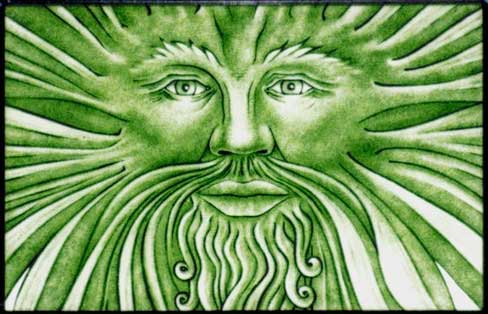
But there is still more. Woods – and wood – sit right in the soul of the Englishman. Not just Heart of Oak – a celebration more of ships than trees – but the spirit of the trees still moves us perhaps more than that of the moors or of the fields. Above all else, the Green Man is the god of England. Other places have lost their secret foliate face – it still peeps out from carvings in stone but no longer lives. Here in England the Green Man still lives, laughs and has space to wander.

The Green Man isn’t someone to fear but, as Mike Harding wrote, his roots go back a long way and his manifestations are many:

"His roots may go back to the shadow hunters who painted the caves of Lascaux and Altimira and may climb through history, in one of his manifestations through Robin Hood and the Morris Dances of Old England to be chiselled in wood and stone even to this day by men and women who no longer know his story but sense that something old and strong and tremendously important lies behind his leafy mask.
One of the earliest English epic poems Gawain and The Green Knight may refer to yet another manifestation of the Green Man as the God that dies and is reborn. He is the Green Man, Jack in the Green, the Old Man of the Woods, Green George and many other things to many other men but one common theme runs through all the disparate images and myths, death and rebirth and the Green that is all life."

Above all else, we know that if we leave things, the trees return. That those trees will break stone, turnover paving and cover over the vain constructions of man. As Ian Anderson put it:

Jack, do you never sleep ---does the green still run deep in your heart?
Or will these changing times,
motorways, powerlines,
keep us apart?
Well, I don't think so ---I saw some grass growing through the pavements today.

And the trees will follow!
...