Showing posts with label election. Show all posts

Sunday, 10 May 2015

How the Conservatives became the workers' party.


There are 79 seats in the "south east region" and all but five of them are held by Conservatives. While we've been talking about Scotland, London and the North, the Conservative Party has consolidated its control of the growing part of Britain. The Labour Party is vanishing across the South and has been for decades - the decline was briefly stemmed by the Blair landslide but is now returned. And Labour offers nothing to the aspiring private sector workers who live in those blue seats.

Most Conservatives I know have greeted the election result with what amounts to an unbelieving sigh of relief. We'll be pinching ourselves repeatedly for the coming few weeks as we realise that it wasn't a happy dream but reality - we really do have a Conservative government with an overall majority. All that effort was, for once, absolutely worth it.

Perhaps understandably given their unexpected defeat, the Labour Party's cheerleaders in the London media have started to chew over the reasons for that inexplicable loss. The anguish in their analysis is palpable and not helped by Peter Mandelson pointing out that Tony Blair was right when he said that with a traditional Labour manifesto you get a traditional result.

While all this is going on a few hundred idiots decided that daubing vulgar signs with "Tory Scum" and "Fuck Austerity" was the way to respond, a decision made worse by one of their number choosing to fight austerity by vandalising a war memorial on the 70th Anniversary of VE Day. This may feel like sticking it to the man but many many people will look on, nod and feel absolutely assured that voting Conservative - often for the very first time - was the right choice.

The analysis we have seen so far is, as is often the case at this stage, more a case of 'how dare these people not vote for us' combined with the desire to pin the entire blame on Ed Miliband and his core vote strategy. It's true that this was always a vanity campaign in which the Labour establishment gathered in a echo chamber and persuaded itself that there's a 'natural progressive' majority, that all those nice Liberal Democrats would vote for Labour this time, and that Ed merely had to sit still until polling day to collect the keys to Number 10.

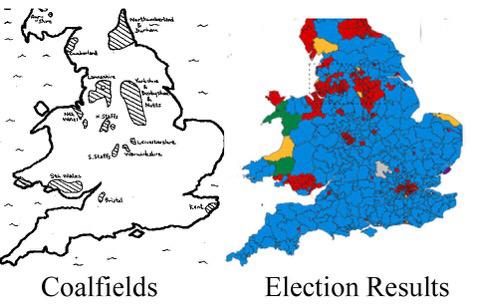
I suspect that, in their quieter moments, many Labour people understand the Party's problem. They can pick up the map and look at how Labour has shrunk back to what we might (a little cruelly) call 'Rust Belt England'. One image doing the rounds compares Labour's seats to an old map of England and Wales' coalfields - an image used to suggest, rather daftly, that somehow all the Party has left is the eternally loyal miners. The real picture is very different because that old working class isn't the main source of Labour's votes any more.

We know, for example, that most members of Unite (the union) probably didn't vote Labour last Thursday and I'd speculate that those Unite members working in the private sector overwhelmingly rejected Labour's message. You'll remember during the campaign that Ed Miliband had a difficult encounter with one of these skilled workers.  We also know that perhaps as much as half of Labour's vote in England is from ethnic minorities - look at where Labour gained seats (London, Bradford, Dewsbury, Birmingham) and look at the Party's remaining handful of seats in the South (Luton, Slough, Bristol). This is as much of a problem for the Conservatives but Labour's working class vote is now increasingly a working class BME vote.

However, Labour isn't run by these people, it's run by its absolute core constituency - public sector workers. When I look across the chamber of Bradford Council, I see fewer and fewer working class faces (and those that are working class are Asian). Instead the faces I see are those of well-educated, middle-class public sector and 'third' sector workers. The very same sorts of faces we saw time and time again on Thursday waiting to hear election results. There's nothing wrong with this except that it gives the Party a very skewed view of the issues and perpetuates a romantic myth of manual labour as a noble calling.

The truth is that the working class don't hew coal from the living rock, pour hot steel or bash metal into shape. We have machines that do that stuff for us these days. Today's working class answers telephone calls, serves you in shops and restaurants, processes transactions and drives delivery vans (often white ones). And there are still skilled manual trades - mostly self-employed. These people look at the Labour Party and see privileged public sector workers with higher wages and better pensions earned doing fewer hours. Labour polled just 15% amonst tradesmen.

Last week those working class people looked at Britain and decided that, however caring and compassionate Labour's message might appear, they would vote to make sure that the slow improvement in their standard of living would continue. And if this means a little more tightening of the funding screw in government then so be it - these aren't wealthy people just middling sorts with mortgages, fuel bills and taxes to pay every month. The Conservatives won because they talked directly to these people instead of creating a false bogeyman of austerity or accusing them of self-interest (and worse).

For me the most telling comment - one we will hear again and again in the next few years - was this;

Grant Shapps, the party chairman, will stand alongside Sir John Major, the former champion of the "classless society", to announce that the Tories are now determined to show they want to spread – and not defend – privilege.

Speaking at the new Conservative campaign headquarters, the Tory chairman will say: "The Conservatives are the Workers' party and we are on your side."

The problem for Labour is that this is pretty nearly true. Unless Labour reaches out to the private sector and people working in the private, stops treating profits and business as evils, and embraces its role in delivering public services it will continue to fail in meeting its mission as a party of labour.

For my party, we have returned again to our mission - the objective set for us by Disraeli all those years ago: to improve the condition of the worker. Long may it stay that way.

....

Wednesday, 6 May 2015

All over bar the voting...thoughts on an election campaign


A Denholme doorstep...

It rained today. I mean really rained. Torrents of cold water pouring down onto the Pennine village of Denholme. And we got wet - "I've never know rain like it" was one slightly exaggerated comment. We plodded on from house to house, talking about the main road through the village, the housing development just starting in the derelict (and unsightly) former mill site, and the work of the library that the community saved when Bradford Council wanted to close it down.

We heard about national politics too, about immigration and jobs, about the NHS and about the lack of trust in politicians. As always we listened, tried to get the message across about an improving economy and how we'd protected the health service from the worst of the cuts. Nowhere did we find antipathy - one man abruptly told us he wasn't voting indeed that he'd never voted and would never vote again. And there was the usual smattering, unsurprising in such dire weather, of people too busy or too tired to engage with a damp canvasser on the doorstep - "not interested", "not now I'm on my way out".

There were worries. The woman who invited me in to shelter in her porch so she could tell me how terrified she was at the prospect of a Labour government. Or the ambulanceman who, putting aside his worry about cuts to his service, said that we couldn't risk the economic recovery so he'd be voting Conservative. Time and time again the message came back - "we can't risk it", "Labour might tip the economy back", "I don't know what will happen if we get Miliband in charge".

And there were the waverers, the don't knows. the not sures and those not voting. Each one with a different concern - maybe immigration and Europe, perhaps something personal about social care but most often a real bemusement about the pitch being made to them. I know I can't change someone's mind on their front step in the pouring rain but I make the points - economic recovery, referendum on EU membership, investment in health - and hope that my little contribution (and the fact I've turned up on their doorstep) might tip them from don't know or not sure into voting Conservative.

Many of you will have watched this election through the prism of the media - debates, interviews, stunts, gimmicks, more manifesto launches than ever before (there seems to be one for every minority and every special interest these days), and the constant bickering of talking heads. You'll have laughed at the gaffes, spluttered in righteous indignation, argued with the TV and the radio. Some might have stepped a little further - attended a local hustings, rung a phone in, clicked on one of the avalanche of petitions that pointlessly clutter up our email in-boxes.

Out there on the doorstep it feels very different. For sure we meet the engaged and involved, the questioning, and the angry. But mostly we meet people who make clear that, however important the election might be to us politicians, they have things in their lives that are much more important. Like the man in Cottingley who said, "yes I'll be voting but I've not had time to think about it yet". Next to running his business, ferrying children around and fixing the cracked pane of glass in the conservatory, my plea for his vote is unimportant.

I've not watched much of the TV campaign and my consumption of the newspaper campaign comes courtesy of Twitter so I can't say who did well and who didn't. But I think that the two main parties have adopted very different strategies - Labour segmenting like mad and targeting bespoke messages to target groups of voters and the Conservatives preferring the bash, bash, bash of a repeated message. The marketer in me is curious as to which will be more effective - my direct marketing bias tells me Labour's approach, cynical and exploitative, owes more to Readers' Digest than David Ogilvie. And I know this works.

But I also know that the repeated message and the bestseller syndrome works as well - some of you are now bored with 'hard-working families', 'long term economic plan' and 'don't let Labour ruin it again' but these messages are just starting to get through to people like the man in Cottingley I mentioned above.

Back on those doorsteps what we get fed back to us are the messages that have filtered through - the real 'cut through' not the belief that getting something trending on Twitter is any sort of engagement with that electorate. So we hear those concerns that have reached people - immigration, health, the economy, the competence of Miliband and the threat to our unity from having separatists dictating government policy. No-one mentioned Miliband's 'pledge slab' or Cameron's slip up, no-one talked about bacon sarnies or Bullingdon boys, and no-one said a thing about the inundation of opinion polling that we've seen during this election.

I don't know what will happen tomorrow - other than that millions of men and women will exercise their franchise. I know what I hope for and I see those polls and their accompanying analysis - your guess is probably as good as mine so I won't be making any predictions. But on the dozens of occasions when people have asked me what's going to happen - usually in the context of not wanting a Miliband/SNP cuddle-up - I've answered along these lines:

"All I can do is put my cross in the right box and tell everyone I meet to do likewise."

That right box - for a load of reasons - is the Conservative box. Some of those reasons are negative - not wanting Labour to ruin the economy yet again while screwing us over for a load more taxes being a really important one. But most are positive - offering lower taxes, better managed services, the sort of real compassion we need rather than Labour's 'hug the poor but do nothing much to help them' attitude, and a chance to have a substantive debate and a real say on the UK's most important relationship, that with our European friends and neighbours.

There are lots of things that I don't like about the last five years - the nannying fussbucketry, the creeping erosion of civil liberties and the enthusiasm for grand projects like HS2 stand out - but anyone who thinks a Labour-led government would be any better in this regard needs their head examining. Add in the fascism of the SNP with their named person laws, minimum unit pricing and banning of songs and you get the recipe for the most illiberal government in the UK's history.

So put your cross in the right box tomorrow. Vote Conservative.

....

Monday, 4 May 2015

Why farmers won't be voting Labour...

****

I've commented before how without EU subsidy and the benefits system we wouldn't have much of a farming business - or at least the sort of farming business us townies like to gawp at on Countryfile. Yes there are some rich farms with million pound plus incomes but the average farm income (that's farm income not farmer income remember) isn't anything close to that.

Still Labour politicians think farmers are nasty people who want to kill badgers and chase vermin like faxes off their land - so they're fair game for policy attack. And it's right between the eyes of some of the country's lowest earners:

The thing that is far more likely to sway farmers is a new Labour policy that has received scant publicity. This is the policy to remove the agricultural exemption from business rates for farm land and buildings and, effectively to tax farms in the UK as if they were out of town shopping centres. If implemented, this policy would have the immediate effect of reducing the average farming income in Britain from £46,635 (in 2012/13) to £40,137 overnight. That is a drop of 14%. It would affect some of the poorest workers in the country who are least able to afford it.

The Labour Party is happy to celebrate townies trampling all over someone else's land without a by-your-leave, to treat the farmed countryside as if it's some sort of playground for urban public sector workers with £200 boots and £500 anoraks. And to screw over the farmer.

,,,

Sunday, 3 May 2015

How to save The Union - if we want to

****

I was going to tell you all why you should vote Conservative. You should of course - not just because the prospect of a Labour government is terrifying but because the Conservative Party appears to be the only party that actually understands the situation of our public administration.

However, I'm going to write instead about The Union. Partly because there are now strong voices wanting to destroy that union and partly because the entire debate is couched in terms of Scottish nationalism rather than in terms of what the union means. The prospect of the Labour Party losing all its seats in Scotland this coming Thursday is real and reflects the inevitable conclusion of the process of unbalanced devolution begun by Tony Blair.

The Union is important. Not for touching historical reasons or for babble about shared heritage but because we are stronger collectively - the benefits Scotland and Wales get from working with a much larger England vastly outweigh the downsides of that relationship. And England gains too from the shared arrangement. So muttering nonsense about 'throwing money over Hadrian's Wall' as a cheap way to garner a few English votes is not the way forward.

If we think the Union important then we have to start talking about England. Not about chopping the country up into a bunch of meaningless chunks that, Yorkshire aside, have no meaning beyond administrative convenience. And not by saying that the issue of English devolution is resolved either by 'English Votes for English Laws' or through giving Leeds City Region control over further education funding. For a system of devolution to work it needs to be seen as fair by all sides and to be balanced.

Right now, without a settlement that meets these conditions, the break up of the Union is inevitable. That bloc of maybe fifty Scottish National Party MPs will make the gradual erosion of 'Westminster' influence in Scotland their mission. And if they have the balance of power they will get what they want. Indeed they will get what they want despite half their fellow Scots opposing independence.

We do not save the union by shouting ever more loudly about how important it is. We don't save the union by painting Nicola Sturgeon as the 'bogiewoman'. And we don't save the union by allowing Scottish nationalists - and pompous Guardian opinionators - to describe the same nationalism in England as a bad thing simply because it's English.

Nor should we allow people to say that England is too big for devolution. It's true that England contains most of the UK's population. But it's not true to say that allowing an English parliament to make decisions about the government of England is somehow unbalanced next to the much smaller devolved governments in Wales, Northern Ireland and Scotland.

The answer, for me, is very straightforward. We've a choice between the break up of the union and the creation of a four nation federal system with a UK government responsible solely for defence, international relations, borders and trade paid for via a precept on taxes set by the four national parliaments. Everything else - health, education, welfare - would fall to the four national parliaments. And if those parliaments chose to devolve further to local governments that would be just fine.

Sadly we are not going to do this but instead will either create an endless row over Scottish MPs voting on English matters or else pretend that devolution to occult groups of English local council leaders meeting in secret is somehow equivalent to Scotland having a parliament elected by the people of Scotland. And the end will be Scotland departing to the sound of a loud raspberry from English voters who, a decade ago, would have been adamant that the union was not negotiable.

...

Thursday, 26 April 2012

Things that really aren't a surprise...

****

George Galloway is a muslim convert (although he didn't quite mention this fact in a recent by-election):

George Galloway, MP for Bradford West, is a Muslim. He converted more than ten years ago in a ceremony at a hotel in Kilburn, north-west London, attended by members of the Muslim Association of Great Britain. Those close to him know this. The rest of the world, including his Muslim constituents, does not. 

What I can't understand - unless George thinks his conversion might lose him votes - why he hasn't come clean about it? What sort of muslim does that make him?

Or maybe it is a surprise - Mr Galloway continues to deny the claim:

 "The opening paragraph of Jemima Khan's piece in the New Statesman [referring to an alleged conversion ceremony] is totally untrue. Moreover I told her it was fallacious when she put it to me. I have never attended any such ceremony in Kilburn, Karachi or Kathmandu. It is simply and categorically untrue."

So there you go! Clear as mud! Which really isn't a surprise at all.

Update II:

It seems that George really didn't go through this ceremony (although the New Statesman say he didn't deny it and he says he did):
 
“Jemima Khan asked me on tape about this phantom ceremony in Kilburn and I told her it was a lie and whoever told her it was a liar. No trace of this exchange appears in the New Statesman piece, which is predicated upon it. Now that they are denying my denial it places the matter in the hands of my solicitor.”

...

Wednesday, 27 April 2011

Campaign Diary: "Why on earth do you do it?"


Mechanics Institute, Denholme - showing the Pricess Diana Memorial Garden
I set out to write a review of my re-election campaign, a sort of halfway point (OK, more than halfway point) appraisal of what I’ve seen and heard plus a comment or two on things that matter to me. But then the bloke at the pub asked me:

“Why on earth do you do it?”

It took a little longer than that – the reminder of Graham’s regular observation that politicians are constrained in what they can say by the conventions of modern political correctness. Partly this is used to explain why there are fewer racist politicians but underneath that is a more profound truth – we are both liberated, given a platform, and restricted in what we may speak from that platform.

The problem was that I couldn’t give that bloke in the pub a snappy response – a substantial observation of local government’s value, a reminder of what we get from democracy or a personal mission of change.

“Perhaps if people like me stop, the nutters will take over,” I quipped.

Not really the best answer, but it was a pub, we were there to watch football rather than discuss politics – or even the purpose of the politician. It was the best I could do at the time!

However, I’ve been thinking – dangerous pastime in a local councillor I know, something our party managements put much effort into suppressing. Thinking about the question that bloke posed – why do I do it? What on earth possesses me to put myself at the mercy of a largely ungrateful electorate, spend time at dreary meetings that seem obsessed with the minutiae of process rather than with grand issues of state,  and wrap myself in the distrust the employers and others have in the politician?

A clue to why lies in my shallow little quip – by nutters I don’t mean people who have peculiar political views, extremists or even the ‘other side’. I mean the nasty side of politics – the status-seeker, the power-hungry, those more interested in their own advantage than in the ‘right thing’. I have encountered such people – men and women who would scheme, manipulate and destroy to get what they want. Perhaps, I am a little tainted by this corruption now but I still cling to the values of service, duty and responsibility – as do many others, of course.

My father – who was a local councillor for a long time – defined for me the priorities of a politician. They go something like this:

Your first priority is to your conscience – to doing the right thing.
Your second priority is to those who elect you, who you represent – to consider their interests
Your last priority is to the Party, to the whip – to your colleagues

This may make uncomfortable reading for the tribal creatures of party – those who adhere to some sort of democratic centralist myth of leadership.

But I do it – stay as a local councillor – firstly for me, for my own desire to have a voice, however that voice may be limited or hobbled. Secondly I do it for my neighbours – for the wonderful people (and one or two not so wonderful ones) who live in the five villages making up Bingley Rural. And thirdly, I do it to stand firm beside others in the Conservative cause, in opposition to socialism and the creeping semi-fascism of social democracy.

These five villages – Cullingworth where I live, Wilsden, Cottingley, Harden and Denholme – great places, real places that deserve affection and require someone who cares for these places, for the old buildings, for the fields, woods and stone walls, for the people living and working here. Above all someone for whom the magic of the South Pennines – or at least this little bit of that beauteous range – sings loudly and who wishes to see that magic preserved.

....

Tuesday, 19 April 2011

Campaign Diary: Lost count of the days! Some fine people and the excellent cake girls

War Memorial at Cullingworth
Another day out and about - glorious sunny weather (although the garden tells me it could use a shower or two) and plenty of smiling folk about. Here are a few I met:

  • Attractive Asian woman supervising the refurbishment of a semi-detached house in Cottingley - very cheery and keen to move in (although from the look of it a bit to go yet).
  • Lady in curlers chasing me down the street (well sort of) to tell me about the ongoing campaign to keep the heart surgery unit in Leeds.
  • Rather annoyed bloke - not at me but at the idiots who threw an egg at his door while he was away. Quite a job to scrub it off. Why do kids do this sort of thing?
  • Doug - who runs the police contact point in Cottingley which we hope to persuade them to keep open. A really useful service provided for just a few quid each year

And in all this I've found little seething anger at the government - some genuine concern about specific services and particular issues but none of the rage that pundits (left-wing ones at least) speak about. The angriest conversations have been about pensions, council tax and the smoking ban.

However, the day's highlight came in the early evening at home. Three girls - 15 years old or so - knocked at the door selling cakes. Not for a charity, not as some school project. But simply to make some money. I approve of this - initiative, production and chutzpah. These girls deserve to succeed - and probably will.

....

Saturday, 9 April 2011

Campaign Diary: Day Five - gardening and e-mails

I know, it's Saturday and the sun is shining - should be out there voter bothering! But we took the day off to do so gardening (see results above) - still managed to get some leaflets dropped with deliverers and to get a new deliverer too!

Also I've got off a load of e-mails to people I dealt with over recent times - always careful with this as we all get plenty of spam. However, it's a good idea to send a nice, personal note to people I've helped over the past few years - so I've done so.

As far as the politics is concerned, the good news of the pension changes is swamped by the annoyance among existing pensioners - who, of course, aren't getting the extra money! And it's the pensioners with savings or a second income who are squealing - they don't get all those pension credits.

Back tomorrow - after a day charging round the farms, barns and cottages that fall into the delivery round entitled: "remote".

....

Friday, 8 April 2011

Campaign Diary: Day Four - Denholme, the AV referendum and curry!

Of the 40 delivery rounds in Bingley Rural, only 16 remain on my dining room floor - this is excellent. Took some down to my ward colleague, Baroness Eaton - had a bit of a giggle about being a "Lord" plus some ace gossip that I can't tell you about! Spent the morning in Denholme though - sad to see the way in which some folk are obviously struggling - evidence of aborted DIY projects, maintenance left undone and a depressing feel about parts. Sad that the good times passed so many folk by - hopefully the tax changes and such will help a little.

Also got a new deliverer - on the back of wanting to campaign against AV. Which was excellent news as the regular deliver for that patch can't do it any more! And reminded me that I've yet to encounter anyone on the doorstep who thinks changing to a new system of voting is a good idea - bear in mind that I'm not mentioning the referendum (selfishly I find my election to be more important).

I've received a few e-mails and phones calls following delivery - shows people are reading the leaflet which is good. One or two of these are real issues with the Council while the others are more political - will respond appropriately!

Last part of the campaign day was canvassing on Long Lane in Harden - really good response, nothing like a bit of sunshine to get a smiley response on the doorstep! And plenty of Tories too so we rewarded ourselves with a curry - at the fabulous Moghul's in Keighley (where we did some actor spotting).

A good day!

....

Thursday, 7 April 2011

Campaign diary: Day Three - great views, charming folk and dogs

Back to Cottingley - onto the council estate for delivery. Not much to report - again a poor register, lots of occupied houses with nobody registered. This really isn't good enough - on the estate getting on for 10% of houses are occupied but not registered. Never used to be this bad - and seems to have got worse in recent years.

Canvassing this evening took us up to New Brighton and Lee Lane - lovely friendly people enjoying the sunshine. Canvassed a whole family of Jehovah's Witnesses - always a joy to doorstep JWs, partly from vengeance, partly from a wry sense of irony! Of course they don't vote - as the nice lady put it: "we've already voted - for God's Kingdom".

On a beautiful clear evening the views across Cottingley to Saltaire, Baildon and beyond were fantastic - spent more time talking about this than about the politics! Also booked a lawn doctor bloke who was working at one house - canvassing's a great way to find such folk!

Finally a note about dogs. There you are delivering - an innocuous house, no warning signs, no gates, no obviously doggy indicators and no barking. Swan up to the letter box, slip the leaflet through and bang! The lurking pooch takes half your finger off, blood everywhere, leaflets strewn across the road and loud cursing. Not good - and rather painful. Do these people not realise what their dog is up too?

....

Wednesday, 6 April 2011

Campaign Diary: Day Two - into the village


Yesterday on the fairy estate we got a good response - finished off there today with some discussions about the management of the protected land along Cottingley Beck. This isn't just a lovely place, it's where some faked photos of fairies were taken - lots of concerns about the management costs, preserving the place as it is and not seeing it as a cut-through to the school.

Which takes us to Cottingley village - the oldest part and a mix of converted terraces, back-to-back housing and in-fill. Again there were plenty of gaps in the register- perhaps less surprising here where the small, relatively cheap terraced housing provides an entry point to the housing market. Got some positive response from the work we put in to stop the Council selling off a piece of land used for car parking

Overall a decent canvass - lots of 'don't know', 'I'll read that' responses but no evidence of switching. which isn't to say folk aren't switching, of course! Not a great area for us, so a pretty decent outcome.

On the AV vote seems to be more of a concern to older voters - really strongly against. The referendum's not in my literature but there are mentions from residents - the national message seems to be getting through.

....

Tuesday, 5 April 2011

Campaign Diary: Day One - adventures in fairyland!

On the fairy estate at Cottingley this evening – Lysander Way, Goodfellow Close, Titania Close, Oberon Way – plenty of support but more conversation than I remember. People raised some real concerns – some national like tuition fees, some local like the lack of police cover after 11pm and the parking problems outside Cottingley Village Primary (something of a long-standing nightmare, that one). And I had a long chat about gritting – real issue on these newer estates as the gritters can’t turn round in the shaped dead end streets.

Good to hear a mostly positive response from the Asian voters on the estate – and to note the normalisation of this place. Nice Tory voting white bloke in a house he bought from equally nice Tory voting Asians!

One big worry – the register is poor, three or four examples of people who should be registered but aren’t which is very sloppy. When we get to Hill Crest in Denholme the gap in the register reaches one in ten houses – all occupied.  It worries me that people are losing the opportunity to vote because the bureaucracy can’t be bothered.

Day One positive – lots to do and a few e-mails from today’s delivery which is good. Thirty days to go before polling day, feet a little sore but pleased by what I’ve seen and heard.

...

Saturday, 15 May 2010

An outsider's thoughts on Labour's choices


Although I guess it’s none of my business, I can’t resist penning a thought or two about the Labour leadership election. I understand that, so far, we have a brace of Milibands and are expecting Balls to join in over the next couple of days. And we may yet see a candidate from the ‘left’ – perhaps John Cruddas. Game on as Labour tweeters like to say!

But catch your breath for a minute and ask yourselves a question – what sort of party do you want Labour to be over the coming few years? Be cause it’s plain that these candidates each offer a different direction. You have a choice between European-style social democracy, a tribal and cynical union-dominated approach or a real attempt to remake the party as a voice for ordinary people.

The Milibands – privileged background and education, pro-European, urbane, metropolitan – represent the shining besuited Euro-elite, the sort of candidates that Paris, Bonn and Madrid would approve. But this positioning means nothing to the ordinary working class voter who’s probably a bit doubting of the EU project and thinks the bloody foreigners should butt out of British politics thanks. The Milibands are part of that patronising Labour elite that gave us Mandelson, Harman and Blair.

Balls – despite his (well-disguised) posh background, Balls represents the cynical side of Labour politics. Lots of sound and fury followed by remorseless attacks on the Party’s enemies (internal as well as external). This is the trade unions’ party (as distinct from the trade unionists’ party), the party of group rights and the party of big government. It is the approach rejected by the electorate on May 6th

The third choice for Labour is to find again the place from which it sprung – the needs and aspirations of hard-working people employed in the private sector. These people – some are trade unionists but most are not – stuck two fingers up at the nannying, hectoring, interfering government of Brown. These people look across at public sector workers and see feather-bedded, protected employees – and worse, that comfort is achieved with their taxes. And these people want to drink beer, smoke fags, go by plane to Benidorm and Paphos, drive pick-up trucks, eat pies and give their kids a chocolate bar to go in the lunch box. They have absolutely nothing in common with the metrosexual niceness of the Milibands or with the bullying authoritarianism of Balls.

It isn’t my business but if the Labour Party wants to find its voice and place they have to get through to these voters – and to the 75% and more of C1/C2s who didn’t vote Labour – they have the chance to change the narrative. To be the party that say to ordinary folk: “you enjoy the money you earn how you like and we’ll try to look after your interests. To help protect your jobs, to support business, to provide doctors, schools and coppers and to defend the country.”

Maybe someone will step forward and make that offer. If they do Labour members would be mad not to take it.
....

Sunday, 9 May 2010

Dave, Nick - it's the economy that matters NOW not voting systems


This is beginning to get me annoyed. Look guys and gals, it’s pretty simple. The only thing that matters right now – the ONLY thing – is sorting out the government’s financial crisis before it comes over all Hellenic.

By all means have a nice fireside chat about voting systems in the down moments from sorting out the mess. But we don’t have to have another election for five years – yes, folks you’ve got five years to discuss and explore the options on voting reform.

But we don’t have five years to sort out the deficit, begin to reduce the debt, stabilise the economy, end the squeezing out of private enterprise and get the economy going again. I’m not sure we’ve the luxury of five months to do this urgent work – the markets, the lenders and the investors won’t give us five days if we insist on blabbering about voting systems rather than sitting down and working out what needs to be done NOW to sort the public finances out.

So Dave, Nick and all the other chatterers – shut up about voting systems and get on with sorting out Gordon’s mess – it’s why you were elected!

....

Sunday, 18 April 2010

Thoughts from Bradford on strategies for a hung parliament

OK, so the worst happens and we get an inconclusive result on May 6th. What’s the deal and how should it be handled? These are some thoughts at least partly informed by ten years of sitting on a ‘hung’ council. Without going into lots of complicated constitutional waffle, the options are as follows:

A minority government formed by one or other of the parties either through getting the support of the second or (in the case of the party with the most MPs) one party abstaining

A coalition of some sort between two (or more parties) – these take a multitude of different forms from formal public agreements to slightly shady backroom fudges. “Governments of National Unity” and such like are merely pompous forms of coalition

The essence of negotiation under these circumstances is as follows:

1. Know your strengths and your limits. The Liberal Democrats have set out their stall which provides strengths but also provides the risk of reneging in order to secure a coalition arrangement

2. Understand the risks of coalition. Joining a coalition as a minority partner means being outvoted all the time – the party only has the ‘nuclear option’ of walking out

3. Appreciate that propping up a minority government can be bad for your popularity. The old Liberal Party discovered this in 1979

4. Don’t try to agree everything at the outset. Again the Liberal Democrats have set out a ‘five point plan’ that contains some specifics (a referendum on electoral reform for example) and some more vague assertions. There is scope for negotiation

5. The deal – whatever arrangement is preferred – is more important than either the detail or who gets which job. Saying Vince Cable has to be chancellor or William Hague has to be foreign secretary sits below the agreement on policy and legislative priorities

6. Be prepared to lose votes and for the party outside the arrangement to look for ‘wedge’ issues aimed at splitting the arrangement. And remember it’s better to lose a vote or have your proposals amended than to lose the ability to propose legislation and act on budgets

If there is to be such and arrangement what might a Tory offer to the Liberal Democrats look like?

1.Putting Gordon Brown back in Downing Street would be a disaster – people voted for change even though they weren’t sure what that change might look like

2. Propose an immediate public review of government finances aimed at identifying the scale of the problem, identifying savings and proposing cuts

3. Agree to a referendum on electoral reform (which I suspect is a non-negotiable Liberal Democrat position) but insist on support for proposals on European referendums

4. Set out a ‘localism’ package combining some of the ideas around ‘free’ schools, changes to local government financing, elected mayors and the system of local elections

5. Scope a “Big Society” plan that gives local activists and others greater power to get change, power or action

6. Insist on rolling back the database state being an absolute priority for action – the Tory deal breaker

Finally, we need to recognise that the hung parliament will mean less legislation since the government can never be assured of support. But also the circumstances place greater powers in parliament – with a smaller legislative programme from government there will be more time to get the detail right, to debate what is happening and for individual members to challenge the hegemony of the whip.

....

Thursday, 8 April 2010

Why you should vote...

***

Why we should all vote.

***
As well as my own meanderings round the matter of voting and not voting, I have been struck by two recent musings from a couple of more thoughtful – and probably wiser than I – bloggers on the matter of the election.

Firstly, we have Billy Gotta Job on the insignificance of voting (and why this is as it should be):


“Except that we’ve been deluded into thinking that democracy is an individual pastime, no different in essence from voting in the X-Factor. That by voting we can somehow take forward our own individual interests. That politics is like a pick’n'mix sweet counter in which we can select our favourite orange creme, but ignore our unloved nut cluster. That identifying interests that we have in common with others is a sort of ego annihilation, and a defeat for our personal independence. But in truth democracy is not about us as individuals. It is the right to be insignificant, to make no personal difference. The true threat to our democratic health is not spin-doctors, or the media, or expenses scandals, or sound-bites, or the distractions of celebrity culture. It is the myth that we should form our political judgments by totting up whether we’ll be 50 quid better off under this party or that, and that collective interest is no more than a quaint hangover from the past.”


Now I don’t really believe (and I guess that this won’t be a surprise to my small band of loyal readers) in the supremacy of collective interest – indeed I see collective interest as merely the mediated agglomeration of individual interests. However, Billy has a point – as an individual act, voting is of vanishingly small significance. You vote, my vote, Gordon Brown’s vote are not going to make the difference.

Whether or not we vote is unlikely to affect the outcome of the election.
The second piece – from the doyenne of Libertarian bloggers, Charlotte Gore – who says she does not care about the result of the election:

“So the most important lesson I learnt was that I really, really, really don’t care any more. In the choice between the Conservatives or Labour, the only real loser is everyone else. A different bunch of vested interests calling the shots, different types of interference with people’s normal day to day lives and I’ve no doubt that the State will be bigger and more expensive by the time they’re through, no matter what. Taxes are going to go up, the Private Sector will continue to shrink and there’s only one direction that Civil Liberties are going in.”


Except Charlotte does care – she cares enough to have spotted what Billy spotted – that her vote is insignificant. That only as part of a perceived collective interest can our votes count (which is why libertarians should oppose proportional systems of voting based on votes for parties). And Charlotte’s problem with voting is not resolved by there being a party somewhere for which she can vote positively – let’s call it the Laser Cat Party. Even with that party, Charlotte’s vote – insofar as it can really effect change – remains insignificant. The large parties (and attached vested interests) continue to control the process and – as membership declines – the use of public funding will act to exclude the Laser Cat Party since it would not receive funding.

So why vote? The answer is simple and it’s the answer your granny used to give. You vote because it’s the right thing to do and because, however insignificant it might be, voting is often the only chance you’ve got of getting something changed. People really did chuck themselves under horses, people really did get killed, people really did strike, march and protest so as to get that right to pick up a stubby pencil and mark a cross in a box once in a while. Don’t get me wrong, if you choose not to bother it doesn’t make you a bad person – you’re not really letting down your suffragette great grandma or the great uncle killed on D-day.

So go and vote it’s your chance to do something. And do it loudly, proudly and knowing that it’s the most significantly insignificant act you can undertake.

Thursday, 25 March 2010

Why Labour is campaigning for a hung parliament

***


I commented a few times that sometime back in 2009, probably after Labour’s train crash autumn conference, they needed to switch strategy. Campaigning for a Labour victory was turning the voters off – people did not want (and still don’t want) another Labour government. I’m sure that all the private polling, focus groups and other research told Brown the same thing – the campaign was off the rails. Labour was heading for oblivion.

But then some bright spark said: “what about a hung parliament?” Once the high command had stopped beating up on this poor spark, they actually asked the question of some voters. And the answer came back – “yes, a hung parliament’s OK. That’s not a Labour government. That’s not Gordon Brown. We’ll vote for that.” Labour’s new strategy was born. Instead of campaigning for a Labour government, they would campaign (surreptitiously) for a “hung parliament”.

And it has worked – the pinko bits of the press love it, the Liberal Democrats love it. The BBC can’t get enough of it. Everywhere you go folk are talking about a hung parliament. The Liberal Democrats have set out their price. And the polls have moved in Labour’s favour as a response. And even the Dark Lord himself has embraced the campaign for a hung parliament:

Lord Mandelson said: "My appeal is to all progressives in the country – to pause and reflect on where their values lie, and to recognise that they have more in common with Labour than with any other party. And that the difference between Labour and the Liberal Democrats is we can form a government and deliver the values progressive people hold."


Labour reckons that they will be able to do a deal with Nick Clegg – after all Gordon’s sold everything else, selling the heart and soul of the Labour Party to keep the keys of Downing Street is nothing! So a referendum on some sort of PR, a job for Nick & Vince and some weasel words about fairness – job done.

Here’s what Cameron should say:

“The future of Britain – our economy, our security and our liberty – is too important to be decided by some shabby deal behind closed doors. The Conservative Party will not compromise on its principles or on the interests of the British people by selling out just for the sake of the keys to Number 10. I say now that we will not enter into any pact with the Liberal Democrats and I urge you to vote for a strong, focused and effective Conservative Government. By trying to vote for a hung parliament, you just vote for five more years of Gordon Brown.”

That should do the trick!

...

Thursday, 19 November 2009

Reasons to Vote Tory No. 1: Ed Balls, education and free schools

***

I have never been an adult customer of our state education system (I attended a state grammar school myself but the nutcases running education scrapped them) - we took a little peek at it back around 1993 and opted out. Now I know this option isn't there for most parents and they have to use a system that regiments, directs and, for many less able children, offers little but the scrapheap of semi-literacy.

But for the truly awful Ed Balls the last vestiges of parental control over their children's education will have to go - so home schooling is out. Or rather not out but inspected to death - complicated forms, self-important visiting experts, endless safeguarding checks and all the unpleasant paraphernalia of bureaucracy will do the job.

...and the kids? Will they be better educated, will they have more life chances? Nah.

In contrast Michael Gove's proposals for free schools present a new opportunity - and are the main reason for voting in a Conservative Government.

...